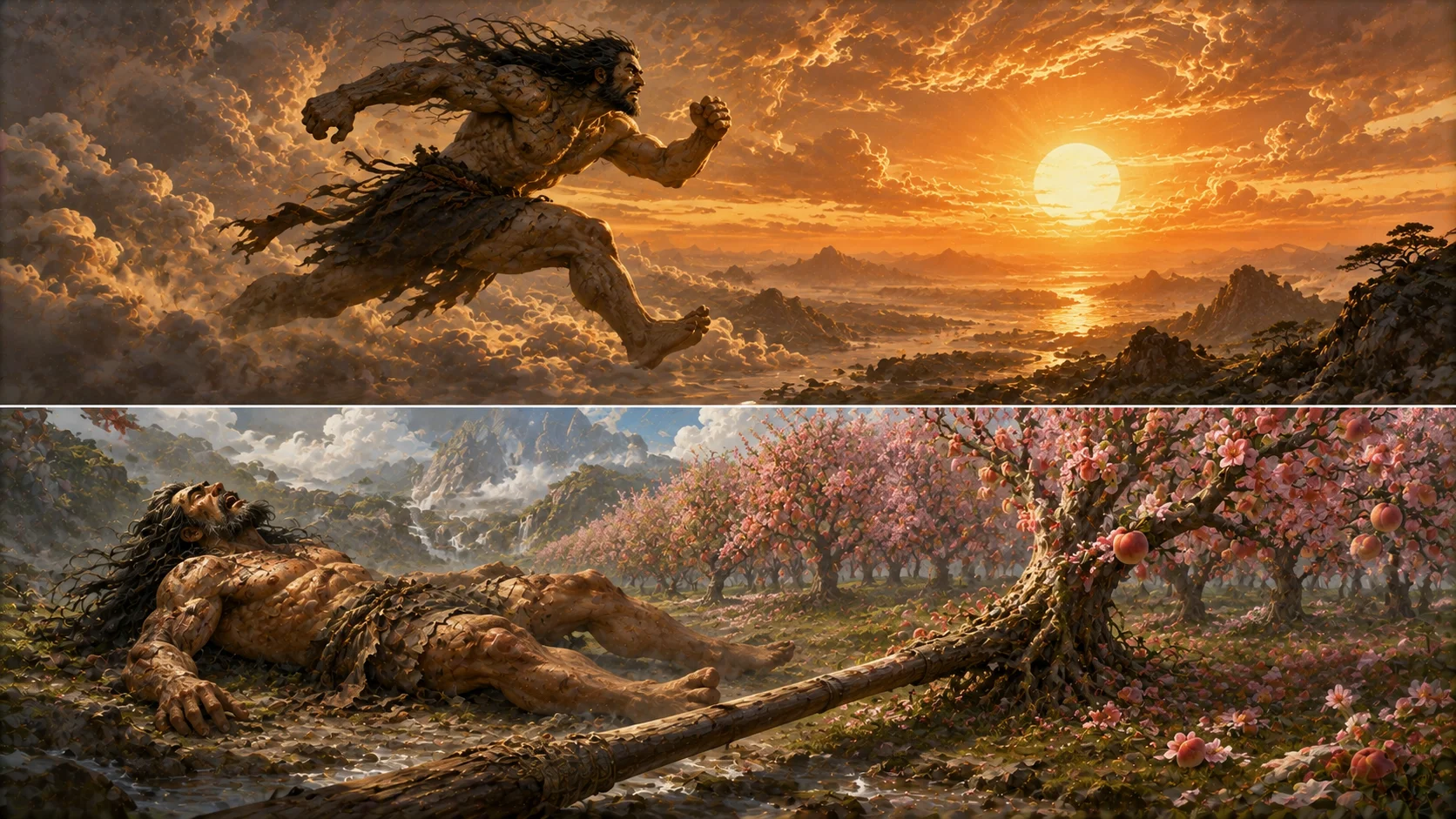
Kuafu (夸父) is the giant of early Chinese mythology who set himself against the sun itself: a being of colossal size and strength who resolved to catch the sun in its course across the sky, ran until thirst overtook him, drank two great rivers dry, and died reaching for a third. Where his body or his staff fell, a forest sprang up. His story is preserved in the Shan Hai Jing (山海經, Classic of Mountains and Seas), in two related but not identical tellings, and it has passed into the Chinese language itself as an idiom for reckless, magnificent ambition.
A Giant Out of the Northern Wilds
The Shan Hai Jing places Kuafu within a lineage descending from Houtu (后土), the earth deity: Houtu fathered Xinyao (信), and Xinyao fathered Kuafu. He is not presented as a solitary marvel but as one of a people — the Kuafu Guo (夸父國), a clan or race of giants dwelling in the far north. The text's terse, catalogue-like descriptions of that region note that its people are shown with yellow snakes hanging from their ears and yellow snakes grasped in their hands, an image repeated of Kuafu himself in the Classic of Mountains chapters. Snakes held or worn this way mark a being as liminal in early Chinese cosmography — neither fully human nor simply monstrous, but tied to wild, unbounded country at the edge of the known world. The north in this literature is where extremity lives: giants, strange rivers, the places the sun has not yet reached or has already left behind. Kuafu belongs to that geography before he belongs to any single episode.
Last updated .
The Decision to Run Against the Sun
The most famous account of Kuafu appears in the "Haiwai Beijing" (海外北經, Classic of Regions Beyond the Seas: North) chapter. There he resolves to chase the sun — to race it, to catch it, to close the distance between a giant's stride and the light crossing the heavens. Nothing in this version supplies a reason beyond the act itself: no divine command, no grievance against the sun, no promise of reward. He simply runs, pursuing the sun west across the sky toward its setting, until he draws near it as the day ends.
A Second Telling, A Harder Judgment
The "Dahuang Beijing" (大荒北經, Classic of the Great Wilderness: North) chapter gives a second, related account that colors the episode differently. Here Kuafu is described as not knowing his own strength — a phrase that shifts the emphasis from raw ambition toward a kind of blindness to his own limits. In this version he wishes to catch the sun's shadow, or to overtake the sun itself, at Yugu (禺谷), the valley named in early cosmography as the place where the sun goes down. The two chapters were compiled at different points in the long assembly of the Shan Hai Jing, and scholars have long noted that they do not perfectly agree; read together, they give Kuafu's pursuit a double character — an act that can be told as heroic defiance or as simple overreach, depending on which chapter's framing a reader follows.
The Rivers Drunk Dry
Whichever motive is granted him, the physical ordeal is consistent across the tradition. The chase itself, under a relentless sun, brought on a thirst equal to Kuafu's own scale — a giant's thirst, unquenchable by anything a river's ordinary course could offer. Nearing the sun at last, he turned to the two great waterways of the region: the Yellow River (Huang He) and the Wei River (Wei Shui). He drank both dry. It is a detail rendered without ornament in the text, and its very plainness is what gives it force — two of the defining rivers of the Chinese landscape reduced to nothing by one giant's need, and still that need was not answered.
The Turn North, and the Failure to Arrive
Still parched, Kuafu turned away from the rivers he had already emptied and set out north, toward the Great Marsh (Dazu, 大澤) — a body of water large enough, the myth implies, to have finally satisfied him. He did not reach it. He died of thirst on the way, collapsing before he crossed the distance between the drained rivers and the marsh that might have saved him. The myth is precise about this failure: not death at the sun's edge, in the instant of catching or being scorched by it, but death in transit, in the gap between one exhausted resource and the next, on ordinary ground far from either triumph or the object of his pursuit.
The Staff Become a Forest
From that collapse comes the myth's final transformation. Kuafu's walking staff — cast aside, or in some readings inseparable from his fallen body — took root where it lay and grew into the Deng Forest (鄧林), a name in some versions of the tradition glossed as a forest of peach trees. This is an etiological turn typical of the Shan Hai Jing's method: a striking feature of the land is explained as the residue of a mythic being's end. The giant who could not slake his thirst becomes, in death, the source of shade and fruit for whoever passes afterward — a forest standing where a body or a staff once fell, on ground that otherwise carries no trace of what happened there.
An Uncertain Second Life in the War of Chi You
The Shan Hai Jing also names giants who fought alongside Chi You (蚩尤) against the Yellow Emperor (Huangdi, 黃帝) in the great conflict between them, and Kuafu is sometimes identified among them — in some tellings dying in that war rather than, or in addition to, dying in pursuit of the sun. The relationship between this account and the sun-chase is unresolved in the scholarship on the text: the Shan Hai Jing is a composite work, and the two episodes may represent separate strands of tradition gathered under one name rather than a single continuous biography. This connection to the Chi You conflict is disputed among interpreters and should be held as one thread among several, not as a settled continuation of the sun-chase story.
A Name Folded Into the Language
Long after the Shan Hai Jing's compilation, Kuafu's chase condensed into a four-character idiom, Kuafu zhu ri (夸父逐日), "Kuafu chases the sun." Like the myth itself, the idiom carries a genuine double valence in later usage: it can praise a determination so complete that it does not weigh the odds against it, or it can warn against exactly that same failure to weigh them — an overestimation of one's own strength dressed as courage. Chinese speakers reach for the phrase in both directions depending on what they mean to say about the ambition in front of them, and neither use overrides the other; the idiom's staying power comes from holding both readings at once, the way the two Shan Hai Jing chapters already did.
Company in a Later Grouping of Defiant Strivers
In more recent literary and pedagogical tradition, Kuafu's story is often taught and discussed alongside two other figures who take on tasks the natural world seems to have set beyond human reach: the bird Jingwei, who tries to fill the sea with pebbles and twigs, and the old man of Yugong Yishan, who sets out to move a mountain by hand. Together the three are sometimes presented as a recognized trio of myths about refusing to accept a limit as final. It is worth being precise about the age of this grouping: nothing in the ancient sources binds the three together as a set. The pairing is a later convention of how the stories came to be read and taught, not a classification the Shan Hai Jing or its contemporaries would have recognized.
Confrontation Against Adaptation
Read within the wider field of early Chinese myth, Kuafu stands as a particular kind of figure: one who meets a force of nature — the sun, the turning of the day itself — with direct confrontation, matching his own strength against it stride for stride. This is often set against the example of Yu the Great, who becomes the model of a different response to overwhelming natural power: not opposing the floodwaters head-on but studying them, channeling them, succeeding through patient adaptation rather than a contest of raw force. Kuafu's death is, in this reading, the cost of choosing confrontation over accommodation — not a moral failing exactly, but a demonstration of what direct defiance of the natural order costs the one who attempts it, however far that defiance carries him first.
A Myth Without a Shrine
Unlike canonized deities who receive temple worship, ritual offerings, and festival observance, Kuafu has no attested cult, shrine, or rite of his own in the mainstream record. His presence in Chinese tradition runs entirely through mythological and literary transmission — the Shan Hai Jing's chapters, the idiom his chase produced, later retellings and school texts — rather than through folk-religious practice. Any claim of a Kuafu temple or a festival kept in his name goes beyond what the sources support and should be treated as unattested.
A Text Assembled Across Centuries
The Shan Hai Jing itself is not a single author's fixed composition but a composite text, assembled in layers from roughly the Warring States period through the Han dynasty — a span of several centuries during which different hands added, copied, and adjusted its catalogues of lands, peoples, and wonders. Kuafu's myth as it survives, including the divergence between the "Haiwai Beijing" and "Dahuang Beijing" versions, is a product of that long and uneven transmission rather than a single original telling later corrupted. The uncertainty in dating and layering is not a flaw particular to Kuafu's episode; it is the standard condition of everything preserved in this text, and it is why the two accounts of his death can sit side by side without either one simply correcting the other.
A Figure for the Question of Limits
In modern reception, Kuafu is a familiar presence in Chinese-language education — commonly taught at the primary-school level as one of the culture's foundational myths — and he continues to surface in discussions that use his chase as a way of thinking about humanity's relationship to the sun and to natural limits more broadly, including in conversations about environmental themes. This later interpretive use is worth naming plainly as a modern layer laid over the ancient story, not a meaning the Shan Hai Jing itself states. What the ancient text offers is starker and less resolved: a giant, a chase, two rivers drained, a death short of the marsh, and a forest left behind — an image potent enough that later readers keep returning to it to ask what it means to run at something the world was never going to let anyone catch.