Hou Yi is the great archer-hero of Chinese myth, the bowman celebrated for shooting down nine of ten suns that once threatened to burn the world to ash. He appears in some of the oldest layers of Chinese mythological memory — the Huainanzi and the Tianwen ("Heavenly Questions") section of the Chuci both preserve pieces of his story, though the tradition behind those texts is older still, carried for generations in oral form before anyone fixed it in writing. Because of that long oral life, Hou Yi's myth survives today in variant and sometimes contradictory versions: in some he is a celestial archer sent down by the Lord on High, Di Jun, to correct a crisis in the heavens; in others he begins as a mortal hero whose feats on earth earn him a place among the divine afterward. Both threads run through the tradition side by side, neither one cancelling the other out.
A Bow Sent Down From Heaven
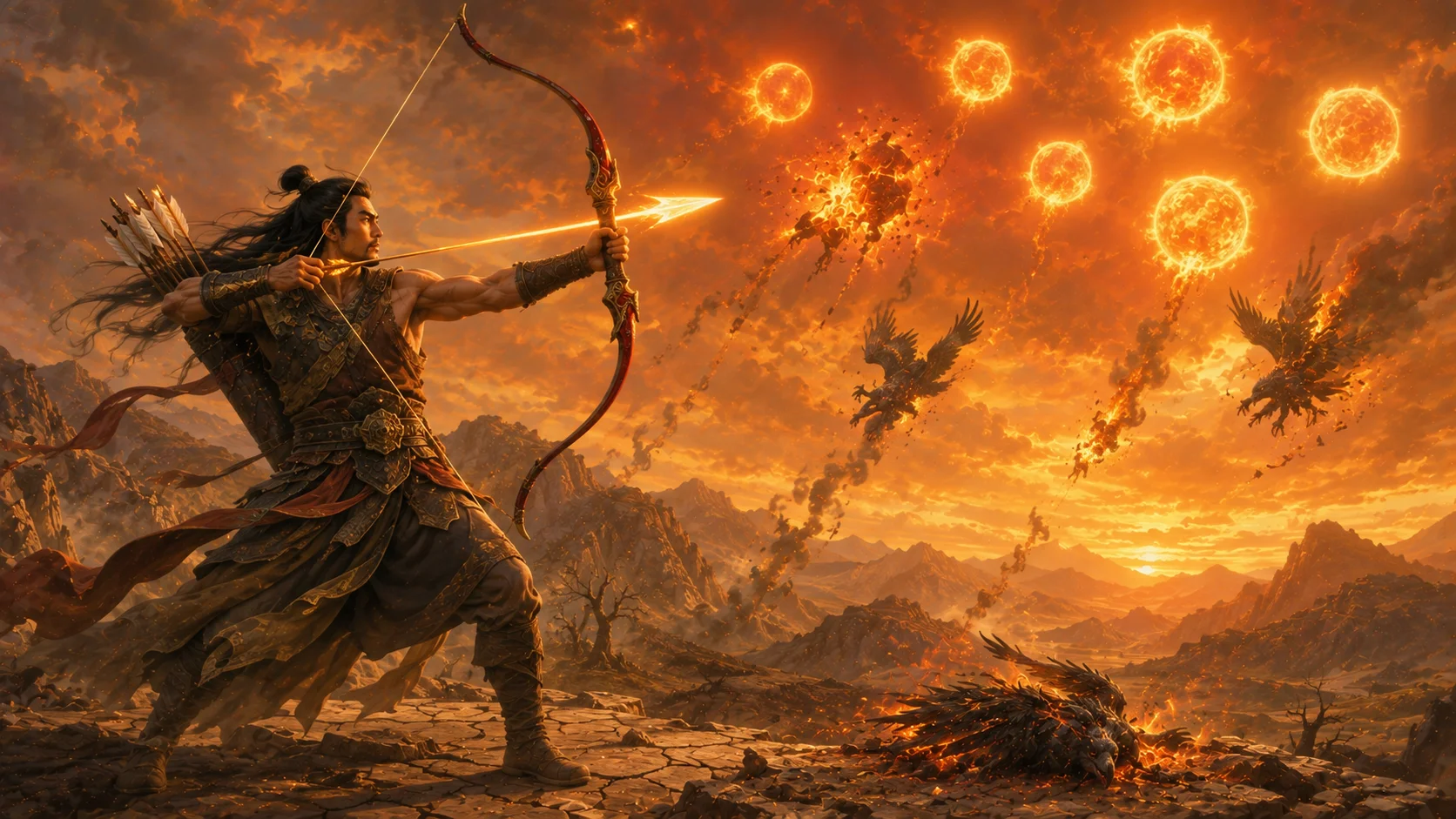
In the tellings where Hou Yi is Di Jun's emissary, his bow is no ordinary weapon — it is described as red, a gift from the Lord on High himself, marking its bearer as an instrument of heavenly order rather than a freelance hero. This detail matters to how the myth reads: Hou Yi's violence, aimed at monsters and even at the sun-crows themselves, is not transgression but restoration. He is sent because something in the ordered world has slipped, and his arrows are the means by which balance is put back in its place. Later art and opera keep this image alive, showing him bow in hand, often in the same frame as Chang'e and the moon that would come to define the second half of his story.
Ten Suns Rise as One
The center of Hou Yi's myth is the crisis of the ten suns. In the ordered cosmos, ten sun-crows — sons of Di Jun and the sun-mother Xihe — rose one at a time, each taking its turn to cross the sky while the others rested. The arrangement kept the earth livable. Then, in an act of either mischief or simple defiance, all ten rose together. The result was catastrophe: crops withered, rivers boiled, stone cracked in the heat, and the ordinary rhythm that let living things survive collapsed within days. This is not framed in the sources as a natural disaster in the modern sense but as a rupture in cosmic order — the sky's own children breaking the pattern their parents had set for them, and dragging the human world down with them.
Yao's Commission
Facing a world scorched past enduring, the sage-king Yao turned to Hou Yi — in some versions the commission comes from Yao directly, in others Di Jun himself authorizes the correction of his own unruly sons. Either way, the task fell to the one archer capable of it. Hou Yi was to shoot the suns down before they finished what they had started. It is worth noting what the myth does not ask of him: not to destroy the sun, not to end the daylight world, but to prune an excess back down to what the earth could bear. The distinction is the whole point of the story — restraint applied with lethal precision, not annihilation.
Nine Arrows, One Sun Left
Hou Yi drew his bow and, arrow after arrow, brought down nine of the ten suns, leaving only one to complete its ordinary crossing of the sky. This act is remembered as the etiological center of the myth — the reason, in the tradition's own terms, that the world has exactly one sun today rather than ten. It ties Hou Yi permanently into Chinese solar cosmology, alongside Xihe as the sun-mother and the Fusang world tree from which the suns were said to rise in turn. Where Xihe represents the generative, maternal order of the sun's cycle, Hou Yi represents the corrective force that had to be exercised when that order broke down — two halves of the same solar mythology, neither one replacing the other.
The Labors Beyond the Sky
The suns were not the only threat Hou Yi was called to answer. The Huainanzi preserves a list of monster-slaying labors carried out for Yao, each aimed at a horror that had made some part of the world unlivable. He killed Yayu, a man-eating monster; Zaochi, known as "Chisel Tooth"; the nine-headed monster Jiuying; the giant boar Fengxi; the river god Feng Yi, whom some tellings identify with the better-known river deity He Bo; and the giant bird Dafeng, the "Great Wind," whose passage alone was destructive enough to count among the labors. Taken together with the shooting of the suns, these labors build a consistent picture of Hou Yi's role: he is called wherever the world has produced something too large, too hungry, or too violent for ordinary life to survive, and he answers with the bow rather than with brute strength or trickery. Skill, not size, is what the myth keeps returning to.
A Marriage Bound to the Moon
Hou Yi's story does not end with the suns brought down and the monsters cleared. He is remembered just as strongly as the husband of Chang'e, the woman whose name would come to be inseparable from the moon itself. Their marriage forms the emotional center of the myth's second half, and its eventual unraveling — through no clean villainy on either side, in most versions — gives the Hou Yi myth its lasting note of loss. Where the ten-suns episode is a story of triumph achieved, the Chang'e episode is a story of triumph that costs something irrecoverable.
The Elixir of the Queen Mother
In most versions of the story, Hou Yi's heavenly deeds — or his standing as a hero worth heaven's notice — earn him an elixir of immortality, obtained from Xiwangmu, the Queen Mother of the West. The elixir is not something he takes lightly; it represents the one reward that could lift a mortal or semi-divine hero permanently out of the world he has spent his labors defending. What happens to it afterward is the hinge on which the rest of the myth turns.
Chang'e's Ascent
The elixir does not stay in Hou Yi's hands. The tradition offers several accounts of how it passes to Chang'e and why: in some she drinks it to keep it from a thief, often named as Feng Meng, Hou Yi's own disciple in archery; in others she drinks it under duress, with no theft involved at all; in still others the choice is closer to her own. What is consistent across the variants is the outcome — Chang'e ascends, becoming the figure who dwells on the moon, and in doing so is separated from Hou Yi by the whole distance between earth and sky. The myth does not resolve this separation with reunion. It stands as loss, plainly, and that is part of why the story has endured: an act meant to preserve something instead divides it.
The Disciple's Betrayal
One of the darker threads attached to Hou Yi's later life names Feng Meng — sometimes rendered Peng Meng — as more than an incidental figure in the elixir episode. In some tellings this same student, having trained under Hou Yi in archery, later turns on his teacher and kills him, a betrayal-by-disciple that sits uneasily alongside the image of Hou Yi as an invincible slayer of monsters. The tradition itself does not present this death as settled fact; it is one account among several, and the sources disagree on its details and even its timing. It is preserved here as part of the myth's own uncertainty, not as a fixed conclusion to his story.
One Figure or Two: The Disputed Archer-King
A separate complication runs through the scholarship on Hou Yi. Some traditions describe a distinct figure named simply Yi — a legendary archer of the Xia dynasty who briefly usurped the throne from Prince Xiang of Xia. Whether this Xia-era archer-usurper is the same figure as the mythic solar archer who shot down the suns, or an originally separate legendary figure whose name and skill with the bow caused later tradition to merge the two, is explicitly disputed among sinologists. No resolution is offered here, because the sources themselves offer none; the honest position is that Hou Yi's story may carry the memory of two heroes folded into one name, and that the folding happened long before any surviving text was written down.
A Festival That Remembers the Moon, Not Only the Archer
Hou Yi's afterlife in living tradition is asymmetrical. The Mid-Autumn Festival, Zhongqiu Jie, centers overwhelmingly on Chang'e and the moon she inhabits, and only reaches back to Hou Yi indirectly, through the myth that explains how she came to be there. Independent cultic worship of Hou Yi himself is comparatively minor next to the devotion paid to his wife. This is not a diminishment of his place in the mythology so much as a reflection of where later tradition chose to rest its heart — on the moon and the figure gazing at it from afar, rather than on the archer left behind on earth.
The Bow as the Measure of the Hero
What holds every piece of Hou Yi's story together — the suns, the monsters, the elixir, the marriage — is the consistent choice of the bow as his defining instrument. He is not remembered as a hero of overwhelming force but of aimed, disciplined skill: nine suns struck down one at a time, not obliterated in a single stroke; named monsters dispatched individually, each requiring its own labor. In a mythology that also has room for giants, floods, and world-trees, Hou Yi stands for the idea that cosmic balance can be restored by precision rather than by power alone — and that even a hero capable of correcting the sky itself is not exempt from the ordinary human costs of loss and separation that close out his story.
Sources & traditions
- EncyclopediaWikipedia — Hou Yi
- TraditionChinese texts, oral tradition and village tellings (China)
Myths change from area to area and from time to time. This chronicle follows the most widely told versions; tellings in other villages, regions and eras may differ.