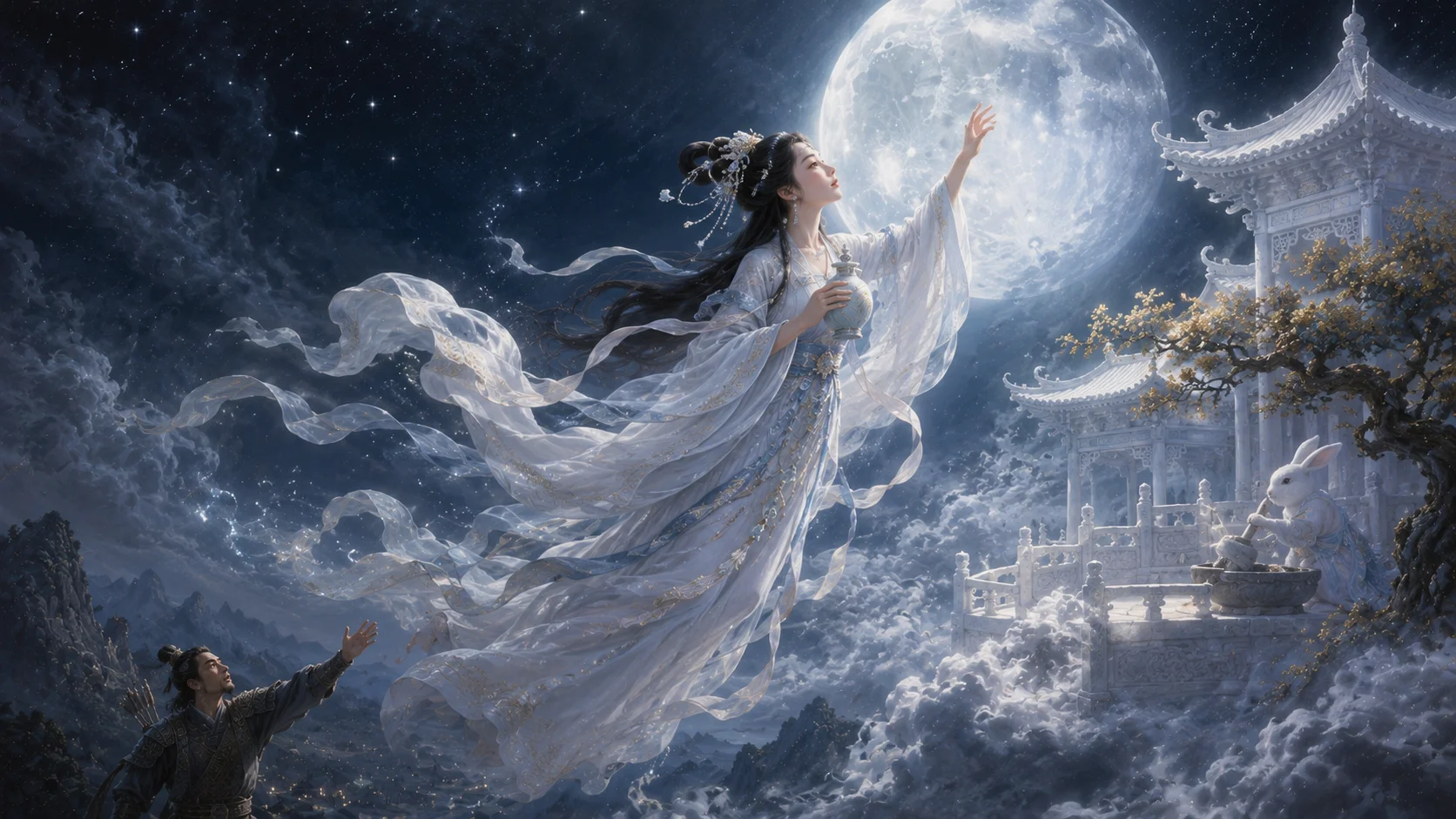
Chang'e is the goddess of the Moon in Chinese mythology — one of the most beloved and enduring figures in the entire tradition, her story told and retold at the same moment every year by families who gather to look up at the same full moon she is said to inhabit. She is the wife of Hou Yi, the archer-hero credited with saving the earth itself, and her own story is one of ascent, separation, and the particular ache of being forever visible yet forever unreachable. Few figures in Chinese religious and folk life carry as much continuous, living weight: she is remembered in verse, in festival, in ritual offering, and now even in the names given to spacecraft sent to the place she is said to dwell.
The Archer Who Emptied the Sky
To understand Chang'e, the tradition holds, one must first understand her husband. Hou Yi is remembered as the great archer of Chinese myth, the figure called upon when ten suns rose into the sky at once and scorched the earth toward ruin. In the most widely told version of events, Hou Yi drew his bow again and again until nine of the ten suns had been shot from the heavens, sparing humanity from a fate of fire. It was a deed of the highest order, the kind that draws the attention of the divine rather than merely the grateful. For it, Xi Wangmu — the Queen Mother of the West, one of the great goddesses of Chinese cosmology — granted Hou Yi an elixir of immortality, a substance so potent that a single dose was said to be enough to raise a mortal into the ranks of the undying.
It is against this backdrop that Chang'e's story begins — not as a myth about her alone, but as a myth about a married pair, a household, and a treasure too powerful to sit easily within either.
A Treasure Entrusted, Not Claimed
Hou Yi did not consume the elixir himself. Various tellings agree that he brought it home and it came to rest with Chang'e, his wife, kept within their household rather than swallowed at once. This detail matters to how the myth is understood in the tradition: the elixir was a shared burden and a shared temptation, not something Chang'e stole or coveted from the outset. What happens next is where the myth becomes genuinely plural — Chinese storytelling itself preserves more than one account of how Chang'e came to drink it, and none of these versions should be flattened into a single "true" original. They exist side by side, each carrying its own emotional and moral weight.
The Version of Protection: Guarding the Elixir from Feng Meng
In one of the most commonly told versions, the elixir's danger comes not from within the household but from outside it. Feng Meng, an apprentice or intruder in some tellings, is said to have attempted to steal the elixir while Hou Yi was away — to seize an immortality he had no claim to and had done nothing to earn. Chang'e, faced with a choice in the moment, drinks the elixir herself rather than allow it to fall into unworthy or dangerous hands. In this telling, her act is one of guardianship, even sacrifice: she takes on the elixir's transformative power not out of desire for what it offers but to keep it from being misused. It is, in this reading, closer to protective duty than to personal longing.
The Version of Longing: A Wish of Her Own
A second, equally persistent strand of the tradition tells a different story — that Chang'e drinks the elixir herself out of her own curiosity, or her own wish for immortality. This version does not require an intruder or a threat; it locates the decision entirely within Chang'e's own desire to know what the elixir would grant her, or to possess for herself the transcendence her husband had been given but had not yet claimed. Where the guardianship version frames her act as selfless, this version frames it as human — a woman reaching, on her own initiative, for something extraordinary. The tradition does not ask that these two readings be reconciled; they simply coexist, each told and retold in different households, different regions, different generations.
The Version of Punishment: An Ascent Not Chosen
A third thread in the myth removes agency from Chang'e almost entirely: in some tellings, she ascends to the moon not by her own choice, protective or otherwise, but as a punishment imposed upon her. In this reading her flight to the moon is not an act she commits but a fate she suffers — the separation from Hou Yi cast not as the consequence of a decision she made, but as something done to her. This variant sits less comfortably beside the other two, and the tradition holds it apart rather than blending its logic into the others. Chinese myth, like most living oral traditions, tolerates — even depends on — such open disagreement about motive.
Turning to Light, Rising from the Earth
Whatever the path that brings her to the elixir, the moment of transformation itself is consistent across the tradition's tellings: upon drinking it, Chang'e becomes light — impossibly, suddenly light — and begins to float upward, rising from the earth she has always known toward the sky. She does not choose a destination so much as she is carried to one: the moon, cold and distant, becomes the place where she comes to rest, and where she has remained ever since. This image of ascension is among the most visually and emotionally potent in all of Chinese mythology — not a triumphant flight toward glory, but a solitary drifting-away, upward and out of reach, while the husband she loved stays behind on the ground, unable to follow.
The Silence Between Earth and Moon
What gives the Chang'e myth its enduring emotional pull, more than any other single element, is the separation itself. Hou Yi remains a creature of the earth; Chang'e becomes a creature of the sky. They are not reunited in the myth's core telling — there is no rescue, no second elixir, no bridge built between the two realms. This is a myth built around loss that cannot be undone, longing that has nowhere to go, and a love that persists precisely because it can no longer be acted upon. It is this quality — bittersweet, aching, unresolved — that later poets would return to again and again, using Chang'e not merely as a character but as an image for the condition of separation itself.
The Rabbit Who Pounds the Herbs of Eternity
Chang'e is not entirely alone in the tradition's imagining of the moon. She is closely associated with the Jade Rabbit, known as Yutu, said to be her companion on the lunar surface. The Jade Rabbit is remembered as eternally at work with a mortar and pestle, pounding herbs in an unending effort to produce an elixir of immortality — a task that echoes, and in some sense continues, the very substance that brought Chang'e to the moon in the first place. The image of the rabbit's ceaseless labor beside the solitary goddess has become one of the most recognizable pairings in Chinese lunar imagery, softening her isolation without ever fully resolving it.
The Woodcutter and the Tree That Will Not Fall
Some tellings place a second figure within the lunar landscape alongside Chang'e and the Jade Rabbit: Wu Gang, a woodcutter condemned to chop endlessly at a cassia, or osmanthus, tree that heals itself the moment his axe withdraws. This is, properly speaking, a separate punishment myth in its own right, not originally part of Chang'e's story — but over generations of storytelling it became loosely woven into the same lunar setting she occupies. The tradition treats this as an association rather than a fusion: Wu Gang's endless, fruitless labor belongs to his own tale of wrongdoing and consequence, even as it shares the same moonlit stage.
The Night the Whole Family Looks Up
Chang'e's story finds its fullest living expression not on a page but at a table, on a single night each year. She is the central figure of the Mid-Autumn Festival, Zhongqiu Jie, celebrated on the fifteenth day of the eighth lunar month, when the moon is at its fullest and roundest. Families gather to view the moon together, to share mooncakes, and to tell — again, as they have told for generations — the story of the goddess who rose from the earth and now watches it from above. It is one of the most widely practiced festivals in Chinese culture today, and Chang'e's presence within it is not a decorative footnote but the emotional center of the occasion: a night organized, in essence, around looking toward someone who cannot look back in quite the same way, and finding comfort in the looking itself.
Traces in Han Bamboo and Tang Verse
The written record of Chang'e's lunar-flight myth reaches back to Han-dynasty-era sources such as the Huainanzi, among the earliest textual attestations of a goddess ascending to the moon. From there, her name and the details of her story were elaborated and reshaped across successive periods, gathering new emphasis and new emotional shading with each retelling. By the Tang dynasty, poets turned to her often and specifically as an image of loneliness and regret — Li Shangyin among them — using her fixed, solitary place in the night sky as a way of speaking about distances that cannot be closed, whether between lovers, between the living and the lost, or between a person and the life they might have chosen differently. That she could carry such weight in classical poetry, centuries after the earliest tellings of her myth, speaks to how deeply the story had settled into the culture's shared imagination.
A Later Place Among the Star-Officials of Daoism
As Chinese religious systems developed more formal structures for organizing their deities, Chang'e was in some schemes drawn into the broader Daoist astral pantheon, correlated with a Moon Goddess figure sometimes called Yue Shen, or linked to Taiyin Xingjun within certain Daoist correlative frameworks. It is important to hold this development in its proper place: this formal Daoist integration is a later layering atop an older folk myth, not the source from which the story of Chang'e originally sprang. The tradition's heart remains the human story — the elixir, the ascent, the separation — with the Daoist astral framing arriving afterward as one further way of situating her within a larger cosmological order.
A Goddess Who Answers to Longing Itself
Across every version of her story, Chang'e comes to stand for a cluster of themes that recur throughout Chinese cultural and literary life: longing, separation, sacrifice, and the strange, sorrowful beauty of the moon itself. She is invoked not merely as a character in a narrative but as a kind of shorthand — a way of naming a particular ache, the ache of being close enough to see and too far to touch. This is why she recurs so often in classical poetry beyond even the Tang court, why mooncakes are shaped and shared in her honor, and why her name has proven durable enough to outlast the specific plot details that vary from telling to telling.
Her Name Sent Back Toward the Moon
That durability has carried Chang'e into an entirely new era. China's lunar exploration program bears her name directly — the Chang'e missions, including Chang'e 4 and Chang'e 5, which have carried scientific instruments to the lunar surface and, in Chang'e 5's case, returned samples to earth. The lunar rover accompanying these missions was named Yutu, the Jade Rabbit, after her mythological companion, so that the pairing at the heart of the old story — the goddess and the rabbit together on the moon — was reproduced, deliberately, in the naming of real hardware sent to that same lunar surface. It is a rare thing for a myth thousands of years old to be given, quite literally, a second flight toward the place it always said its central figure had gone. The choice reflects how alive the story remains: not a relic explained in footnotes, but a name still considered fitting for humanity's own reach toward the moon.
Sources & traditions
- EncyclopediaWikipedia — Chang'e
- TraditionChinese texts, oral tradition and village tellings (China)
Myths change from area to area and from time to time. This chronicle follows the most widely told versions; tellings in other villages, regions and eras may differ.