Hypnos was the gentle god of sleep — the soft, painless power that visits every living thing each night, the only force strong enough to lay even the king of the gods unconscious. Brother of Death and son of Night, he belongs to the oldest generation of Greek divinity: not an Olympian ruling from a bright mountain court, but a primordial-adjacent personification, born in the same breath as Doom, Deceit, Old Age, and Strife. From his silent home he sent slumber across the world, and in one of the fullest myths to survive about him, he proved his power was enough to trouble even Zeus.
Born of Night Alone
In Hesiod's Theogony, Hypnos is named as a child of Nyx, the primordial goddess of Night, born without a father — parthenogenetically, in the same passage that lists several of Nyx's children as hers alone. This is one of the most solidly attested facts about him: no other tradition seriously disputes it, and it places Hypnos among the earliest layer of Greek cosmogonic beings, older in conception than the Olympian order itself. He did not descend from Zeus's line or marry into it by birth; he predates it, a force present in the universe before the gods of Olympus had finished settling their quarrels.
Twin of Death
Hesiod names Hypnos explicitly as the twin brother of Thanatos, Death, and the two are listed together among Nyx's children alongside Moros (Doom), the Keres, Momus (Blame), Oizys (Woe), the Hesperides, the Moirai (the Fates), Nemesis, Apate (Deceit), Philotes (Friendship), Geras (Old Age), and Eris (Strife) — a genealogy that reads like a roll call of everything mortal life must eventually pass through. Of that whole company, the pairing of Hypnos and Thanatos as twins is the detail poets and later writers return to again and again, because the metaphor writes itself: Sleep and Death, indistinguishable at a glance, one merciful and temporary, the other final. The Greeks folded that same pairing into ordinary language, speaking of sleep and death almost as if naming siblings rather than two separate ideas.
The House Where the Two Dwell Together
Hesiod places Hypnos and Thanatos dwelling together in the gloomy depths of the underworld, within or near the House of Nyx, in the region of Erebus. It is a striking image: the two brothers do not live apart, one among the living and one among the dead, but share a single dark household, gentle and final aspect of unconsciousness residing side by side. Nothing in the tradition suggests rivalry or distance between them — they are conceptually and literally inseparable, and the poets never bother to explain why sleep and death would share a roof, because to a Greek audience the answer was obvious.
Hera's Request and an Old Wound
The fullest narrative appearance of Hypnos in all of surviving classical literature comes in Book Fourteen of the Iliad. During the Trojan War, Hera wishes to distract Zeus so the Greeks can gain ground on the battlefield without his interference, and she turns to Hypnos to lull her husband to sleep. He is reluctant, and his reluctance carries the weight of memory: he recalls that he once before put Zeus to sleep at Hera's request, as part of an earlier scheme of hers against Heracles that drove the hero off course at sea, and that when Zeus woke and discovered the deception, his fury nearly destroyed Hypnos. The god of sleep, who can subdue every other living thing without resistance, remembers being hunted by the one being his own power could not permanently disarm.
A Bride Named Grace
Hypnos agrees to help Hera a second time only after she offers him something he clearly wants badly enough to risk Zeus's anger again: marriage to one of the younger Graces, Pasithea. Hera swears the oath, and Hypnos accepts. This is a specific, attested detail rather than folklore built up around him later — the Iliad names the bride directly, and it is one of the only concrete relationships in Hypnos's story that comes with a name attached and a bargain struck in the open, on the record, between two divine parties. Sleep, for once, has a price and a reward, not merely a duty performed in silence.
Lulling the King of Olympus
Having secured his bride, Hypnos succeeds where almost nothing else in the Greek cosmos could: he settles over Zeus and puts him to sleep, holding the king of the gods unconscious long enough for Hera's plan to unfold unopposed. The episode is remembered as much for what it proves as for what it accomplishes narratively — that Hypnos's power reaches even the throne of Olympus, that the god who otherwise appears in myth only briefly and quietly is, when the story finally slows down to look at him directly, revealed as formidable enough to be worth Hera's careful negotiation and worth Zeus's fear in the earlier telling.
Sons Who Shape What We See in Sleep
Later classical and Hellenistic sources, most fully Ovid's Roman-era Metamorphoses, developed Hypnos further as father of Morpheus and the other Oneiroi, the personified Dream-spirits, with Morpheus specifically credited as the shaper of the human forms that appear within dreams. This material belongs to a later poetic elaboration rather than to the core Hesiodic-Homeric tradition, and should be read as such — a fuller, later flowering of the idea that sleep itself might have offspring who govern what fills it, rather than a detail present in the earliest layers of the myth. Even so, it is this later strand that gave the world one of mythology's most enduring linguistic legacies: the modern word "morphine," named directly for its opium-derived, sleep-and-dream-inducing effect, traces straight back to Morpheus, and through him to Hypnos.
The Poppy and the Horn
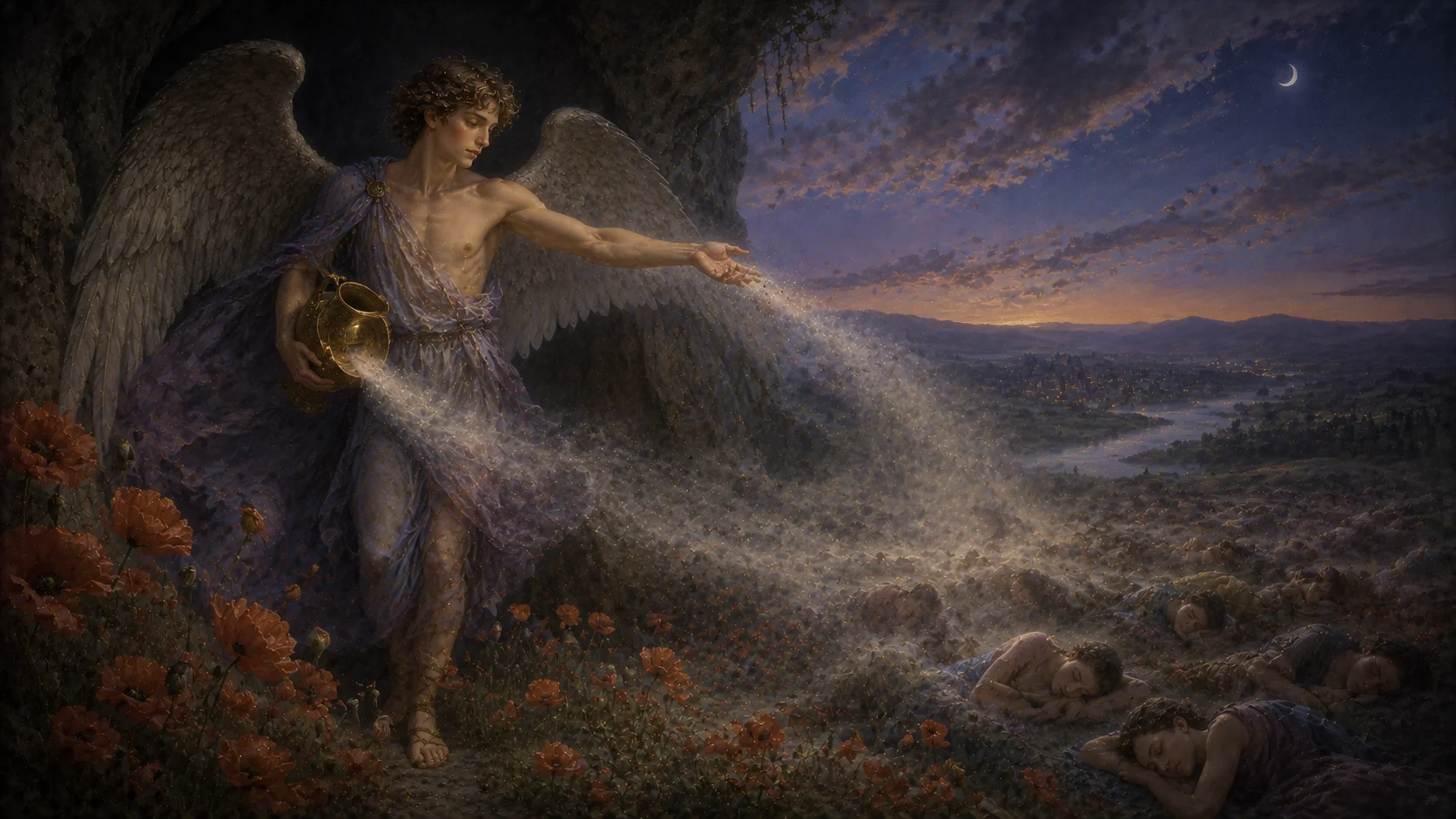
In Greek art, Hypnos is most commonly shown as a winged youth or young man, sometimes carrying a horn of sleep-inducing liquid drawn from the opium poppy, sometimes shown pouring a stream from that horn over a sleeping figure below him, or holding a poppy stem outright. The poppy is by far his most consistent attribute across surviving depictions, chosen precisely because opium's soporific power made it the natural plant-emblem for a god whose entire domain was the loss of waking consciousness. Wings, too, recur — sleep as something that arrives on silent flight, settling over a person rather than approaching on foot.
His Roman Counterpart
Hypnos corresponds directly to the Roman god Somnus, a well-attested equivalence within Greco-Roman religious syncretism rather than a loose or later invention. It is under the name Somnus, in Ovid's Book Eleven, that the god's cave and his son Morpheus receive their fullest literary treatment — material frequently cited in discussions of Hypnos generally, though strictly speaking it belongs to the Roman-named counterpart and the Roman poetic tradition rather than to Hypnos's own earlier Greek sources.
A Small Cult at Troezen
Hypnos was not the focus of major panhellenic temple worship the way the Olympian gods proper were, and no significant epithets beyond his own name are strongly attested for him. He did, however, have a known and specific cult site at Troezen, where, according to Pausanias, he was worshipped jointly with the Muses — a modest, localized honor, but a real and recorded one, suggesting that at least in one Greek city sleep was thought worth a shared shrine alongside the goddesses of memory and inspired thought, an odd and telling pairing in its own right.
Power Measured Against the Unconquerable
What the surviving myths keep circling back to is the same paradox: Hypnos is gentle, quiet, almost background in most tellings — and yet twice in his story he is shown overpowering Zeus himself, the one act that no other being in the Greek pantheon, god or mortal, could easily claim. His power is never loud. It does not announce itself with thunder or contest. It simply settles, inevitably, over anyone at all, king of the gods included, and that quiet inevitability is precisely what makes him formidable rather than minor.
The Gentler of the Two Brothers
Across the tradition, Hypnos personifies sleep as a cosmic force closely allied with, but always kept distinct from, death — a pairing Homer's own phrasing leans on when the two are named together, and one the Greeks clearly found worth returning to rather than resolving. Hypnos is consistently the kinder twin: he takes nothing permanently, asks nothing of those he visits, and returns each of them, eventually, to waking life. Where Thanatos closes a story, Hypnos merely pauses it, and it is that pause — nightly, universal, and gentle even when it touches Olympus itself — that the Greeks kept naming as a kind of mercy owed to every living thing.
Sources & traditions
- EncyclopediaWikipedia — Hypnos
- TraditionGreek texts, inscriptions and later retellings (Greece)
Myths change from area to area and from time to time. This chronicle follows the most widely told versions; tellings in other villages, regions and eras may differ.