Morpheus was the god of dreams — the shaper of the human figures who walk through our sleeping minds, the divine artist who can take the form of anyone and appear to a sleeper as vividly as life. His name has become a byword for sleep and dream itself, and he lent it to morphine, the drug that brings the deepest slumber.
The Shaper of Dreams
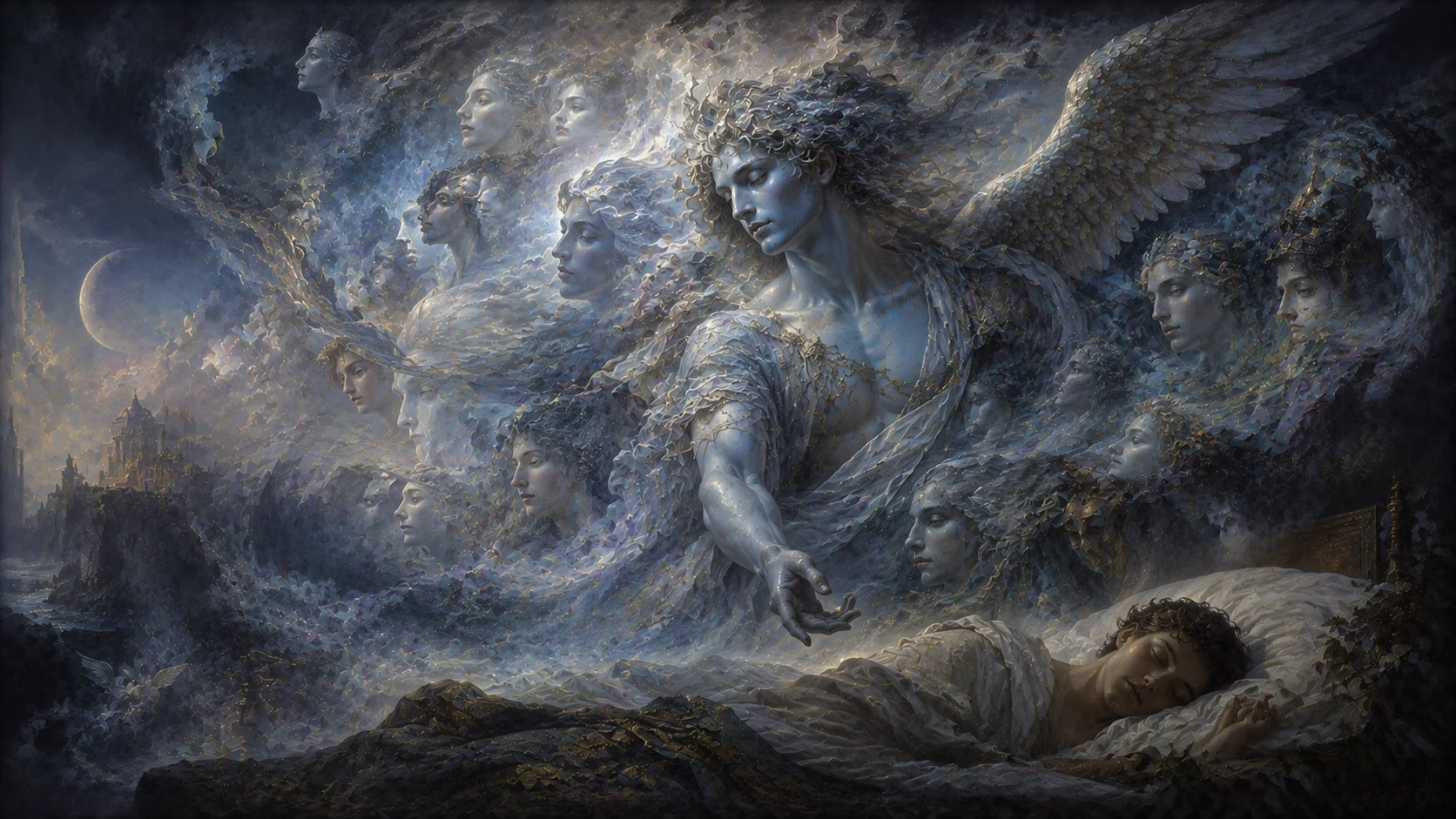
Morpheus was one of the Oneiroi (Dreams), the many sons of Hypnos (Sleep) who lived in their father's dark cave at the edge of the world. His specialty, and the source of his name (from the Greek morphe, “form” or “shape”), was the ability to take on the perfect human form in dreams — to appear to a sleeping person as another human being, mimicking their voice, their walk, their every gesture flawlessly. While his brothers shaped the animals and objects of dreams, Morpheus was the master of dream-people.
The Messenger in Sleep
Because he could appear so convincingly as anyone, Morpheus served as a messenger of the gods within dreams — sent, for instance, to appear to the grieving Alcyone in the form of her drowned husband to gently reveal his death. The Greeks understood the strange power of this: that the dead and the distant can return to us, real as life, in the country of sleep — and that it is Morpheus who wears their faces.
The God We Visit Every Night
Morpheus endures perhaps more intimately than any other Greek god, because everyone meets him. To be “in the arms of Morpheus” is to be deep in sleep and dreams. His name shapes our language for the dream-world, for sleep-bringing medicine (morphine), and for transformation itself (to “morph”). He is the quiet god of the third of our lives that we spend asleep — the artist who paints the faces in the dark.
Every face that visits you in a dream — the loved, the lost, the stranger — is one he chose to wear.
A God Ovid Invented
Search Hesiod for Morpheus and you will not find him. The Theogony lists among the children of Nyx (Night) both Hypnos, Sleep, and the whole tribe of Oneiroi — Dreams, plural and unindividuated, named only as a crowd. Homer comes closer without arriving: in the second book of the Iliad, Zeus sends a Dream to Agamemnon and it appears wearing the shape of old Nestor, but that Dream has no name beyond the word for what it is. It is Ovid, writing in Latin and finishing the Metamorphoses around 8 CE, who does the sorting. He takes the anonymous swarm the Greek poets left him, pulls three brothers out of it, gives each a name and a speciality, and hands the most demanding job to Morpheus. As far as anything that survives can show, the god most people assume is old Greek folklore first appears as a character in a Roman poem.
Three Brothers, Three Kinds of Dream
In Ovid, Sleep — Somnus, standing in for the Greek Hypnos — does not have one son but a thousand, the empty Somnia. Out of that crowd, three are singled out and named:
- Morpheus, whom no other can match at counterfeiting a person. Ovid's inventory of what he copies ends with two items that summaries almost always drop: the clothes a person wears, and the particular words that person is in the habit of using.
- Icelos to the gods, Phobetor to everyone else — one brother under two names depending on who is speaking. He arrives as beast, bird, or long-bodied serpent.
- Phantasos, who puts on the shape of things that were never alive at all: earth, rock, water, a wooden beam.
Then comes the detail no retelling keeps. These three are the dreams sent to show their faces to kings and commanders; the rest of the thousand are left to wander among the general population. Dreams issued by rank — an oddly bureaucratic touch in a poem about transformation, and the only ancient account that gives the dream-gods separate names and separate trades at all.
The Cave at the Edge of the World
Before Morpheus can be sent anywhere, Ovid takes the reader to where he lives, and the passage is one of the strangest sustained pieces of scene-setting in the whole poem. The house of Sleep is a hollow mountain near the Cimmerians, which the sun cannot reach at rising, at noon, or at setting; fog steams up out of the ground and the light never gets past dusk. No crested bird calls up the dawn there, no anxious dog barks, no goose — sharper-eared than any dog — raises the alarm. No wild animal, no cattle, no branch stirred by wind, no human quarrel makes a sound. Exactly one noise is permitted: a stream of Lethe's water slipping out from the base of the rock, murmuring over rattling pebbles, and that sound alone is enough to invite sleep. Poppies flower at the entrance among countless other herbs, and Night gathers drowsiness from their milk to sprinkle across the darkened earth. There is no door anywhere in the house, so that no hinge can creak, and no watchman on the threshold. At the centre stands a high couch of ebony, downy, all one colour, spread with a dark coverlet, and there the god lies with his limbs gone slack. Around him lie the empty Dreams, as many as the harvest has ears of grain, the forest leaves, the shore grains of sand.
A Goddess Sends Him Out
Morpheus never acts on his own initiative in any surviving text; he is dispatched. Juno, unable to bear that Alcyone keeps bringing prayers to her altars for a husband who is already drowned, sends Iris down to the cave to have Sleep deliver the news in a dream. Even a goddess struggles in that air: Iris has to push the crowding Dreams aside with her hands, and the brightness of her robe is the only light the house gets. Sleep can barely stay conscious long enough to hear the errand out — his eyes fall shut, he sinks back again and again, his chin nods down onto his chest, and at last he shakes himself free of himself. Rather than go, he wakes the one son whose speciality the job requires. Morpheus flies out on wings that make no sound, reaches the Haemonian city where Alcyone is waiting, lays the wings aside and puts on Ceyx's face: naked, corpse-pale, his beard wet, water running from his soaked hair. Then he stands over her bed and speaks to her in her husband's voice.
Halcyon Days
What happens next belongs to Alcyone rather than to Morpheus, but it is the reason the whole episode was told, and it never survives into a summary of what Morpheus can do. She wakes reaching for a man who has just finished telling her he is dead, and goes down to the shore at first light. Something is drifting in on the tide, and it is him. Grief-mad, she springs onto a mole built out into the sea to throw herself after him — and in mid-air she is flying rather than falling, feathers where her arms were. Ceyx changes on the sand below her. The two become birds, still a pair, still calling to each other over the water that killed them. Alcyone's father is Aeolus, keeper of the winds, and for seven calm days each winter he shuts the winds in and flattens the sea so that his daughter can brood on a nest floating on open water. Those are the original halcyon days, and the phrase has outlived the story it came from by two thousand years. Morpheus's one recorded errand ends, in other words, not with him at all, but with a grief so total that it changes what a person is.
A God With No Temple
For a god nearly everyone meets nightly, Morpheus was never worshipped. No altar carried his name, no priest served him, no festival was set aside for him — and the reason is structural rather than accidental: there was never a Greek public that believed in him to build one. His father did better. One of the Orphic Hymns, a collection of cult hymns from the Roman imperial period, addresses Hypnos directly as lord of all the blessed gods and of mortal men, the one whose rest loosens every care. Morpheus gets nothing of the kind: no known shrine, no cult image, no inscription, and a single appearance in a single poem. He is about as purely as any figure in classical myth a god who exists only on the page — never once called on by anybody who needed him to answer.
Two Modern Dreamers Who Borrowed His Name
Two very different works of the late twentieth century reached back for the name rather than the function. Neil Gaiman's The Sandman, serialised from 1989, calls its central character Dream of the Endless and gives him a long roster of other names, Morpheus among the most used — an echo anyone who knows the Roman figure catches at once: a being whose entire nature is to take a shape, to appear as whatever the sleeper needs to see, with no guarantee that the shape is honest. The Matrix took the name outright for its guide-figure and inverted the job: this Morpheus exists to show a man that the world he has been living inside was built and shaped for him by something he could not see. Both borrowings land on the nerve the Roman story found first — the suspicion that the familiar face in front of you was put there by someone else, for reasons that are not yours.
Sources & traditions
- EncyclopediaWikipedia — Morpheus
- TraditionGreek texts, inscriptions and later retellings (Greece)
Myths change from area to area and from time to time. This chronicle follows the most widely told versions; tellings in other villages, regions and eras may differ.