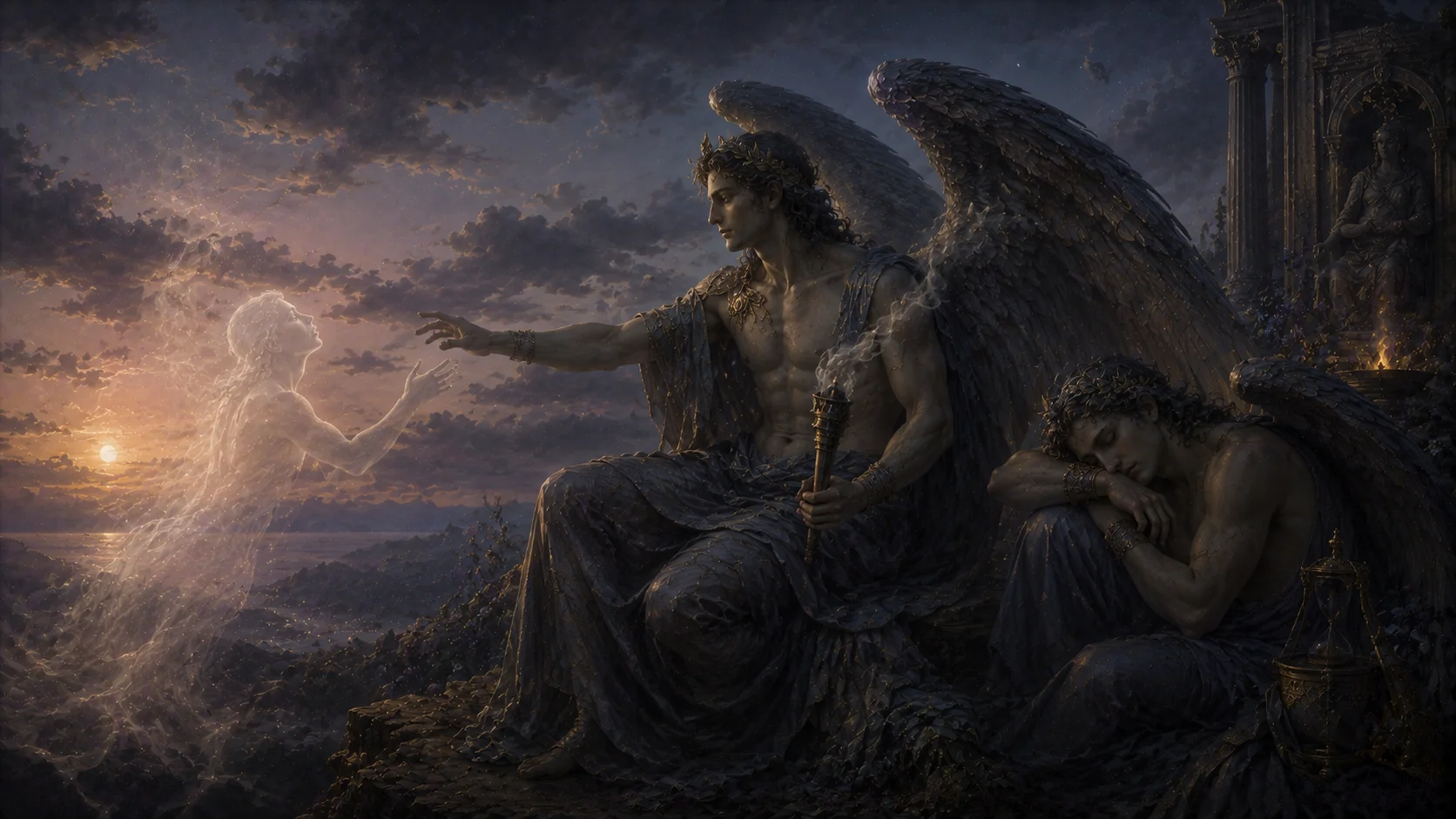
Thanatos was Death itself — not the grim reaper of later imagination, but a winged god who came gently to carry away those whose time had come. Twin brother of Sleep and son of Night, he was the personification of peaceful, natural death, the quiet end that comes to everyone — and one of the few powers that even the cleverest mortal could only delay, never defeat.
Son of Night, Twin of Sleep
Thanatos was a child of Nyx (Night), born without a father, and the twin brother of Hypnos (Sleep). The pairing is one of the most beautiful in Greek myth: Sleep and Death, the two great stillnesses, born together — alike in their quiet, but one a nightly mercy and the other the final one. Homer pictures the two brothers together carrying the body of the slain hero Sarpedon gently home from the battlefield.
The Gentle Hand
Unlike the violent death-spirits called the Keres (who haunted battlefields drinking blood), Thanatos represented a calm, non-violent passing. When a person's allotted thread was cut by the Fates, it was Thanatos who came to escort the soul on its way. He was stern and implacable — he showed no favouritism, taking king and beggar alike — but he was not cruel. He was simply the necessary, universal end.
The Death That Was Chained
His most famous myth is his humiliation by the trickster king Sisyphus. When Zeus sent Thanatos to chain the deceitful king in the underworld, Sisyphus cunningly tricked Death into demonstrating how the shackles worked — and locked Thanatos up instead. With Death himself imprisoned, no one on earth could die, and the natural order collapsed, until the war-god Ares freed him. It is a striking idea: that to bind Death is not a blessing but a catastrophe, for a world where nothing can end is no world at all.
The Necessary End
Thanatos endures as one of mythology's most dignified and humane visions of death — not a punishment or a horror, but a gentle, winged brother to sleep, the natural close of every story. His name lives on in words like “euthanasia” (a good death) and in Freud's “thanatos,” the death drive. The Greeks looked death in the face and gave it a calm, weary, almost merciful expression.
His brother lays us down each night — and one night, gently, he comes instead.
The Word Before the God
Thanatos was an ordinary Greek word long before it was ever a person. It sat in everyday speech exactly where “death” sits in ours — in a physician’s prognosis, in the flat noun for what happened to a man on a battlefield, in the phrase for the end of a natural span. The god is that common word standing up and walking. This is the Greek imagination at its most characteristic: give the abstraction a parentage, a temper and a face, and you can at least look at it directly. Strife, Fear, Rumour, Old Age, Victory and Ruin were all handed the same treatment.
It also quietly settled a question that later Europe would fight over. Greek nouns carry grammatical gender, and personifications almost always follow the noun. Thanatos is masculine — so Death is a young man with wings. Latin mors is feminine — so Roman Death, on the rare occasions a poet bothers to give her a body, is a woman. The sex of Death in the Western imagination was decided by grammar centuries before anyone thought to decide it by theology.
Hesiod’s Heart of Iron
The gentle escort is only half the record. Hesiod’s Theogony, describing the house of Night where the twins live side by side, draws a hard line between them: Sleep wanders the earth kindly, a friend to men, while Death has a heart of iron and a pitiless spirit of bronze, keeps fast hold of whomever he once takes, and is hateful even to the deathless gods themselves.
The Greeks, in other words, were never of one mind about him, and they did not pretend to be. The same figure who lifts a hero tenderly from the field is elsewhere a thing the gods find repellent. This is not inconsistency so much as honesty. Death at the close of a long life is a mercy; death that takes a child is an enemy with an iron grip — and any culture that tells the truth about dying will need both portraits, sometimes on the same day.
The One Play in Which Death Speaks
In 438 BC Euripides did something almost no other Greek dramatist attempted: he put Death on stage as a speaking character. Alcestis opens with Apollo leaving a doomed house, and Thanatos arriving to claim it — black-robed, resentful, and deeply protective of his prerogatives.
The situation behind the play is a bargain. Apollo, obliged to King Admetus for a year of decent treatment while serving as his herdsman, had won him a reprieve from the Fates — by trickery, and in Aeschylus’ telling by getting the ancient goddesses drunk. The condition was that somebody else go down in his place. His parents refused. His young wife Alcestis agreed.
What follows in the prologue is a negotiation with Death, and it fails. Apollo asks merely for a delay — let her live out an old age, you will have her regardless. Thanatos refuses flatly: he takes greater honour, he says, from the young. Then he goes into the palace to consecrate her, and the gesture he uses is a genuine piece of ritual grammar rather than poetic invention — a lock of hair cut with his blade, the offering that makes a life the property of the gods below. Death here is not a monster. He is a priest, performing a rite, correctly.
He is also, for the second time in his mythology, physically beaten. Heracles — a guest in the house, and at first cheerfully drunk because nobody has told him whose funeral it is — goes out to the tomb, waits for Death to come down to drink the offerings poured at the grave, and takes hold of him in a wrestler’s grip until he gives Alcestis back. The scene is played offstage, which only makes it stranger: somewhere beyond the wall, a man has Death in a headlock.
The God Nobody Prayed To
For a figure this famous, Thanatos left almost no religious footprint. There is no great temple, no festival in his honour, no priesthood, next to nothing in the way of dedications. Pausanias, touring Sparta in the second century AD, records images of Sleep and of Death standing near one another, and notes that the Spartans held the two to be brothers on the authority of the Iliad. Statues, though — not a sanctuary, and no rite attached. Even Hades was barely better served: Pausanias knew of a single genuine temple of his, at Elis, opened one day a year, and on that day only the priest was allowed inside.
The reason is structural. Greek worship was an exchange — you gave, in the expectation of receiving. So what, precisely, would you ask Death for? Not more time; the thread belongs to the Fates and he only arrives once it is cut. Not favour; impartiality is the whole of his character, and a Thanatos who could be flattered would not be Thanatos at all. A god with nothing to trade attracts no altars. He is the one power in the Greek pantheon that is pure necessity, and the only real liturgy addressed to him is the funeral itself.
How to Recognise Him
Two conventions run through the art, and they do not agree. The earlier one makes him formidable: on the great mixing-bowl painted by Euphronios around 515 BC, Hermes supervises while Sleep and Death — winged, bearded, in armour, built like soldiers — lift the bleeding body of Sarpedon between them. The painter lettered every name into the scene, Death’s written backwards across the space in front of his face, so that no one could mistake who was doing the carrying.
The later convention softens him, and by the fourth century he is generally a beardless winged youth. The turn was not a clean one, and the vases catch it mid-change. He appears most often on Athenian lekythoi — the slender white-ground oil flasks made specifically to stand at a grave — where the two brothers stoop over a dead man and lift him with a gentleness that is genuinely difficult to look at. On the best known of these, painted around 435–425 BC, Sleep has already become a smooth-faced boy while Death beside him is still shaggy-bearded, his body scored with red markings like plumage. The painter signed nothing; scholarship knows him by no other name than the Thanatos Painter, after that one vase.
Roman funerary sculpture kept the youth and gave him a new attribute: a winged boy, legs crossed, half asleep, leaning on a torch turned downward so the flame goes out against the ground. It is the softest image of death antiquity produced, and it never really disappeared — the reversed torch is still there, centuries later, cut into the headstones of Victorian cemeteries.
Mors, Letum, and the Etruscans Next Door
Rome inherited the idea and mostly declined to give it a body. Horace’s pale Death, kicking with the same impartial foot at the poor man’s hut and the towers of kings, is an argument about equality rather than a character with a temper. Virgil stations Letum at the very mouth of the underworld among Grief, Cares, Diseases, Old Age, Fear, Hunger and Toil — and puts Sleep beside him, still explicitly called Death’s blood-relation. The Greek brotherhood survives even in that catalogue of horrors, which is a small measure of how firmly it had lodged.
What makes the Roman restraint interesting is the alternative sitting immediately to the north. Etruscan tomb painting imagined the moment of death with no gentleness whatever: Charun, hook-nosed and discoloured, carrying a heavy hammer, and Vanth, a winged woman with a torch, who appears at the edge of scenes simply watching, present because it is time. Rome grew up between the two pictures and appears to have used both — the Greek one for poetry, and something closer to the Etruscan one for the arena, where Christian writers describe an attendant clearing the dead in the character of a hammer-bearing god of the underworld.
How Death Lost His Wings
The skeleton with the scythe — the figure almost everyone now pictures — contains nothing Greek at all. It was assembled in Christian Europe out of at least three separate parts.
- From Revelation, the fourth rider on a pale horse, whose name is Death, with Hades following after him.
- From the plague centuries, a fixation on the corpse rather than the soul, which produced the danse macabre: a grinning cadaver leading pope, king and ploughman off in a line, painted where the living would have to walk past it.
- From a long-running confusion between Kronos, the Titan who unmanned his father with a curved blade, and Chronos, Time. Time took the Titan’s blade and added an hourglass; Death then borrowed the blade from Time; and the crop being harvested became human beings.
Something was gained in the exchange. A skeleton is unanswerably impartial — it has no expression to appeal to, and it looks identical under every rank of clothing. But a great deal was lost, and it is exactly what the Greeks had built: a face. You cannot meet a skeleton at a tomb. You can meet a tired young man with wings.
Rehearsing the Separation
Greek philosophy did something with the word that the myth-makers never quite did. In Plato’s Phaedo — the dialogue set on the last day of Socrates’ life — death is defined with almost clinical calm as the separation of soul from body, and philosophy itself is described as meletē thanatou, the practice or rehearsal of dying: a lifetime spent voluntarily doing what death will one day do involuntarily. It is the most demanding thing the Greeks ever said about Thanatos, and it is said without a single wing or torch.
The modern borrowing is looser than usually assumed. Freud wrote about a Todestrieb, a death drive, and in his own published work never actually called it Thanatos; the Greek label was fastened on afterwards by others in his circle, as a tidy counterweight to Eros, and it stuck so thoroughly that it is now quoted back to him. The word has gone on breeding regardless — thanatology for the study of dying, thanatophobia for the fear of it. A minor god with no temples ended up lending his name to an entire clinical vocabulary.
Why He Has to Be Somebody
Across twenty-seven centuries the wings come and go, the beard comes and goes, the scythe arrives late and the torch burns out — but one thing does not change: the insistence that Death be somebody. That insistence is the whole point. A person can be ambushed at a tomb, argued with in a doorway, tricked into his own shackles, delayed. A process cannot. There is nothing to say to a failing heart, and no posture to take towards a cooling body, and the mind refuses that emptiness so completely that it will invent a character rather than accept it.
What is unusual about the Greek solution is how little it flatters us. Alcestis is precise about the terms: a substitute may be accepted, an escape may not, and the price of Admetus’ extra years is that he must live them knowing who paid. Even Heracles wins back one woman, once, by main force, and the play never suggests the rule itself has moved. The bargain on offer is not survival. It is only a shape, a name, and a set of wings.
And of all the shapes we have given the end, the harvester is not the one that stays longest in the mind. It is the older one, the one painted on the flasks left standing at Athenian graves: not a blade raised over a crop, but two winged figures bending at either end of a body, taking the weight between them, and carrying it out of the noise.
Sources & traditions
- EncyclopediaWikipedia — Thanatos
- TraditionGreek texts, inscriptions and later retellings (Greece)
Myths change from area to area and from time to time. This chronicle follows the most widely told versions; tellings in other villages, regions and eras may differ.