Above even the gods of Olympus, beyond the reach of Zeus himself, sat three ancient sisters who held the destiny of every being — mortal and immortal alike — in their hands: the Moirai, the three Fates, who spun, measured, and cut the thread of every life that ever was. They are the most powerful and most terrifying figures in all of Greek myth, because not even the king of the gods could overrule them.
A Portion Owed to Every Soul
Their very name, Moirai, means "portions" or "shares" — the due measure of life allotted to each person at the moment of birth. This is the oldest sense of the word: not simply three goddesses but the shape of fate itself, the impersonal, inexorable order that governs how long anyone gets to live and what fortune, good or bad, will fill that span. In the earliest Greek poetry, in the Iliad, "moira" appears again and again as a concept before it fully hardens into personality — heroes speak of their "moira" the way a modern person might speak of "what's coming to them," a fixed portion that cannot be argued with. Only later, in Hesiod and the poets who followed him, does that abstract portion take on faces, names, and a household of three.
Daughters of the Dark, or Daughters of Themis
Even the tradition itself could not settle where the Moirai came from. Hesiod's Theogony preserves two answers, side by side, neither one erasing the other. In one telling they are daughters of Nyx, primordial Night, born without a father alongside Thanatos (Death) and the Keres, the spirits of violent doom — fate here is older than the Olympian order, a force that predates Zeus's rule entirely. In another passage of the very same poem, they are daughters of Zeus and Themis, goddess of divine law, and sisters to the Horai, the goddesses of the seasons and of right order. This is not a contradiction anyone in antiquity felt obliged to resolve. Both genealogies point at the same truth from different directions: fate is either older than the gods, or it is woven into the law that even the gods must keep. Either way, it does not answer to anyone.
The Spinner, the Allotter, the Unturnable
Whatever their parentage, the three sisters' work was never in dispute. It appears in its clearest form centuries later in Plato's Republic, in the Myth of Er, but the division of labor it describes was already ancient by then.
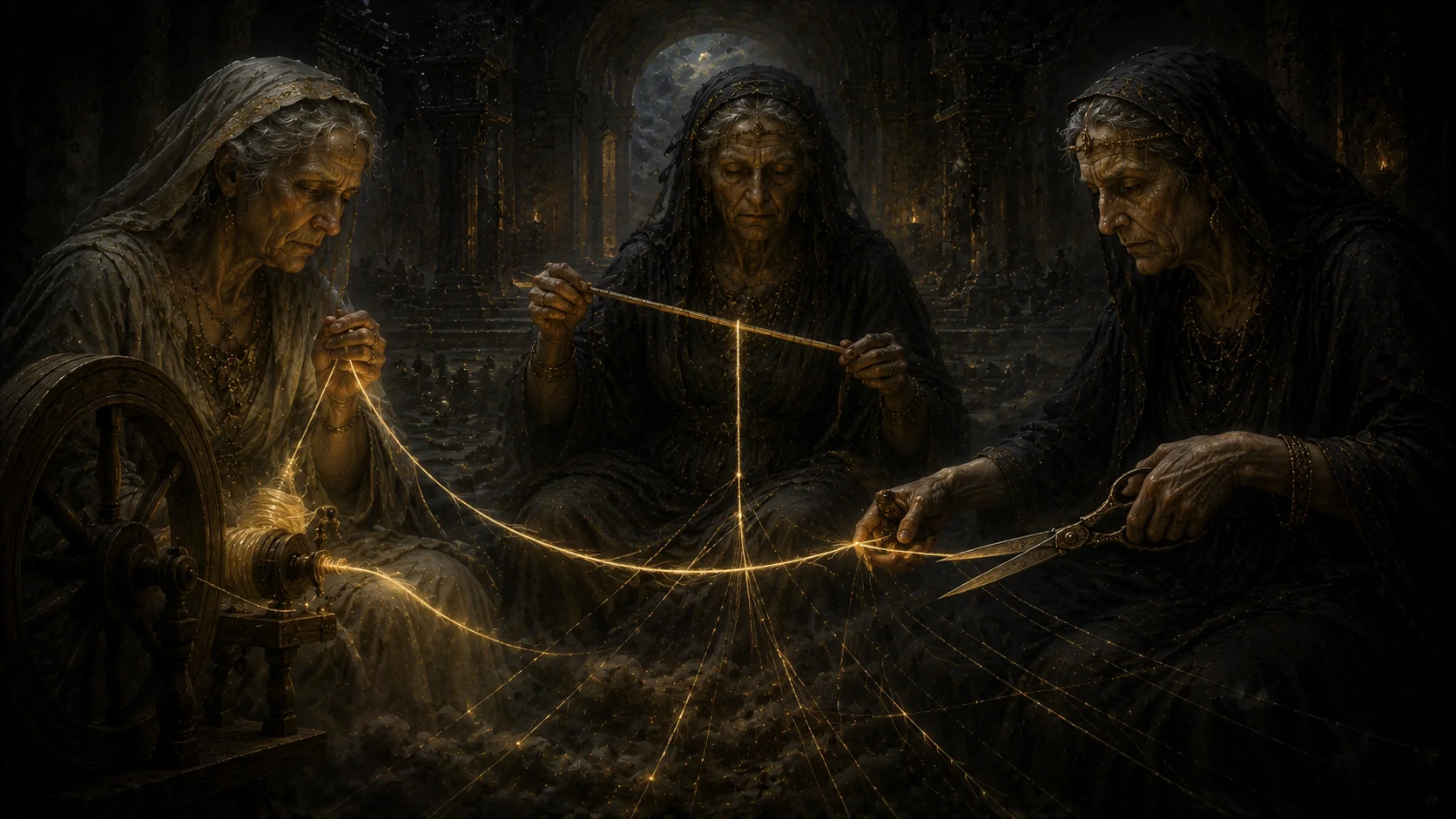
Clotho, "the Spinner," draws out the thread of a life from her distaff — the raw fact of existence, spun into being at the instant of birth. Lachesis, "the Allotter," measures that thread's length, deciding — or perhaps simply declaring — how much of it each person will be given: a long life or a short one, ease or hardship, glory or obscurity. Atropos, "the Unturnable" or "Inflexible," is the last and most feared of the three. When the measured length runs out, she cuts the thread with her shears, and at that snip the life ends. There is no appeal, no renegotiation, no thread half-cut and mended. What Atropos does cannot be undone — the name itself means that turning back is not possible.
Singers on the Spindle of the World
Plato's Myth of Er, which closes the Republic, gives the fullest picture of the Moirai at work, and it is stranger and grander than any household scene. There they are daughters of Ananke, Necessity herself, seated around the great spindle on which the whole cosmos turns, and they sing — one voice for what has been, one for what is, one for what is to come — in harmony with the Sirens who also ride that spindle. Souls pass before them to receive the lot and the pattern of the life they are about to live. It is one of the most vivid images the Greeks ever produced of fate as literally cosmic: not three sisters at a hearth with a spinning wheel, but the mechanism of the universe itself, given voice.
The One Limit Even Zeus Could Not Cross
The single most striking thing about the Moirai is the boundary they placed on the king of the gods. Zeus is sometimes cast as fate's guarantor, the one who sees that the Moirai's decrees are carried out — but the deeper and more common thread in the tradition is that their decrees bound him too. The clearest, most human moment of this tension comes in the Iliad, in the battle over Sarpedon, Zeus's own mortal son. Zeus grieves for him, and for a moment appears to weigh whether he might simply lift Sarpedon out of his fated death — and even he cannot make that choice without consequence. Whether this scene shows Zeus genuinely capable of overriding fate and choosing not to, or shows him bound by it despite his grief, is a point the poem itself leaves unresolved, and scholars still argue over which reading Homer intended. What is not in doubt is the weight of the moment: even the sky-father hesitates before the Moirai's ledger.
Present at the First Breath as at the Last
The Moirai were not only death-goddesses. Their portion is measured out at birth as surely as it is collected at death, and Greek cult reflected that by linking them closely with Eileithyia, goddess of childbirth. Where a woman labored to bring a child into the world, the sisters who would one day measure and cut that child's life were understood to already be present, fixing the shape of what was beginning. Birth and death were, for the Moirai, two ends of the same thread — there was no meaningful way to honor one without the other.
The Log on the Hearth
No story shows the Moirai's power over an individual life more starkly than the myth of Meleager, preserved by Apollodorus among others. When Meleager was newly born, the Fates appeared and prophesied — in some versions all three together, in some only one speaking — that he would live only as long as a particular log burning on the hearth remained unconsumed. His mother, Althaea, snatched the log from the fire, doused it, and hid it away, and so her son's life continued for years beyond what the flames alone would have allowed. But fate deferred is not fate defeated: when Meleager, in a rage, killed her own brothers, Althaea took the log from its hiding place and cast it into the fire herself. As it burned to ash, so did he. The tale is often read as a meditation on how far a mortal can bend the letter of a prophecy — Althaea did not break the Moirai's word, she merely postponed the day it came due, and it came due all the same, by her own hand.
Altars at Delphi, Sicyon, and Corinth
The Moirai were not only poetic figures; they received real worship. Cult sites dedicated to them are attested at Delphi, at Sicyon, and at Corinth, among other places, where their favor — or at least their forbearance — was sought at moments that mattered most: birth, marriage, the turning points of a life still unspun. Because their function overlapped with the maintenance of cosmic and moral order, the Moirai were sometimes associated, even loosely conflated, with the Erinyes, the Furies who pursued those who broke the deepest laws of blood and oath. The two groups of goddesses are distinct in origin and character — the Erinyes punish transgression, the Moirai simply measure what is owed — but both stood, in the Greek imagination, as forces that answered to no one and could not be bought off with sacrifice alone.
The Spinners, Collectively
Beyond their individual names, the three were sometimes addressed simply as the Klothes, "the Spinners" — a collective title that folds Lachesis's measuring and Atropos's cutting back into Clotho's founding act, as though all three tasks were, at bottom, variations on a single continuous labor of thread-work. It is a small detail, but it says something about how unified the Greeks understood their function to be: three goddesses, doing what amounts to one uninterrupted job passed hand to hand.
Nona, Decima, and Morta
When Roman religion absorbed and translated the Greek pantheon, the Moirai found their equivalents in the Parcae — Nona, Decima, and Morta — who took over the same three-part division of spinning, measuring, and cutting under new names. The substance of the myth crossed the linguistic border essentially intact: a trio of goddesses, a thread, an ending that cannot be argued with.
A Law Beneath the Gods Themselves
What makes the Moirai unlike almost any other figures in Greek religion is the direction their power runs. Most gods can be bargained with — offered sacrifice, flattered, angered, appeased. The Moirai represent something underneath that whole transactional relationship: moira, the due portion, the order of things that holds even when no one is praying to it. In most tellings this impersonal order stands conceptually above the individual will of the Olympians, Zeus included. The gods could quarrel, scheme, and intervene in a thousand human affairs — but the length of the thread, once measured, was not theirs to renegotiate.
The Thread That Outlasts Every Telling
The Moirai endure as humanity's starkest image of destiny and mortality — the truth that every life has a measured span, spun at birth and cut at death, and that there are limits no power, however great, can cross. They echo across cultures that never spoke to one another — the Norse Norns at the roots of the world-tree, the Roman Parcae with their Latin names, the fairy godmothers who still gather at the cradle in later folk tale — because the question the three sisters embody is universal: how much of a life is truly its own to shape, and how much was measured out before the first breath was drawn.
The gods themselves grew quiet before the three sisters — for even Olympus hangs by a thread they can cut.
Sources & traditions
- EncyclopediaWikipedia — Moirai
- TraditionGreek texts, inscriptions and later retellings (Greece)
Myths change from area to area and from time to time. This chronicle follows the most widely told versions; tellings in other villages, regions and eras may differ.