A shepherd, walking the marshes, finds an egg. Not a bird's egg exactly — too large, too strange, lying where no nest should be. He carries it home and gives it to a woman named Leda, who keeps it in a chest until, in time, it hatches. The woman who laid it was fleeing the king of the gods when she laid it, and the reason she was fleeing him at all is the whole of her story.
Her name was Nemesis. Ask a modern English speaker what a "nemesis" is and they will say an arch-rival, an inescapable enemy, the person or force built specifically to bring you down. That definition is not a metaphor borrowed from her — it is her, worn down by long use into a common noun. Before she was a word, she was a goddess, and her job was the most feared job in the Greek moral universe: making sure nothing — no fortune, no pride, no mortal at all — rose higher than it was owed.
The Goddess of Due Measure
Nemesis's name comes from the Greek verb nemein — to give what is due, to allot justly. That etymology is the whole theology in miniature. She was not a goddess of punishment in the way a storm god punishes, arbitrarily, from above. She was the personification of proportion itself — the conviction, foundational to Greek thought, that everything in the world has a rightful measure, and that measure must be kept.
The Greeks did not believe good fortune was simply good. Too much of it — wealth without limit, beauty without humility, victory without gratitude — put a person out of balance with the order of things, and an imbalance could not stand. Something would come to correct it. That correction had a name and a face, and the name was Nemesis. She corrected excessive, undeserved good fortune just as readily as she punished outright arrogance — her domain was proportional cosmic balance, not simple vengeance. She was not cruelty. She was the universe's own bookkeeping, and the ledger she kept had no unpaid line.
Born of the Night, Disputed by Everyone
The oldest surviving account of Nemesis's birth comes from Hesiod's Theogony, which places her among the children of Nyx — Night herself — born without a father, in the same breath as some of the most unsettling figures in Greek myth: the Moirai, the Fates who measure out a life's thread; the Keres, spirits of violent death; the Oneiroi, the gods of dreams; and her two sisters in consequence, Eris, goddess of Strife, and Apate, goddess of Deception. It is a genealogy that tells you what kind of goddess Nemesis is before a single myth about her is told. She keeps company with Fate, Death, and Deceit because she operates in the same register they do — beneath argument, beyond appeal.
But even the Greeks themselves did not agree on where she came from. Other traditions call her a daughter of Nyx and Erebus, Darkness paired with Night. Others make her a daughter of Zeus. Still others trace her to Oceanus, the world-river. The disagreement itself is telling: a goddess this old, this fundamental, accretes different parentage in different regions and different centuries, the way a force everyone feels but no one fully explains tends to gather more than one origin story.
The Punisher of Pride
Where Nemesis actually appears in myth, she appears at the edge of hubris — the specific Greek sin of forgetting your limits as a mortal and reaching past them, whether in arrogance, in cruelty, or in simply having too much. Greek tragedy runs on something close to a formula: hubris leads to ate, a kind of blinding ruin or delusion that settles over the proud, and ate in turn calls Nemesis, whose arrival is catastrophe. It is not random misfortune. It is consequence, arriving exactly where it was earned.
The clearest surviving story of her at work is the myth of Narcissus — the beautiful youth who scorned everyone who loved him, who took every offered heart and threw it back with contempt. Nemesis is credited with his undoing, though not by her own hand in any violent sense: myth has her leading him, not striking him. She brought him to a still pool of water, and there he saw his own reflection and fell in love with it, unable to look away, unable to possess what he desired, wasting there until he was gone. It is a punishment shaped exactly like the crime — a man who could love no one but himself, condemned to love no one but himself, forever, fatally.
The Goose, the Swan, and the Egg
Nemesis's most famous story, though, is the one that begins this account — and it is a myth of pursuit, not punishment. In one strand of tradition, Zeus desired her, and Nemesis, unwilling, fled him by shifting her shape into a goose. Zeus did not relent; he became a swan, and pursued her still, and caught her.
From that union came an egg — laid in the marshes, found by a shepherd, and carried to Leda, who kept it until it hatched. What emerged, in this account, was Helen of Troy, along with Clytemnestra, and the twin brothers Castor and Pollux, the Dioscuri. It is worth being precise about what kind of story this is: it exists alongside other traditions in which Leda herself is simply Helen's mother by more ordinary means. The egg is not the only account of Helen's birth that Greek myth preserves — but where it appears, it makes the goddess who exists to correct excess the mother of Helen of Troy, the woman whose very name would become shorthand for beauty carried past its rightful measure.
Rhamnous: Where She Was Worshipped
Nemesis was not only a figure in stories. She had a home — an actual sanctuary, a temple, a place where people went to honor her, at Rhamnous, an isolated district in northeastern Attica. There she was worshipped under the epithet Rhamnousia, "she of Rhamnous," her cult title fused permanently to the ground she stood on.
It is worth pausing on what that isolation meant. A sanctuary tucked into a remote corner of the Attic countryside, rather than at the civic heart of Athens, suited a goddess whose business was the uncomfortable truths — the reckonings people would rather not think about while they are still enjoying their good fortune. You went to Rhamnous, it seems, when the ledger was on your mind.
The Statue Built From the Enemy's Own Marble
The single most striking fact about Nemesis's cult concerns the statue that stood inside her temple at Rhamnous. The traveler and geographer Pausanias, writing in the second century CE, described a cult image carved by the sculptor Pheidias — or sculptors of his circle — from a block of fine Parian marble. That marble, according to the tradition Pausanias records, had been brought to Greece by the Persians themselves, hauled all the way to the battlefield at Marathon in 490 BCE, because they had intended to carve a victory monument the moment their invasion succeeded.
The Persians lost at Marathon, and the marble they had shipped across the sea to commemorate their own triumph was carved, instead, into a statue of the goddess who exists to humble the overconfident. Few objects in Greek religion carry a more exact irony. A monument prepared in advance for a victory that never came was instead carved into the likeness of the very power that punishes exactly that kind of premature certainty. The finished statue, as described, wore a crown decorated with stags and small figures of Nike, Victory herself — worn, here, as an ornament on the goddess who decides when victory has gone too far.
How to Recognise Her
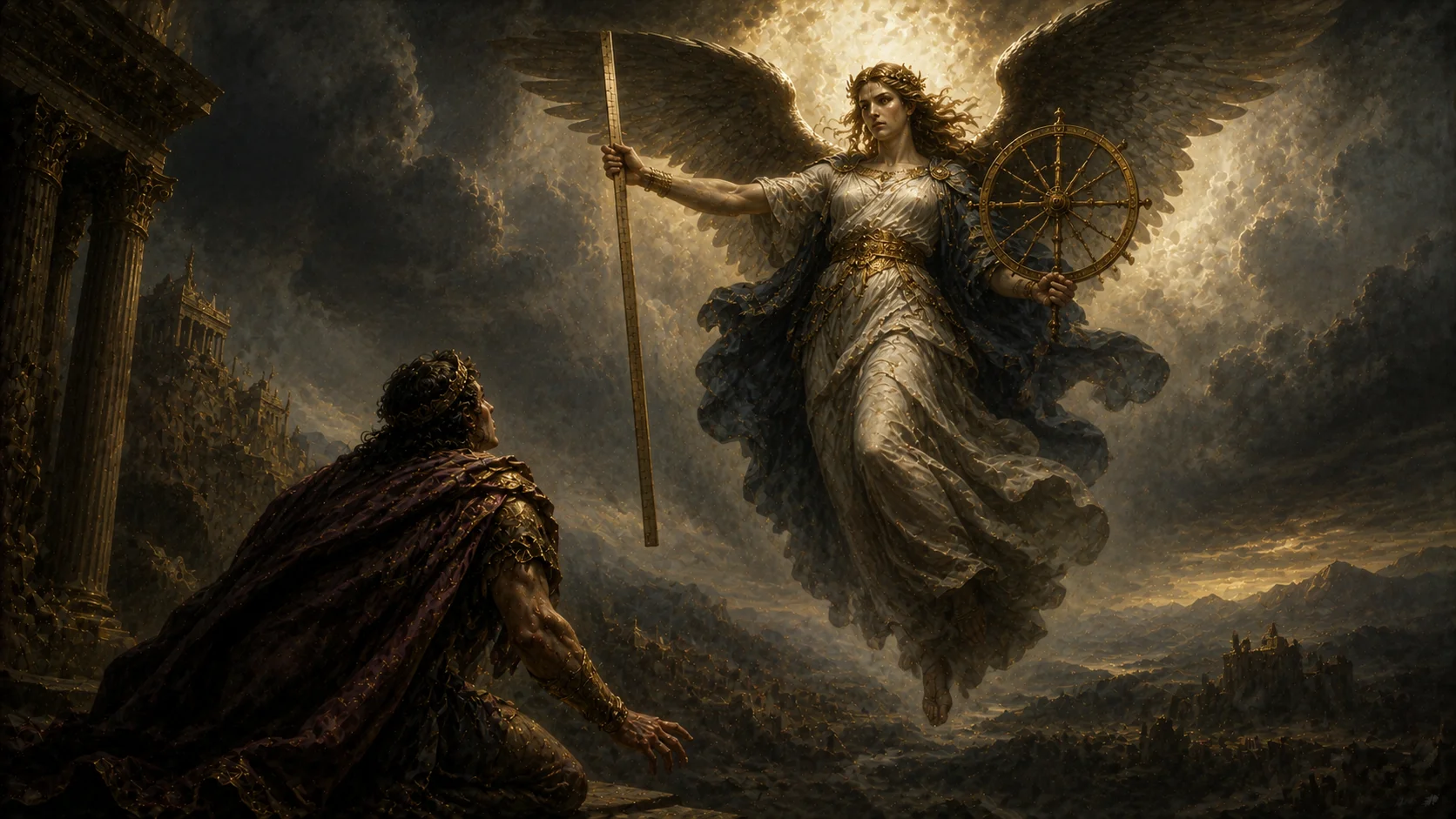
In art, Nemesis is a winged woman, robed in white, often shown wreathed. She carries a set of attributes that read almost like a checklist of her office: a cubit-rule or measuring rod, for the "due measure" her name promises; a bridle, for the restraint that pride refuses to apply to itself; scales, for weighing right against wrong; and a scourge or sword, for the moment weighing is finished and correction begins.
A recurring motif places one of her feet on a wheel — the turning Wheel of Fortune, under her foot because she is the one force that outlasts its turning, immune to the luck it hands out and withdraws from everyone else. Her animal was the griffin, the part-lion, part-eagle creature sometimes shown drawing her chariot, a beast that, like her, belongs to no single domain but commands respect in all of them.
- Wings — swift, inescapable arrival
- The wheel underfoot — fortune turns; she does not
- The cubit-rule — the measure a mortal life is meant to keep
- The bridle — restraint, imposed where none was chosen
- Scales — the weighing that precedes the verdict
- Scourge or sword — the verdict, carried out
- The griffin — her chariot beast, part-lion, part-eagle
Not Fortune, and Not Fury
Nemesis is easy to blur with two other figures, and the Greeks themselves seem to have felt the pull of that blurring even as they kept the lines distinct. Tyche, goddess of Fortune and Chance, governed the same territory of rising and falling luck — but Tyche's turns were amoral, chance without judgment behind it. Nemesis's corrections were never that. She answered specifically to excess and to pride; her reckonings had a moral shape that Tyche's spins of the wheel did not. In later Greco-Roman religion the two were sometimes paired or set beside each other in cult, distinct powers acknowledged as working the same territory from different angles — luck on one side, its moral correction on the other.
She is equally distinct from the Erinyes, the Furies — the chthonic goddesses, daughters of Gaia, who track down and avenge kin-murder and broken oaths, blood-guilt specifically. Nemesis's domain was never blood-guilt. It was the swelling of a mortal life past its rightful proportion — pride, excess, fortune unearned or unacknowledged — a different debt, collected by a different power.
The Word That Outlived the Goddess
Temples fall, cult statues are broken or lost, and the specific rites once performed at Rhamnous are no longer practiced by anyone alive. And yet Nemesis is, in a real sense, still spoken every day, by people who have never heard of Rhamnous or Pheidias or the Battle of Marathon. "Nemesis" survives in English as an ordinary word for an inescapable rival, the opponent built exactly to your measure, the one who will bring you down precisely because you cannot get past them. Modern usage has loosened her original, moral, cosmic function into something closer to "arch-enemy" — a comic-book or action-movie rival is not what the ancient Greeks meant by the word, and the ancient goddess should not be confused with any such modern character who happens to share her name. But the loosening itself is a kind of monument. A goddess whose entire purpose was to be inescapable has made "inescapable" mean her.
Why She Still Matters
What Nemesis represents is not really about ancient religion at all — it is about a shape of experience that has never stopped recurring. Pride goes before a fall. Fortune turns. No one climbs so high that consequence cannot still find them. The Greeks gave that recognition a face, a temple, a statue carved from an enemy's own miscalculated confidence, and a name that a shepherd's chest, a swan's disguise, and a war fought over a woman all, in their different ways, trace back to.
She kept the great ledger of the cosmos, and no debt of pride went uncollected.
Sources & traditions
- EncyclopediaWikipedia — Nemesis
- TraditionGreek texts, inscriptions and later retellings (Greece)
Myths change from area to area and from time to time. This chronicle follows the most widely told versions; tellings in other villages, regions and eras may differ.