The Erinyes — the Furies — were the ancient, merciless goddesses of vengeance who hunted down those who committed the most unforgivable crimes: murder within a family, broken oaths, and offences against the natural order. Older than the Olympians and answerable to no one, they pursued the guilty to the ends of the earth and beyond the grave, and they did not stop.
Born from a Primordial Wound
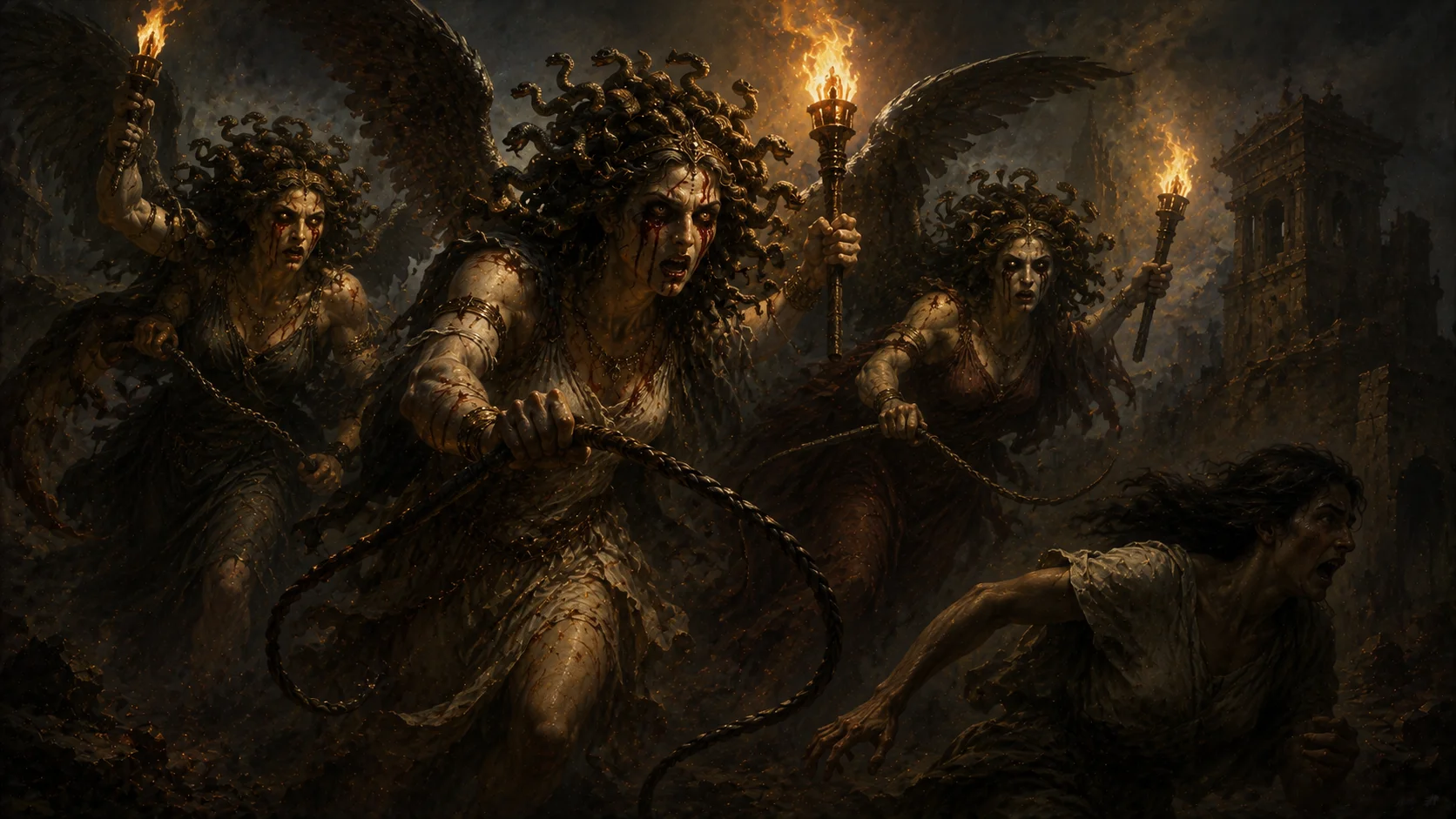
The Erinyes sprang from the blood of the castrated Uranus where it fell upon Gaia the Earth — born, fittingly, from one of the first crimes of kin against kin in the cosmos. Three in number (named Alecto, Megaera, and Tisiphone), they were dread, archaic powers, often pictured as terrible winged women with snakes for hair and eyes weeping blood, carrying whips and torches.
The Hounds of Blood-Guilt
Their special province was the blood-crime — above all, the murder of one's own kin, and the breaking of sacred oaths. When such a crime was committed, the Erinyes rose to pursue the guilty with relentless fury, driving them to madness, torment, and ruin. They could not be reasoned with, bribed, or escaped; they were the conscience of the cosmos given fangs.
The Trial of Orestes
Their most famous myth marks a turning point in the very idea of justice. When Orestes killed his mother Clytemnestra (to avenge her murder of his father Agamemnon), the Erinyes hunted him mercilessly for the crime of matricide. But Athena intervened, establishing the first court of law (the Areopagus) to try the case by reason and a jury's vote rather than by endless blood-vengeance. Orestes was acquitted, and the Furies — furious at being denied — were finally appeased and transformed into the Eumenides, the “Kindly Ones,” honoured protectors of justice. It is myth's great image of civilisation replacing the cycle of vengeance with the rule of law.
The Conscience That Hunts
The Erinyes endure as the personification of guilt and the inescapable consequence of terrible crimes — the relentless inner and cosmic vengeance that hounds the wrongdoer. The Greeks called them the “Kindly Ones” partly out of fear of even speaking their true name. To be “pursued by the Furies” is to be hounded by a guilt that will never let you rest.
They were the dark before the law — the vengeance that came when there were no courts, only blood for blood.
A Name Older Than Homer
Centuries before Homer sang the first line of the Iliad, a scribe at Knossos pressed a stylus into wet clay to record an allocation of oil — and among the recipients, listed alongside gods and sanctuaries, the syllabic script of Linear B spells out e-ri-nu. The tablet belongs to the Late Bronze Age palace archives, some seven centuries older than Hesiod’s Theogony, and many Mycenologists read the word as an early form of the name Erinys. If the identification holds, the name reaches back past the entire heroic age the Greeks would later tell stories about, into palace bureaucracies that collapsed and were forgotten before those stories were ever set down. Whatever “e-ri-nu” meant to the man holding the stylus, something in it survived the centuries of illiteracy that followed the Bronze Age collapse and came out the other side still owed blood.
Before the Sisters Had Names
Homer never counts the Erinyes, never names an individual one, and never describes what they look like. In the Iliad they surface as something closer to a law of nature than a person — the force a curse activates rather than a goddess who deliberates. Phoenix flees a house in which his father has already called the loathsome Erinyes down on him. Althaea, grieving the brother her own son has killed, kneels and beats the earth with her fists, begging Hades and Persephone for Meleager’s death, and “the Erinys that walks in darkness” hears her out of Erebus. Homer never shows her doing anything at all; being heard is the whole mechanism. Agamemnon, sealing his great oath before the army, swears by Zeus, Earth and Sun, and by “the Erinyes, who under the earth take vengeance on men, whoever has sworn a false oath” — invoked as an office, never as individuals. And when Hera grants Achilles’ horse Xanthus a human voice and the animal prophesies his master’s death, it is the Erinyes — not Zeus, not the goddess who gave the voice — who take it away again the moment he has finished. Before they were three sisters with names and a genealogy, the Erinyes were simply what happened when a curse, an oath, or the limit of what may rightly be said was broken.
The Grove at Colonus
Sophocles set his last play in a real grove just outside Athens — Colonus, his own birthplace — and told his audience it was ground sacred to the Erinyes, worshipped there under the name the Athenians preferred: the Semnai Theai, the August or Revered Goddesses. It is here that the blind, exiled Oedipus, after years of wandering as the most polluted man alive, finally stops walking. He does not flee the grove; he claims sanctuary inside it, and the goddesses whose whole office is the punishment of blood-guilt become the shelter of the man carrying the most notorious blood-guilt in Greek myth. At the play’s end an unearthly voice calls his name and asks why he is delaying, and he walks out of sight with Theseus alone. Nobody watches him die. The messenger can report only that the end came without pain, and that the earth opened for him kindly. The reconciliation Aeschylus staged at the close of the Eumenides is here given an address — a patch of ground a fifth-century Athenian could walk to.
Wineless Altars
The Semnai Theai were not merely a chorus’s exit line. They had a sanctuary in Athens, in a cleft at the foot of the Areopagus, and Athenians left them real offerings under a rule that set their cult apart from most of the city’s: no wine. Their libations were nephalia, “sober” offerings of water and honey. Aeschylus has Clytemnestra’s ghost, trying to rouse the sleeping Erinyes in the Eumenides, remind them how many wineless offerings she used to pour them; the elders of Colonus give Oedipus the identical instruction — water, honey, and no wine — when he asks how to make amends to the goddesses whose grove he has trespassed in. The prohibition is shared with other cults of the powers below the earth, but it is worth noticing what it meant in practice: the one thing the city would not carry to these particular altars was the substance it used everywhere else to approach a god. Pausanias saw a comparable sanctuary of the Eumenides at Sicyon, with a one-day annual festival and libations of honeyed water. None of this is myth about the Erinyes. It is the ordinary religious infrastructure of communities that took the possibility of their anger seriously enough to build them a house and feed them correctly.
Furor Comes to Rome
Roman poets inherited the Erinyes as the Furiae and put them to work on their own literature’s central anxiety: not blood-guilt exactly, but furor — unreasoning violence bursting through the restraint a Roman was supposed to embody. In the Aeneid, Juno calls the Fury Allecto up from the underworld for the specific purpose of wrecking the peace Aeneas has just secured in Italy: she sets a snake at Queen Amata and drives her out of her senses, then hurls a smoking brand into the breast of Turnus, and the war that occupies the poem’s second half follows from her touch. Ovid hands her sister Tisiphone the same errand in the Metamorphoses, sent by Juno to the house of Cadmus to madden Athamas and Ino; Athamas, raving, shouts that he has sighted a lioness with her cubs, seizes his own small son and kills the boy against a rock. In both poems the Fury is less a character than a mechanism — the hinge at which a human decision stops being a decision. Rome did not soften these goddesses into anything kinder than the Greeks had them. It made them the working machinery of every war and every atrocity a poet needed to explain as something other than ordinary human choice.
Why “Fury” Still Means What It Means
The Greek name has never been securely explained; philologists are still arguing about what Erinys originally meant. The Latin one is transparent. Furia comes straight from furere, to rage — a name that is already a diagnosis — and it is the Roman word, not the Greek, that survived into English by way of French. Anyone who has never read a line of Aeschylus and could not name a single Erinys still uses it correctly: a fury is not a feeling you have but a force that has you.
The architecture survived too, and the most instructive modern borrowing is the one that refuses the ending. Eugene O’Neill took the Oresteia as his open model for Mourning Becomes Electra in 1931 and moved the whole structure — murdered father, avenging children, guilt inherited rather than earned — into a New England household at the close of the American Civil War. What he would not move was the trial. Aeschylus ends with a vote, an acquittal, and a new cult installed beneath the Areopagus. O’Neill ends with Lavinia Mannon ordering the shutters nailed shut and walking into the house to live out her life alone with the family dead, on the reasoning that no court exists that could hear her case. Twenty-four centuries after Athens built a jury to get out from under the Erinyes, the most famous modern retelling of their story is the one in which the sentence is served in full.
Sources & traditions
- EncyclopediaWikipedia — Erinyes
- TraditionGreek texts, inscriptions and later retellings (Greece)
Myths change from area to area and from time to time. This chronicle follows the most widely told versions; tellings in other villages, regions and eras may differ.