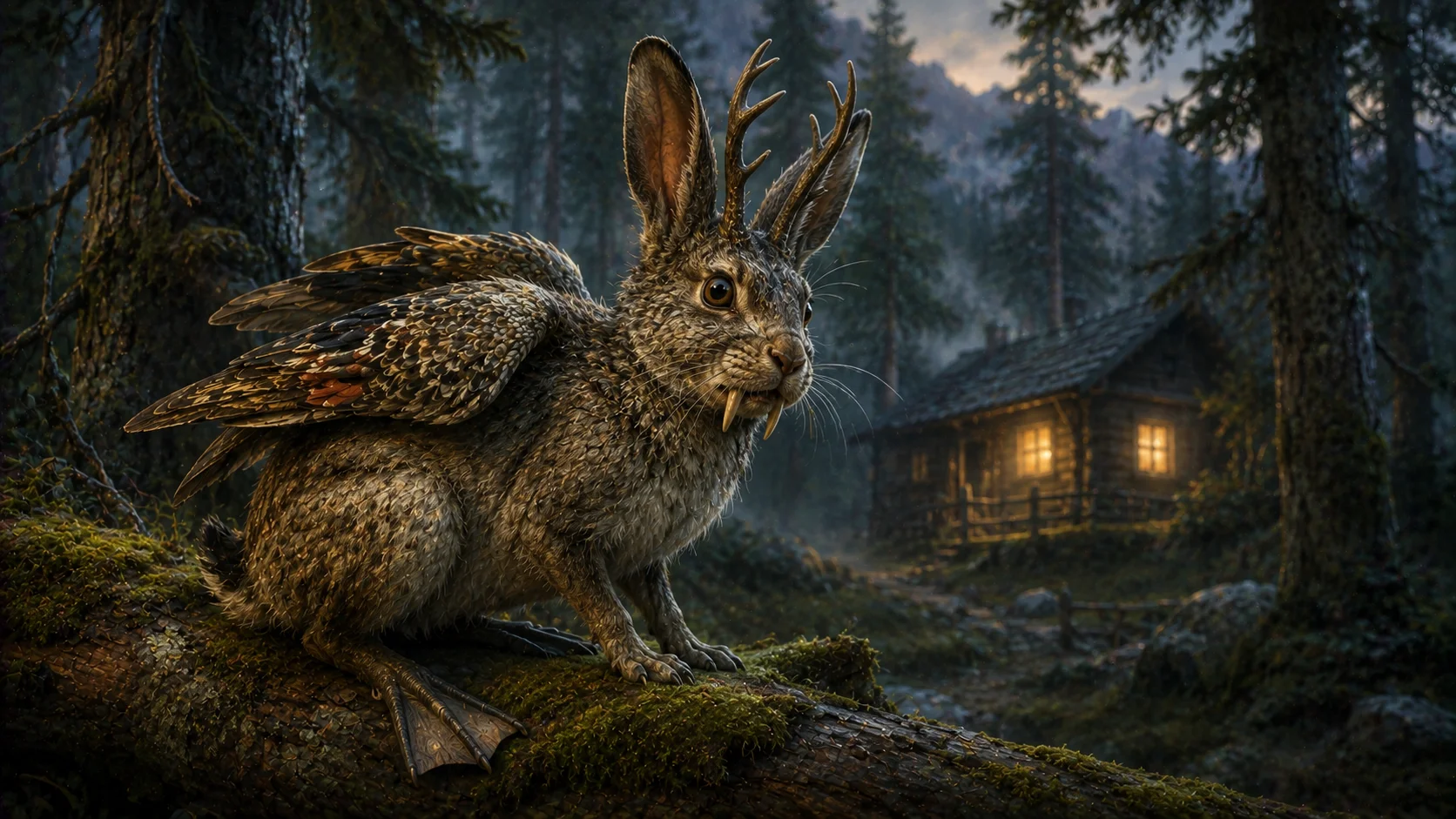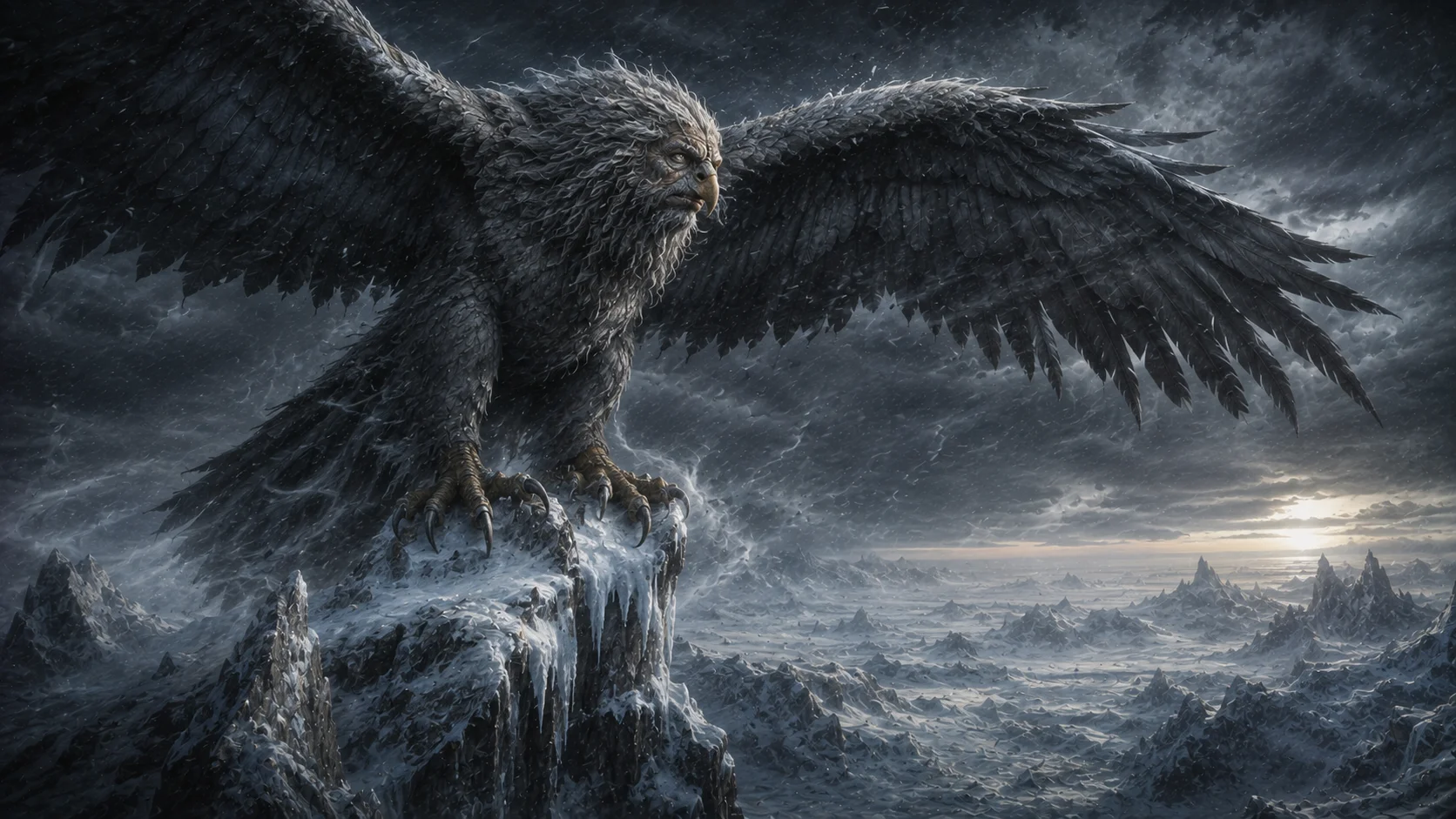
Hraesvelgr was the giant who sat at the edge of the world in the form of a colossal eagle, and whose beating wings are the source of all the winds — the “corpse-swallower” perched at the northern end of the sky, creating the wind that sweeps across all the worlds with every movement of his vast pinions. He is the Norse personification of the origin of the wind itself.
The Corpse-Swallower
Hraesvelgr (Old Norse Hræsvelgr, “corpse-swallower”) was a giant (jötunn) of the most ancient and elemental kind, who took or possessed the form of a gigantic eagle. His name — grim and striking — suggests a being associated with death and the eating of the dead, perhaps an image of the eagle as a carrion-bird, the devourer of corpses on the battlefield. But his great cosmic role was something else entirely: he was the source of the wind.
Last updated .
The Origin of the Wind
Hraesvelgr was said to sit at the northern edge of the sky, at the very end of the world, in his eagle form. And from this perch, the beating of his enormous wings created the winds that blow across all the worlds: every movement of his vast pinions sent the air rushing out over the earth and sea. When the wise being was asked, in the old verses, where the wind comes from — the wind that passes over all people yet is itself never seen — the answer was Hraesvelgr: the giant eagle at the edge of the sky, from whose wings the wind is born. Thus the Norse explained one of the great invisible forces of nature: the wind is the wind of an eagle's wings at the world's end.
The Eagle at the Edge of the World
Hraesvelgr belongs to the Norse vision of a cosmos full of vast, elemental beings positioned at the edges and structures of the world — like the eagle perched in the branches of the world-tree Yggdrasil, the squirrel Ratatoskr who runs up and down its trunk, or the serpent Nidhogg gnawing its roots. The image of a giant eagle at the northern edge of the sky, its wing-beats stirring the winds of all the worlds, is part of this grand cosmology in which the natural forces of the world — wind, day, night, sun, moon — are each the work of a living being, a giant or god or beast set in its appointed place.
The Wind-Maker
Hraesvelgr endures as the Norse personification of the origin of the wind — the corpse-swallowing giant in eagle form at the edge of the sky, whose beating wings stir the air across all creation. He embodies the Norse impulse to find a living source behind every natural force, to answer the question “where does the wind come from?” not with abstraction but with an image: a vast and ancient eagle-giant perched at the world's northern rim, and the wind that is the breath of his wings.
Where does the wind come from? At the northern edge of the sky sits a giant in eagle form — and the wind that sweeps over all the worlds is the beating of Hraesvelgr's wings.
A Wager of Heads
Two travellers sit across from each other in a giant's hall, and the price of losing is a head. That is the frame the wind-question survives in: Vafþrúðnismál, the “Sayings of Vafþrúðnir,” generally reckoned among the older poems of the Poetic Edda. Odin travels in disguise under the name Gagnráðr and challenges the giant Vafþrúðnir — whom the poem itself calls alsvinnr, all-wise — to a contest of cosmological knowledge, and the two of them wager their heads on it across the hall. The poem is built as a relentless catalogue: where the earth came from, where the sky came from, where the sun and the moon and night and day came from, and, two-thirds of the way through the exchange, where the wind comes from that travels over everyone and is itself never seen. Vafþrúðnir's answer is Hraesvelgr, a giant in eagle's shape at heaven's end. He answers it correctly, as he answers everything else. What ends him is the final question, which is not cosmology at all: what did Odin whisper into the ear of his dead son Baldr on the funeral pyre — a thing only Odin could know. The giant concedes in the poem's last stanza that no living being knows that answer, that he has been contending with Odin all along, and that he has spoken his ancient lore with what the verse calls a doomed mouth. The beheading itself is never shown. The poem simply stops, with the forfeit acknowledged.
The exchange survives in the Codex Regius, the manuscript of the Poetic Edda copied around 1270. It survives a second time, and earlier, in Snorri Sturluson's Prose Edda of roughly 1220 — half a century before that manuscript was written — where Snorri sets the same question inside Gylfaginning's own frame of a disguised traveller interrogating wise beings, paraphrases the answer, then quotes the stanza outright. Snorri adds one detail the verse does not give: the wind rises when the eagle spreads his wings for flight, not merely when he beats them. That stanza and Snorri's retelling of it carry very nearly everything that is known about Hraesvelgr.
A Skull for a Sky
Before there was a sky for Hraesvelgr to sit at the edge of, there had to be a sky at all — and in Snorri's account of creation it was built out of a corpse. When Odin, Vili and Vé killed the primordial giant Ymir, they raised the world from what was left of him: his flesh became the earth, his blood the sea, his bones the mountains, and his skull, hoisted up and set over everything, became the dome of the sky. Four dwarfs — Norðri, Suðri, Austri and Vestri, named for the four directions — were placed beneath its corners to hold it up. Snorri never connects that passage to the wind-question a few pages later, but the arithmetic is entirely his: the northern end of heaven where the eagle-giant perches is a point on the inside of a dead giant's skull, with Norðri braced under the very corner the bird sits above. A corpse-swallower roosting on the corpse the sky is made of.
The Unnamed Eagle and the Pale Hawk
Norse myth has a second great eagle, and the sources are careful never to name it. Grímnismál knows only “the eagle” in the branches of Yggdrasil, whose words the squirrel Ratatoskr carries down the trunk to Nidhogg at the roots. It is Snorri, describing the same tree in Gylfaginning, who adds that this eagle knows a great deal and that between its eyes sits a hawk called Veðrfölnir — a name usually glossed “wind-bleached” or “storm-pale,” though its second element is disputed. Whether that eagle and Hraesvelgr are one figure is a question no medieval source raises. The poem that gives the tree its eagle and the poem that gives the wind its giant never refer to each other, and nothing in either compels the identification; the tree-eagle sits at the world's vertical summit, Hraesvelgr at its northern rim, and those are not obviously the same place. What the two share is a pattern rather than an identity — a raptor stationed at the furthest point the cosmos reaches in some direction, perched where nothing else goes. Veðrfölnir's name is the more suggestive detail: built on veðr, weather or wind, it shows the poets already filing birds of prey and moving air in the same drawer, whether or not they meant the two great eagles to be one.
Feeding the Eagle
Old Norse and Old English poets shared a stock scene for the aftermath of battle, one modern scholarship calls the beasts of battle: a wolf, a raven and an eagle converging on the dead to feed. It recurs constantly in heroic verse on both sides of the North Sea, and telling a lord he had “fed the eagle” was standard praise — he had left enough slaughtered enemies behind him that the carrion-birds ate well. Hraesvelgr's name lives inside that convention rather than beside it. Hræ and svelgja are the ordinary working vocabulary of the battlefield, not an exotic coinage minted for a cosmic being; whoever named him reached for the plainest words available and applied them to something the size of the sky. The same verb gave Old Norse its word for a whirlpool, svelgr — the sea gulping itself down. It is as though the language kept one root in reserve for anything vast enough to swallow the world's leavings, whether that was flesh, water or, in this case, air.
A Myth Without a Story
Fenrir strains against a fetter he will one day break. Jörmungandr circles the earth, waiting. Even Thjazi, the other giant who takes an eagle's shape, gets a full narrative — he carries off Idunn and her apples of youth, and is killed for it. Hraesvelgr gets none of that. He has no enemies, no genealogy, no death, no part in Ragnarök; he is given no verb beyond sitting and lifting his wings. He is one of the few figures in Norse myth whose entire existence is explanatory rather than dramatic — not a character events happen to, but a fixed answer left standing because someone once needed to account for why the air moves when nothing visible moves it. That is very likely why so little of him survives: there is no plot to retell, no death to avenge, nothing for a later poet to expand or complicate. And it is why the two mentions that do survive read as something better than thin. They preserve a moment of plain curiosity — a wise being asked where the wind comes from, answering not with a law of nature but with a bird at the edge of the world, and an audience that found the answer sufficient.