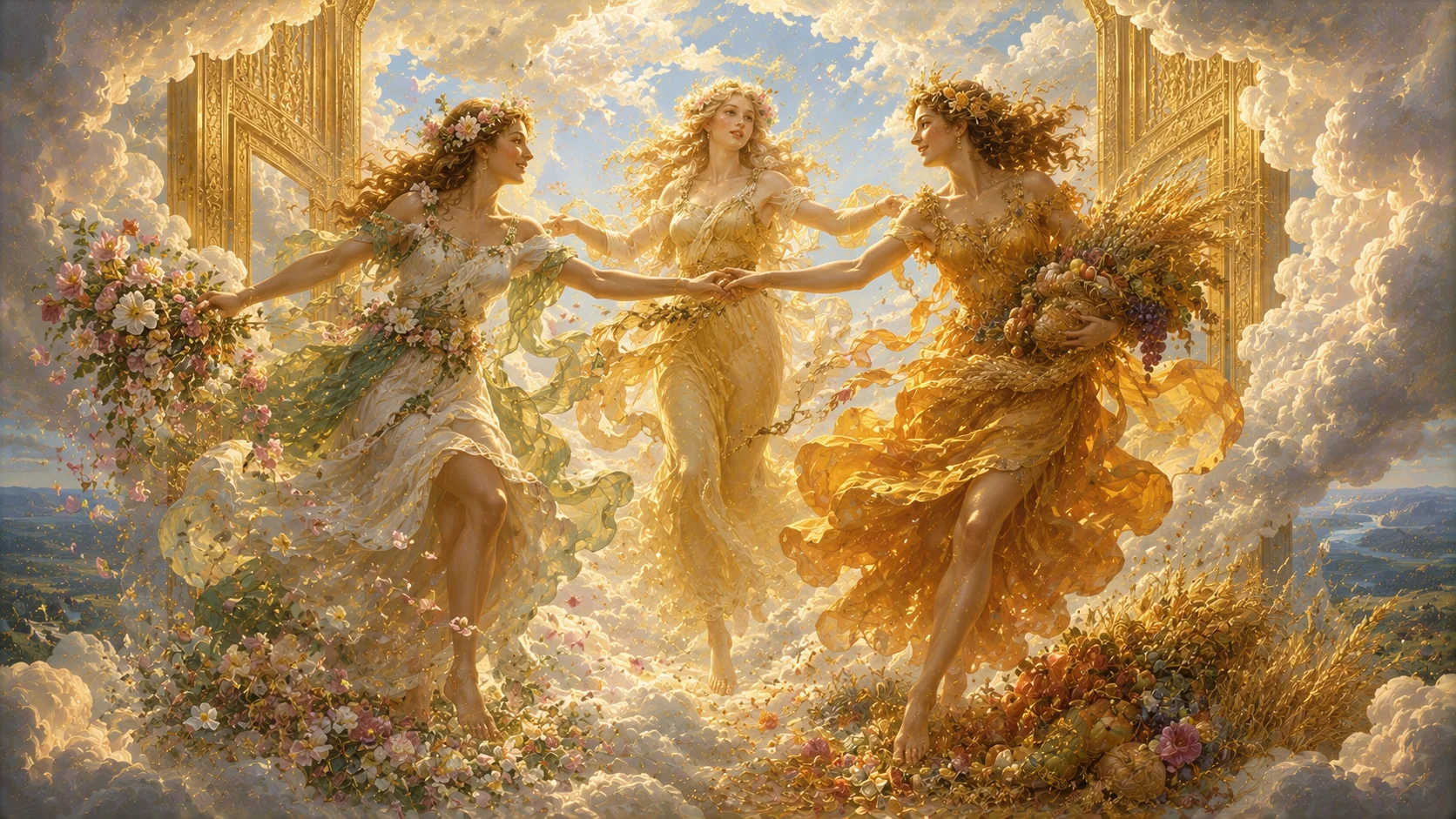
The Horae were the goddesses of the seasons, the hours and the natural order of time — the daughters of Zeus and the Titaness Themis who governed the orderly turning of the year, opened the gates of Olympus, and bound together the rhythms of nature and the rhythms of justice. They were time made beautiful and lawful: the goddesses who made sure the seasons came in their proper order and the world ran as it should.
The Goddesses of the Seasons
The Horae (the “Hours” or “Seasons”) were attendants of the great goddesses and guardians of the natural order. In the most celebrated tradition, they were three in number, daughters of Zeus and Themis (Divine Law), and bore names that reveal their double nature as both seasonal and moral powers: Eunomia (“Good Order, Lawfulness”), Dike (“Justice”) and Eirene (“Peace”). That the goddesses of the turning seasons were also the goddesses of order, justice and peace expressed a profound Greek idea: that the regularity of nature and the rightness of human society spring from the same divine source.
Keepers of the Gates of Heaven
The Horae were charged with guarding the gates of Olympus, rolling away or piling up the thick clouds that served as the doorway of heaven, so that the gods might pass in and out. They attended Aphrodite when she rose from the sea, clothing and adorning her; they tended the horses of the sun; and they brought the seasons round in their proper turn, so that spring followed winter and harvest followed sowing in unbroken order. Wherever the natural year unfolded as it should, the Horae were at work.
Seasons and Hours
In a later tradition the Horae multiplied into the goddesses of the twelve hours of the day, marking the divisions of daylight as the older Horae marked the divisions of the year. But in either form their meaning held: they were the deities of time rightly ordered — not the raw, devouring time of Cronus, but time as rhythm, measure and law, the kindly turning of season into season that makes life and growth possible.
The Order of Time
The Horae endure as the goddesses of the seasons and the lawful order of time — their name surviving distantly in our “hour.” They embody the Greek faith that time is not chaos but order, that the seasons turn by divine law, and that the same justice which governs the heavens governs — or should govern — the affairs of mortals below.
The Horae opened the gates of heaven and turned the seasons of the earth — for to the Greeks, the order of nature and the order of justice were one.
Two Poets, Two Horae
Homer never gives the Horae a name. In the Iliad they appear only in passing, and always at the same post: the gates of heaven groan open so that Hera’s chariot can pass, and it is the Horae who hold those gates and the thick cloud that serves as their door; when the chariot comes home to Olympus, it is the Horae who unyoke the horses. They are simply hai Horai, “the Seasons” — doorkeepers of heaven with no parents, no names of their own and no will of their own recorded. Hesiod, writing at roughly the same moment, does something stranger with them: he gives them a family and a moral office, and from that point the turning of the year and the turning of justice in human affairs are the business of the same three goddesses. The two portraits never quite merged into one clean story. What survives is a single divine office with two job descriptions bolted onto it — keepers of the sky’s machinery, and watchers over how mortals behave toward one another — and later myth simply assumed both were true of the same goddesses, without ever troubling to explain how.
Two smaller glimpses fill out the portrait. In the Homeric Hymn to Apollo, the Horae dance in the house of Zeus with the Graces, Harmonia, Hebe and Aphrodite, holding one another by the wrist while Apollo plays the lyre — heaven at its leisure rather than heaven at its post. In Hesiod’s Works and Days, when the gods assemble their gifts to make the first woman, it is the Horae who set a crown of spring flowers on Pandora’s head. Away from the gatehouse, they are almost always doing one of two things: dancing, or dressing someone in blossom.
The Robe Dyed with Spring
The loveliest image of the Horae survives only because a later writer quoted it. The Cypria — a lost epic of the Trojan cycle that told the story leading up to the point where the Iliad begins — described the robe Aphrodite wears when she goes among the gods: a garment the Graces and the Horae had made for her and dyed in the flowers of spring, in crocus and hyacinth and violet, in the rose and the narcissus and the lily, the very blossoms, the poem adds, that the Horae wear themselves. The passage reaches us second-hand, preserved centuries afterwards in the Deipnosophistae of Athenaeus, a writer with a habit of quoting books that no longer exist. What makes it worth the rescue is the way it folds the goddesses into their own handiwork. The Horae do not preside over spring from a distance; they weave it, dye it and wear it, so that the flowering of the earth and the ornament of the goddess of love turn out to be cut from the same cloth.
Thallo, Auxo and the Oath of the Ephebes
Outside epic and hymn, the Horae also stood inside a working civic institution. The Athenian ephebic oath — the pledge sworn by young citizens on being enrolled for military service, preserved on a fourth-century BCE stone from the deme of Acharnae — summons a long list of divine witnesses, and among Aglauros, Ares, Athena and Zeus stand three quieter names: Thallo (“Bloom”), Auxo (“Growth”) and Hegemone (“Leader”). Which company they properly belonged to was already unsettled in antiquity. Pausanias, touring Greece in the second century CE, reports that the Athenians honoured Auxo and Hegemone as Graces, and takes the trouble to insist that Karpo (“Fruit”) is the name of a Hora and not a Grace, and that Thallo is a Hora too — a correction nobody makes unless the two groups are being confused. The muddle is ancient, not modern, and it says something true about how close these attendant goddesses stood to one another. What is not in doubt is the substance of the cult: an entire city bound its young soldiers to their duty in the name of goddesses of budding and increase, treating a good growing season and a well-run state as the same kind of thing.
Four Seasons, and the Faces They Wear
By the Roman period the Horae most often came as four, one to a season, and each had acquired a face. Ovid, describing the Palace of the Sun in the Metamorphoses, ranges Day and Month and Year and the Centuries to the right and left of the throne, with the Hours spaced at equal intervals among them, and standing nearby: new Spring wearing a crown of flowers, Summer naked and garlanded with ears of wheat, Autumn stained from the trodden grape, and icy Winter, bristling and white-haired. Roman workshops cut that quartet again and again — on the seasons sarcophagi of Rome, in the floor mosaics of North African villas — until four figures carrying the year’s produce had become one of the most familiar images in the empire, still being carved long after anyone was sacrificing to Eunomia or Dike by name. No count ever cancelled the others: three sisters, four seasons and the hours of daylight all stayed in circulation at once, because the Horae were never really a fixed number of goddesses. They were a fixed idea — time cut into whatever segments a culture needed to measure — wearing however many faces the moment required.
The Season on the Shore
The clearest afterlife of the Horae in Western art hangs in the Uffizi. In Botticelli’s Birth of Venus, the goddess drifts to land on her shell while a flower-strewn figure at the right hurries forward with a flowered cloak held open to cover her. Art historians identify that figure as one of the Horae, conventionally the Hora of Spring, performing the office ancient poets had given her some two thousand years earlier: clothing Aphrodite the instant she arrives in the world. Botticelli was not reading lost Greek epic. The scene reached fifteenth-century Florence by shorter roads — through the Homeric hymn in which the Horae meet Aphrodite on the shore of Cyprus and dress her in immortal garments and a golden crown, and through Poliziano’s Stanze per la giostra, written in the same city a few years before the painting, which describes the same arrival and the same attendants waiting on the sand. The agreement with the Cypria is exact all the same, and neither poet nor painter arranged it: the goddess of love cannot arrive naked into the world. A Season has to be standing there, holding the year’s first flowers, to receive her.
Why the Turning Had to Be Divine
It is worth asking why a farming people would make goddesses out of something as impersonal as the calendar. The answer sits with the same poet who first named the three sisters. Hesiod also wrote the Works and Days, a poem given over almost entirely to timing — when to plough, when to cut timber, when it is safe to put a ship to sea — and it keeps that time by the rising and setting of stars, because there was no dependable calendar to keep it by. Ploughing three weeks early or late was not an inconvenience; it was the difference between a full granary and a hungry winter. Making the correct order of the seasons a matter for goddesses — goddesses who could be honoured or offended, one of whom, Dike, sits beside her father Zeus in that same poem reporting the crooked judgments of men until a whole people pays for them — gave a community a way to talk about a vulnerability it could neither predict nor control. A failed harvest was not senseless bad luck. It was an order broken somewhere, and a Hora out of step. That is the anxiety the Horae were built to hold, and it is why the Greeks were never quite willing to let the seasons be only weather.
Sources & traditions
- EncyclopediaWikipedia — Horae
- TraditionGreek texts, inscriptions and later retellings (Greece)
Myths change from area to area and from time to time. This chronicle follows the most widely told versions; tellings in other villages, regions and eras may differ.