Tyche was the goddess of fortune, chance and prosperity — the capricious power who governed the luck of cities and individuals alike, raising one to riches and casting another into ruin with the turn of her wheel. As the old certainties of the heroic age gave way, Tyche rose to become one of the most worshipped deities of the later Greek world: the goddess of the one thing no mortal can control.
The Goddess of Fortune
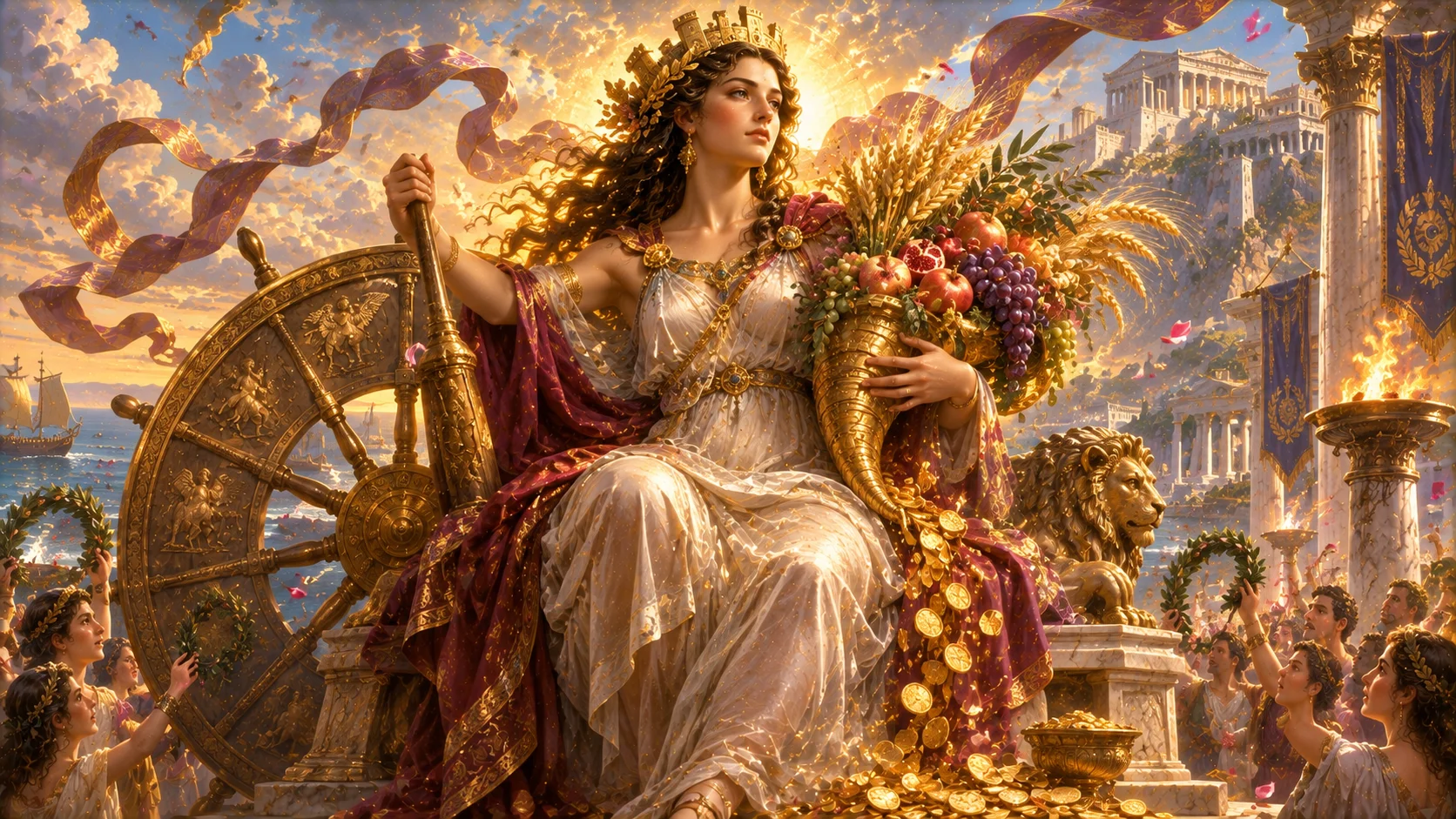
Tyche (whose name means “luck,” “chance,” “fortune”) personified the unpredictable workings of fate — the good and bad luck that fell upon mortals seemingly at random. She was variously called a daughter of the Titan Oceanus, or of Zeus, and she dispensed prosperity and disaster without regard for justice or desert. Her emblems captured her changeable nature perfectly: a rudder (for she steered the affairs of the world), a ball (for fortune is unstable and rolls this way and that), a cornucopia or horn of plenty (for the wealth she could pour out), and above all the wheel, ever turning, that lifts and lowers without warning.
Guardian of Cities
In the Hellenistic age, nearly every great city adopted Tyche as its protecting deity — its “Tyche,” or guardian fortune, often shown crowned with a circuit of city walls (the mural crown) and holding the cornucopia. The famous Tyche of Antioch became a model copied across the ancient world. As war, conquest and sudden reversal made the old order feel fragile, people increasingly felt their fates lay in the hands of blind fortune — and so they prayed to the goddess who embodied it, hoping to win her favour or at least escape her wrath.
The Two Faces of Fortune
Tyche was a goddess of two faces. As Agathe Tyche (Good Fortune) she blessed; but her gifts were never secure, and the same wheel that raised a man could just as easily crush him. The Greeks paired her, in thought, with Nemesis — the goddess of retribution who corrected fortune's excesses, cutting down those whom Tyche had raised too high. Together they expressed a deep moral intuition: that luck is real and powerful, but that it is dangerous to trust, for fortune's wheel never stops turning.
The Wheel of Fortune
Tyche endures as the personification of luck and fortune — the ancestor of the Roman Fortuna and of the “Wheel of Fortune” that would haunt medieval and modern imagination alike. She embodies the timeless human awareness that so much of life lies beyond our control, in the hands of a goddess who gives and takes without reason — and whose wheel is always, silently, turning.
Tyche's wheel lifts the lowly and casts down the mighty — and it never, for any mortal, stops turning.
Origins in Poetry: Hesiod, the Homeric Hymn, and Pindar
The claim that Tyche was born of Oceanus rests on a single line in Hesiod’s Theogony, where she is folded into the catalogue of the Oceanids — one name among the three thousand daughters Hesiod grants Oceanus and Tethys. Early Greek poetry, in other words, filed luck alongside the rivers and the springs: a force as old and as elemental as water, and about as answerable to argument. She surfaces again in the Homeric Hymn to Demeter, in Persephone’s own account of her abduction, listed among the girls gathering flowers in the meadow on the day the earth opened — a placement with a quiet irony in it, fortune standing beside the one who is about to lose all of hers.
It is Pindar, in the fifth century BCE, who gives her the fullest early portrait. His Twelfth Olympian Ode opens by addressing her as daughter of Zeus Eleutherios, Zeus the Liberator, and calls on her as Soteira, the Saviour, to keep watch over the city of Himera. What follows is an inventory of what she steers: swift ships at sea, rushing wars on land, and the assemblies where counsel is given. Then Pindar turns to the thing that unsettles him — that mortal expectation is tossed up and down like a hull in a swell, and that no sure sign of what is coming has ever been given to anyone on earth.
The ode was written for Ergoteles, a runner driven out of Knossos by civil strife who had made a new home in Himera, and Pindar states the uncomfortable point plainly: had Ergoteles not lost his homeland, he would have stayed a local champion, crowing at home like a cockerel that never fights abroad. The exile that ruined him made him an Olympic victor. That is Pindar’s Tyche exactly — not a trickster with a grudge, but a governing weather under which the worst thing that ever happened to a man turns out to be the making of him.
The Tyche of Antioch: A Goddess Carved in Stone
Around 300 BCE the sculptor Eutychides of Sicyon, a pupil of Lysippos, was commissioned to give the newly founded city of Antioch a patron image worth praying to. His bronze Tyche sat on a rocky outcrop standing for Mount Silpius, the peak above the city, a sheaf of grain in her hand and the turreted mural crown of city walls on her head. At her feet a young male figure surfaced from beneath her drapery: the river god Orontes, on whose water Antioch depended, caught mid-swim under the hem of her robe so that the city’s fortune and the city’s river appeared physically joined.
The original bronze is lost, melted down or simply worn out of existence, but its fame outlived the metal. Roman sculptors reproduced it in marble — the best-known copy stands in the Vatican Museums — and Antioch stamped the composition onto its coinage for centuries. What made the statue matter, though, is that it became a grammar rather than a monument. Other cities of the Hellenistic and Roman East ordered their own version and swapped in their own mountain, their own river, their own circuit of walls, so that a great many city-Tyches on ancient coins are recognisably Antioch’s goddess wearing somebody else’s fortifications.
Fortune and the Philosophers
Not everyone was willing to credit a goddess with human achievement, and how much of history belonged to Tyche rather than to human skill became a real quarrel rather than a rhetorical one. Plutarch wrote two treatises on precisely that question. In On the Fortune or the Virtue of Alexander he argues hard for virtue, insisting that Alexander’s conquests were earned by daring and discipline rather than handed over by an indulgent Fortune. In On the Fortune of the Romans he sets Fortune and Virtue against each other as rival claimants to Rome’s rise and is markedly more generous to Fortune — a reminder that the goddess of chance was a position to be argued with at length, not a superstition anyone could simply wave away.
Greek thought also set Tyche against a graver counterpart in Ananke, the personification of necessity — the binding compulsion that not even the gods were held able to break. Where Ananke stood for the fixed order beneath the world, Tyche was the pocket of pure accident inside it: the reason two lives built on identical virtue can end so differently. The pairing let the Greeks hold two ideas at once, that the cosmos runs on iron law and that luck still has room to move inside it.
A Goddess Who Outlived Her Own Worship
Tyche’s staying power shows most clearly in how long her image kept working after belief in her had thinned. By late antiquity the Tyches of the great capitals were being produced as a set: the fourth-century Esquiline Treasure, now in the British Museum, includes four silver-gilt statuettes personifying Rome, Constantinople, Antioch and Alexandria, each marked out by her own attributes and each crowned with city walls. Mosaics and household silver carried the same figures into the Christian centuries, long after anyone was burning incense to her in a temple. She had stopped being a goddess people prayed to and become something more durable — visual shorthand for a city’s sense of its own luck, equally usable by a pagan household and a Christian one.
Lady Fortune’s Wheel: Boethius and the Long Middle Ages
The text that did more than any other to carry the wheel into the modern imagination was written by a man waiting to be executed. Boethius, a Roman consul condemned on a charge of treason, composed The Consolation of Philosophy in confinement in the early sixth century CE. Lady Philosophy visits him there, and in the second book she does something stranger than console him: she adopts Fortune’s own voice and lets the goddess argue her case. The wheel turns, Fortune says, because turning is the whole of what it is; she promised no one constancy; the only real error was ever mistaking a loan for a possession. Medieval Europe found the argument unanswerable, copied and translated the book for a thousand years, and through it Rome’s own Fortuna — an old Italic goddess long since identified with Tyche — became the image writers reached for whenever a king fell or a fortune vanished.
Her wheel then turned up everywhere: worked into the wheel windows of medieval churches, painted into the margins of manuscripts with kings clinging to the rim as it rolls them from throne to gutter, and sung in the goliardic verse later gathered into the Carmina Burana, whose opening address to Fortune was set to music by Carl Orff in the 1930s and is now probably the most recognisable stretch of medieval poetry in the world. The wheel survives in idioms and game shows that no longer remember whose wheel it was, and in the tarot’s Wheel of Fortune — still turning, still indifferent, exactly as Pindar’s helmsman-goddess and Boethius’s prisoner both found her to be.
Sources & traditions
- EncyclopediaWikipedia — Tyche
- TraditionGreek texts, inscriptions and later retellings (Greece)
Myths change from area to area and from time to time. This chronicle follows the most widely told versions; tellings in other villages, regions and eras may differ.