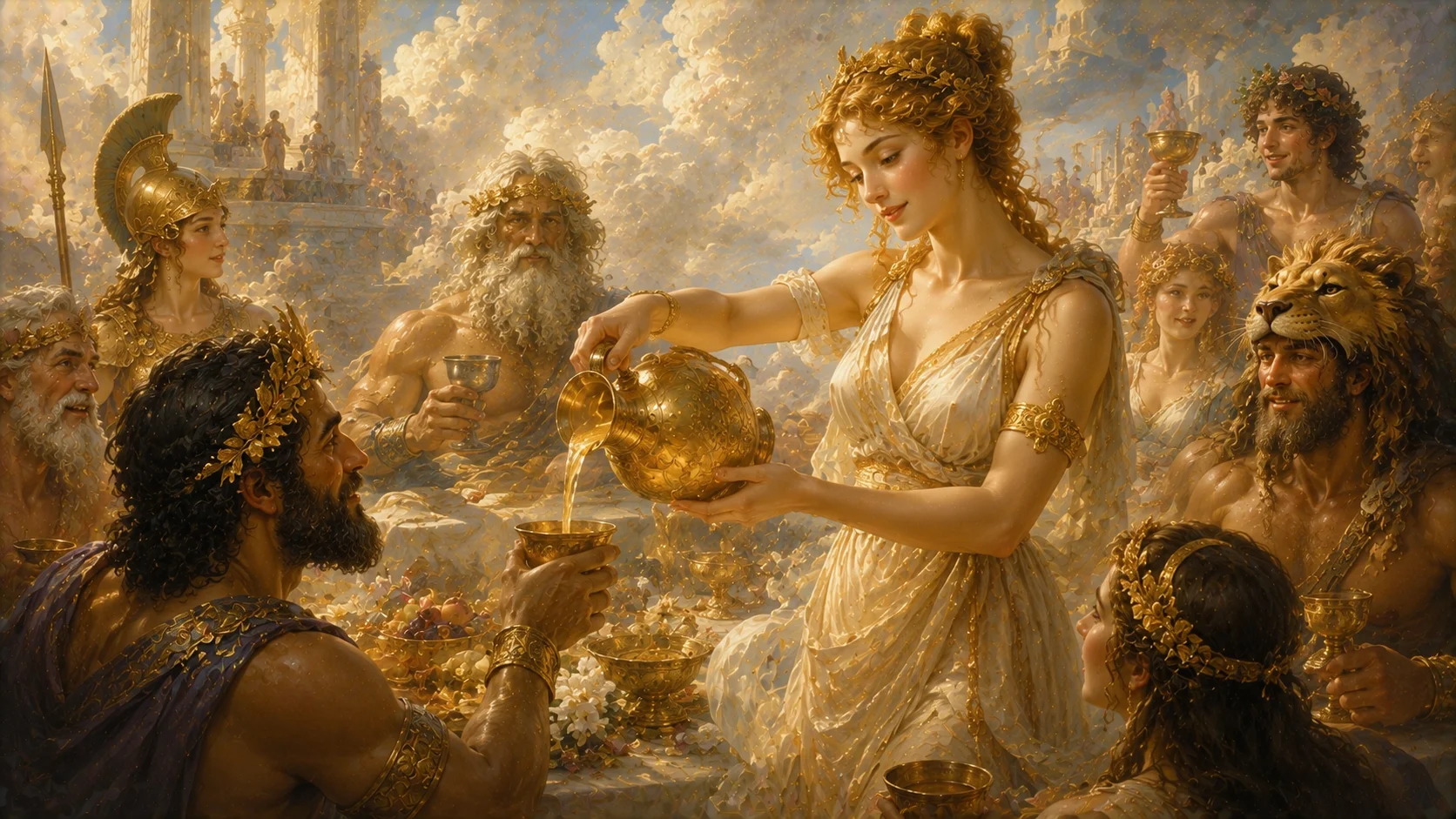
Hebe was the goddess of youth and the cupbearer of the gods — the eternally young daughter of Zeus and Hera, who poured the nectar and ambrosia at the feasts of Olympus and who, as the personification of youthful bloom, became the bride of the deified hero Heracles. She was the divine embodiment of the prime of life, the freshness of youth made into a goddess.
The Cupbearer of Olympus
A daughter of Zeus and Hera, Hebe held one of the most intimate offices in the divine household: she was the cupbearer who served the nectar and ambrosia — the food and drink of immortality — to the gods at their feasts. To pour for the gods was a position of high honour, and Hebe filled it as the bright, youthful daughter of the royal couple, the very image of grace and bloom moving among the immortals. She also drew baths for the war-god Ares and helped her mother Hera yoke her chariot.
Goddess of Youth
Hebe was the personification of youth itself (hebe in Greek means the bloom of young adulthood, the prime of life). She had the power to restore youth and vigour — in one tale she gave back their lost youth to others as a divine favour. She represented everything fresh, vigorous and unspent: the season of life before age and care, the brief and beautiful prime that mortals lose and the gods keep forever.
Bride of Heracles
When Heracles completed his labours, died his fiery death and was raised to Olympus as a god, he was reconciled with Hera at last and given her daughter Hebe as his immortal bride. The pairing was deeply fitting: the greatest of heroes, who had suffered and toiled all his life, was rewarded in heaven with eternal youth made flesh. By Heracles, Hebe bore two sons, Alexiares and Anicetus. Her marriage marked the hero's final passage from mortal struggle to divine, ageless bliss.
The Bloom of Youth
Hebe endures as the goddess of youth and the cupbearer of the gods — her name a byword for the bloom of young life. She embodies the Greek tenderness toward youth's brief season, and the lovely idea that the reward for a life of heroic toil is to be young forever, pouring the wine of immortality in the halls of heaven.
To the gods who never age, Hebe was their youngest joy; to the hero who had aged through every trial, she was eternity's reward.
The Oldest Mention: Homer and Hesiod
Hebe is married off in a single startling line buried inside the darkest scene the Odyssey ever stages. In the underworld, among the shades of the dead, Odysseus sees the ghost of Heracles — and then corrects himself: what stands before him is only a phantom, while the hero himself feasts among the immortals with Hebe "of the fair ankles" as his wife, daughter of Zeus and of Hera of the golden sandals. It is the oldest surviving reference to the marriage that would define her, and such an odd, luminous exception in a book otherwise crowded with grey ghosts that ancient critics suspected the lines had been stitched in later by another hand. Hesiod's Theogony, composed within the same span of centuries, states it without hesitation: once Heracles had finished his grievous labours he took Hebe as his bride on snowy Olympus, and lived on among the deathless gods, untroubled and unageing all his days. Two of the earliest surviving poems in Greek already agree on the ending of her story before either bothers to tell us much else about her.
A Family Built From the Stages of Life
Zeus fathered gods on dozens of mortal and immortal women, but the children born inside his marriage to Hera make a strange, orderly household. Hesiod names three: Hebe, Ares and Eileithyia — the bloom of youth, the god of war, and the goddess who presides over childbirth. Set side by side they cover the hinge-points of a human life: the pain of being born, the vigour of being young, and the violence that so often cut a Greek life short. Hephaestus is sometimes counted a fourth, though Hesiod tells a sharper story — that Hera bore the smith-god alone, without Zeus, in her anger at a husband who had produced Athena out of his own head. Whatever the exact roster, Hebe's place in it is telling. She is not a goddess born of ambition, seduction or war, but the one Olympian whose entire being is the plain fact of being young: legitimate, undramatic, and for that reason almost overlooked beside her more turbulent siblings.
Passing the Cup to Ganymede
Every cupbearer eventually loses the cup, even an immortal one. Homer has both Hebe and Ganymede pouring for the gods, and later tradition tidies the two into a sequence: when Hebe leaves her post to become the wife of Heracles, the office passes to the Trojan prince Zeus had already carried up to Olympus. The Homeric Hymn to Aphrodite gives the reason plainly — Ganymede was taken for his beauty, so that he might live among the immortals and pour the drink of the gods in the house of Zeus. The eagle that does the snatching in every famous painting of the scene belongs to later tellings, not to that hymn. The pairing of the two cupbearers left a physical trace as well: at Phlius, in the north-eastern Peloponnese, Pausanias found a cypress grove sacred to a goddess whom the oldest inhabitants called Ganymeda and later Greeks called Hebe. The precinct gave asylum to suppliants, and prisoners who were set free hung their fetters on the trees of the grove — a small, physical residue of an old belief that the goddess of youth's freedom could unbind more than years.
Juventas: Rome's Guardian of Youth
When Rome went looking for its own Hebe it found a goddess already old in Italian religion: Juventas, keeper of the city's youthful vigour. Livy tells the story of the Capitoline. When Tarquin cleared the hill to raise the great temple of Jupiter, the augurs unmade every shrine standing on it and moved the gods aside — every one except two. Terminus, god of boundaries, and Juventas, goddess of youth, would not be shifted, and Rome read the refusal as a promise: its borders and its young men would never desert it. The goddess kept a hold on ordinary Roman lives too. A boy putting on the toga virilis for the first time was expected to drop a coin into Juventas's treasury — a small civic tax paid to youth at the exact moment of leaving it. A temple to her stood in the Circus Maximus, vowed in the desperate years of the war against Hannibal and dedicated long after the fighting was won. Youth, for Rome, was not a private bloom but a public resource worth thanking a goddess for.
Knowing Her in Art
On an Attic vase Hebe is easy to miss and hard to mistake once you know what to look for. No owl, no thunderbolt, no sceptre and crown mark her out the way attributes mark out Athena or Zeus or Hera; where a painter wants her recognised beyond doubt, he simply writes her name beside her. Otherwise she is known by what she is doing — standing at the shoulder of a god, or of a newly divine Heracles, with an oinochoe tipped toward a shallow phiale, caught mid-pour. Her iconography is a job description rendered in paint: youth and service, with no weapon, no creature of her own, and no story that happens to her rather than around her.
From Marble to the Asteroid Belt
The image of the girl caught mid-pour outlived paganism by two thousand years. Antonio Canova carved several marble versions of a light, almost dancing Hebe from 1796 onward, jug raised in one hand and cup held out in the other, and Bertel Thorvaldsen produced his own Neoclassical Hebe soon afterwards — both sculptors arriving, unprompted, at the gesture Greek vase painters had settled on centuries before. The name kept travelling long after the marble cooled. In 1847 the German astronomer Karl Ludwig Hencke found the sixth asteroid ever discovered and left the naming of it to Carl Friedrich Gauss, who chose Hebe. Gardeners across the temperate world now grow flowering shrubs called simply "hebes", a largely New Zealand genus named for the same goddess by eighteenth-century botanists, though taxonomists have since folded it back into Veronica. From a cupbearer in the oldest Greek poetry to a garden shrub and a spinning rock in the asteroid belt, Hebe's oldest trick has been to stay exactly what her name always meant: perpetually, resiliently young.
Sources & traditions
- EncyclopediaWikipedia — Hebe (mythology)
- TraditionGreek texts, inscriptions and later retellings (Greece)
Myths change from area to area and from time to time. This chronicle follows the most widely told versions; tellings in other villages, regions and eras may differ.