The Hippocampus was the “sea-horse” of Greek myth — a magnificent creature with the head and forelegs of a horse and the coiling, scaled tail of a great fish, which drew the chariots of the sea-gods across the waves. It is the very image of the ocean's power harnessed into beauty, and it gave its name to a real animal and to a part of the human brain.
The Steed of the Sea-Gods
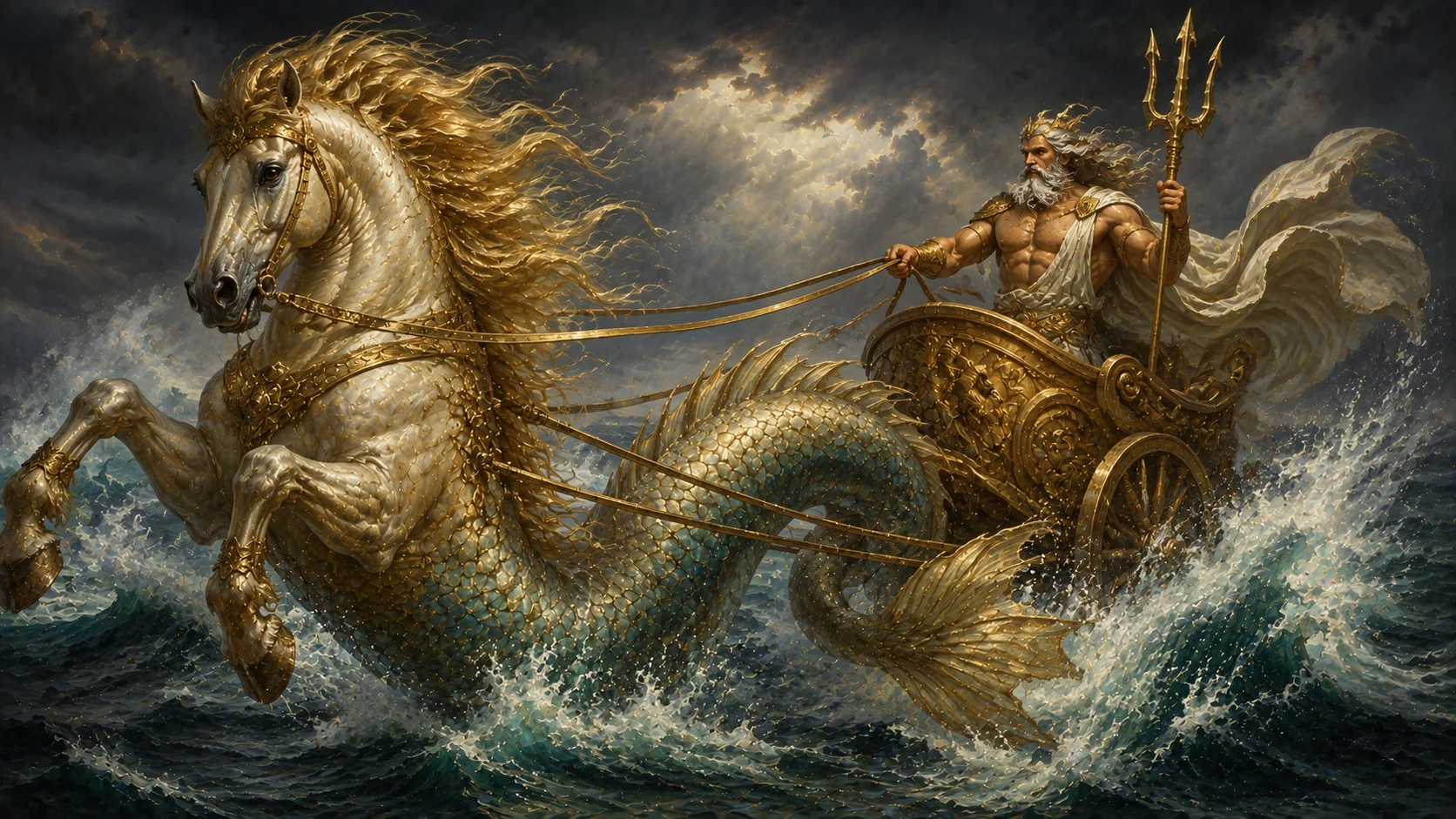
The Hippocampus (from the Greek hippos, “horse,” and kampos, “sea-monster”) was a noble sea-creature: a horse from the chest forward, with a green or fish-scaled body tapering into the long, coiling tail of a fish or serpent, and often webbed, fin-like hooves. Herds of them swam the deep, and they were the chosen steeds of the gods of the ocean.
The Chariot of Poseidon
Poseidon, lord of the sea, was most often depicted riding across the waves in a great chariot drawn by these splendid Hippocampi, their golden manes flying and their fish-tails churning the water to foam. His queen Amphitrite, the Nereids, and the other sea-deities rode them too. To the Greeks, the white-capped waves rolling toward shore were the manes of Poseidon's sea-horses galloping — the ocean's motion imagined as a herd of divine steeds. The Hippocampus thus embodied the link the Greeks felt between horses and the sea, both of which were Poseidon's domain.
From Myth to Science
The Hippocampus endures with unusual reach into the modern world. Its name was given to the small marine fish we still call the sea horse (genus Hippocampus), whose horse-like head and curling tail recall the mythical beast. And anatomists, noticing that a particular curved structure deep in the human brain resembled a sea-horse's shape, named it the hippocampus — the region central to memory. So the mythical steed of Poseidon lives on in both the sea and the mind.
The Beauty of the Deep
Where so many sea-creatures of myth are monstrous, the Hippocampus is a creature of beauty and majesty — the noble face of the ocean, the divine steed that turns the sea's raw power into something to be ridden in splendour. It remains a beloved emblem of the sea in art, heraldry, and fountains the world over, forever drawing the chariot of the sea-king across the waves.
The white-capped waves rolling to shore, the Greeks said, are the flying manes of Poseidon's sea-horses at the gallop.
Poseidon, Horse-Tamer
Long before anyone imagined a fish-tailed steed drawing his chariot, Poseidon already had a claim on horses in general. Greek worshippers gave him the cult title Hippios — “Poseidon of the Horses” — and honoured him under that name at Colonus outside Athens, the deme itself known as Colonus Hippios, “Colonus of the Horses,” where Sophocles set Oedipus at Colonus in a grove of the Eumenides beside the god's own precinct. Centuries later the traveller Pausanias still found an altar there shared by Poseidon Hippios and Athena Hippia, though the temple had long since gone. The title carried furthest in Arcadia, a landlocked upland of horse-breeders, where Poseidon Hippios held an oracular sanctuary outside Mantinea — a sea-god honoured in a basin ringed by mountains, in a grove the locals called Pelagos, “the Sea.”
Pausanias also recorded, at Thelpusa in the same region, the story that explains the god's grip on horses. Wandering in search of her stolen daughter, Demeter was pursued by Poseidon; to escape him she took the shape of a mare and grazed among the herds of Onkios. Poseidon simply became a stallion and found her anyway. Of that union came a daughter whom the Thelpusans would not name to outsiders, and the horse Arion — immortal, impossibly swift, and the reason Adrastus alone rode out of the slaughter at Thebes when every other Argive captain died there. It is a rough, uncomfortable myth even by Greek standards, but it does real work: it roots Poseidon's mastery of horses in something older and stranger than decoration, and it explains why, when the Greeks needed to give the sea a body to ride, they reached for the horse.
Two Traditions, Two Shapes
Homer never describes a hippocampus. In the Iliad, when Poseidon yokes his chariot to cross to Troy, the horses are bronze-hooved and golden-maned — magnificent, immortal, and entirely ordinary in shape. The sea-beasts gambol up from the deep because they know their lord, the water parts in gladness, and the poet's one miraculous detail is that the bronze axle beneath is never wetted. The fish-tailed hybrid belongs to a separate tradition altogether: the potter's wheel and the painter's brush, not the epic line. It takes shape in the Archaic period, when Greek art was absorbing a wave of Near Eastern influence and assembling an entire bestiary of composite creatures — griffins, sphinxes, chimeras — to which the horse-fish belongs. The poets kept Poseidon's steeds conventional. It was the vase-painters, and after them the mosaicists and sculptors, who took the imaginative leap of splicing the noblest land animal onto the tail of a fish.
Kin Beneath the Waves
The Hippocampus was never alone down there. Greek and Roman art populated the sea with a whole family built on the same logic — the forequarters of a trusted land animal fused to a tail made for water. The Ichthyocentaurs carried a centaur's human torso and horse forelegs into the water on a fish's tail; a third-century mosaic from Zeugma, on the Euphrates, labels the pair lifting Aphrodite's shell clear of the waves with their names, Aphros and Bythos — “Sea-Foam” and “Sea-Depths.” The goat-fish of the zodiac obeys the same grammar, though it reached Greece from much further off: Capricorn began as the Mesopotamian suhurmashu, older than Greek myth by millennia, and the Greeks fitted a story to it long afterwards — Pan, or his goatish double Aegipan, fleeing the monster Typhon, diving into the river, and transforming only halfway, goat above and fish below.
Carved in Stone, Set in Mosaic
The motif travelled everywhere Greek culture went, and it kept finding its way into tombs. Etruscan artists made the hippocamp — often winged, in their version — a fixture of tomb walls and funerary reliefs, where it suits an Etruscan intuition that the road to the next world crosses water. Roman craftsmen turned it into one of the most reliable set-pieces in bath-house and villa mosaic across the empire, from Ostia to the workshops of Roman North Africa: typically a Nereid or a plump Eros astride a hippocamp, a Triton alongside. From the late Antonine period the creature became standard on a class of sarcophagus known as the “marine thiasos,” a jubilant procession of sea-gods, Nereids and hippocamps carved in relief around the coffin. What that procession meant is still argued: many read it as the soul's own escorted passage across the water to the Isles of the Blessed, others as splendid decoration that had simply become conventional, and the likeliest answer is that a Roman commissioning a coffin never had to choose between the two. Either way, the sea-king's beautiful, biddable steed ended up carved on the boxes that carried the Roman dead.
Telling It From Its Cousins
In a crowded marine scene the Hippocampus is the one hybrid with no human in it, which alone separates it from the Triton, a man to the waist, and from the Ichthyocentaur, who adds horse forelegs to a human torso; its equine head distinguishes it in turn from the ketos, the blunt-snouted sea-monster that Perseus and Heracles are sent to kill. Later variants sometimes give it wings, more often in Etruscan work than Greek. It is almost never shown standing still — it swims, the body caught mid-undulation. In formal scenes it comes harnessed in a matched pair or a team of four to a shell-chariot; ridden singly, its rider is nearly always divine or semi-divine, a Nereid or a Triton or an Eros. The exception proves the point: in funerary art the dead are carried through those same waters by those same creatures, which is precisely why they were put there.
From the Trevi to the Bookshelf
The image proved impossible to retire. Renaissance and Baroque Europe revived it as an emblem of water brought under control, and its grandest survivor still draws crowds. Rome's Trevi Fountain, completed in 1762, sets Oceanus's shell chariot behind two hippocamps sculpted in deliberate contrast — one led quietly by a Triton sounding his conch, the other rearing and fighting while its Triton wrestles it back. One monument, both moods of the sea, held in stone. Centuries later the creature swam just as easily into modern children's fantasy, where a bestselling series about the children of the Greek gods gave individual hippocampi names and personalities, introducing the beast to readers who will never open Pausanias or stand before a Roman sarcophagus.
What is strange, given all that visibility, is how little the Hippocampus ever actually does. No surviving Greek story takes one as its subject: it is never born, never named, never fought, never outwitted. It exists to be ridden. For a culture that handed a biography to almost every monster it imagined, the sea-horse stayed pure function — and that may be exactly why it outlived the monsters. A creature with no story of its own can be lent to anybody's.
Sources & traditions
- EncyclopediaWikipedia — Hippocampus (mythology)
- TraditionGreek texts, inscriptions and later retellings (Greece)
Myths change from area to area and from time to time. This chronicle follows the most widely told versions; tellings in other villages, regions and eras may differ.