Gullinkambi was the golden rooster of Valhalla — the cockerel with a comb of gold who perches over the hall of the slain and whose crowing will wake the heroes and the gods on the morning of Ragnarök, when the final battle is at hand. He is the alarm-bell of the end of the world, the golden cock whose crow heralds the doom of the gods.
The Golden-Combed Cock
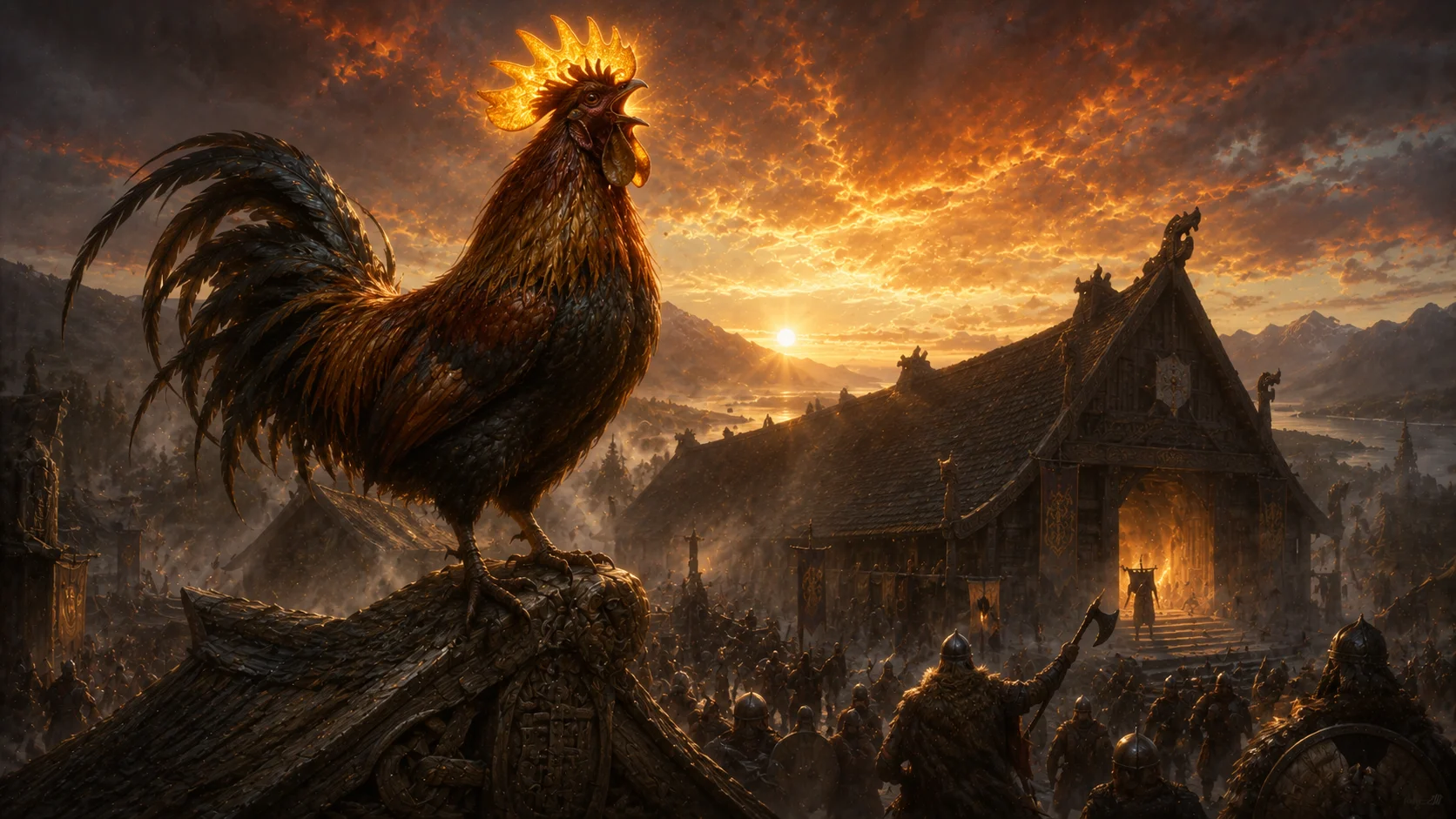
Gullinkambi (Old Norse Gullinkambi, “golden comb”) was a rooster with a comb of shining gold who dwells in Valhalla, perched above or among Odin's hall of the heroic dead. He is one of three roosters named in the Norse prophecy of the world's end — one that crows for the gods, one (a soot-red cock) that crows for the dead in Hel, and one that crows in the giants' world — each heralding the coming of Ragnarök to its own realm. Gullinkambi is the cock of the gods and the heroes, the golden bird of Valhalla.
The Crow That Wakes the Heroes
Gullinkambi's great role comes at the dawn of Ragnarök. When the doom of the gods is at last at hand, it is Gullinkambi whose crowing wakes the Einherjar — the slain warriors gathered in Valhalla — rousing the heroes from their feasting to take up their arms and march out to the final battle alongside the gods. As a rooster's crow announces the dawn, so Gullinkambi's golden crowing announces the last dawn of all, the morning of the end of the world, calling the warriors of Odin to the war they have been kept and trained for since their deaths. His crow is the wake-up call of the apocalypse.
The Three Roosters of the End
The Norse prophecy of Ragnarök names the crowing of the cocks among the great signs of the coming end. As Gullinkambi crows to wake the gods and heroes in Valhalla, the soot-red rooster Fjalar crows to the giants in the gallows-wood, and a third rooster crows in the halls of Hel to rouse the dead. The crowing of these birds across all the worlds — the world of the gods, the world of the giants, the world of the dead — signals that the bonds are breaking, the monsters are loosing, and the final battle has come. Gullinkambi is the golden voice of that alarm in the hall of heaven.
The Cock of the Last Dawn
Gullinkambi endures as the golden rooster of Valhalla and the herald of Ragnarök — the cock whose crowing wakes the heroes for the end of the world. He embodies the Norse vision of the apocalypse as something heralded and awaited, announced by signs and crowing birds across all the worlds; and he gives the great cosmic drama of the end a homely and unforgettable image: a golden-combed rooster crowing at the last dawn, waking the warriors of heaven to march out to their doom.
When the last dawn breaks, a rooster with a comb of gold will crow over the hall of the slain — and the heroes will wake and take up their arms for the end of the world.
A Name Cut From Gold
Norse myth hands out the gold-prefix — gull-, gullin-, “gold,” “golden” — to a small and select company of creatures, and the company Gullinkambi keeps says a great deal about what kind of animal he is. Freyr owns the boar Gullinbursti, “golden-bristled,” forged for him by dwarves with bristles that glow so fiercely that no other light is needed on the darkest night. The giant Hrungnir's horse Gullfaxi, “golden-mane,” passes after his owner's death to Thor's young son Magni. Heimdall, watchman of the gods, rides Gulltoppr, “golden-top.” None of these golden things are treasure locked in a chest — they are golden because they belong to gods, and gold in the Norse imagination reads less like wealth than like a colour worn by the otherworldly. Gullinkambi's comb marks him out the same way: not a barnyard bird but a creature of the hall of the slain, gilded because he is sacred.
The Oldest Witness
Gullinkambi still crows because one poem wrote him down. He appears in Völuspá, “The Seeress's Prophecy,” the visionary poem that opens the Poetic Edda and carries the Norse cosmos from its making to its burning. Two medieval Icelandic manuscripts preserve it, in versions that do not entirely agree: the Codex Regius, copied around 1270, and the Hauksbók, copied in the early fourteenth century. Both were made well over two hundred years after Iceland's official conversion to Christianity, and both are widely reckoned to carry material composed while the old religion was still a living practice — verse built to be recited rather than read. Earlier still, around 1220 and a good half-century before the Codex Regius was written out, Snorri Sturluson was already quoting the roosters into his own prose account of the world's end, in the part of the Prose Edda called Gylfaginning. The stanza that carries Gullinkambi is spare to the point of bluntness: he crows among the Æsir, and he wakes the warriors at Herjaföðr's — “Host-Father's,” one of Odin's many names. A handful of lines, and a bird becomes permanent.
A Second Name in the Dark
Old Norse verse may keep one more name for a bird very like him. In Helgakviða Hundingsbana II, one of the heroic poems of the Poetic Edda, the dead hero Helgi breaks off a night's visit and rides the reddening roads back to Odin's hall before a cock called Salgofnir — a name usually read as something close to “hall-crower” — wakes the host of the victorious. The role sits close enough to Gullinkambi's that readers of the poems have long wondered whether the two names belong to a single bird or to two roosters doing the same work in different corners of the tradition. Eddic poetry is never as tidy as an encyclopaedia would like: gods carry a dozen names apiece, and it would be no surprise if the watch-cock of the hall of the slain did too. What the overlap does establish is that a crowing rooster attached to Odin's hall was no one-off image struck for a single stanza. It was a fixture, remembered across more than one poem.
Why a Rooster Stands the Last Watch
Of all the animals a Norse poet had to hand, the rooster is a pointed choice for the threshold of the apocalypse. Across the Germanic-speaking world and far beyond it, the cock was the creature that ended the night: its crow was heard as the sound that scattered whatever walked in the dark, and it arrived unprompted, at the first grey edge of dawn, whether or not anyone was awake to hear it. Households kept roosters as much for that reliability as for eggs or meat. To people who lived by sunrise and sundown, a bird that called out on time every morning of its life looked like a sentry posted between the human world and whatever moved in the hours humans could not see. Gullinkambi's part at Ragnarök is that same ordinary alarm raised to cosmic pitch. He is neither warrior nor monster; his whole weapon is a sound the world already trusted to mean wake up, something is beginning.
Two Alarms for One Morning
Völuspá does not leave the gods relying on a bird alone. In the same run of omens that brings the roosters to their feet, the poem has Heimdall — the watchman kept at the border of Asgard for exactly this purpose — raise the Gjallarhorn and blow a blast held aloft for every world to hear. Horn and cock answer the same emergency by entirely different means. One is an instrument, made and kept for a single purpose and sounded, by design, once. The other is a living creature doing what living creatures of its kind do every morning of the year, except that this time the dawn it announces is the last one there will be. Setting a rooster's ordinary crow beside a god's cosmic horn-blast is exactly the sort of doubling the Eddic poets favoured — the enormous and the homely striking the same note at the same terrible moment.
Gold Before the Fire and Gold After It
Gold runs through Völuspá as a colour attached to beginnings and to whatever survives the end, and Gullinkambi's comb sits inside that pattern rather than beside it. At the world's dawn, in the poem's account, the gods gather on a green plain and pass their early days playing at tafl with pieces of gold, an age of ease before care or conflict enters the story. After Ragnarök has burned the old world down, the poem circles back to the same image: the survivors meet again on grass grown up over the ashes, and there in the turf they find those golden game-pieces waiting, as though the world had merely blinked. And among the halls the poem imagines standing in the world made new is one thatched with gold and fairer than the sun, at Gimlé, where the poem says the virtuous will live out their days. Set against that pattern, Gullinkambi's golden comb reads less like decoration than like a promise folded into the herald himself — the last gold-bright thing in the old world doubling as the first sign of the gold that outlasts it.
Why the Alarm Still Rings
Strip away the scale, and what is left in Gullinkambi's one scene is something oddly like kindness. The heroes in Odin's hall have spent their afterlives feasting and cutting one another down for sport, healed again each evening in time for supper; and when the last morning comes, nobody hauls them off the benches unwarned. A bird crows, and they get up. That the warning is entrusted to a rooster rather than to a monster or an omen written in blood changes its temperature entirely: the same small, domestic sound that gets a household moving on an ordinary day is the sound that gets the greatest fighters who ever lived moving toward the end of everything. Gullinkambi never lifts a weapon in the myth that names him. He only crows — and in a tradition that measured people by how they met a doom they could not avoid, being the one voice that makes certain nobody sleeps through it turns out to be its own quiet kind of service.
Sources & traditions
- EncyclopediaWikipedia — Gullinkambi
- TraditionNorse texts, inscriptions and later retellings (Scandinavia)
Myths change from area to area and from time to time. This chronicle follows the most widely told versions; tellings in other villages, regions and eras may differ.