Heidrun was the magical goat of Valhalla — the she-goat who stands upon Odin's hall, feeds upon the leaves of a special tree, and from whose udder flows an endless supply of mead for the slain warriors who feast there. She is the inexhaustible source of the drink of the Einherjar, one of the wonders that make Valhalla a warrior's paradise.
The Goat Upon Valhalla
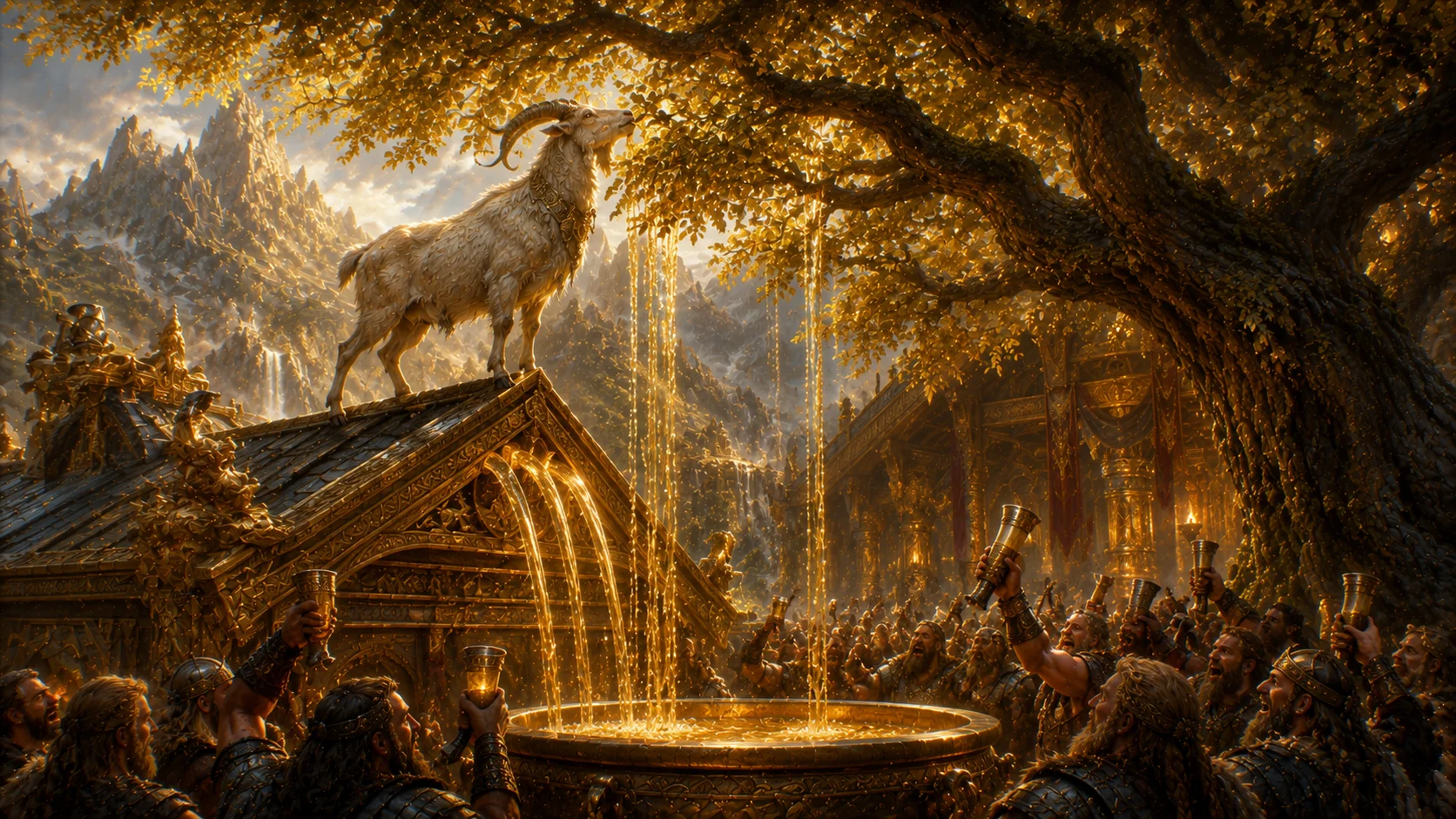
Heidrun (Old Norse Heiðrún) was a she-goat that stands upon the roof of Valhalla, Odin's great hall of the slain. There she browses upon the leaves and branches of a tree called Læraðr (often identified with the world-tree Yggdrasil), feeding upon its foliage. And from this feeding comes her marvelous gift: from Heidrun's udder flows not milk but mead — clear, sweet mead in such abundance that it fills a great vat every day, enough to satisfy all the warriors in Valhalla, however many they may be.
The Endless Mead of the Einherjar
Valhalla was the paradise of the slain warriors — the Einherjar, the bravest of those who died in battle, gathered by Odin to feast and fight in his hall until they should be called to the final battle of Ragnarök. Each day these warriors fought and were healed, and each night they feasted — and the drink at their endless feast came from Heidrun. Her mead never ran dry: however many warriors filled the hall, however deeply they drank, the magical goat upon the roof provided mead enough for all, an inexhaustible fountain of the warriors' drink. Together with the boar Saehrimnir, who was eaten each day and made whole each night to provide endless meat, Heidrun made the feast of Valhalla a feast that could never fail.
The Wonder of the Warriors' Paradise
Heidrun embodies the Norse vision of Valhalla as the perfect warrior's afterlife — a place of endless battle by day and endless feasting by night, where the bravest of the dead want for nothing. The magical goat whose udder flows with mead is a wonderfully concrete image of that paradise: not abstract bliss, but an inexhaustible supply of the good mead that a Norse warrior loved, provided forever by a goat browsing on the leaves of the great tree atop the hall. It is a vision of heaven shaped entirely by what a warrior would most desire — battle, feasting, and mead that never runs out.
The Mead-Goat of Heaven
Heidrun endures as the magical goat of Valhalla — the she-goat upon Odin's hall whose udder flows with endless mead for the feasting slain. She embodies the Norse warrior's dream of the afterlife, a paradise of inexhaustible plenty, and stands among the most charming and distinctive images of Norse myth: a goat on the roof of heaven, browsing the world-tree, giving mead instead of milk, so that the heroes who feast in Odin's hall need never run dry until the world ends.
Upon the roof of the hall of the slain stands a goat who browses the world-tree and gives, instead of milk, an endless flow of mead for the feasting heroes below.
The Poem That First Named Her
Heidrun enters recorded memory inside a single, crowded catalogue of cosmic secrets. In the Eddic poem Grímnismál, Odin — disguised as the wanderer Grímnir, bound between two fires in the hall of King Geirröðr — recites, stanza after stanza, the furniture of the worlds: the rivers, the gods' dwellings, the roots of the world-tree, and, almost in passing, the goat standing on the roof of Valhalla. It is a strange way for so vivid a figure to arrive in the record: not as the subject of her own tale, but as one fact among dozens, spoken by a god half-dead from torture and moments from revealing his true name. Snorri Sturluson, assembling his prose handbook in thirteenth-century Iceland, quotes that stanza almost intact in Gylfaginning — and between them, poem and handbook, that is very nearly all we have of her. One catalogue verse and its retelling are what stand between Heidrun and silence.
Eikþyrnir, Her Companion on the Roof
Heidrun does not stand on that roof alone. The stanza immediately following hers in Grímnismál names a hart, Eikþyrnir, browsing the same tree at her side. Where Heidrun's udder gives mead, Eikþyrnir's antlers give water: drops fall from his horns down into Hvergelmir, the bubbling spring beneath a root of the world-tree, and from there, the poem says, all waters find their ways. The pairing is exact and looks deliberate — two animals, one tree, one roof, and between them the two liquids a Norse audience most needed accounted for: the water that feeds the world below, and the mead that rewards the dead above. Read together rather than apart, goat and hart turn the roof of Valhalla into something like an engine, quietly manufacturing the substances that keep both worlds running at once.
Sisters in Magic: Thor's Goats and the Feast That Cannot End
Heidrun is not the only goat doing impossible work in Norse belief. Thor's chariot is drawn by two goats, Tanngrisnir and Tanngnjóstr — roughly, "teeth-barer" and "teeth-grinder" — and Snorri tells how, on his travels, the god would slaughter and eat them in the evening, lay out their hides, have the bones thrown back onto the skins, and hallow the remains with Mjölnir the next morning to raise them whole and living again. The one time it goes wrong is the story's real point: lodging with a farmer's family, Thor shares the meal out, but the son &Thorn;jálfi splits a thigh-bone open for the marrow, and the goat rises the following day lame in a hind leg. It is a different miracle from Heidrun's — hers is inexhaustible supply, theirs is repeatable resurrection — but the two share a logic. The goat is the animal Norse story reaches for whenever a myth needs to explain food that by rights should run out, and does not.
Why a Goat
It is worth pausing on the choice, because it is not the obvious one. A culture building a warrior's heaven might have reached for something grander than a goat on a roof — a fountain, a spring, a cauldron tended by a god. Instead the Norse imagination reached for an animal of the ordinary farmstead: the creature that gave milk, meat, hide and horn, and whose keeping was unglamorous daily work. Heidrun is that same animal, simply promoted — the household goat's udder, except that what it yields is not milk to carry a family through winter but mead to reward warriors forever. Valhalla's luxury, in other words, is stated in the vocabulary of the farm, because to the people telling this story around their own fires that was the vocabulary rich enough to describe wanting for absolutely nothing.
A Name Still in Use
Heidrun's afterlife has not stayed inside literature. Since 1995 a producing oil and gas field in the Norwegian Sea has carried her name — one of many installations on the Norwegian continental shelf named out of Old Norse myth, alongside neighbours called Åsgard, Draugen, Balder and Skuld. It is an odd but fitting continuity: a country that no longer worships Odin still reaches for his hall's mead-goat when it needs a name for something built to be dependable and productive, drawn steadily from beneath the sea the way Heidrun's mead was drawn steadily from a tree. The goat who once explained the plenty of the afterlife now lends her name to plenty of a much more literal, and considerably more taxable, kind.
Sources & traditions
- EncyclopediaWikipedia — Heiðrún
- TraditionNorse texts, inscriptions and later retellings (Scandinavia)
Myths change from area to area and from time to time. This chronicle follows the most widely told versions; tellings in other villages, regions and eras may differ.