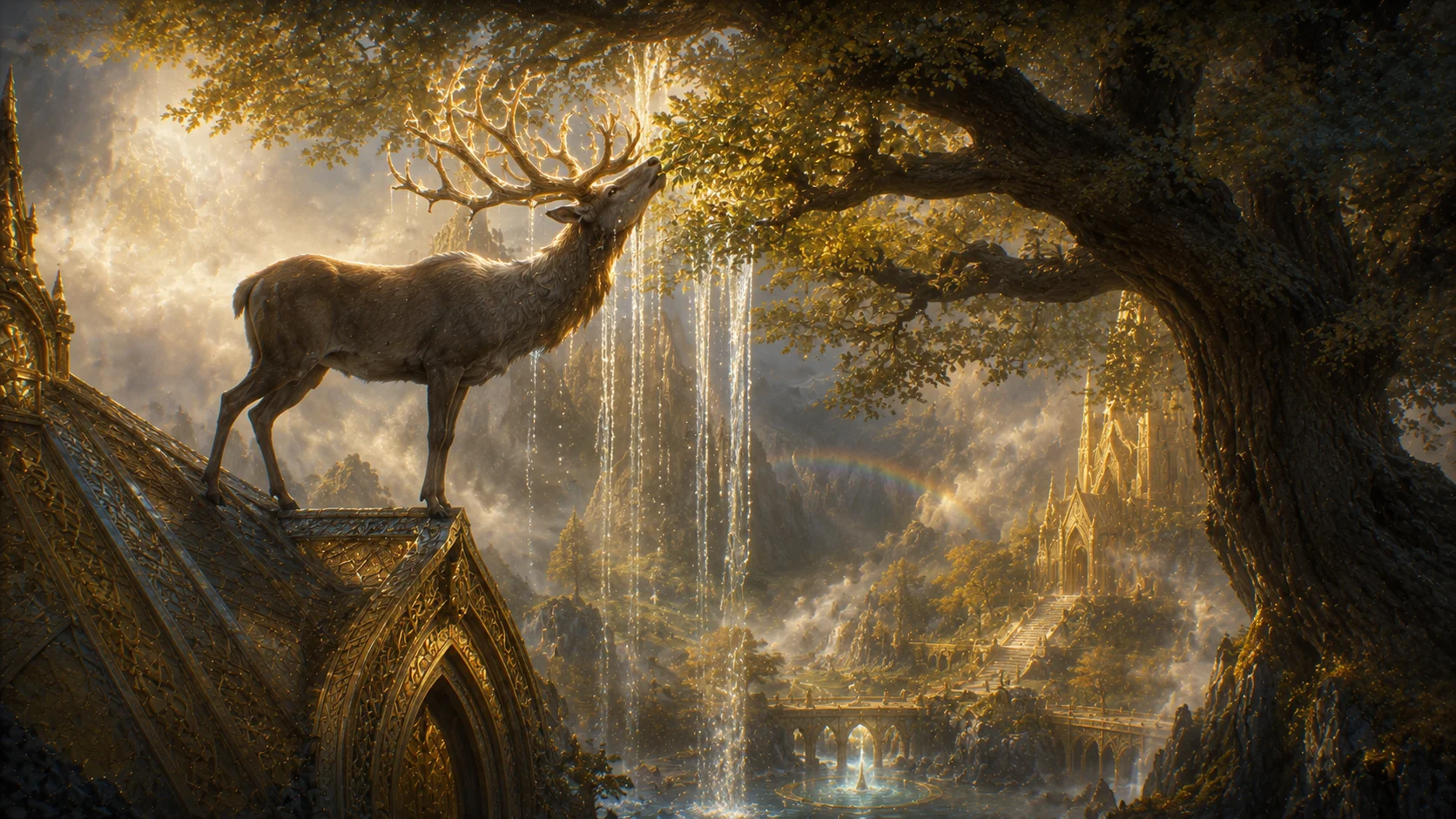
Eikthyrnir was the great stag that stands upon the roof of Valhalla — the wondrous deer who browses the leaves of the world-tree and from whose antlers drips the water that becomes the source of all the rivers of the worlds. With the mead-goat Heidrun, he is one of the marvelous beasts that crown Odin's hall, and he is the very origin of the world's waters.
The Stag Upon the Hall
Eikthyrnir (Old Norse Eikþyrnir, “oak-thorny” or “the one with oak-tips on his antlers”) was a great hart or stag that stands upon the roof of Valhalla, Odin's hall of the slain, alongside the magical she-goat Heidrun. Like Heidrun, he feeds upon the leaves and branches of the tree called Læraðr (often identified with the world-tree Yggdrasil), browsing its foliage from his place atop the great hall.
The Source of All Rivers
Eikthyrnir's wonder lies in what flows from him. As the stag browses the leaves of the tree, water drips from his great antlers — and this water falls down into the spring Hvergelmir, the great well in the cold depths of the cosmos. And from Hvergelmir, fed by the dripping of Eikthyrnir's antlers, flow all the rivers of all the worlds — a great list of named rivers that water the realms of gods, giants, men and the dead. Thus the stag upon Valhalla is, astonishingly, the ultimate source of every river in the cosmos: the waters of the worlds begin as moisture dripping from the antlers of a deer browsing the world-tree atop the hall of the slain.
The Beast of the Cosmic Waters
Eikthyrnir takes his place among the wondrous creatures that the Norse imagined dwelling upon and around the world-tree and Valhalla — the eagle and the dragon, the squirrel Ratatoskr, the four stags that browse Yggdrasil's branches, the goat Heidrun, and Eikthyrnir himself. Together they give the Norse cosmos a teeming, living detail, in which the great structures of the world — the tree, the hall, the wells and rivers — are bound up with living beasts. Eikthyrnir is the beast of the waters, the stag whose antlers feed the spring from which all rivers flow.
The Antlers That Feed the World's Rivers
Eikthyrnir endures as one of the marvelous beasts of Valhalla and the Norse cosmos — the great stag upon Odin's hall whose dripping antlers are the source of all the world's rivers. He embodies the Norse vision of a cosmos alive in every part, where even the rivers have a living origin, and where atop the hall of the heroic dead stand two wondrous beasts: a goat giving endless mead, and a stag from whose antlers flow the waters of all the worlds.
Atop the hall of the slain a great stag browses the world-tree, and from his antlers drips the water that becomes every river in all the worlds.
A Catalogue Spoken Through Fire
Eikthyrnir is not the star of any saga. In the surviving Eddic poetry his whole existence is a single stanza, spoken by a god who is being tortured. In Grímnismál, Odin enters the hall of King Geirröd in disguise, calling himself Grimnir, “the masked one.” The king, suspecting sorcery, has him seized and set between two fires, and there he is left for eight nights with nothing to eat or drink, sustained only by a horn that the king's ten-year-old son, Agnar, brings him in secret. Tormented and unrecognised, the god does not curse his captor. He teaches. Bound between the flames, Odin recites the shape of the universe: the halls of the gods one by one, the roots of the world-tree, the beasts that live upon it — and, in a single breath, the stag on the roof of Valhalla and the well his antlers feed. Eikthyrnir enters recorded myth not as a creature anyone set out to describe for its own sake, but as one detail inside a god's recitation of everything he knows, delivered to a boy, in the hall of a king who is dead by the time the poem ends — fallen on his own half-drawn sword in the moment he finally understands whom he has been torturing.
The Tree Is Never Called Yggdrasil
Read the stanza closely and a small but telling detail emerges: Grímnismál does not call the tree Eikthyrnir grazes upon “Yggdrasil.” It names it Læraðr, a word whose meaning is no longer certain. Nor does Snorri Sturluson correct it. Retelling the stanza in his Prose Edda in thirteenth-century Iceland, he keeps the name Læraðr and adds only that the tree is mjök nafnfrægt, “very renowned” — as though his readers already knew perfectly well which tree was meant. That one adjective is most of the evidence there is. The familiar identification of Læraðr with the world-ash is a reading supplied by later scholars, on the reasonable ground that a single cosmology has little room for two world-scale trees. It is not a statement either medieval source actually makes. The stag on the roof may well be browsing Yggdrasil; nobody who wrote the surviving texts ever quite said so.
Not the Only Antlers in the Branches
Eikthyrnir keeps unusual company. Seven stanzas after his single appearance, Grímnismál names four further stags — Dáinn, Dvalinn, Duneyrr and Duraþrór — necks thrown back, gnawing at the highest shoots; Snorri places them squarely in the branches of the ash. Two of those names, Dáinn and Dvalinn, belong elsewhere in the tradition to dwarfs, turning up among the dwarf-names catalogued in Völuspá. Norse myth seems entirely untroubled by giving a dwarf's name to a deer; in this tradition a name marks a role or a quality far more often than one fixed individual. What separates Eikthyrnir from the four is not the browsing — it is what the browsing produces. The four simply eat, and the tree suffers for it. Eikthyrnir's feeding yields water, dripping from horn to well to river, so that an ordinary mouthful of leaves becomes, almost as an aside, the origin of the world's fresh water.
Hvergelmir, and the Route the Water Takes
The spring that catches the drip from Eikthyrnir's antlers carries its own weight in Norse cosmology. Hvergelmir — a name built on the word for a cauldron or hot spring, suggesting something seething and loud — lies, in Snorri's account, beneath one of Yggdrasil's three roots, in Niflheim, the cold dark world to the north. It is no tranquil pool. Snorri writes that so many serpents lie in Hvergelmir alongside the dragon Níðhöggr that no tongue can count them; Grímnismál agrees that more snakes lie beneath the ash than any fool would guess, and has Níðhöggr tearing at the tree from below while the hart bites it from above. Notice, then, the route the water travels. It begins at the highest point in the picture — a stag's muzzle on the roof of the hall of the slain — falls the whole depth of the cosmos to its coldest, most venomous, most gnawed-upon corner, and only from there flows out as the rivers of every world. Norse rivers do not come down out of the sky. They rise out of the underworld, and they have passed the dragon on the way.
Two Lists of Rivers That Never Quite Agree
Snorri's Edda catalogues the rivers of the world twice, and the two lists do not match. Early in Gylfaginning, describing what there was before creation, he has rivers pouring out of Hvergelmir under the collective name Élivágar, the “ice-waves” — waters carrying a venom that hardened into rime as they ran, until the rime met the heat drifting up from Muspell, thawed, and dripped into life as the frost-giant Ymir, from whose body the world was afterwards built. Later in the same book, retelling Grímnismál, he lists the rivers that flow from Hvergelmir precisely because Eikthyrnir keeps filling it: a different catalogue, describing a process still under way rather than a single event at the beginning, and the two are never reconciled. Worth noticing, too, that the poem's own list mixes purely mythical waters with at least one that is unmistakably real — Rín, generally understood to be the Rhine. The poet cataloguing the rivers of the gods saw no difficulty in setting a river his audience could have stood beside alongside waters that fall from a stag's antlers on the roof of Valhalla. In this cosmology the cosmic and the everyday shared one hydrology.
A Beast With No Face
Odin's eight-legged horse appears on Gotland picture-stones carved centuries before either Edda was written down. The World Serpent coils across Viking-age crosses and rune-stones, hauled up on Thor's fishing line. Thor's hammer was worn as an amulet the length and breadth of the Norse world. Eikthyrnir has left no such trace. No surviving carving, textile or coin has been securely identified as the stag of Valhalla; he exists nowhere but in the two texts that describe him. This is not unusual for the smaller wonders of the Norse cosmos — Heidrun the mead-goat fares no better — but it is a useful check on the assumption that a myth's vividness on the page tells you anything about how often it was carved, worn or invoked. Eikthyrnir was not made to be looked at. He was made to be recited: one stag on the roofline of a hall that existed, for its earliest audiences, only for as long as somebody was speaking it.
Why a Stag, and Not a Cloud
Every mythology has to account for fresh water somehow, and a great many reach upward to do it — rain-gods, storm-gods, rivers let down out of the sky. Norse tradition roots its rivers in an animal instead: in the wet muzzle and living antlers of a browsing deer, an image any farmer or hunter in early medieval Scandinavia would have seen with their own eyes on a wet morning — a stag's antlers glistening after it has fed among soaked leaves. The myth takes that ordinary, half-noticed sight and refuses to stop at the treeline. It follows the water down through the roots of the world, past a serpent-choked well, and out into every river anyone would ever cross, drink from or drown in. And it asks nothing further of the listener. No cult of Eikthyrnir is attested, no prayer, no festival, no story of his own; he is not a power to be bargained with but a piece of machinery to be admired — and the Norse cosmos, it turns out, is full of such machinery, running quietly whether or not anyone is watching.
Sources & traditions
- EncyclopediaWikipedia — Eikþyrnir
- TraditionNorse texts, inscriptions and later retellings (Scandinavia)
Myths change from area to area and from time to time. This chronicle follows the most widely told versions; tellings in other villages, regions and eras may differ.