The tables are set, the wine is poured, and every god who matters has come down to bless the marriage of a mortal man and a sea-nymph. Peleus and Thetis will have a son named Achilles, though no one at the feast knows that yet. What they do know is who is missing. One name was struck from the list on purpose, because the last thing anyone wants at a wedding is the goddess of quarrels. She comes anyway. She says nothing. She rolls a golden apple into the middle of the party and leaves before the shouting starts — and by the time the shouting stops, a war has begun that will burn for ten years and empty a city. That is Eris: the smallest of the Greek powers to actually start something, and the only one whose entire myth fits in a single, spiteful gesture.
Born Without a Father, in the Company of Night
Hesiod's Theogony places Eris among the children Nyx, the primordial goddess of Night, bore alone, with no father named. It is telling company: her siblings in that list include Moros (Doom), Thanatos (Death), Hypnos (Sleep), and the Keres, the dark spirits who hover over battlefields waiting to claim the slain. Eris was never one of the Twelve Olympians and never lived among them on Olympus in any account. She belongs instead to an older, dimmer register of Greek divinity — the daimones, forces and states of being given a name and a shape rather than a throne. Where Zeus and Athena ruled, Eris simply happened, the way an argument happens, the way a grudge happens.
The Olympians could be bargained with, flattered, appeased with sacrifice and temple. A force like Eris is not so easily managed — you do not build a shrine to stop yourself from quarrelling any more than you build a shrine to stop yourself from sleeping. She was less a goddess to be worshipped than a condition to be recognised and watched for.
A Monstrous Family Tree
If Eris herself was abstract, her own children make the abstraction concrete in the most unsettling way. Hesiod catalogues her offspring as a roll call of everything that ruins a household, a city, or an army: Ponos (Toil), Lethe (Forgetfulness), Limos (Starvation), the Algea (Pains), the Hysminai (Fightings) and the Makhai (Battles), the Phonoi (Murders) and the Androktasiai (Man-slaughters), the Neikea (Quarrels), the Pseudo-logoi (Lies), the Amphilogiai (Disputes), Dysnomia (Lawlessness), Ate (Ruin, or blind folly), and Horkos (Oath) — who, Hesiod says, does the most damage to men who swear falsely and know it.
Read as a single sentence, the list is almost a diagnosis: what discord produces if it runs its course, from the first harsh word (Neikea) through lies and broken oaths to outright killing. Ate deserves a note of her own, since she is often confused with her mother in casual retelling: Ate is the spirit of ruin and blind folly, a distinct figure in the Theogony's catalogue, not another name for Eris.
- Ponos — Toil
- Lethe — Forgetfulness
- Limos — Starvation
- The Algea — Pains
- The Hysminai and Makhai — Fightings and Battles
- The Phonoi and Androktasiai — Murders and Man-slaughters
- The Neikea, Pseudo-logoi, Amphilogiai — Quarrels, Lies, Disputes
- Dysnomia — Lawlessness
- Ate — Ruin, blind folly
- Horkos — Oath, and its punishment
Two Kinds of Strife
Hesiod did not leave Eris as simply villainous. In a later work, Works and Days, he revises his own account and says that there are, in fact, two Erides — two Strifes, not one. The first is the destructive kind familiar from the Theogony, the one that feeds evil war and battle. But there is an elder one too, Hesiod says, set by Zeus in the very roots of the earth, and she is far kinder to men. This second Strife is competitive rivalry: the sight of a wealthier neighbour that stirs even a lazy man to work. It is discord turned productive — the same underlying force, ambition and comparison, without the bloodshed.
Rivalry, in other words, is not simply condemned — it is split in two, and one half is endorsed. The Eris who throws the apple at a wedding belongs to the first, ruinous kind.
Small at First, Then Vast
Homer gives Eris her most vivid single appearance, in Book 4 of the Iliad, where he calls her "the sister and companion of murderous Ares" — placing her at the god of war's side rather than beneath him. Homer's description of her on the battlefield is one of the most striking images of any minor Greek power: she is small when she first appears, but she grows, until her head strikes the sky while her feet remain planted on the ground. In that towering form she strides through the fighting, spreading grief and bitterness impartially — not favouring the Achaeans, not favouring the Trojans, simply increasing the moaning of men on both sides equally. She does not choose a side because discord does not choose a side. It touches whoever is close enough to be touched.
That image is, in miniature, the whole shape of her mythology: a starting point so slight it can be dismissed, and a consequence so vast it darkens everything under it.
The Guest List
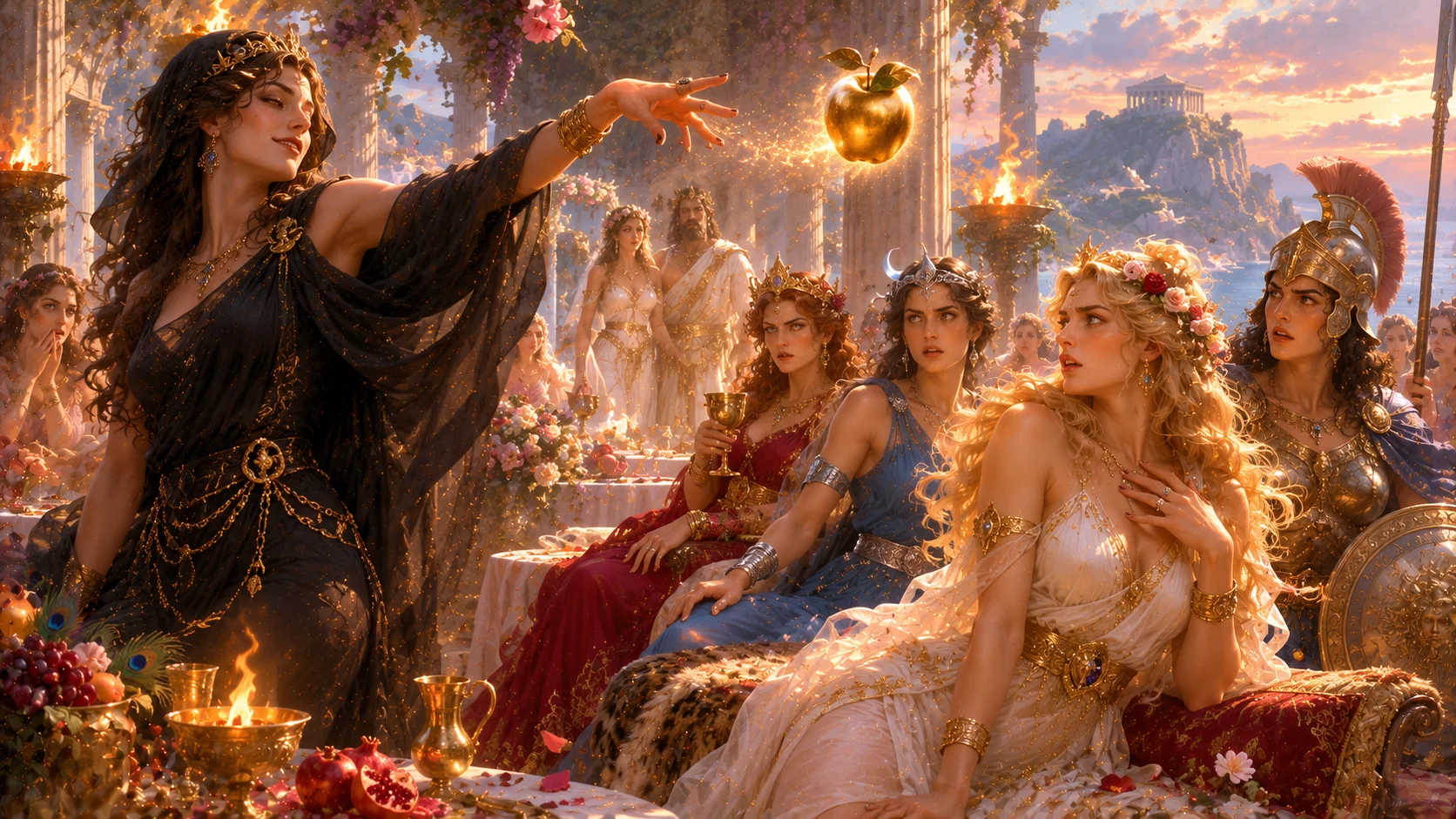
The event that made Eris famous begins with an invitation she did not receive. When the gods gathered for the wedding of the mortal hero Peleus and the sea-nymph Thetis — the couple who would become the parents of Achilles — every deity of consequence was asked. Eris alone was left off the list, and she was left off deliberately, because her nature as a maker of trouble was already well understood among the gods themselves. She was not forgotten. She was excluded.
She came regardless. Whatever protocol was meant to keep her out did not hold, and into the middle of the wedding party she threw a single golden apple, inscribed with the Greek word kallistē — "to the fairest." She said nothing else. She did not need to. The object itself, addressed to no one and everyone at once, was the entire attack, and it is this apple, thrown once and never touched again by Eris herself, that history came to call the Apple of Discord.
Three Goddesses, One Word
Three of the most powerful goddesses at the feast stepped forward to claim the apple as rightfully theirs: Hera, queen of the gods; Athena, goddess of wisdom and war; and Aphrodite, goddess of love and beauty. Each believed — or insisted — that the word "fairest" could only mean her. Eris had not judged between them. She had simply supplied a single, unanswerable claim and let three of the proudest figures in the Greek pantheon fight over who owned it.
Eris did not award the apple to anyone, and she did not stay to watch the contest unfold. She threw the object and the inscription did the rest — exactly the kind of intervention her name describes: not violence, not command, just a claim that cannot be shared.
Zeus Refuses to Choose
Faced with three goddesses each certain of her own beauty and each capable of holding a grudge, Zeus made a decision that says as much about him as about Eris: he declined to judge the contest himself. To rule in favour of one goddess was to guarantee the enduring anger of the other two, and even the king of the gods preferred not to make that enemy list. Instead, he delegated the judgement entirely, handing the decision to a mortal — the Trojan prince Paris.
The choice of Paris as judge is itself part of the machinery Eris set in motion: a single thrown apple had already escalated from a wedding slight into a dispute among three of the most powerful goddesses in Greek myth, and now it was about to be handed to a young prince entirely unequipped for the position.
The Judgement of Paris
Each of the three goddesses offered Paris a bribe in exchange for the apple. Hera offered political power and kingship. Athena offered wisdom and skill in war. Aphrodite offered him the most beautiful mortal woman in the world. Paris chose Aphrodite, and she made good on her promise: the woman in question was Helen of Sparta, and Aphrodite's reward set in motion Helen's abduction to Troy.
From there the chain runs to its famous end. The abduction of Helen gave the Greek kingdoms their cause for war, and the resulting conflict — the Trojan War, held in the Homeric tradition to have lasted ten years — became the deadliest and most consequential war in Greek myth. One apple. Two words. Three goddesses who could not share a compliment. A war that swallowed a generation of heroes on both sides.
One apple, two words, and ten years of war — never underestimate the goddess of discord.
A Goddess With No Temple
What is almost as striking as Eris's one great myth is how little evidence survives of her being formally worshipped. Unlike the major Olympians, with their temples, priesthoods, and civic festivals, Eris appears to have had little to no organised cult in ancient Greece. She functioned above all as a literary and poetic figure — invoked by poets like Hesiod and Homer to explain why quarrels happen, rather than a deity a household prayed to or a city built an altar for.
That absence fits her character. Strife is not a force people petition for more of, and unlike the productive rivalry of Works and Days, the destructive Eris of the Theogony offers little a worshipper would want to secure through sacrifice. She was named and feared in verse far more than she was ever honoured in stone.
The Apple in Paint and in Speech
Ancient artists, particularly on painted vases, returned again and again to the wedding scene: Eris shown winged, tossing the apple among the assembled gods and goddesses at Peleus and Thetis's feast, caught just before three of the most powerful figures in Greek religion lose their composure.
The story outlived its original tellers. The English idiom "apple of discord," meaning any small, seemingly trivial thing that sets off a major and bitter dispute, comes directly from this myth — a fossil of the story pressed into everyday language, still meaning exactly what it meant beside Peleus and Thetis's wedding table.
Discordia, Her Roman Shadow
The Romans gave Eris a direct equivalent in Discordia, their own personification of strife, carrying the same essential role into Latin literature — the same force under a different name, moving from Greek epic into Roman poetry with its character intact.
What Survives
Eris's afterlife runs in two directions that could hardly be more different from one another, and both are worth knowing. In 2005, the astronomers Mike Brown of Caltech, Chad Trujillo of the Gemini Observatory, and David Rabinowitz of Yale discovered a large object far beyond Neptune, nicknamed "Xena" during the years before it received an official name. In September 2006, the International Astronomical Union formally named it Eris — a choice made in part because the object's discovery had stirred real controversy within the astronomical community, controversy that fed directly into the debate that ended with Pluto's reclassification as a dwarf planet. A goddess of discord, discovered by way of an argument about how to define a planet, was named for exactly that kind of trouble. Her moon carries the name Dysnomia — Lawlessness — who is, in Hesiod's own catalogue, Eris's daughter, a deliberate piece of mythological matching by the astronomers who named it.
The second afterlife is stranger still and entirely modern: Discordianism, a parody religion founded in the twentieth century, places Eris — often under her Roman name, Discordia — at the centre of its satire, associated with ideas like the "23 enigma" and chaos as a kind of sacred principle. It is a recent American cultural phenomenon built in a spirit of play, not a surviving thread of ancient Greek cult practice.
What began as one goddess left off a guest list has outlasted the empire that told her story, lodged itself in the English language as a warning about small causes and large consequences, and reached all the way to a body of ice and rock orbiting far past Neptune. Eris never needed a temple. She only ever needed one apple, and the willingness of three goddesses — and everyone after them — to fight over a single word.
Sources & traditions
- EncyclopediaWikipedia — Eris (mythology)
- TraditionGreek texts, inscriptions and later retellings (Greece)
Myths change from area to area and from time to time. This chronicle follows the most widely told versions; tellings in other villages, regions and eras may differ.