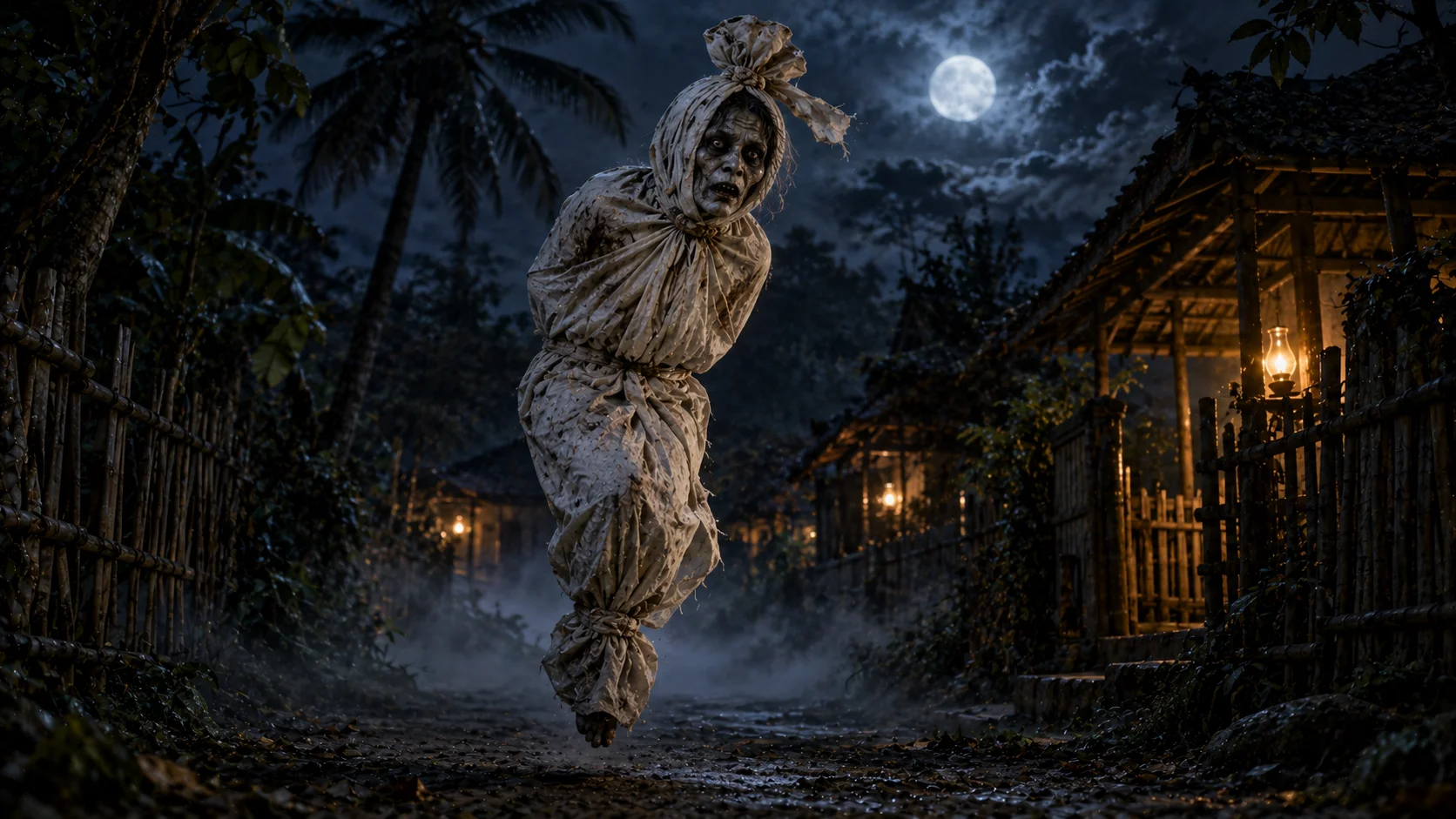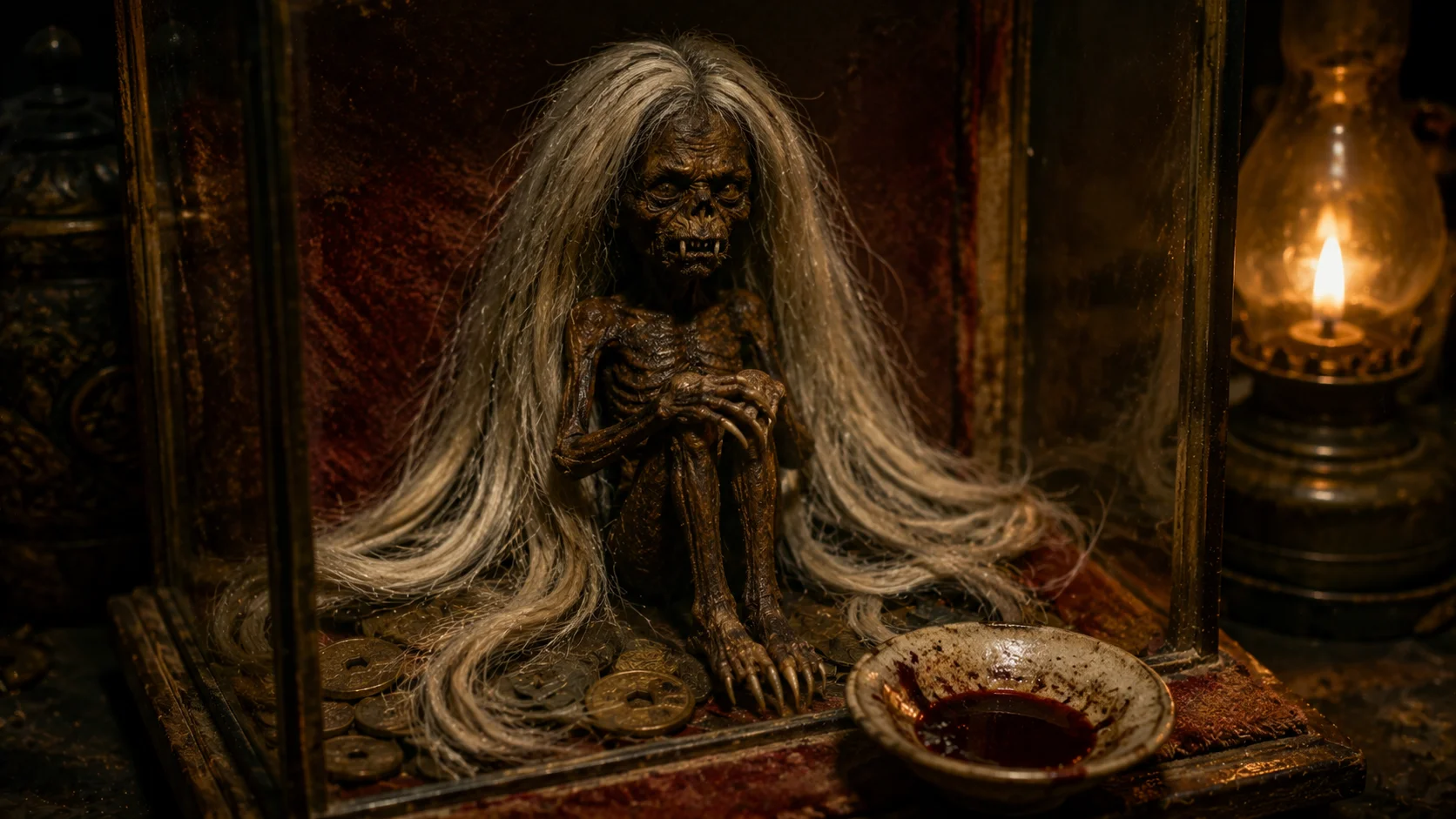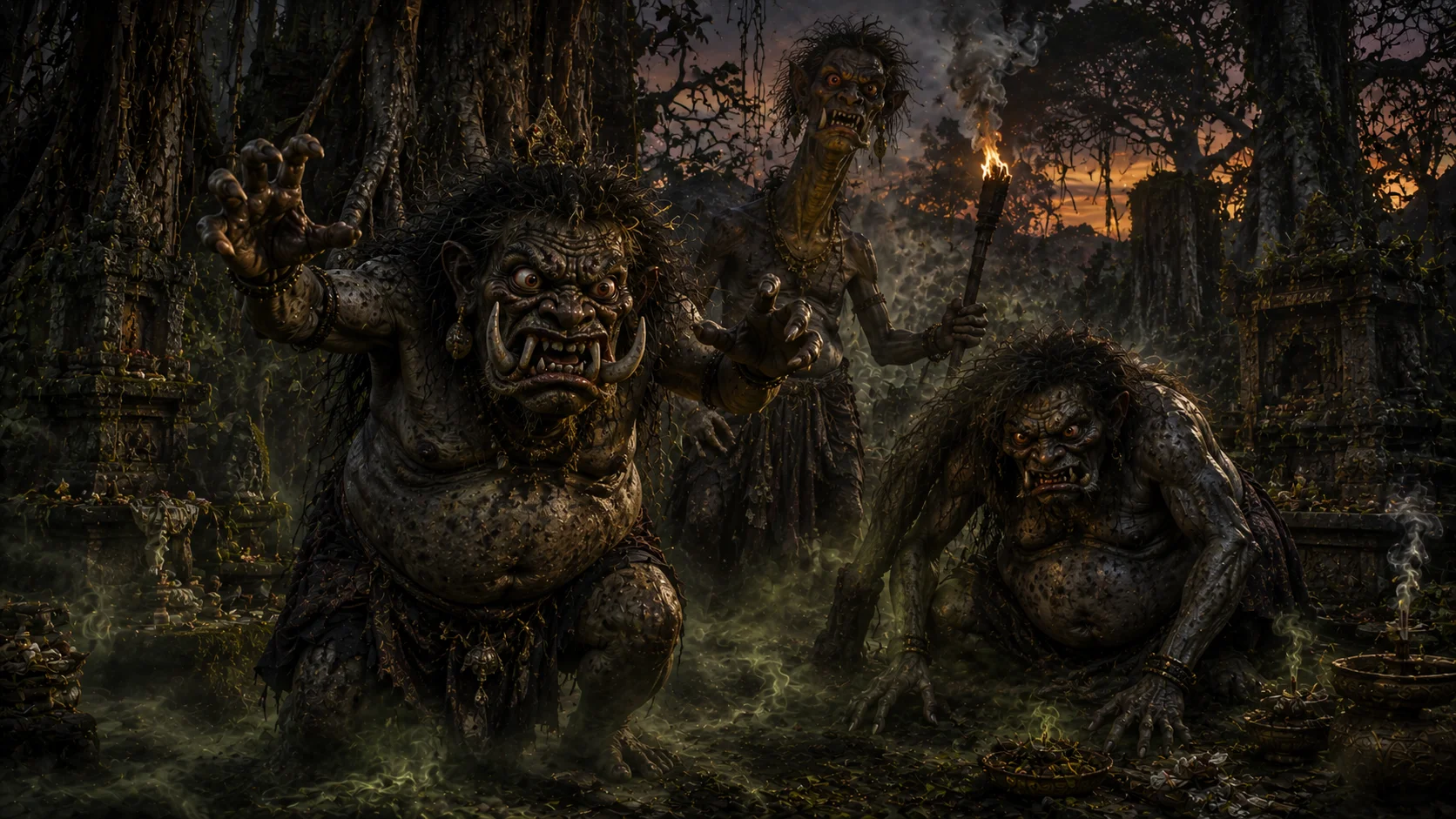
The Bota — more widely transliterated Buta or Bhuta, from the Sanskrit bhuta, "has-been," "element," or "ghost-spirit" — belong to a class of lower, often malevolent spirits within Balinese Hindu (Agama Hindu Dharma) cosmology. They are not a single named deity with a personal myth attached, but a whole order of earthbound, unrefined beings whose presence must be constantly acknowledged, fed, and balanced rather than defeated. That distinction — a class of spirit, not an individual figure — is worth holding onto from the outset, because it shapes everything else about how the Balinese relate to them.
A Class of Spirits, Not a Single Name
Where many entries in a chronicle of this kind describe one being with a lineage, a story, and a fixed identity, the Bota resist that shape. Spelling itself varies across scholarly transliteration and everyday Balinese usage — Buta, Bhuta, and Bota appear interchangeably depending on the source and the dialect of the writer. What they name consistently, however, is a category: the host of lower spirits that inhabit the Balinese world alongside the divine, the human, and the ancestral. To speak of "the Bota" is to speak of a population, not a person, and any account that flattens them into a single character risks losing what actually matters about them — their number, their diffuseness, and the sheer scale of ritual attention they require.
Bhūta and Kāla: The Paired Forces of Disorder
The Bota are standardly paired with Kāla, a time-demon figure connected to the fearsome aspect of Shiva, in the compound term Bhūta Kāla. This compound functions as the umbrella name for the disorder-bringing, unrefined, earthbound spiritual forces of the Balinese cosmos — forces that are neither purely evil nor purely benign, but raw and untransformed. Bhūta Kāla is the category ritual is built to manage: not eradicate, not worship, but hold in balance. Kāla's association with time gives the pairing a particular charge, since time itself — its passing, its cycles, its dangerous junctures — is understood in Balinese thought as a domain where these forces gather and act.
Where the Unseen Presses on the Seen
Balinese cosmology organizes the universe along two overlapping structures. The first is the tripartite division of bhur, bwah, and swah — roughly the underworld, the middle world, and the upper world — and the Bota belong to the lower, earthly register of that structure, closest to the ground, the soil, and the places where human and animal life is most exposed. The second structure is the duality of sekala and niskala, the visible and the invisible. The Bota sit on the niskala side: unseen, but not therefore unfelt. Their action on the visible world is assumed as a matter of course in daily Balinese life — a reason for illness, a cause of misfortune, an explanation for why a place feels wrong to walk through after dark.
The Raw Edge of Nature and Desire
What the Bota are said to embody is not malice for its own sake but the raw, untransformed aspects of existence — the parts of nature and of human desire (kama) that have not yet been shaped, refined, or brought into harmony. Illness, misfortune, chaos: these are the effects attributed to their unmanaged presence. This framing matters, because it places the Bota closer to a force of entropy than to a villain with intent. Balinese ritual does not treat them as enemies to be destroyed but as an ever-present, natural condition of the world that requires continual tending — the same way a garden requires continual weeding, not a single victory over weeds.
Feeding What Must Not Be Worshipped
A central and easily overlooked distinction in Balinese religious life is the difference between the devotion given to the dewa — the gods proper — and the propitiation given to the Bota and Kāla. The dewa are worshipped; the Bota are appeased. Offerings are made to the Bota not out of reverence for their virtue but to keep them content enough that they do not disturb the human world. This offering-to-appease-rather-than-worship distinction is documented in ethnographic studies of Balinese religion, including Clifford Geertz's writing on Balinese cosmology and ritual and Fred B. Eiseman Jr.'s Bali: Sekala and Niskala (1989). It is a register of religious practice distinct from prayer, closer in spirit to diplomacy than to devotion.
Bhūta Yadnya: The Ritual of Pacification
Among the Panca Yadnya — the five categories of sacred ritual in Balinese Hindu practice — one is directed specifically at the Bhūta Kāla complex: Bhūta Yadnya. This is the formal ritual apparatus built to pacify the Bota and Kāla spirits, ranging in scale from small daily household rites to the large temple-purification ceremonies that mark significant points in the ritual calendar. Bhūta Yadnya is not an occasional or optional observance; it is one of the five pillars of sacred obligation, placed alongside the yadnya owed to the gods, to ancestors, to fellow humans, and to spiritual teachers. Its inclusion at that level signals how seriously the maintenance of balance with these lower spirits is taken.
Segehan and Caru: Offerings Set Upon the Ground
The practical expression of Bhūta Yadnya takes two principal forms. Caru are ground offerings that range from modest daily gestures to elaborate ceremonies undertaken to purify a temple or a piece of land. Segehan are the smaller, more frequent offerings — rice, salt, chili, and other simple items — set directly on the ground for the lower spirits, typically at thresholds, corners, and other points where the household or village meets the wider, less governed world. These are not showpieces; segehan are humble, repeated, almost domestic acts, woven into the rhythm of ordinary days rather than reserved for festival occasions. Their frequency is itself the point: the Bota are not placated once, but continuously.
The Ogoh-Ogoh and the Night Before Silence
The most publicly visible expression of this whole tradition is the ogoh-ogoh — large effigies built from bamboo and papier-mâché by youth groups known as sekaa teruna, and paraded through the streets during Ngrupuk, the eve of Nyepi, the Balinese Hindu New Year. These effigies conventionally take monstrous Bhūta-Kāla or Bota forms: fanged, wild-eyed, exaggerated in scale and menace. They are paraded, at times spun and set against one another in mock battle, and finally destroyed or burned. The purpose of the whole sequence is purgative — to draw the negative and chaotic forces of the community into visible, effigied form and then to expel them, clearing the way for Nyepi itself, the day of total silence and stillness that follows.
Guardians Carved in Stone
Beyond the seasonal drama of Ngrupuk, Bota figures also appear in the permanent architecture of Balinese temples, carved as guardian-demon figures at gateways and thresholds. Their function there is apotropaic — their fearsome appearance is deployed defensively, to ward off forces worse than themselves, rather than as an object of veneration in its own right. This is a widely attested pattern across Southeast Asian and Indic guardian-demon traditions more broadly: the monstrous face at the gate is not there to be admired but to do a job, standing sentinel over the boundary between the ordered space within and the less governed space beyond.
The Charged Nights of Tilem and Kajeng Kliwon
Balinese ritual life follows the pawukon calendar, and within it certain days are understood to be spiritually charged in ways that intensify the need for Bota propitiation. Tilem, the dark moon, and Kajeng Kliwon days are both treated as occasions requiring extra segehan offerings, made at both the household and the village level. The logic is consistent with everything else about the tradition: these are not days of celebration for the Bota, but days of heightened caution, when the ordinary rhythm of small offerings is deliberately increased because the balance between seen and unseen is understood to be more easily disturbed.
Retinues of Rangda and the Watch of Barong
Within the wider mythic structure of the Calonarang tradition, the Bota spirits are understood as subordinate to and mobilized within the conflict surrounding Rangda, the demon queen. They form part of the retinue of chaotic forces that stand opposed, in the tradition's dramatic and ritual performances, to the protective magic of the Barong. This places the Bota not as an isolated category of nuisance spirits but as one thread within a larger fabric of Balinese cosmological drama, in which the tension between order and disorder is enacted, watched, and ritually renewed by the community itself.
Rwa Bhīneda: Balance Over Banishment
Underlying all of this is a principle that runs through Balinese religious thought more broadly: rwa bhīneda, the balance of opposing forces. The Bota are not treated as an evil to be eliminated, because Balinese cosmology does not generally frame the relationship between order and disorder as a contest to be won outright. Instead, the aim of ritual — daily segehan, periodic caru, the yearly burning of the ogoh-ogoh — is to keep the disordered and the ordered in a working equilibrium. Destroying the Bota entirely is not the goal, and arguably not even coherent within this worldview, since the raw, untransformed forces they represent are understood as a permanent feature of existence rather than an intruder that could be permanently expelled.
A Name Unsettled Across Sources
One point in this record deserves to be marked plainly as uncertain rather than smoothed over: whether "Bota" refers, in every source, specifically to this broad Buta/Bhuta spirit-class, or whether some usage of the name points to a more specific, individually named figure. The available material supports the former reading — Bota as a dialectal or colloquial spelling of Buta/Bhuta, denoting the class of lower spirits described throughout this account — and no independently attested individual myth-narrative for a singular figure called "Bota" appears in the scholarly record consulted here. That absence is itself informative. It suggests that, unlike figures with a fixed personal story, the Bota's significance lies precisely in their being many, unnamed individually, and ever-present.
What the Ethnographers Recorded
The Bhūta-Kāla complex and its associated Panca Yadnya rituals are among the more thoroughly and reliably documented parts of Balinese folk-religious cosmology, appearing across standard academic treatments including Clifford Geertz's Negara and his broader essays on Balinese ritual, and Fred B. Eiseman Jr.'s Bali: Sekala and Niskala, alongside general ethnographies of Balinese temple and village life. This is worth stating directly: where a single named mythic figure might rest on a handful of retellings, the Bota rest on a body of observed, recorded practice — offerings placed, effigies burned, calendars followed — carried out by living communities as an ongoing and unbroken part of religious life, not as a story preserved only in text. To encounter the Bota, in that sense, is to encounter a practice still being kept rather than a tale merely being told.
Sources & traditions
- TraditionBalinese folk and village traditions (Indonesia)
Myths change from area to area and from time to time. This chronicle follows the most widely told versions; tellings in other villages, regions and eras may differ.