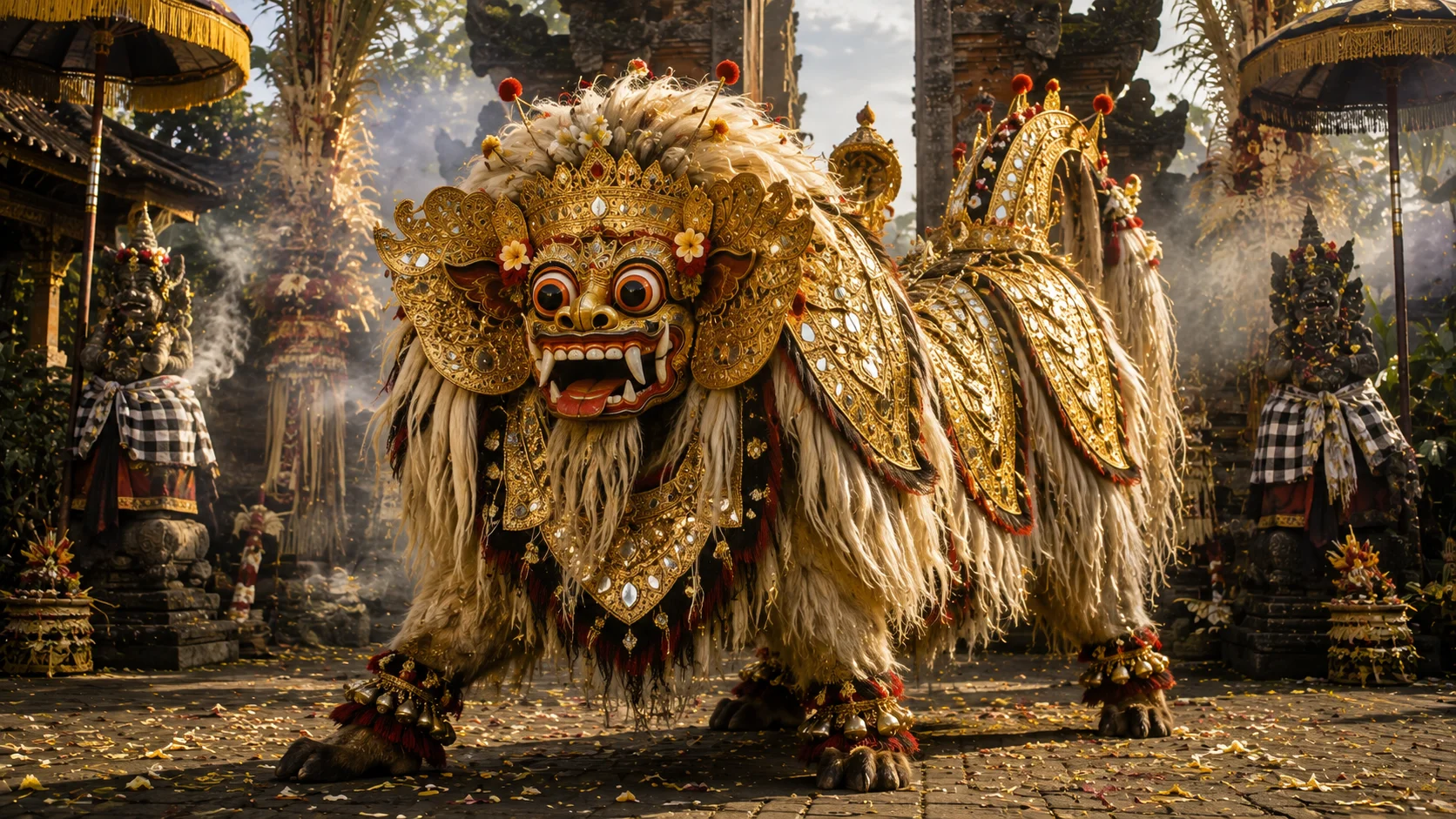
Barong is a protective spirit-being of Balinese Hindu tradition, most widely known in the form of Barong Ket — a great fringed, lion-like guardian brought to life in performance by two dancers working the front and rear of an elaborately mirrored, shaggy costume. Understood by the Balinese as a manifestation of benevolent, right-hand magic, Barong is described as a king among protective spirits and a guardian of villages, standing in perpetual, unresolved opposition to the forces of disorder. He is not a myth confined to the page — he is a living presence housed in temple masks, invited into trance, and paraded through the streets to keep a community whole.
The Shape the Mask Takes
Barong Ket's form is unmistakable: a heavy carved wooden mask with bulging eyes and a wide, snapping jaw, framed by a mane of dyed fiber or hair and hung with small mirrors and gilded leather ornamentation that catch torchlight and temple lamps alike. The costume beneath is long and shaggy, built to carry two performers in close coordination — one animating the head and forelegs, the other the hindquarters — a structural arrangement that invites comparison to the lion-dance costumes of Chinese tradition, though the resemblance is architectural rather than religious. Barong's mythic role, ritual function, and place within Balinese cosmology belong to an entirely separate lineage of meaning, rooted not in a New Year procession but in the deep structure of Balinese Hindu belief about order, protection, and the spirit world that surrounds a village.
Not One Beast But a Family of Guardians
Barong Ket is the best known of the Barong, but not the only one. Balinese villages and temples across the island maintain their own distinct Barong forms, each tied to a different animal or being and often specific to a particular place: Barong Macan takes the shape of a tiger, Barong Bangkal that of a wild boar, Barong Gajah an elephant, and Barong Asu a dog. Standing apart from these animal forms is Barong Landung, not a single beast but a pair of towering human-like puppet figures — the male Jero Gede and the female Jero Luh — who are carried rather than danced in the same sense as the animal Barong, yet belong to the same broader category of protective spirit-beings. This regional variation is well documented in the ethnography of Balinese performance: a village's Barong is not a copy of a national archetype but often a locally rooted guardian, consecrated to that place and that community alone.
The Widow of Kediri and Her Long Journey
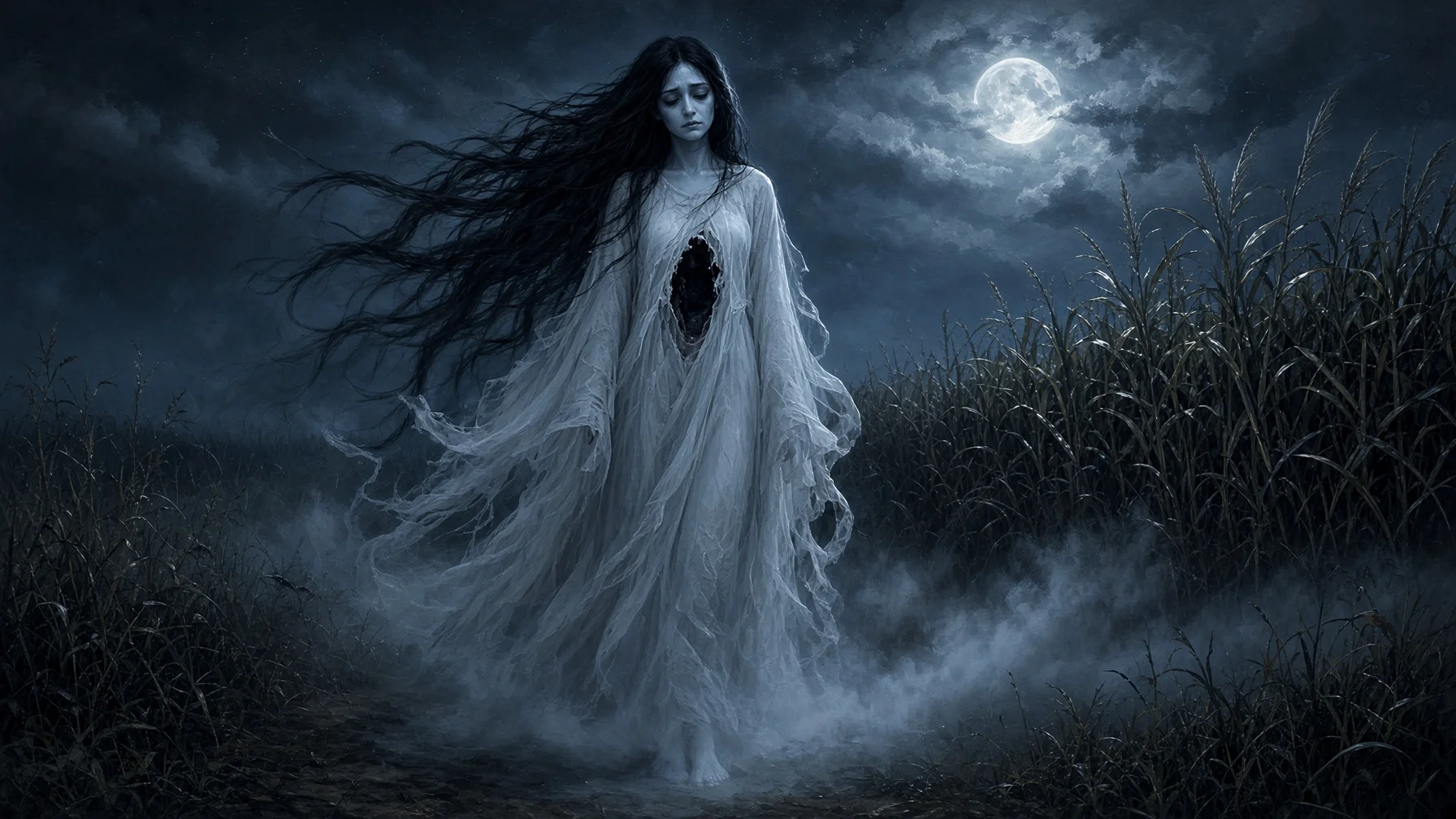
Barong's central mythic opposition is with Rangda, the demon queen — a widow-witch figure bound to black magic, to the practice known as leyak, and to death itself. Their conflict is dramatized in the Calonarang, a story and dance-drama whose roots reach back to a semi-historical figure: Calon Arang, a widow-sorceress said to have lived in the East Javanese kingdom of Kediri during the reign of King Airlangga, in roughly the eleventh century. Carried across the strait into Bali, her narrative was not simply retold there but re-rooted — absorbed into ritual performance and given a new life in temple courtyards, where it continues to be enacted as something closer to a living rite than a piece of theater recalling a distant past.
A Balance, Not a Victory
It would be a misreading to treat the Barong-Rangda conflict as a simple story of good triumphing over evil. Balinese cosmology frames their struggle through the principle of rwa bhineda — the necessary and perpetual balance of opposing cosmic forces, order set always against chaos, the right-hand way set always against the left. Performances of the Calonarang and its Barong dance conventionally end not with Rangda's destruction but with the struggle unresolved, or cyclically renewed at the next telling. Balinese performers and scholars alike are explicit on this point: the drama does not exist to declare a winner. It exists to enact, again and again, the tension that keeps the world upright.
When the Blades Turn Inward
The most thoroughly documented sequence in Barong performance arrives at its climax. Rangda casts a trance — kerauhan — over the men who follow Barong, and under her spell they draw their kris daggers and turn the blades against their own bodies. It is Barong's protective power, the tradition holds, that keeps the blades from piercing the entranced dancers' skin even as they press the points into their own chests. This self-stabbing trance ritual has drawn the attention of outside observers since early in the twentieth century, most notably the anthropologist Jane Belo, whose 1960 study "Trance in Bali" remains a foundational account of what she and others witnessed and photographed in temple courtyards across the island. Few elements of Balinese ritual performance carry as strong or as long a documentary record.
Sacred Rite Before It Is Entertainment
Balinese performance culture sorts its dances by degree of sacredness, a tripartite ranking running from wali and bebali — ritual forms performed within or adjacent to sacred space — down to balih-balihan, performance meant purely for an audience. The full Barong dance, performed in its proper temple-ritual context and especially during a temple's odalan anniversary festival, belongs to the sacred end of that spectrum. The shorter, daytime Barong-and-Kris performances staged for visitors are a different thing entirely: a deliberately abbreviated and desacralized adaptation, built to fit a schedule and a stage rather than a ritual calendar. Scholars of Balinese dance, among them I Made Bandem and Fredrik deBoer, have written carefully about this distinction, and it is one worth holding onto — the tourist show and the temple rite share choreography but not standing.
A Mask That Can Hold a Spirit
A Barong mask and costume are not treated as props in the ordinary sense. They are tapakan — vessels capable of being inhabited by a deity or spirit — and as such they are ritually consecrated through a pasupati ceremony, housed within a village temple, and given regular offerings as one would give to any other sacred presence. Balinese tradition holds that a Barong mask can carry taksu, a form of spiritual power and charisma, and a small number of especially old or potent Barong are handled with particular reverence, their care and even their touching restricted to specific members of the community that owns them. To speak of "the Barong costume" as mere craftsmanship misses what the object is understood to be capable of holding.
Guardian of Dharma
Within Balinese religious thought, Barong is widely understood — by practitioners and by scholars of Balinese religion alike — as an embodiment of dharma, cosmic order and rightful duty, standing against adharma, its disruption. This is not an abstract theological position; it has a practical, village-level expression. Barong is invoked especially in moments of perceived spiritual vulnerability — an outbreak of illness, a calamity, a sense that something in the community has slipped out of balance — as well as through the ordinary rhythm of the temple ritual calendar, where his presence is called on to restore what has been disturbed.
Door to Door Through the Village
Beyond the temple-bound drama of the Calonarang, Barong has a second, more itinerant ritual life. In ceremonies called ngelawang, a Barong is paraded from house to house or through the streets of a village, dancing at each threshold, especially during the period surrounding Galungan and Kuningan. The purpose here is more local and more immediate than the temple drama's cosmic balancing act: cleansing negative spiritual influence, bhuta kala, at the level of the individual household. Where the Calonarang performance addresses the community and its temple as a whole, ngelawang brings the same protective presence directly to a family's door.
Barong Among the Bhuta Kala
Barong does not stand alone in the wider landscape of Balinese spirit-cosmology. The bhuta kala — lower spirits associated with disorder and malevolent influence — populate the same ritual world that Barong and Rangda inhabit, and Barong's protective function is defined in part by his role guarding communities against the disruption such spirits, and Rangda's forces, can bring. Barong, Rangda, and the bhuta kala are best understood not as three isolated legends collected under one cultural umbrella, but as three linked and distinct categories within a single, coherent ritual-cosmological system — each with its own character and function, each meaningful partly in relation to the others.
What Is Settled, and What Remains an Open Question
The Barong-Rangda tradition and the Calonarang performance complex rank among the most thoroughly documented elements of Balinese religious performance in both Western and Indonesian scholarship, with a record stretching from Covarrubias's earlier "Island of Bali," published in 1937, through Belo's mid-century fieldwork to Bandem and deBoer's 1981 study "Kaja and Kelod: Balinese Dance in Transition." That gives Barong an unusually strong ethnographic foundation. What remains genuinely unsettled, and what should be presented as such rather than resolved in either direction, is the question of Barong's ultimate origin: whether the lion-like form of Barong Ket descends from a pre-existing Austronesian or indigenous Balinese animist guardian-spirit tradition that was later overlaid with Hindu-Javanese narrative material — the Calonarang story among it — or whether it represents a more purely Hindu-period importation to the island. Scholars have not resolved this, and neither claim should be asserted as settled fact.
A Living Balance
What endures across all of this — the mask in its temple shrine, the trance dancers with blades pressed to their own chests, the procession moving door to door at Kuningan, the unresolved clash with Rangda performed again at the next odalan — is a single understanding held in common: that protection is not a permanent state won once and kept forever, but a balance renewed continually, through ritual, through performance, through the ongoing presence of a guardian spirit that a community has agreed to house, honor, and call upon. Barong's story does not end because it is not built to end. It is built to be reenacted, season after season, for as long as the village that keeps him continues to ask for his protection.
Sources & traditions
- EncyclopediaWikipedia — Barong (mythology)
- TraditionBalinese folk and village traditions (Indonesia)
Myths change from area to area and from time to time. This chronicle follows the most widely told versions; tellings in other villages, regions and eras may differ.