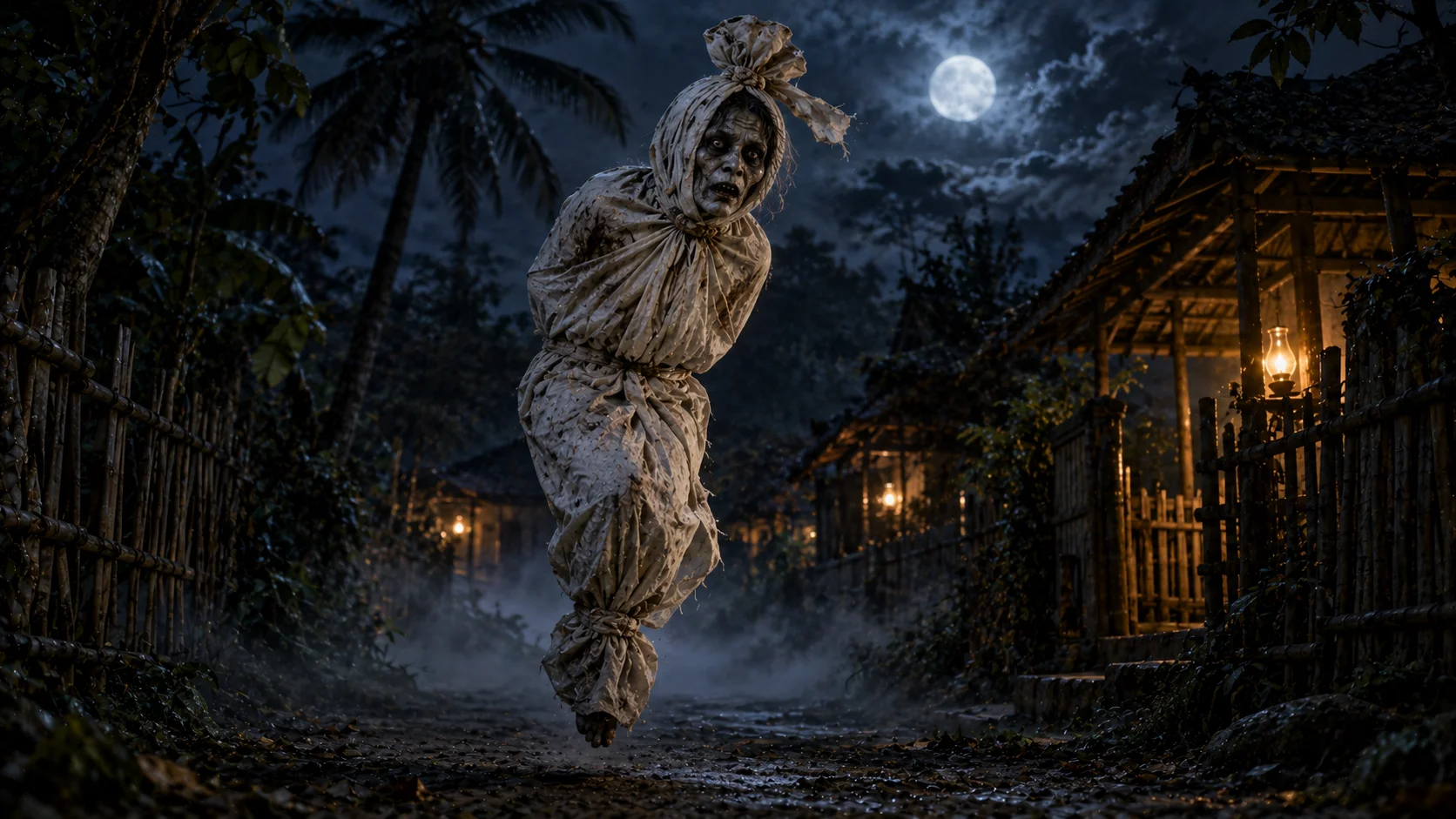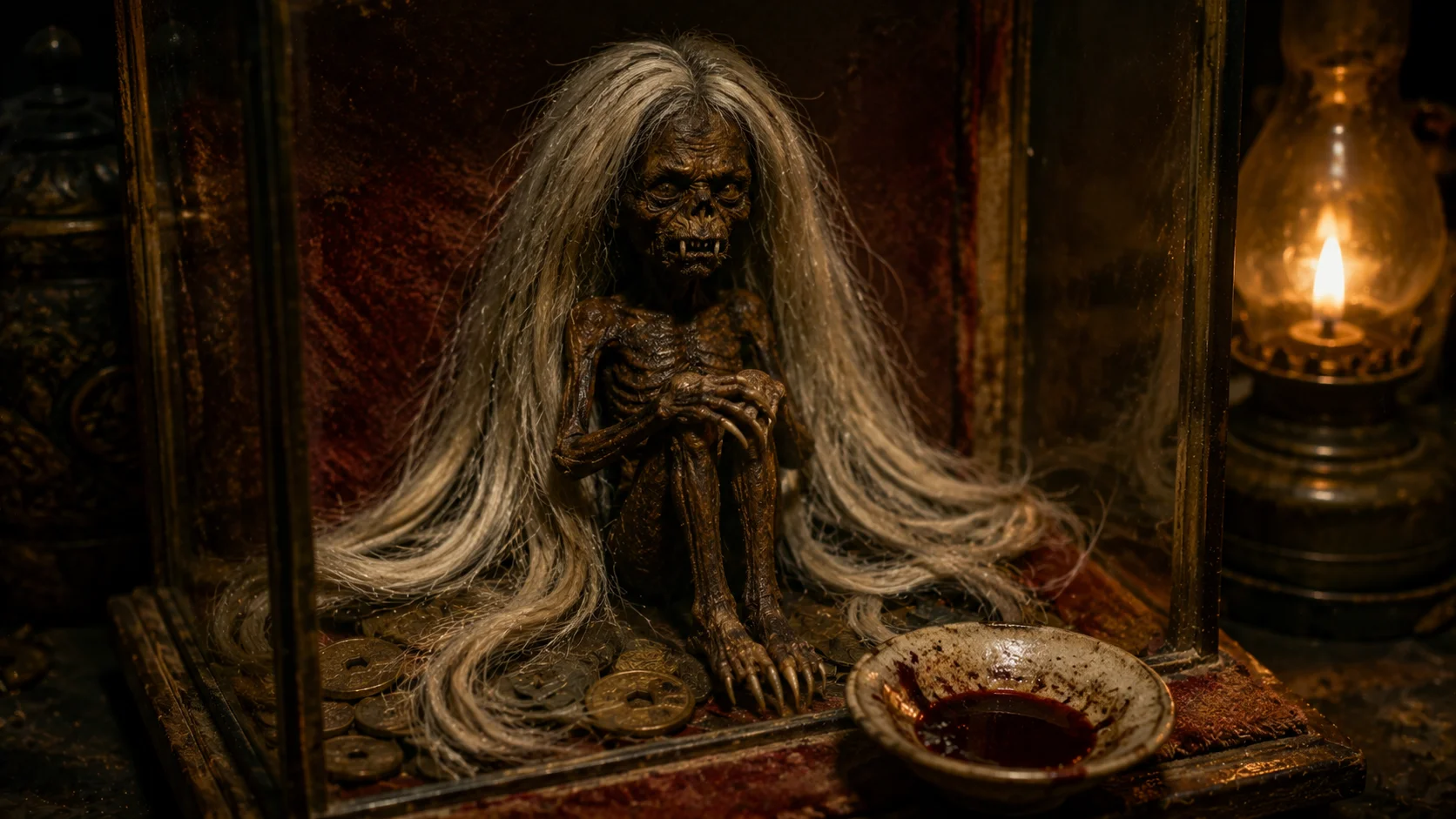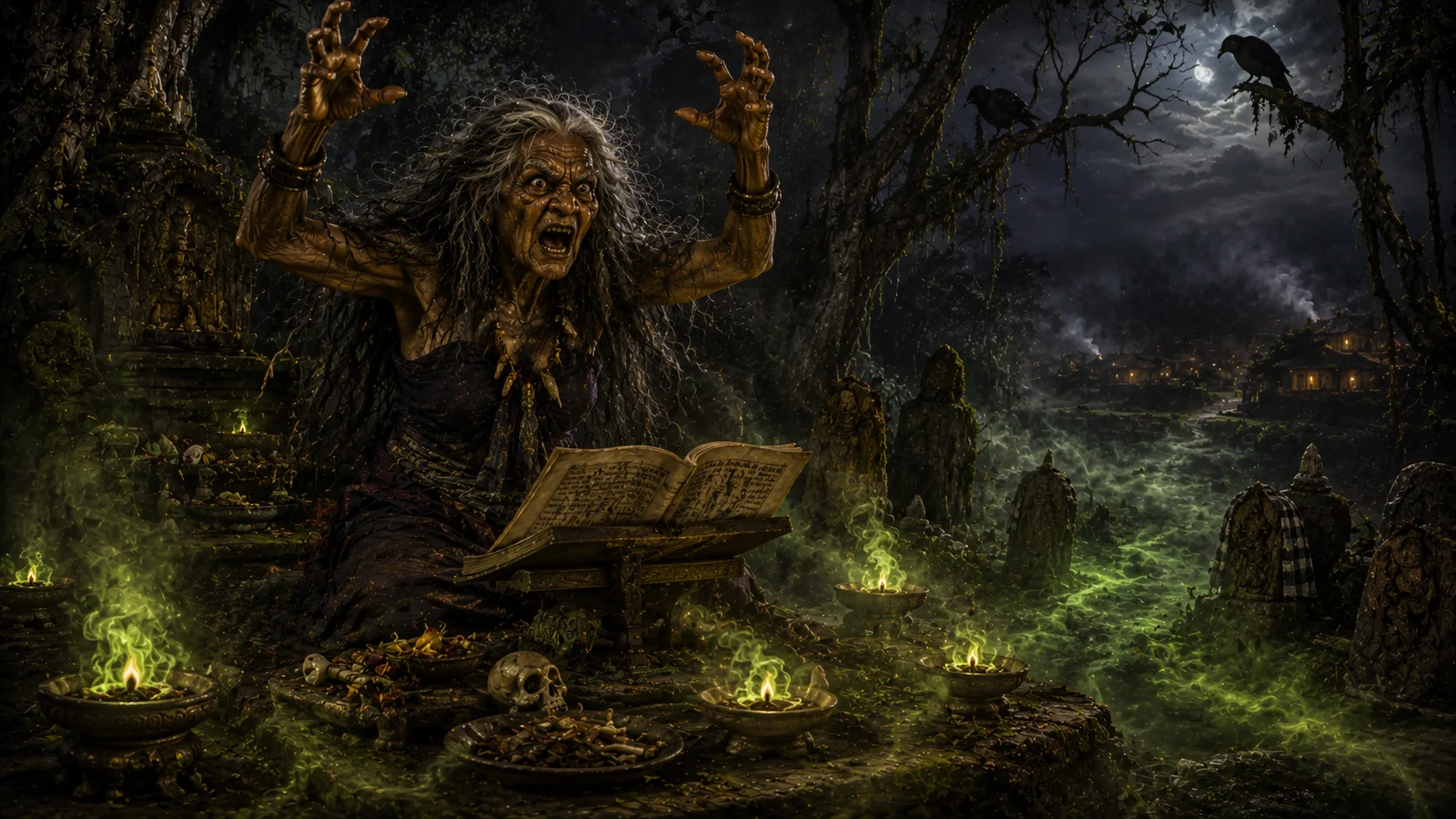
Calon Arang is remembered in Javanese and Balinese tradition as a widow of formidable and dreaded power — a practitioner of black magic whose grief and fury, provoked by her daughter's unmarriageable reputation, brought plague upon a kingdom. Her story survives chiefly through the Javanese Middle-period narrative Cerita Calon Arang, known today from Balinese lontar (palm-leaf) manuscript copies, and it remains, in Bali, a living ritual inheritance rather than a closed literary tale. The narrative is traditionally set in the Kediri-era court associated with King Airlangga, though the surviving manuscripts are later Balinese redactions, and scholars treat the precise dating and even the historicity of Calon Arang herself as open questions rather than settled fact.
A Widow's Reputation in Girah
The story places Calon Arang in the village of Girah, where she lived as a janda — a widow — versed in desti, the black arts, and known as a leak: one who commands magical forces associated with death and the unseen. Her standing in the village was not merely feared but structurally isolating: reputation itself became the engine of the tragedy that followed. She had a daughter, Ratna Manggali, described in the tradition as beautiful, yet no family in the kingdom would permit a son to marry her, so thoroughly did dread of the mother eclipse any regard for the daughter. This is the wound at the center of the narrative — not cruelty enacted upon others first, but a humiliation absorbed, which then curdled into vengeance.
Devotion at the Setra
Calon Arang's power is inseparable from her devotion to Bhatari Durga, worshipped in her fierce, death-associated aspect at the setra — the graveyard or cremation ground. This setting matters: in Balinese religious geography, the setra is not merely a place of the dead but a threshold space where left-hand (pengiwa) magical practice is understood to draw its potency. Calon Arang's practice there situates her within a real and recognized current of Balinese-Hindu theology, in which Durga holds a dual nature — benevolent in some manifestations, terrible and destructive in others. Calon Arang is a devotee specifically of the latter aspect, and Balinese tradition does not treat this duality as a contradiction to be resolved but as a fundamental structure of the divine itself.
The Grubug Unleashed
Unable to secure her daughter's marriage and consumed by rage at the shame she believed the kingdom had heaped upon her family, Calon Arang turned to Durga at the setra and called down a grubug — a plague — upon King Airlangga's realm. The dead multiplied faster than the living could mourn them, and the narrative frames this catastrophe not as random misfortune but as the direct, terrible consequence of one woman's power fused with one goddess's most fearsome aspect. It is worth sitting with the shape of this myth rather than flattening it: this is not a tale of motiveless evil but of a specific social wound — the daughter's exclusion — metabolized into magical retribution on a kingdom-wide scale.
The King Turns to Mpu Baradah
Facing a plague he could not contain by ordinary means, Airlangga sent for his advisor and priest, Mpu Baradah (Empu Bharada), a figure of great spiritual learning. Mpu Baradah's role in the story is not that of a warrior but of an investigator and, ultimately, a spiritual counterforce — someone whose power is coded as knowledge and holiness rather than force alone. His task was first to understand what he faced: to trace the plague to its source in Girah and to determine how a power rooted in secret ritual and a hidden text might be approached at all.
A Marriage as Strategy
The stratagem devised to penetrate Calon Arang's household is one of the narrative's most distinctive turns: Bahula — Mpu Baradah's son or disciple, depending on the telling — was married to Ratna Manggali. The marriage is presented in the tradition as an act of infiltration rather than romance for its own sake, though it also resolves, however uneasily, the very grievance that had set the plague in motion: the daughter finally married. Through this union, Bahula gained access to the inner life of Calon Arang's household — access that no direct confrontation could have won.
The Secret Beneath the Shrine
Within the household, Bahula discovered the source of Calon Arang's power: a sacred manuscript or formula, sometimes called the Book of Rerawos, kept concealed beneath a family shrine. This detail carries real weight in the tradition — power of this kind is not simply innate but textual, transmissible, and vulnerable precisely because it is written down and hidden rather than diffuse. Bahula reported what he had found back to Mpu Baradah, and it was this intelligence, more than any direct clash, that made the eventual confrontation possible.
Spiritual Combat at Girah
Armed with knowledge of the manuscript's contents, Mpu Baradah confronted Calon Arang directly. The climactic encounter is described across different tellings with real variation in tone: some render it as an outright defeat, even destruction, of Calon Arang by the priest's superior spiritual force; others frame it less as annihilation and more as pacification or liberation — a moksha of her leak power, in which her fearsome capacity is not simply crushed but spiritually released or transformed. This divergence is not incidental. It reflects a broader Balinese reluctance to reduce the story to simple villainy defeated by simple virtue, and it should be held as a genuine feature of the tradition rather than resolved in favor of one reading.
Rwa Bhineda: The Logic Beneath the Story
To read Calon Arang only as a monster vanquished by holiness is to miss how the narrative actually functions within Balinese cosmology. She embodies the destructive, adharmic pole set against Barong, the benevolent protective spirit-lion, and their opposition enacts rwa bhineda — the principle that balance depends on the coexistence of opposing cosmic forces, not on the permanent elimination of one by the other. This is why the Calon Arang story does not end with her erasure from the world's memory or ritual life. Her power, and the force she represents, remain necessary counterweights within a cosmology that does not imagine good as the absence of its opposite but as its ongoing, ritually managed balance.
The Disputed Kinship with Rangda
Calon Arang is closely associated in Balinese performance tradition with Rangda, the widow-witch queen mask-figure central to the Barong-Rangda ritual dance. It is tempting to state plainly that Calon Arang "became" Rangda, and popular retellings often do so — but this should be handled carefully. Balinese tradition and scholarship generally treat Rangda as a related yet distinct or composite figure, one that folk and performance tradition, over time, merged with or modeled upon Calon Arang. Whether the two are ultimately the same figure under different names, or two figures whose identities converged through centuries of performance, is genuinely unsettled, both academically and within Balinese tradition itself. Any account that asserts a clean, settled identity between them is overstating what is actually known.
Her Disciples and the Leyak
Calon Arang's story also names her students or disciples as witches — figures aligned in Balinese folk belief with the leyak, practitioners said to command shape-shifting and curse-craft in service of dark ends. Their assistance to her curses situates Calon Arang not as a solitary anomaly but as the head of a recognized current of practice, with its own transmission of knowledge and its own community of adherents, however feared. This detail reinforces the textual, teachable nature of her power already visible in the hidden manuscript beneath her shrine: what she commands is learnable, and therefore able to be both passed on and, eventually, uncovered.
Living Performance, Not Distant Memory
The Calon Arang story continues to be enacted in Bali through the Calonarang dance-drama, frequently performed at temple anniversaries (odalan) or during periods considered spiritually vulnerable. This is not staged as costume theater at a safe remove from belief. Many Balinese performers and audiences hold that the performance carries real magical potency — practitioners in these dramas have been described as entering trance or possession states attributed to leyak spirits during the enactment. This detail matters for how the whole tradition should be approached: the boundary between "story" and "rite" is, for many practitioners, not a boundary at all, and the narrative's charge is understood as active rather than archival.
Between Java's Court and Bali's Temples
A final distinction deserves emphasis. The narrative's origin point is textually and historically tied to the Javanese Kediri court era, associated in tradition with King Airlangga's eleventh-century reign. Yet the figure's devotional and performance life today is overwhelmingly Balinese-Hindu — sustained through lontar transmission, temple ritual calendars, and the Barong-Rangda dramatic tradition. Collapsing these two contexts into one another — treating the historical Javanese setting as though it were interchangeable with the living Balinese religious practice that has carried the story forward — would misrepresent both. The story's origin and its ongoing life are related but not identical, and both deserve to be named on their own terms.
Sources & traditions
- EncyclopediaWikipedia — Calon Arang
- TraditionBalinese folk and village traditions (Indonesia)
Myths change from area to area and from time to time. This chronicle follows the most widely told versions; tellings in other villages, regions and eras may differ.