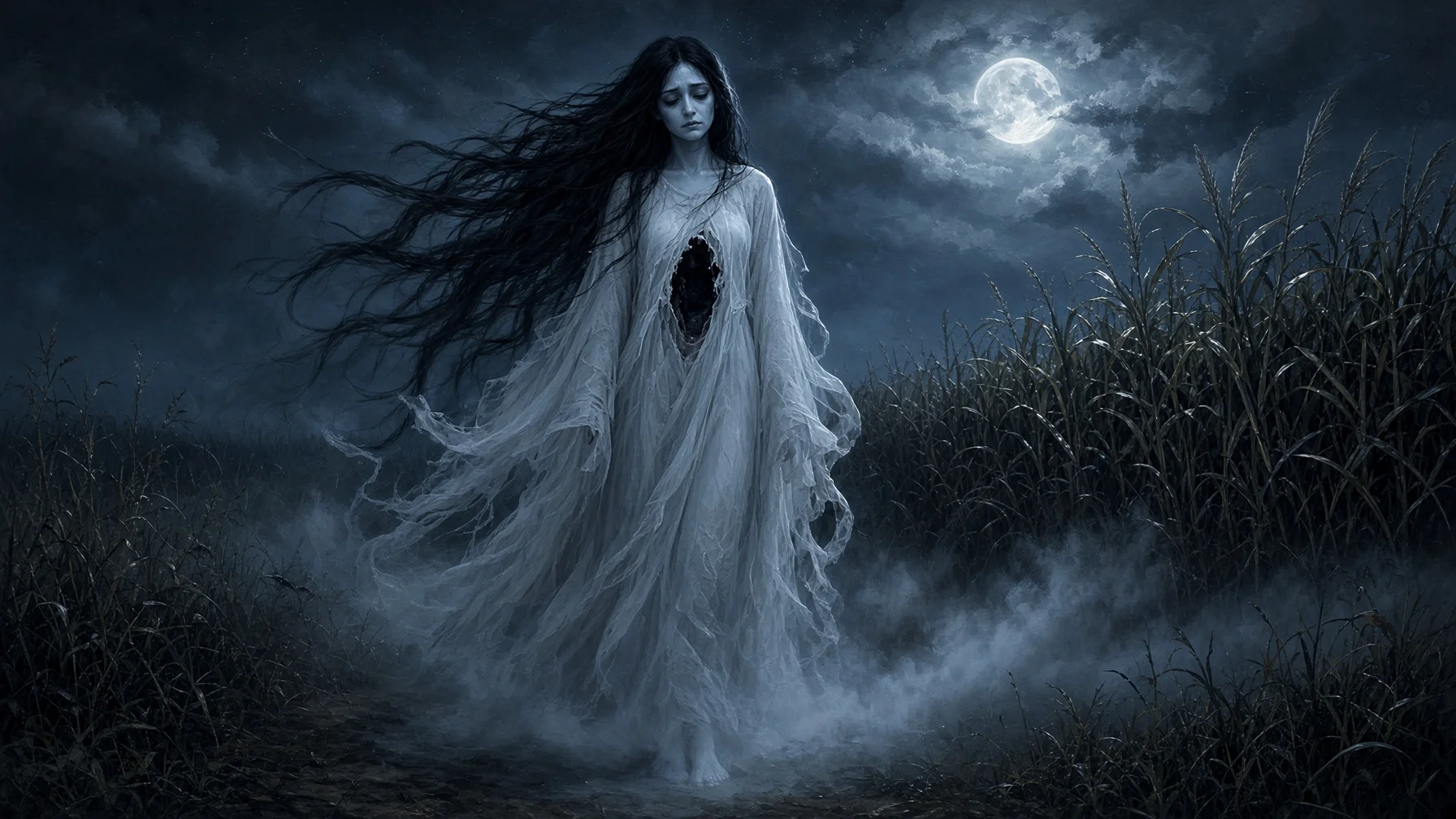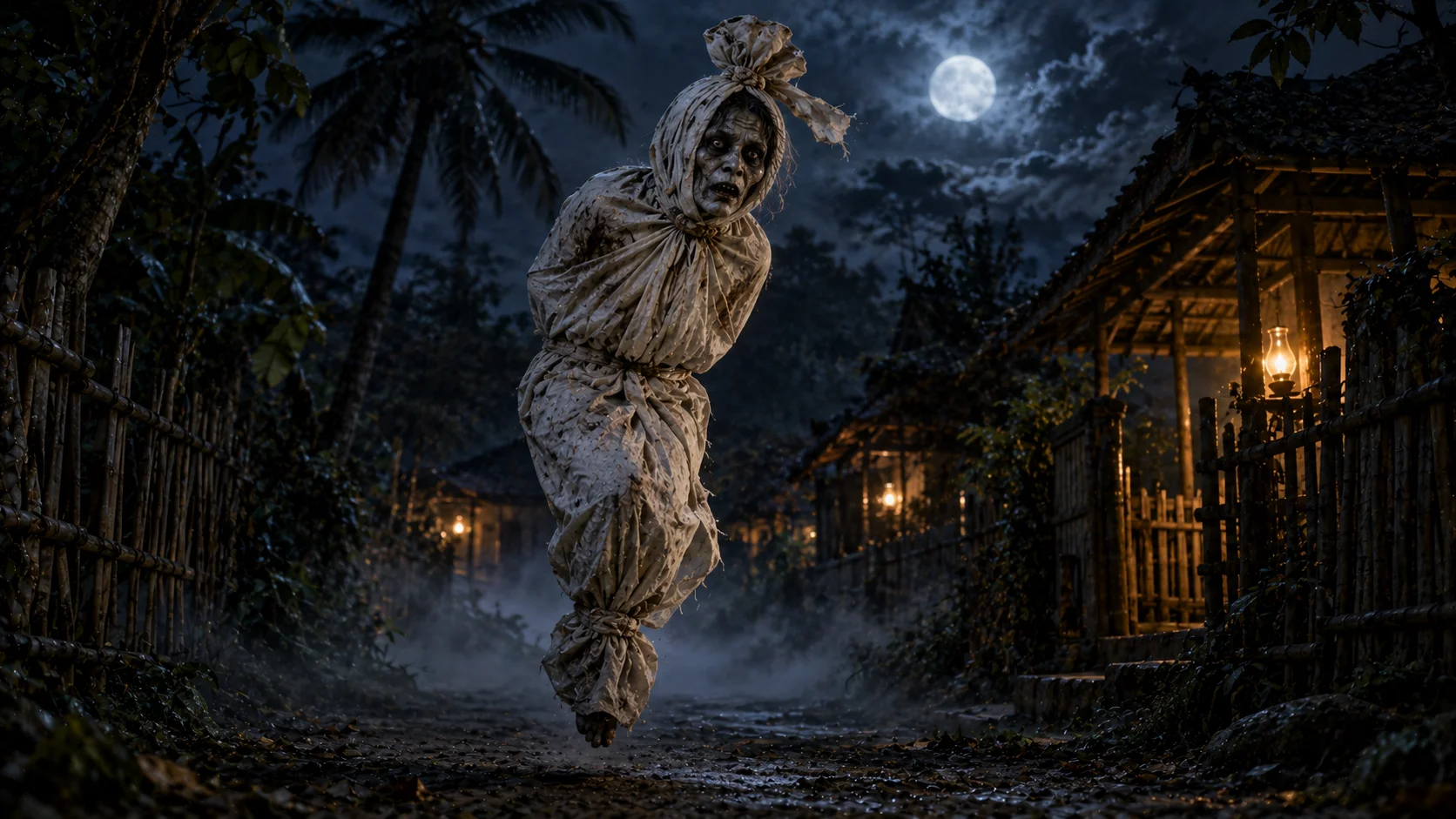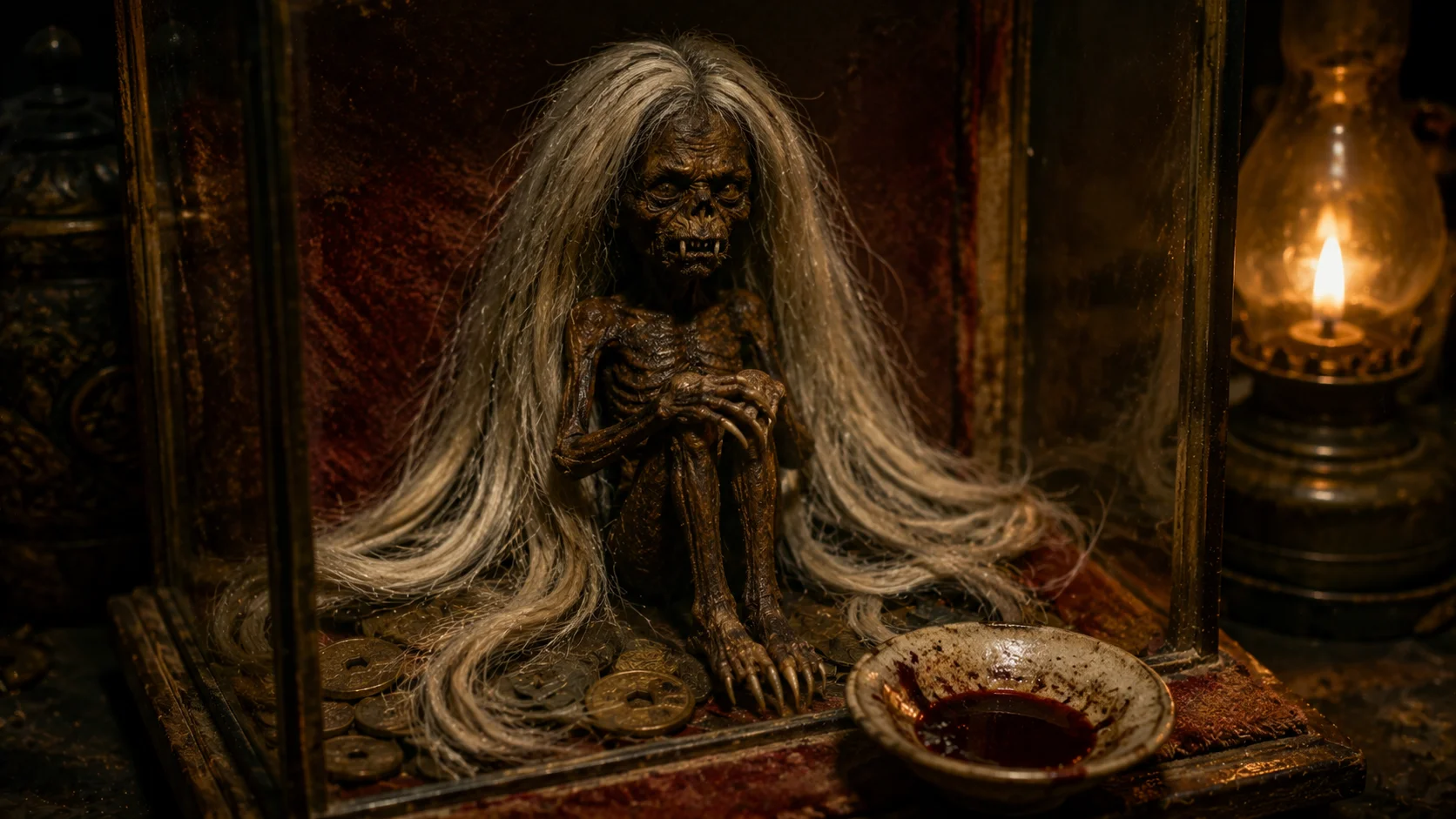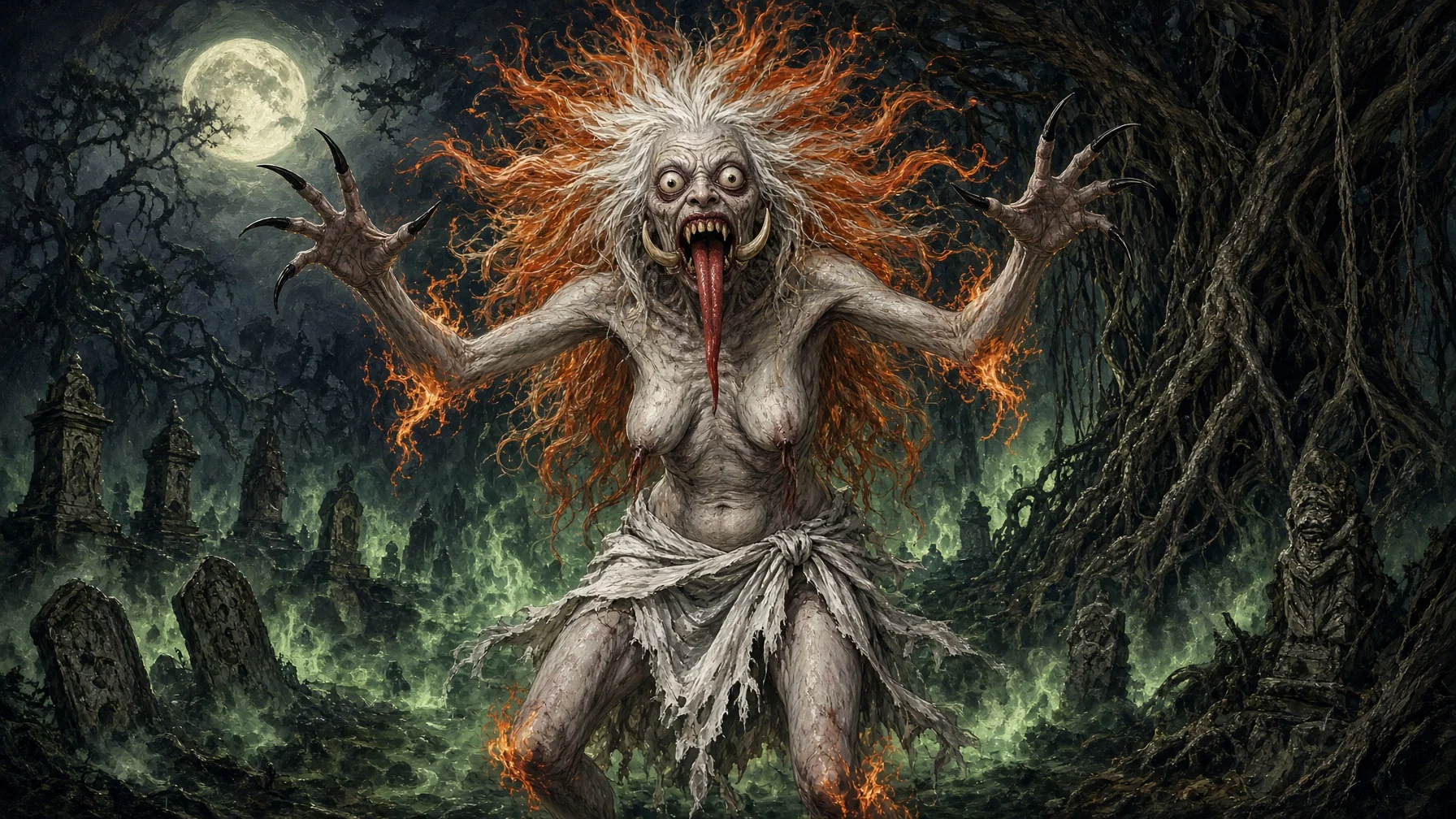
Rangda is the demon-queen of Balinese mythology — the terrifying witch-goddess of black magic, death, and destruction, the leader of the evil spirits and the eternal adversary of the protective lion-beast Barong. With her wild mane of hair, her bulging eyes, her long fangs and lolling fiery tongue, her pendulous breasts and claw-like nails, Rangda is the fearsome embodiment of the destructive forces of the cosmos, the dark half of the eternal balance at the heart of Balinese belief.
The Terrible Witch-Queen
Rangda (the name means “widow”) is the queen of the leyak (the witches and were-creatures of Balinese black magic) and the ruler of the demons. Her appearance is the stuff of nightmare: a hideous old woman with a mask of fury — wild white or flame-coloured hair streaming to the ground, eyes huge and protruding, a mouth full of fangs with a long flame-like tongue, sharp tusks, claw-nailed hands, and naked drooping breasts. She is the mistress of black magic, the bringer of plague and death, the devourer of children, the queen of the dark arts — a figure of genuine terror in Balinese belief, her image so powerful that her mask is treated as deeply sacred and dangerous.
The Eternal Enemy of Barong
Rangda’s great role is as the eternal opponent of Barong in the cosmic struggle of good and evil. In the sacred Barong dance, Rangda comes forth with her black magic to attack the people and do battle with the protective Barong. At the climax, she casts a spell upon Barong’s kris-bearing followers, compelling them to turn their daggers upon their own breasts in a suicidal trance — but Barong’s counter-magic makes them invulnerable, and they press the blades to their chests unharmed. The duel of Rangda and Barong does not end in the final victory of either: in Balinese belief, the destructive force of Rangda and the protective force of Barong are eternal, complementary opposites (the rwa bhineda), and their balance — not the triumph of one — sustains the order of the world.
Calon Arang and the Origin of Rangda
Rangda is closely identified with the legend of Calon Arang, a powerful and vengeful witch of Javanese-Balinese tradition whose story is the mythic basis of the Rangda figure: a widow versed in black magic who, in her rage, unleashed plague and destruction upon a kingdom, and was confronted by holy power. As the deified or demonic culmination of this legend, Rangda embodies the terror of the vengeful witch and the destructive feminine power of black magic. Her worship and her dance are bound up with the very real Balinese reverence for and fear of the dark arts and the forces of destruction that must be acknowledged, propitiated, and held in balance.
Legacy
Rangda endures as one of the most powerful and terrifying figures of Balinese culture — the demon-queen of black magic and death, the leader of the leyak, the eternal adversary of Barong. In her the Balinese gave form to the destructive force of the cosmos and to the terror of the dark arts, and in the sacred Barong dance her eternal struggle with the lion-beast re-enacts the balance of good and evil that sustains the world. As the fanged, fiery-tongued witch-queen who dances against the light, Rangda remains the dread dark power at the heart of Balinese myth.
The Widow of Girah
In the story that gives Rangda her human face, she is not born a demon — she becomes one. The Calon Arang narrative, set in the East Javanese court of the historical king Airlangga, tells of a widow from the village of Girah — Dirah or Jirah in other tellings — who has mastered the black arts and worships Durga at the village graveyard by night. Calon Arang has a daughter, Ratna Manggali, beautiful and unmarried: no suitor in the kingdom will approach her, terrified of the mother he would inherit. Humiliated on her daughter’s behalf, Calon Arang gathers her disciples at the cremation ground, invokes Durga, and unleashes a plague upon the land. Corpses pile faster than they can be burned, and the soldiers sent against her are destroyed by her sorcery before they reach her door.
The kingdom is saved not by force but by cunning. The priest Mpu Bharada sends his pupil Bahula to court Ratna Manggali — a marriage that finally gives an outsider the run of Calon Arang’s house. Once inside, Bahula finds and steals the manuscript in which her most lethal spells are written, the source of her power, and carries it to his master. Armed with her own magic, Mpu Bharada confronts her directly, and in the versions the Balinese tell today he does not simply kill her: overpowered, she is released rather than merely destroyed, granted at last the liberation she could not reach alive. It is that liberated-yet-still-terrible remainder which Balinese tradition identifies with Rangda — not the living widow of Girah, but what she became after death, a power loose in the world rather than contained in one grave.
Durga of the Graveyard
Calon Arang does not invoke just any power at the cremation ground. She invokes Durga, and that detail is the key to who Rangda actually is. In Bali, Durga is approached in her fierce, world-dissolving aspect at the Pura Dalem, the temple of the dead — one of the three temples every traditional village maintains, alongside the temple of origin and the village temple. It is the one sited at the seaward, downstream end of the settlement, beside the graveyard: the point where the village turns to face decay and the forces that return flesh to the earth. Rangda is widely understood as a Balinese face of this graveyard Durga — not a folk invention set against the Hindu pantheon, but a local and densely dramatised expression of a goddess whom Balinese Hinduism already holds to be genuinely dangerous when approached without the correct rites. It is the same logic that places the leyak so persistently among graves and temples of the dead: in Balinese belief that is where the membrane between the living world and the world of spirits runs thinnest, and where power of this kind is at once most available and most perilous to seek.
The Mask That Must Not Touch the Ground
Not every Rangda mask used in performance is treated as a prop. Certain masks — old, ritually consecrated, kept in temple storehouses rather than backstage trunks — are held to carry real spiritual charge, and are handled accordingly: wrapped in cloth, given offerings and incense before they are put on, carried rather than worn casually between scenes, never left to rest on bare ground. A mask of this kind is not simply put on for a role. The dancer who takes it up is understood to be inviting something into himself, and troupes treat that boundary as real rather than theatrical, which is why consecration and periodic re-consecration matter to a village more than craftsmanship does, and why people speak of a particular mask as having power of its own, quite apart from whoever is inside it. Around the sites where Rangda appears, the black-and-white chequered cloth called poleng is wrapped about shrine stones, gateways and guardian figures: the pattern is Bali’s visual shorthand for rwa bhineda, the inseparable pairing of opposed forces, and it marks a place as a threshold between them rather than as standing firmly on either side.
Beyond the Tourist Stage
The version of the Barong and Rangda drama most visitors to Bali see is a compressed daylight performance, staged for a ticketed audience and a fixed running time. It is not a fabrication — the story and the choreography are genuine — but it is a different object from the ritual it is drawn from. In its full ceremonial form the drama belongs to the night and to a temple courtyard, tied to a temple’s anniversary or to another point in the ritual calendar, with no schedule built around tourist convenience. The difference is not decorative. In those settings the trance can be real rather than acted: performers lose consciousness of themselves, and priests stand by with holy water to bring them back afterwards. What the daytime show presents as a climax is, in the temple, an event whose outcome the community treats as consequential. The tourist dance is a window offered to outsiders; the practice it looks onto is not a metaphor for the Balinese who perform it, but a periodic re-enactment understood to hold the destructive and protective forces of the world in the balance the tradition says they require.
Mead, Bateson, and the Camera
Rangda entered Western scholarship largely through the fieldwork of the anthropologists Margaret Mead and Gregory Bateson, who spent extended periods in Bali during the 1930s and documented trance practice with camera and cine film rather than with the notebook alone. Their footage of a Barong and Rangda ceremony, later released as the short film Trance and Dance in Bali, became one of the most widely circulated pieces of ethnographic film of the twentieth century, precisely because it carried what prose struggles to convey: the visible, physical reality of trance — the collapse, the blades, the recovery. It let Western academia meet Rangda not as a costume or a folktale character but as the centre of a living ritual technology for managing fear. The decades since have layered a stranger afterlife onto the figure. Indonesian genre cinema found in the leyak a durable horror subject and pushed the imagery toward spectacle — the flying head trailing its own entrails, the hidden manuscript of forbidden spells — carrying a coarsened version of Rangda’s world to audiences who had never heard her name.
Why Rangda Still Dances
It would be easy to read Rangda as misogyny given a shape: the ageing widow punished with fangs and sagging breasts for the crime of being past use to men. Balinese tradition does not read her that way, and the difference matters. She is never finally killed in the dance, never exorcised for good, because the belief that produced her does not hold that evil can or should be eliminated from the world — only balanced. A Barong triumphant and permanent would be, in this cosmology, its own kind of catastrophe: order with nothing left to hold it accountable, protection with nothing left to protect against. Rangda persists because she is doing work the culture considers necessary rather than regrettable. She is invited back, ritual season after ritual season, so that a community can keep rehearsing its own capacity to look at what she represents and not be destroyed by it. That is a harder and more demanding idea than good defeats evil, and it is why her mask is treated as dangerous rather than decorative. Bali is not pretending the fear is fictional. It is agreeing, once again, to face it.
Sources & traditions
- EncyclopediaWikipedia — Rangda
- TraditionBalinese folk and village traditions (Indonesia)
Myths change from area to area and from time to time. This chronicle follows the most widely told versions; tellings in other villages, regions and eras may differ.