Banasura — Bāṇāsura, "the arrow-demon" — was a thousand-armed asura king, eldest of the hundred sons of the great Asura sovereign Mahabali, and one of the most ardent worshippers of Shiva in all asura lore. His descent from Mahabali ties him to the same Puranic Asura lineage that produced the earlier Vamana-Bali cycle, though Banasura's own story stands apart from that older tale — a distinct episode centered not on Vishnu's dwarf-avatar but on Krishna, generations later. It is unusual among demon-stories in one respect above all: it ends not in annihilation but in mercy, because the demon's patron and the demon's adversary both proved, in the end, to be the same God wearing two faces.
Heir to a Fallen Kingdom
Banasura's birthright was itself a kind of inheritance of grief. His father Mahabali had once ruled the three worlds, before Vishnu, descending as the dwarf Vamana, measured heaven and earth in two strides and pressed the humbled king down into the netherworld with the third. Banasura grew to manhood in the shadow of that story — eldest of a hundred brothers, heir to a line that Vishnu himself had once brought low. Whatever bitterness or ambition that inheritance planted in him, tradition does not say directly; what it records instead is where he turned for strength. Not toward Vishnu, whose avatar had unmade his father's empire, but toward Shiva, the destroyer-ascetic, whose favour asuras and devas alike could equally hope to win through austerity alone.
The Thousand-Armed Devotee
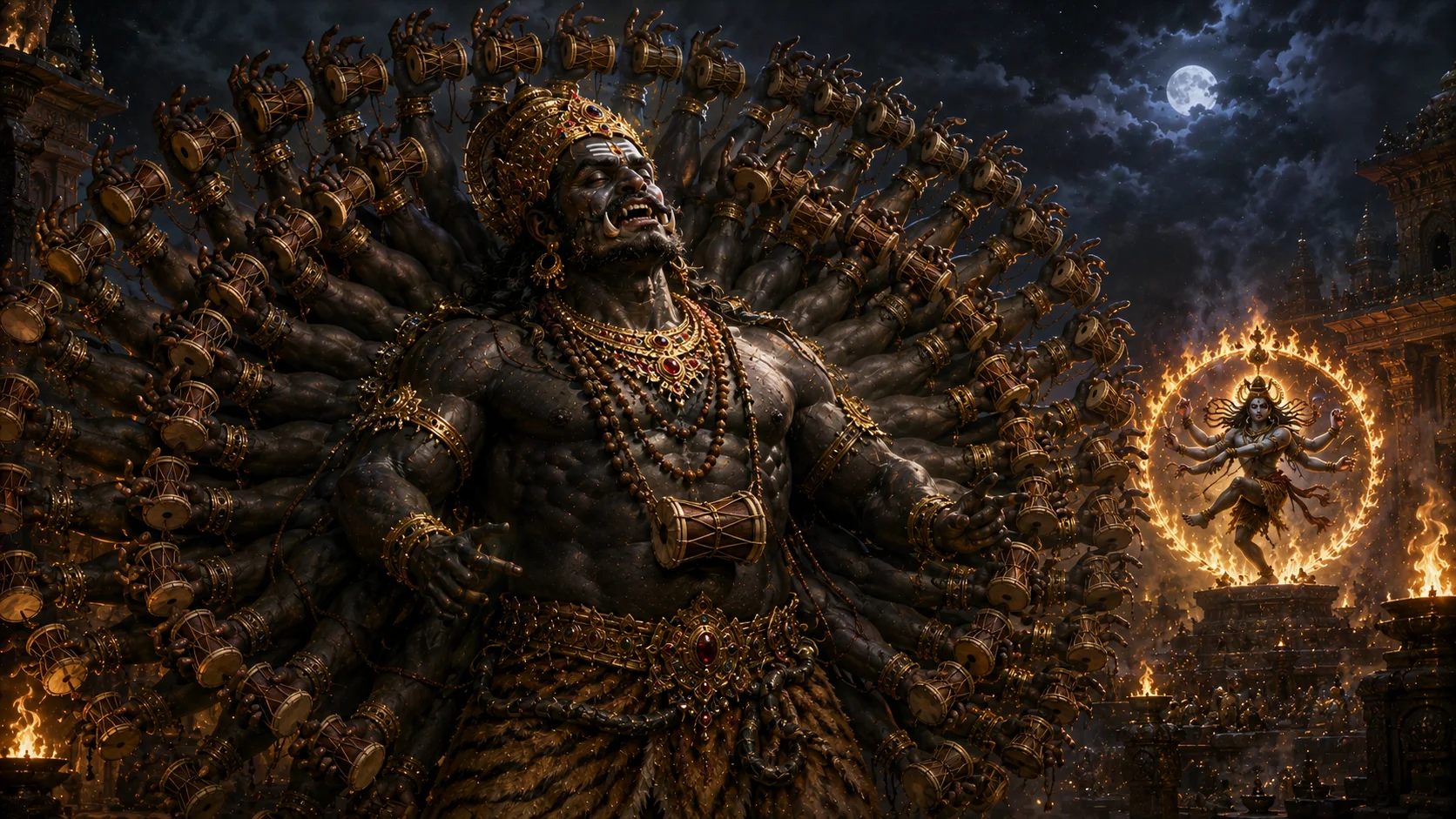
Banasura ruled from the city of Shonitapura — remembered in devotional tradition as lying near what is now Assam, though the precise geography belongs more to later temple memory than to certain text. There he gave himself to Shiva with a completeness that few worshippers, asura or otherwise, ever matched. His austerities were rewarded with a boon unlike any other: a thousand arms, granted by Shiva himself, transforming Banasura into one of the most formidable warriors in the Puranic cosmos. It was a gift that named its giver — every arm raised in battle or in prayer was a thousand-fold testimony to whose devotee he was, and Shiva's regard for him ran deep enough that the god was later willing to stand at Banasura's side against Krishna's own army, a rival deity's fury be damned.
An Epithet Worth Untangling
Later tradition sometimes calls Banasura Sahasrabahu — "thousand-armed" — a title that describes him accurately but does not belong to him alone. The same epithet attaches, in an entirely separate legend, to King Kartavirya Arjuna, also called Sahasrarjuna, whose thousand arms came from a different boon and a different story altogether. The label is a description, not a name reserved for one figure, and the two thousand-armed kings — the devout asura of Shonitapura and the storied Kartavirya Arjuna — belong to unrelated cycles that should never be folded into one another merely because they share a count of limbs.
A Daughter's Dream
The central drama of Banasura's reign begins far from any battlefield, in the private world of his daughter Usha. She dreamed of a youth she had never met and woke in love with him — a love with no name attached, no way to trace its object, until her companion Chitralekha undertook to find him for her. Chitralekha's gift was for likeness-making, and by her arts she was able to identify the face from Usha's dream and put a name to it: Aniruddha, grandson of Krishna, of the Yadava line ruling from Dwaraka. What followed is remembered only in general terms — tradition holds that Chitralekha used magical powers to bring Aniruddha to Usha, without specifying by what means the youth crossed from Dwaraka into Shonitapura's private chambers.
Discovery in the Palace
Banasura's discovery of a stranger in his daughter's private rooms was, by any king's reckoning, an intolerable trespass — and Banasura, thousand-armed and Shiva-favoured, was not a king inclined to overlook it. He had Aniruddha seized and imprisoned. Whatever grounds a father might claim for such fury, the act set in motion a conflict that reached far beyond Shonitapura's walls, for the prisoner was no ordinary youth: he carried the name and the protection of Krishna's own household, and a household of that standing was not one that would leave its own to languish in another king's dungeon.
The Army That Answered
Word of Aniruddha's captivity reached Dwaraka, and the response came in force. Krishna marched on Shonitapura, accompanied by Balarama and by Pradyumna — Aniruddha's own father — at the head of the Yadava clan's strength. What had begun as a private grievance inside one palace became, in the space of that march, a war between two kingdoms, with a bound prisoner as its cause and a father's wounded authority as its fuel. Banasura, for his part, did not stand alone to meet them: his patron Shiva, true to the devotion he had accepted for so long, took the field at his devotee's side, so that the battle before Shonitapura's walls carried a weight beyond ordinary armies — it was fought under the eyes, and by the hands, of the god who had made Banasura what he was.
The Fields Before Shonitapura
The clash that followed pitted Krishna's forces against a king armed with a thousand hands and shielded by the presence of Shiva himself. It was not a contest either side could expect to end quickly or cleanly. Banasura's boon meant he could meet the battle with a warrior's advantage almost no mortal or asura king possessed, and Shiva's support gave the defenders of Shonitapura a divine backing to match whatever Krishna's own army might bring. Tradition does not linger on tactics or turning points beyond its single decisive image: Krishna, pressing the fight to its outcome, began to cut down Banasura's arms one after another.
The Cost of a Thousand Arms
Arm by arm, Krishna's assault stripped away the very gift that had made Banasura formidable. Tradition remembers the toll variously — in some tellings reduced to four remaining arms, in others to as few as two — but every version agrees on the shape of the outcome: the boon that had defined Banasura's power across his whole reign was undone in the course of a single battle, and with it went any real hope that Shonitapura could hold against Krishna's advance. A king who had gone to war with a thousand hands raised was brought, hand by hand, to the edge of defeat.
Shiva Stands Between
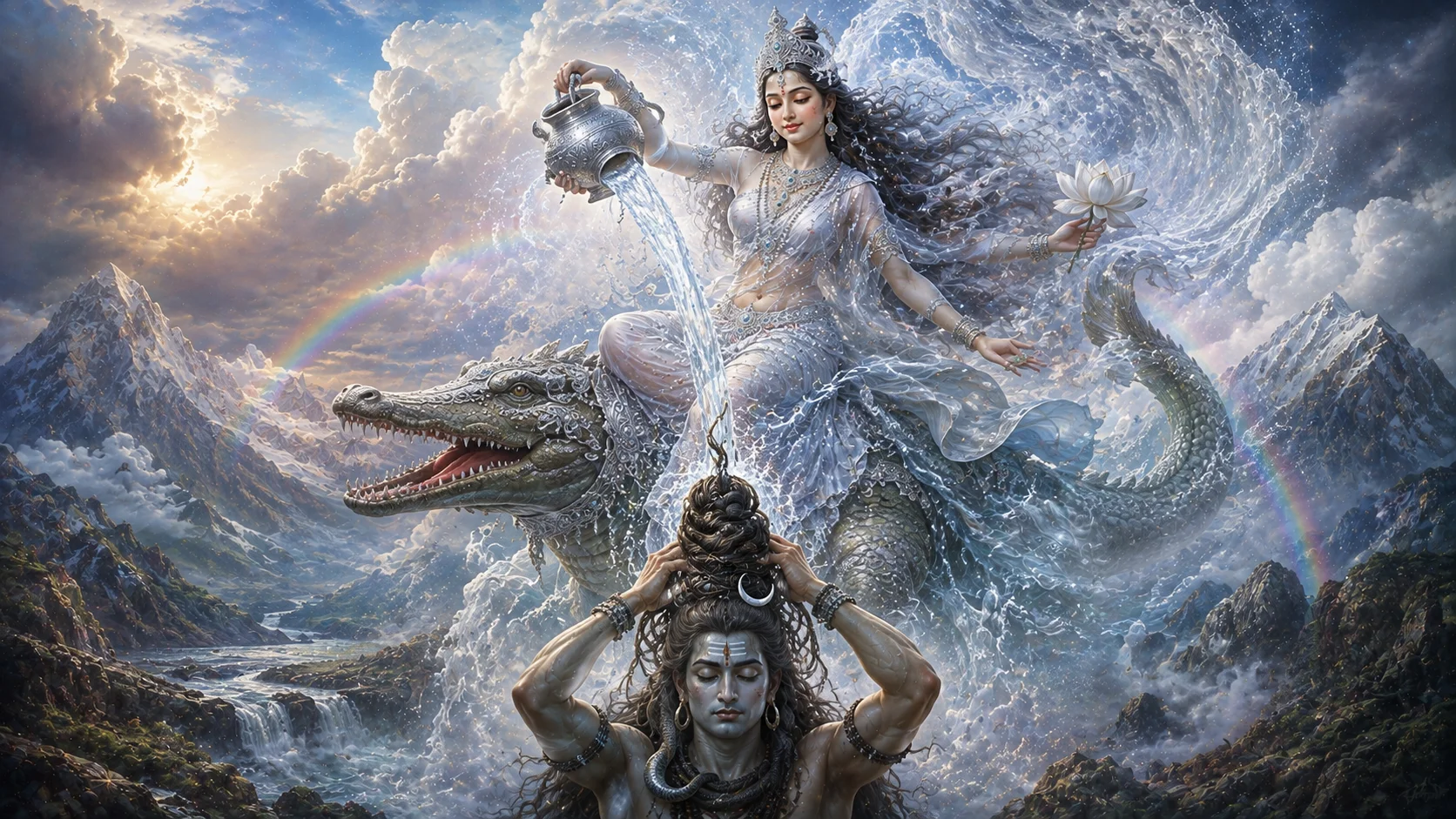
It was at this edge that Shiva intervened directly — not merely as an ally fighting beside his devotee, but as a protector stepping between Banasura and the death Krishna's victory would otherwise have delivered. The god who had granted the thousand arms was not willing to see the devotee who earned them destroyed outright, whatever the outcome of the war itself. That intercession is the turn on which the whole story pivots: two gods, in their different aspects, arriving at the same battlefield with opposite aims for the same defeated king, and choosing, in the end, not to let that opposition become a fight to the finish between themselves.
What Krishna Chose to Spare
Faced with Shiva's protection of his devotee, Krishna relented and spared Banasura's life. It was a resolution that asked something of both gods — Shiva's devotee lived, but stripped of the power that had made him a threat; Krishna's cause was answered, but without the total destruction a lesser victor might have demanded. The episode is remembered in Vaishnava tradition as one of several in which Krishna's role as protector of his own Yadava clan is shown alongside a countervailing respect: even in triumph over a rival deity's champion, he did not treat that god's devotion as something to be erased along with the war that devotion had drawn him into.
A Marriage Out of War
With the fighting ended and Banasura's life spared, the conflict resolved itself into the very outcome the war had obscured: Usha and Aniruddha were permitted to marry. The dream that had begun the whole chain of events — a princess's vision of a youth she had never met, traced by Chitralekha's arts — reached its conclusion not in tragedy but in a wedding, the private longing that had first crossed Shonitapura's threshold now sanctioned openly by the very households that had gone to war over it.
A Story Remembered in Stone and Song
Banasura's tale occupies a distinctive place in Puranic literature, recorded notably in the Bhagavata Purana and the Vishnu Purana, and it has carried on beyond the texts into regional devotional memory, particularly in traditions associated with Assam and the Sonitpur region, where local temple lore has built further reverence atop the Puranic core — though the fine detail of that later cultic practice is understood to be less fixed and less textually anchored than the central narrative itself. What endures most clearly across every retelling is the shape of the episode as a whole: a demon king's devotion to one god drawing the protection of that god even against another, and a private, dream-born love allowed, after all that, to become a marriage rather than a casualty.
Sources & traditions
- EncyclopediaWikipedia — Banasura
- TraditionHindu texts, oral tradition and village tellings (South Asia)
Myths change from area to area and from time to time. This chronicle follows the most widely told versions; tellings in other villages, regions and eras may differ.