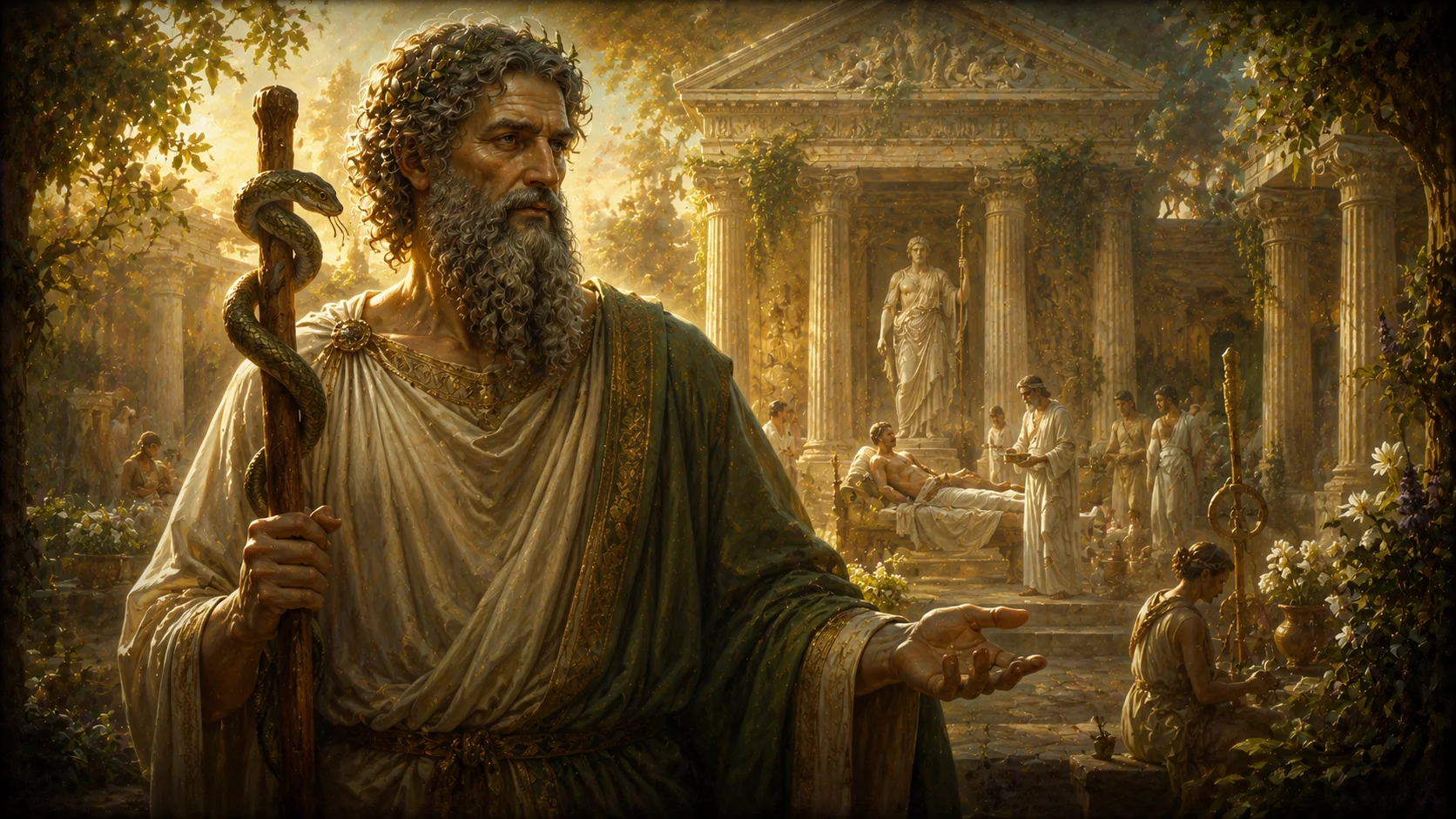
Asclepius was the god of medicine and healing — so gifted that he could cure any illness and even raise the dead, a power so dangerous it got him killed by Zeus. His staff, entwined with a single serpent, remains the symbol of medicine across the world to this day.
The Son of Apollo
Asclepius was the son of Apollo (god of healing among his many domains) and a mortal woman. Rescued from his mother's funeral pyre by Apollo, he was given to the wise centaur Chiron to be raised — and Chiron, the great teacher and master of medicine, trained the boy in the healing arts until Asclepius surpassed all others, mortal or divine, in the craft of medicine.
The Healer Who Conquered Death
Asclepius's skill grew so great that he could not only cure the sick and wounded but bring the dead back to life. This was a step too far. By raising the dead, Asclepius threatened the natural order and the boundary between life and death that even the gods respected — and Hades complained that his realm was being robbed of souls. Zeus, to preserve the cosmic order, struck Asclepius dead with a thunderbolt. (In his grief and rage, Apollo killed the Cyclopes who had forged the bolt.) Yet Asclepius's death was not the end: he was raised to the heavens and made a god of healing, set among the stars as the constellation Ophiuchus, the Serpent-Bearer.
The Rod of Asclepius
His cult became one of the most beloved in the ancient world. The sick travelled to his great healing temples (the Asclepieia, the hospitals of antiquity), where they would sleep in the sacred precinct hoping the god would visit them in a dream and reveal a cure. Sacred non-venomous snakes slithered freely through these temples, for the serpent — which sheds its skin and seems reborn — was his emblem of renewal and healing. His symbol, the Rod of Asclepius (a staff with one entwined serpent), remains the universal sign of medicine and healthcare.
The God of the Healer's Art
Asclepius endures wherever medicine is practised. His daughters' names became words we still use — Hygieia (hygiene), Panacea (a cure-all). And his story holds a profound tension at the heart of medicine itself: the healer's eternal struggle against death, and the question of whether there are limits that even the greatest healing should not cross.
He healed so well that he conquered death — and learned that even mercy has a boundary the gods will defend.
The Blameless Physician of the Iliad
Homer never once calls Asclepius a god. In the Iliad, composed centuries before the great healing sanctuaries reached their height, he is remembered as a mortal physician from Thessaly — the ‘blameless physician’ — and on the battlefield at Troy it is his sons who do the healing, not Asclepius himself. Machaon and Podalirius lead thirty ships from Trikka in the Catalogue of Ships, and Machaon becomes the army's doctor of choice: when Menelaus takes an arrow in Book 4, it is Machaon the Greeks send for, and he draws out the shaft and sprinkles on the wound soothing drugs that Chiron had long ago given to his father. The elevation from gifted mortal to full god belongs to a later layer of the tradition, carried by the spread of the sanctuaries — the cult reached Athens from Epidaurus in 420 BC and travelled outward from there. The two versions were never quite reconciled: a mortal doctor whose sons inherited the craft, and a god whose temples promised what medicine alone could not.
A Household of Healers
Asclepius's household reads like a personification of the entire practice of medicine. His wife was Epione, whose name means something close to ‘soothing’ — the one who eases pain. Alongside Hygieia and Panacea, ancient sources give him further daughters who personify successive stages of getting well: Iaso, the cure itself; Aceso, the process of healing as distinct from the cure achieved; and Aegle, whose name means radiance — the glow of good health returning to a convalescent's face. Machaon and Podalirius, the battlefield surgeons of the Iliad, complete the family. Taken together the household is less a genealogy than a taxonomy: an entire family of gods and goddesses assembled to name every stage between falling ill and walking away well again, from the treatment to the cure to the colour returning to the skin.
Telesphorus, the Hooded Companion
Asclepius rarely travelled alone in Roman-period art. Sculptures and coins, especially from Pergamon and the Danubian provinces, show a small, hooded figure standing at his side or at Hygieia's: Telesphorus, whose name means ‘the one who brings to completion’. He personified convalescence itself — the slow, unglamorous stretch of getting better after the crisis of an illness has passed — and his cloaked, childlike form appears on votive offerings left by patients grateful not for a miracle but for the ordinary business of recovering.
Trikka, Epidaurus, Kos, and Pergamon
One tradition placed Asclepius's birthplace at Trikka in Thessaly, where the geographer Strabo reported that the oldest and most famous of his shrines stood — though by the classical period the honour of greatest Asclepieion had passed to Epidaurus in the eastern Peloponnese. The dream-cure practised there had a name, incubation, and a procedure: pilgrims purified themselves and sacrificed before spending the night in a long hall called the abaton, the ‘not-to-be-trodden’ place, where the god was expected either to heal outright or to prescribe. Epidaurus grew into one of the great pilgrimage complexes of the Greek world, with a stadium for games held in the god's honour and a theatre — still standing, still used for performances today — built to hold the crowds the sanctuary drew. The island of Kos held its own famous Asclepieion, traditionally linked to Hippocrates and to the observation-based medicine that grew up alongside the older temple cures; and at Pergamon in Asia Minor a sanctuary flourished well into the Roman period, drawing the physician Galen, who was born in the city and served the sick there before becoming the most influential doctor of antiquity. Wherever a spring, a mild climate, and a reputation for cures could be found, an Asclepieion tended to follow.
How a Snake Crossed the Sea to Rome
In 293 BC, with a plague ravaging the city, the Romans consulted the Sibylline Books and were told to fetch the god of Epidaurus in person. An embassy sailed to Greece, and — according to the story reported by Livy and told at length by Ovid in the closing book of the Metamorphoses — the god answered by taking the shape of one of his own sacred serpents, gliding aboard the Roman ship of its own accord and coiling on the stern for the voyage home. When the ship reached Rome and sailed up the Tiber, the snake slipped into the water and swam to a small island in the middle of the river, and there the Romans built their temple, adopting the god under the Latinised name Aesculapius. The island — the Insula Tiberina — was later faced with travertine carved to resemble the prow of a ship, a monument to the crossing that is still visible today, and the site has never entirely stopped being a place of healing: a hospital has stood on it since the sixteenth century and treats patients still. It is one of the clearest cases in the ancient world of a cult spreading not by conquest but by deliberate invitation — an entire state deciding a foreign healer was worth adopting wholesale.
One Snake, Not Two: The Staff Everyone Gets Wrong
Look closely at any hospital, ambulance, or medical association logo and you are likely seeing one of two different Greek symbols, routinely confused for each other. The Rod of Asclepius is a plain staff with a single serpent and no wings. The caduceus, a short winged staff with two snakes intertwined, belongs to an entirely different god: Hermes, messenger of the gods and patron of trade, travellers, and, rather pointedly, thieves. The confusion is old, but it spread through modern medicine after institutions — most visibly the United States Army Medical Department, which adopted the winged double-serpent staff in 1902 — mistook the caduceus for the medical emblem, embedding the wrong symbol into American medical iconography ever since. The serpent behind the true rod has a species attached to it: the docile, pale Aesculapian snake (Zamenis longissimus), the non-venomous climber let loose in the sleeping-halls at Epidaurus to brush past pilgrims waiting for the god's dream. Isolated colonies of it still survive far north of its Mediterranean range, clustered around old spa and bathing towns in central Europe — a distribution that herpetologists have long suspected was created by Romans carrying the sacred snake to their healing springs.
A God the Greeks Recognised Abroad
When Greek settlers arrived in Egypt they did not treat Egyptian religion as wholly foreign — they went looking for equivalents, and in the healing cult of Imhotep they found one. Imhotep had been a real man: the architect and chancellor who served the pharaoh Djoser in the twenty-seventh century BC and built the Step Pyramid at Saqqara, remembered afterwards as a sage and a healer and finally deified by the Egyptians themselves more than two thousand years after his death. Greek visitors encountering a mortal-turned-healing-god, with a temple where the sick came seeking cures, called him Imouthes and identified him outright with Asclepius; part of the necropolis at Saqqara became known to them as an Asclepieion in its own right. The pattern is wider than that one meeting. Cultures with no contact produced gods whose entire domain was the physician's craft — Imhotep in Egypt, Dhanvantari in the Ayurvedic tradition of India — but only at Memphis did the Greeks go so far as to decide that the foreign healer and their own were the same god under another name.
The Oath and the Symbol That Outlived the Temples
The most famous document in the history of medicine begins by calling on him by name. The classical Hippocratic Oath opens not with a promise but an invocation — swearing by Apollo the physician, by Asclepius, by Hygieia and Panacea, and by all the gods and goddesses, taking them as witnesses to what follows. Physicians who have never read a line of Greek mythology still, in a sense, swear by him: the modern adaptations recited at medical school graduations are the last widely practised ritual descended from his cult. His staff had an equally long afterlife. The World Health Organization sets the Rod of Asclepius against a globe; the Star of Life on ambulances across the United States and beyond is built around the same single serpent-wound staff; and national medical bodies around the world still use some version of it. Few ancient gods left so little trace of active worship and so much trace of function — nobody burns offerings to Asclepius any more, but the shape of his staff is still the first thing a patient sees painted on the side of the vehicle coming to save them.
Sources & traditions
- EncyclopediaWikipedia — Asclepius
- TraditionGreek texts, inscriptions and later retellings (Greece)
Myths change from area to area and from time to time. This chronicle follows the most widely told versions; tellings in other villages, regions and eras may differ.