Argus Panoptes — “Argus the All-Seeing” — was the giant covered in a hundred eyes, the perfect watchman who never fully slept because only some of his eyes ever closed at a time. His name became the very byword for unsleeping vigilance, and his death gave the peacock its glory.
The Hundred-Eyed Giant
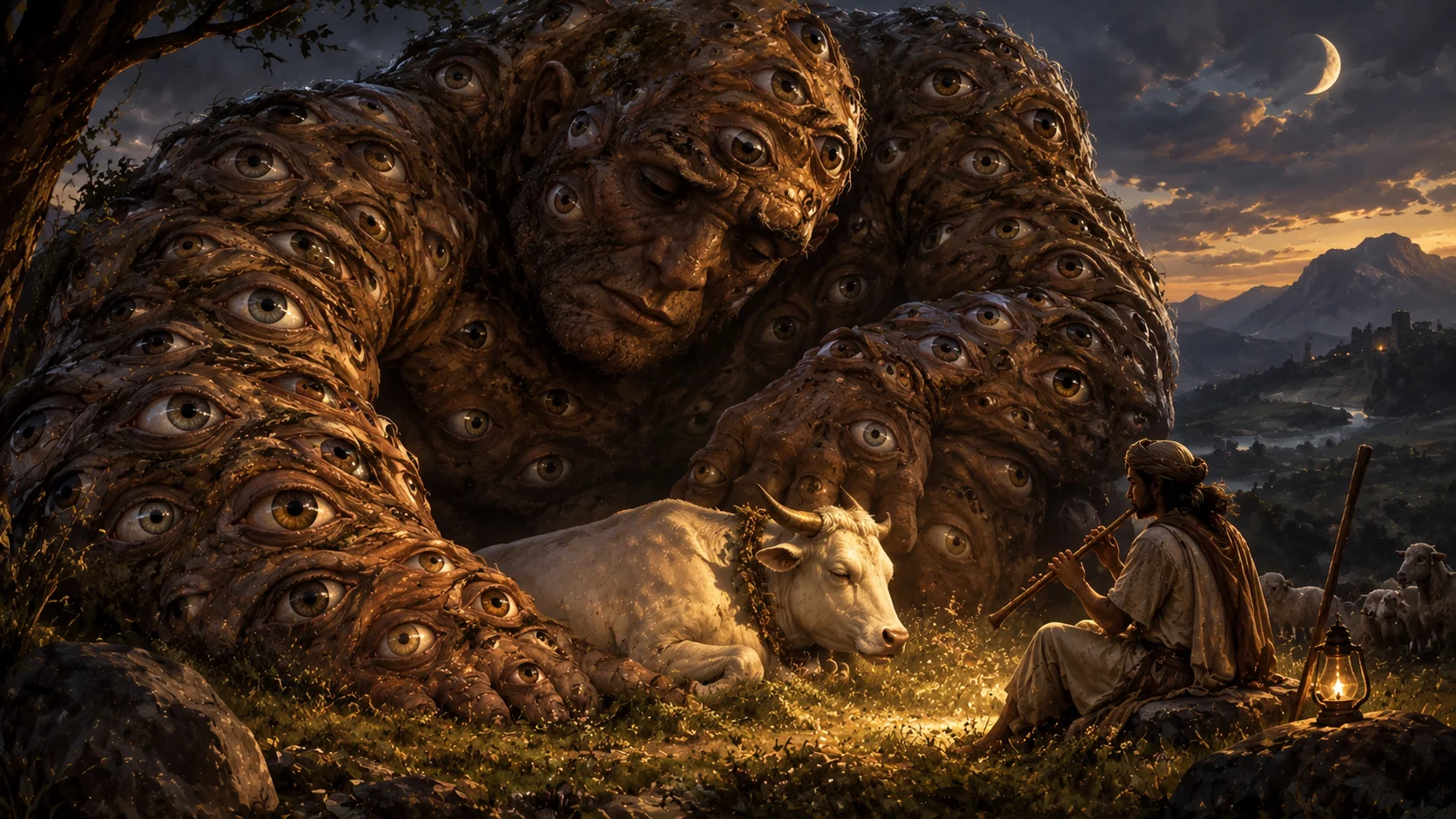
Argus was a giant of enormous strength whose entire body was studded with a hundred eyes. This made him the ideal guardian: when he slept, he closed only some of his eyes at a time, so that dozens were always open and watching. Nothing could approach unseen, nothing could slip past while he rested. He was vigilance made flesh — the watchman who could never be fully caught off guard.
The Guardian of Io
His most famous task came from the jealousy of Hera. When Zeus had an affair with the mortal princess Io and transformed her into a white heifer to hide her, the suspicious Hera demanded the heifer as a gift and set Argus to guard her — precisely because his hundred eyes meant Zeus could never sneak Io away or restore her. Io was kept tethered, watched eternally by the all-seeing giant, with no hope of escape.
The Music That Closed His Eyes
To free Io, Zeus sent the cleverest of the gods, Hermes. Hermes could not simply overpower the watchman, so he used cunning instead: disguised as a shepherd, he sat beside Argus and played soft, droning music on his pipes, and told long, dull, soothing stories — on and on, until, one by one, all hundred of Argus's eyes finally drifted shut in sleep. Once every last eye was closed, Hermes slew the giant (earning his title Argeiphontes, “slayer of Argus”). The unsleeping watchman was defeated not by force but by boredom and lullaby.
The Eyes of the Peacock
Hera mourned her faithful servant, and to honour him, she took his hundred eyes and set them into the tail of her sacred bird, the peacock — which is why the peacock's tail is covered in shimmering eye-like spots to this day. Argus endures as the emblem of total surveillance and unsleeping watchfulness (his name lives on in companies and systems meant to “watch everything”), and as the strange, beautiful origin of the peacock's hundred eyes.
A hundred eyes that never all slept — closed at last by a lullaby, and scattered forever across the peacock's tail.
The Monster-Killer Nobody Remembers
Before Hera chained him to a heifer, Argus was a hero. The mythographers who catalogue the royal house of Argos give him a career of monster-clearing that reads like a rough draft of Heracles: he killed the bull that was ravaging Arcadia and afterwards wore its hide as a cloak; he hunted down the satyr who had been robbing the Arcadians of their cattle; he put to death the men guilty of the murder of Apis; and he destroyed Echidna, the serpent-woman who carried off travellers from the road — catching her, the tradition specifies, while she slept.
Hold that last detail up to the light. The one great predator Argus destroyed, he destroyed by finding her asleep. The one thing in the world that could destroy Argus was sleep itself. Greek myth rarely signposts its ironies; it lays them side by side and trusts you to notice.
How Many Eyes? The Count That Never Settled
The hundred is not the oldest answer. Trace the figure backwards through the surviving texts and the eyes multiply and dwindle like a rumour. An early epic fragment ascribed to Hesiod gives him only four — a watcher who looks every way at once, and upon whom, that fragment insists, sleep never fell at all. Aeschylus abandons counting: his Io is shadowed by an earthborn herdsman of countless eyes. Euripides hangs him on a warrior's shield, spangled all over with eyes that open as the stars rise and close again as they set. And it is Ovid, writing in Latin centuries after the Greek versions, who fixes the round, memorable hundred that everyone now repeats.
The placement moved too, and that disagreement is more interesting than the arithmetic. The Greek mythographers put the eyes over the whole body — he had eyes, one of them says flatly, in all of his body. Ovid rings them around the head instead: a hundred lights in a crown, resting two at a time by rota while the remaining ninety-eight stay open.
The whole-body version is the one that made him unforgettable, and it is worth seeing why. A creature with eyes on its back has no back — no blind side, nothing to creep up on. That is a much stranger idea than a large number of eyes, and it is the reason Argus works as an image: he is not a watchman with excellent vision, he is a watchman with no direction in which he is not looking.
He has a structural twin in the Greek imagination and an exact structural mirror. The twin is the Hecatoncheires, the hundred-handed ones — a hundred grips where Argus has a hundred gazes, seizing where he sees. The mirror is the Cyclops: one eye instead of a hundred, and yet undone in precisely the same way, by a clever traveller who talks, offers a gift, waits for sleep, and then strikes at the eye. Whether the Greeks gave their monster one eye or a hundred, the man with the plan always won the same way.
Four Fathers and a Confusion of Arguses
Nobody could agree where he came from. The mythographic tradition preserves four competing parentages side by side, each with a named authority behind it: son of Arestor, son of Inachus, son of Argus and Ismene, or no one's son at all but earthborn, sprung directly from the ground like the sown men of Thebes. That last version is the most disquieting. It makes him not a person with a family but a product of the soil — an organ the earth grew for the purpose of looking.
The genealogies that do give him a family place him inside the ruling house of Argos, which means that in several tellings the jailer and the prisoner are kin. Io is not guarded by a hired monster. She is guarded by a relative, at the command of a goddess whose greatest temple stands in their shared homeland. Domestic surveillance in the most literal sense.
It is worth untangling the names here, because Greek myth is careless with them. The Argos who gave his name to the city is a different figure. The Argus who built the ship Argo is a different figure again. And the most famous watcher in all of Greek literature is a dog: Argos, Odysseus's hound, who waits out his master's twenty-year absence on a dung-heap and dies the moment he recognises him. Set the two side by side and you have the whole spectrum of watchfulness in a single word — the watcher who is lulled into sleep and killed, and the watcher who stays awake out of love until recognition finishes him.
Ovid's Version: The Story That Put Him To Sleep
Not every account kills him with music. The driest of the mythographers has Hermes simply brain the giant with a thrown stone and be done with it. But the fullest surviving version is Ovid's, and it contains a joke so elegant that most retellings lose it entirely.
Mercury comes down disguised as a goatherd, driving a flock he has stolen along the way, playing his reed pipe. Argus has never heard such an instrument, and invites the stranger to sit on the rock beside him. They talk. The hours go by. Some of the eyes begin to droop — but not all, never all, and the god has to reach for something stronger. So he tells a story: how the Arcadian nymph Syrinx, fleeing Pan, was halted by the water of the Ladon and begged her sisters of the river to change her, and became a stand of marsh reeds; how Pan, sighing into the reeds in his disappointment, heard the thin sweet sound they made; and how he bound them together with wax and gave the instrument the girl's name.
The story that closes Argus's eyes is the origin story of the pipes being played to close them. The weapon explains itself while it works.
And Ovid does something no summary can reproduce: he breaks off. The poet reports that Mercury had more to tell, but glanced over and saw that every eye had gone dark — so he checked his voice mid-tale, and the reader is left, like Argus, without the ending. Then the curved blade, the strike where the neck meets the head, and one of the most quietly devastating lines in Latin poetry: a single night takes all hundred lights at once. There is no gradual dimming. The most sleepless thing in the world is switched off in one motion.
Argeiphontes: An Epithet Older Than The Story
Hermes is called Argeiphontes in Homer, in formulaic lines of the kind epic inherits rather than invents, and long before any surviving text tells us who Argus was or why he died. The Greeks themselves read the word as “Argus-slayer” and treated the myth as its explanation.
Modern philology is not convinced. The epithet resists a clean derivation, and rival readings have been proposed for well over a century — attaching the first element instead to argos in its ordinary senses of bright, shining or swift, and reading the second element quite differently. No proposal commands agreement, and the honest position is that we do not know.
Which raises a genuinely unsettling possibility about the direction of causation. If the epithet came first and was later misheard as “slayer of Argus,” then the hundred-eyed giant may exist because a word needed a victim — a monster reverse-engineered out of a syllable, and then so vivid that he outlived every god in the story. It is not proven. It is not disprovable either. And it is a good reminder that myths are not only invented forwards.
The Peacock Arrived Late
The most beautiful part of the story is the part that was bolted on afterwards.
Hera's older bird is the cuckoo. The ancient traveller who wrote up the great Heraion of Argos describes the seated goddess holding a sceptre with a cuckoo perched on it, and records the reason given locally: Zeus courted her in that form, and she caught the bird and kept it. A later commentator fills in the scene — the god arriving bedraggled in a storm so that she would take pity and hold him to her breast. The cuckoo is a local bird, a Greek bird, and a brood-parasite: a thoroughly appropriate emblem for a marriage founded on a deception.
The peacock is not a Greek bird at all. It is Indian, and it reached the Aegean as a luxury import by way of Persia — late enough that the Greeks still called it the Persian bird, and late enough that its arrival was worth remarking on. Samos, the other great seat of Hera's worship, kept peacocks at her sanctuary, and from there the bird becomes her standard attribute in later art, the way the eagle belongs to Zeus.
So the aetiology runs backwards. The eyes in the tail did not make the peacock Hera's bird. The peacock became Hera's bird, and then storytellers, confronted with a spectacular foreign creature whose feathers were unmistakably covered in eyes, went looking through their existing myths for a hundred eyes going spare. Argus had them. A story that had ended with a corpse on a rock acquired, long afterwards, a consolation.
The Heifer Runs On
Killing the watchman does not free Io. Hera simply changes instruments: she sends a gadfly, and the maddened heifer is driven out of Greece and across the known world, leaving her name on the map behind her — the Ionian gulf for her wandering, and the Bosporus, the “ox-ford,” for the strait she crossed. On the way she passes Prometheus on his rock, and he recites her route and her descendants to her, which is the closest thing to comfort anyone offers her in the whole cycle.
Aeschylus adds the cruellest touch. Io is not only stung by the fly; she is haunted by the phantom of earthborn Argus, come up out of the ground to hunt her with his gaze still on her. The eyes go on working after the body has stopped. Kill your watchman and you have not stopped being watched — you have only moved the watching inside your own head, which is as exact an account of how surveillance actually operates as anything written since.
She ends in Egypt, restored to human shape by the touch of Zeus's hand, and bears a son whose name the Greeks heard as “Touch” — Epaphus. Greeks who travelled in Egypt identified her with Isis, whom they saw portrayed with a cow's horns exactly as they portrayed Io. And from Epaphus the line runs on through Libya and Belus to Danaus and Aegyptus, to the Danaids who flee back to Argos claiming kinship with the land through her, and onward to Perseus and eventually to Heracles.
Which makes the death of Argus a hinge rather than an episode. Hermes' blade at that neck is the point at which the rest of the Argive line — and the greatest hero the Greeks ever imagined — becomes possible.
How To Recognise Him In Art
Argus is one of the easiest figures in Greek art to identify and one of the hardest to draw. Attic vase-painters solved him in several incompatible ways: sometimes a bearded man stippled all over, limbs and torso alike, with small open eyes; sometimes eyes only on the face and chest; sometimes a second face on the back of the head, which is the cheapest solution and the most eerie. Io stands beside him either as a full heifer or as a woman with a cow's horns pushing through her hair. Hermes is unmistakable — travelling hat, herald's staff, and, in the killing scenes, the curved blade.
Roman wall-painters returned to the subject repeatedly; versions survive on the Palatine and at Pompeii, usually the quiet moment before the violence, the god sitting down beside the watchman with the pipe in his hand. The Baroque painters wanted the other half. Rubens gives us Juno standing over the headless body, lifting the eyes out one by one to set them into the tails of her peacocks. Velázquez, at the very end of his life, painted Mercury creeping toward a slumped and sleeping Argus in almost total darkness — the whole hundred-eyed terror reduced to a heavy labourer asleep in the shadow, which may be the truest reading of the myth anyone has produced with a brush.
Other Sleepless Eyes
The image is not uniquely Greek, and the parallels are worth setting out carefully — not as borrowings, but as the same solution reached independently by people facing the same problem.
- In the Avestan hymn to Mithra, the god who guarantees contracts is described as having a thousand ears and ten thousand eyes, and as never sleeping. He is the divine enforcement of a promise, and the way to say that no oath-breaker can hide from him is to give him too many eyes to count.
- In Hindu tradition Indra carries the epithet Sahasrākṣa, the thousand-eyed, and the Puranic literature explains it as the transformation of a curse into a mark of power.
- In Jewish and Christian scripture the living creatures of Ezekiel's vision, and the wheels beside them, have rims full of eyes all around; the four beasts before the throne in Revelation are full of eyes before and behind.
The pattern is consistent enough to be diagnostic. Whenever a culture needs to say that something cannot be deceived, it does not describe intelligence or judgement. It describes a surplus of eyes. Sight is the sense we associate with proof, and multiplying it is the crudest, most immediately legible way of drawing omniscience.
From Argus To The Panopticon
The word survived better than the giant. When Jeremy Bentham designed his ideal prison — a ring of cells around a central inspection tower, every inmate visible, the inspector invisible — he named it from the same two Greek roots that make up Argus's epithet: pan, all, and optes, seeing. The Panopticon is Argus rebuilt in brick. Foucault later made it the master image of modern power, and the term “panopticism” now does duty for everything from workplace monitoring to the ambient data-gathering most people carry in a pocket.
What is usually missed is how precisely Bentham's design reproduces the actual mechanism of the myth. Argus's advantage was never the hundred eyes as a total. It was that some of them closed and Io could never tell which. She had to behave, at every moment, as though every eye were open, because she had no way of locating the blind spot. That is the whole trick of the inspection tower, and the whole trick of surveillance since: not being watched, but being unable to know when you are not.
The literary afterlife knows this too. Shakespeare uses the name as flat shorthand for the jealous watcher. Milton, arming the guard of Eden in Paradise Lost, gives his cherubim more eyes than Argus had — and then adds, pointedly, that no Arcadian pipe and no sleep-bringing wand of Hermes will ever charm these ones shut. It is a small correction to a very old ending, and it tells you exactly which part of the story everyone remembers.
Why The Lullaby Is The Point
Strip the myth down and it is not a story about eyes at all. It is a story about attention, and it arrives at a conclusion that modern psychology needed instruments and controlled trials to reach.
A hundred eyes is one attention span multiplied by nothing. Watch-keeping research — the study of radar operators, quality inspectors, anyone required to stare at a mostly empty display and catch the rare event — found that detection rates fall away sharply, and that they fall not because the watcher's eyes give out but because nothing has happened for long enough. The effect has a name, the vigilance decrement, and its cause is exactly what Hermes exploited: monotony, administered patiently, by someone willing to sit down and talk.
There is a second failure underneath the first, and it is Hera's. She did not recruit an ally; she installed an instrument. Argus obeys, but he has no stake whatever in Io. He is not protecting anything he loves, and he is owed nothing by the arrangement. A watcher with no interest in the outcome is a watcher who can be bored into failure, and every surveillance system built since has inherited that flaw along with the name.
Which is why the giant will not go away. He is the fantasy of total oversight and, in the same story, the proof that it does not hold.
Sources & traditions
- EncyclopediaWikipedia — Argus Panoptes
- TraditionGreek texts, inscriptions and later retellings (Greece)
Myths change from area to area and from time to time. This chronicle follows the most widely told versions; tellings in other villages, regions and eras may differ.