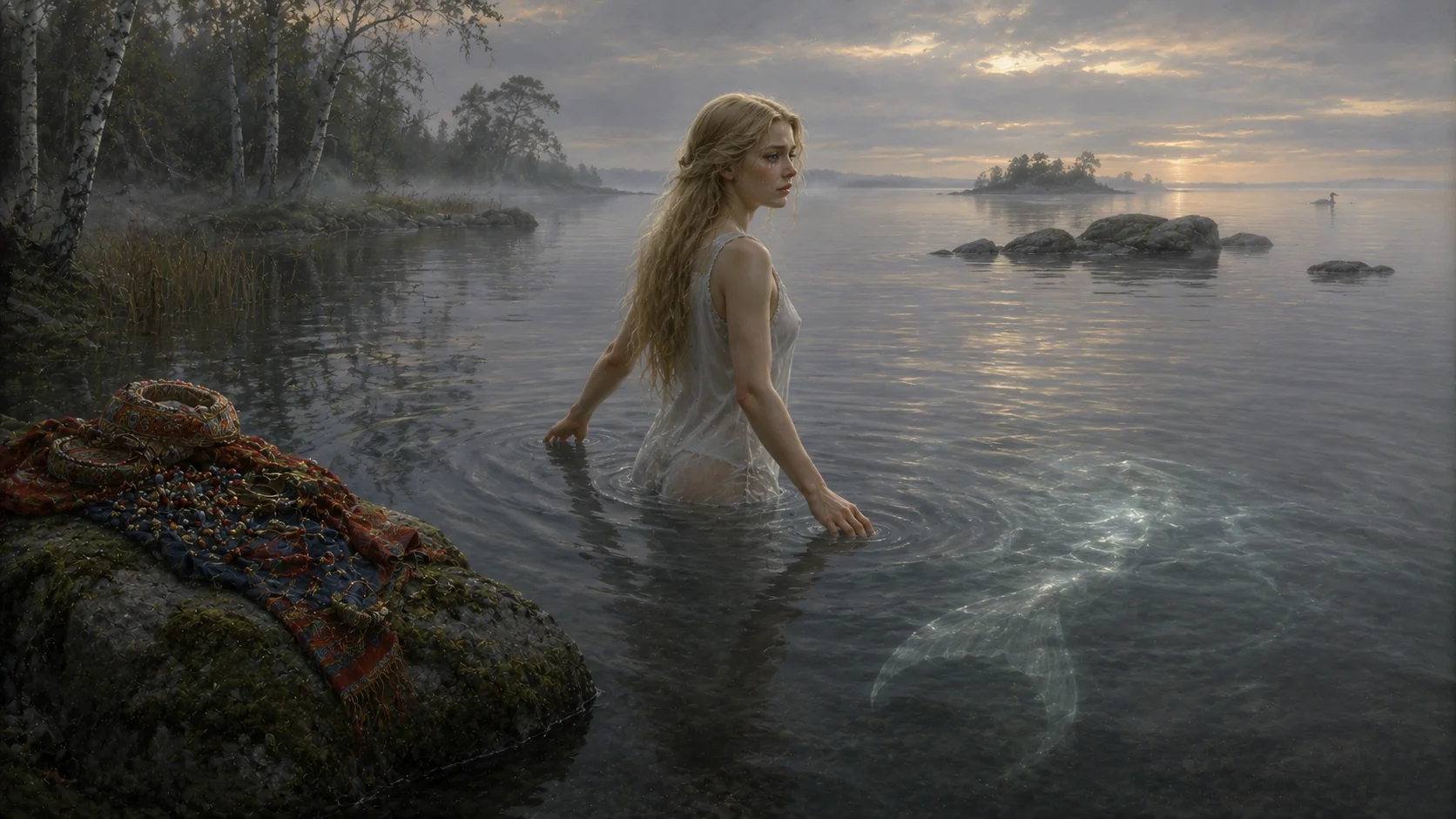
Aino is the sorrowing maiden of the Kalevala, the Finnish epic compiled by Elias Lönnrot from Karelian and Finnish oral poetry in its final form of 1849. She is a younger sister forced toward a marriage she cannot accept, and rather than submit she gives herself to the sea and is changed into a creature of the water. Hers is not the story of a goddess with temples or offerings; no cult or rite has ever attached to her name. She stands instead as one of the epic's most human figures — a young woman whose grief was assembled by Lönnrot out of older, shorter Karelian laments about drowning maidens, drawn together into a single continuous telling across Runos 4 and 8 of the epic. Scholars are careful to note that the unified plot as read today is Lönnrot's own literary arrangement of these fragments rather than one unbroken myth handed down whole from antiquity — a distinction worth holding onto even as the story is treated here with the same seriousness owed to any living strand of Finnish cultural memory.
A Wager Sung Into a Swamp
Aino's story begins with her brother, Joukahainen, a young bowman and singer out of the Lapland-adjacent north country of Pohjola. Proud of his own skill, Joukahainen challenges the old sage Väinämöinen to a contest of singing and knowledge. He loses badly — so badly that Väinämöinen's singing sinks him into a swamp, mud rising past his shoulders, with no way to free himself by his own strength. Facing death in the mire, Joukahainen bargains for his life. Among the promises he flings out in desperation is his own sister's hand in marriage: Aino, still a girl at home, is offered to a man decades her elder as the price of her brother's rescue. Väinämöinen accepts the ransom and releases him. It is a bargain struck entirely without Aino's knowledge or consent, and the epic does not soften that fact — the promise is made over her, not by her.
A Mother's Joy, A Daughter's Grief
When Joukahainen returns home and tells his family what he has promised, the reaction splits the household in two. Their mother, a prominent and outspoken figure in her own right within the epic, is overjoyed. A marriage tie to Väinämöinen — renowned, respected, a man whose name carries weight throughout the sung world of the poem — seems to her a triumph, an elevation of the family's standing that no one could have engineered on purpose. She presses the match eagerly, seeing status and honor where her daughter sees only dread. Aino's own response could not be more different. She is horror-struck. To her, Väinämöinen is simply old, a man entirely unsuited to be her husband, and the thought of the marriage undoes her. She weeps without being consoled, and the distance between the mother's delight and the daughter's despair is one of the epic's most quietly devastating passages — two people who love each other, reading the same news in opposite directions.
The Weight of an Arranged Match
What follows is not a tale of monsters or sorcery but of social pressure pressing down on a young woman with nowhere to turn. Aino is caught between filial duty — the expectation that a daughter's marriage serves the family's interest — and her own refusal to be handed over as settlement for someone else's mistake. The epic gives her grief real space; she is not a passing detail in Väinämöinen's story but a person whose anguish is rendered in full. This tension between obligation and personal will is the emotional center of everything that follows, and it is why Aino has endured in Finnish memory not as a minor character in someone else's epic but as an emblem in her own right — the sorrow of a marriage forced upon someone too young and too unwilling to bear it.
To the Shore, Alone
Unable to accept the marriage and unable to be heard by those arranging it, Aino leaves the household and makes her way to the shore. There, alone, she undresses to bathe in the sea — an ordinary act turned into the epic's turning point. What happens next is left in the ambiguous register that oral lament often prefers: she drowns, or she is drawn under by the water itself, the two readings folded into one image. She does not return to her family. She does not marry Väinämöinen. The shore, in the geography of the Kalevala, sits near the northern territory associated with Pohjola, though it is not tied to any single lake attested in older, pre-Lönnrot oral tradition — it belongs to the epic's imagined landscape more than to a mapped one.
The Maiden Becomes the Water's Own
In the logic of the poem, Aino's death is also a transformation. She becomes a fish — most often described as a salmon — passing out of the world of daughters and marriages and mothers entirely and into the sea itself. This is the moment the oral maiden-drowning songs that fed into Lönnrot's compilation were built around: not death as an ending but death as a change of state, the drowned girl surviving in another form, one that can no longer be claimed by the arrangements of the living. It is a transformation rather than a disappearance, and that distinction matters to how the story is read — Aino is lost to her family and to Väinämöinen, but she is not erased.
The Line Cast Without Knowing
Time passes, and Väinämöinen goes fishing in those same waters. He hooks a salmon unlike any other he has caught — and it is Aino. For a moment he holds in his hands the very bride he was promised, transformed, though he does not yet know it. This is one of the epic's sharpest ironies: the man to whom she was bargained away encounters her again by pure chance, through the ordinary act of fishing, with no sense at first of who — or what — he holds.
Recognition, Too Late
Before Väinämöinen can secure his catch, Aino reveals her true nature to him. She speaks, rebuking him, making plain that she is the girl he would have married and that she has chosen the sea over him. Having said what she came to say, she slips from his grasp and returns to the water. The recognition arrives at the exact moment it can no longer change anything — Väinämöinen understands who she is only as she is already leaving him for the second and final time.
The Search That Cannot Undo the Loss
Shaken, Väinämöinen tries to recapture her. He turns for guidance to his mother, Ilmatar, seeking counsel on how to win the salmon-maiden back from the sea. Her advice does not succeed. Despite his efforts, Aino is gone for good — not merely fled, but lost to him in a way no pursuit can reverse. The epic is unambiguous that this loss is final; there is no second bargain, no further chance, no path by which the story is undone.
A Loss That Sets a Larger Story Moving
Aino's disappearance does not end Väinämöinen's role in the epic — it redirects it. Having lost the bride that circumstance handed him, he turns his attention outward, toward Pohjola, in search of a wife by his own effort rather than another's promise. That search becomes one of the engines driving the epic's later, larger arcs, including the cycle surrounding the forging of the Sampo. Aino herself takes no part in those later events; her role is to be the catalyst, the loss that turns Väinämöinen's path in a new direction, and the epic treats that turning as significant precisely because of what — and who — was lost to bring it about.
A Name That Outgrew the Page
Few figures from the Kalevala have traveled as far into everyday Finnish life as Aino has. The composer Jean Sibelius, whose home Ainola was named after his wife Aino, drew on this same body of Kalevala material for early tone poems such as Kullervo and other works inspired by the epic. More strikingly, Aino became — and remains — a widely used given name in Finland, popularized directly by this character rather than by any older naming tradition. It is a rare instance of a nineteenth-century literary compilation reshaping something as intimate and enduring as how Finnish parents name their daughters.
A Character, Not a Deity
It is worth being precise about what Aino is and is not within Finnish tradition. Figures such as Ilmatar, Väinämöinen, and Ukko carry the weight of cosmological or divine figures within the world the epic constructs. Aino carries no such standing. She has no independent cult, no ritual practice, no worship recorded anywhere in the tradition — she exists purely as a character within the narrative fabric of the Kalevala, her power drawn entirely from the emotional truth of her story rather than from any sacred function. That she has nonetheless become one of the most recognized and beloved figures in the whole epic says something about how deeply the story of a young woman refusing a marriage not of her choosing has resonated, long after the oral fragments that first gave rise to it were gathered and set down.
Sources & traditions
- EncyclopediaWikipedia — Aino (character)
- TraditionFinnish folk and village traditions (Finland)
Myths change from area to area and from time to time. This chronicle follows the most widely told versions; tellings in other villages, regions and eras may differ.