Joukahainen is the brash young rival of Väinämöinen in the Kalevala — a challenger from the north whose defeat in a singing contest sets loose a chain of sorrow and vengeance that reshapes the whole epic.
A Young Man Rides South from Lapland
Joukahainen comes from Lapland, the cold northern country that the Kalevala repeatedly sets against the homeland of Kalevala proper — the world of Väinämöinen and his kin. He is young, confident, and restless with the particular impatience of someone who has heard of a great reputation and cannot bear that it belongs to someone else. Word has reached him of the old singer Väinämöinen, whose songs are said to be older and deeper than any other's, capable of shaping the world itself. Rather than accept this at a distance, Joukahainen decides he will go and prove it false. He sets out toward Kalevala with his sledge, driven by pride rather than any grievance — the journey itself is an assertion, a young man announcing that fame is a thing to be contested, not simply admired.
The Boast That Cannot Be Unmade
When the two finally meet upon the road, Joukahainen does not offer a greeting so much as a declaration: he claims knowledge and singing power equal to or greater than Väinämöinen's own. This is not idle talk in the world the Kalevala describes — a challenge to sing is a challenge to a kind of combat, since knowledge-songs in this tradition are also a form of power, a way of naming and thereby commanding the world. To claim superior knowledge is to claim the right to be believed, obeyed, even feared. Once spoken aloud on that open road, the boast cannot be quietly withdrawn. Väinämöinen, older and unhurried, does not refuse the challenge; he answers it, and the contest begins there on the spot, with no witnesses but the winter road and the two men's own voices.
A Contest Older Than the Poem Itself
The form the two men fall into is a singing duel — a battle of knowledge conducted entirely in verse, each singer trying to out-know and out-last the other until one runs dry or is proven wrong. This is not an invention unique to Joukahainen's story: competitive knowledge-singing was a genuine feature of the older Karelian-Finnish oral tradition from which the Kalevala's compiler, Elias Lönnrot, drew his material. Singers in real village life measured themselves against each other this way, testing memory, lineage of knowledge, and command of the old lore. What the Kalevala does is give that living custom a single, unforgettable staging: two named men, one youthful and one ancient, meeting to decide by voice alone which of them truly possesses the deeper song.
Boyhood Answers Against a Bottomless Memory
Joukahainen opens with what he knows — small, correct, but slight things: the shapes of the natural world, simple facts a clever young man might have gathered and rehearsed for just such an occasion. Väinämöinen listens and answers each claim, and where Joukahainen speaks of surface things, Väinämöinen speaks of origins — how the world itself came into being, how the earliest things were shaped and named. The contest is never close. It is not a duel between equals interrupted by an upset, but a demonstration of the distance between accumulated cleverness and something closer to the memory of the world's own beginning. Joukahainen, cornered, abandons careful answers and simply asserts that he was present at creation himself, boasting past the point his knowledge can support — the exact overreach that a knowledge-contest exists to expose.
Sung Down Into the Bog
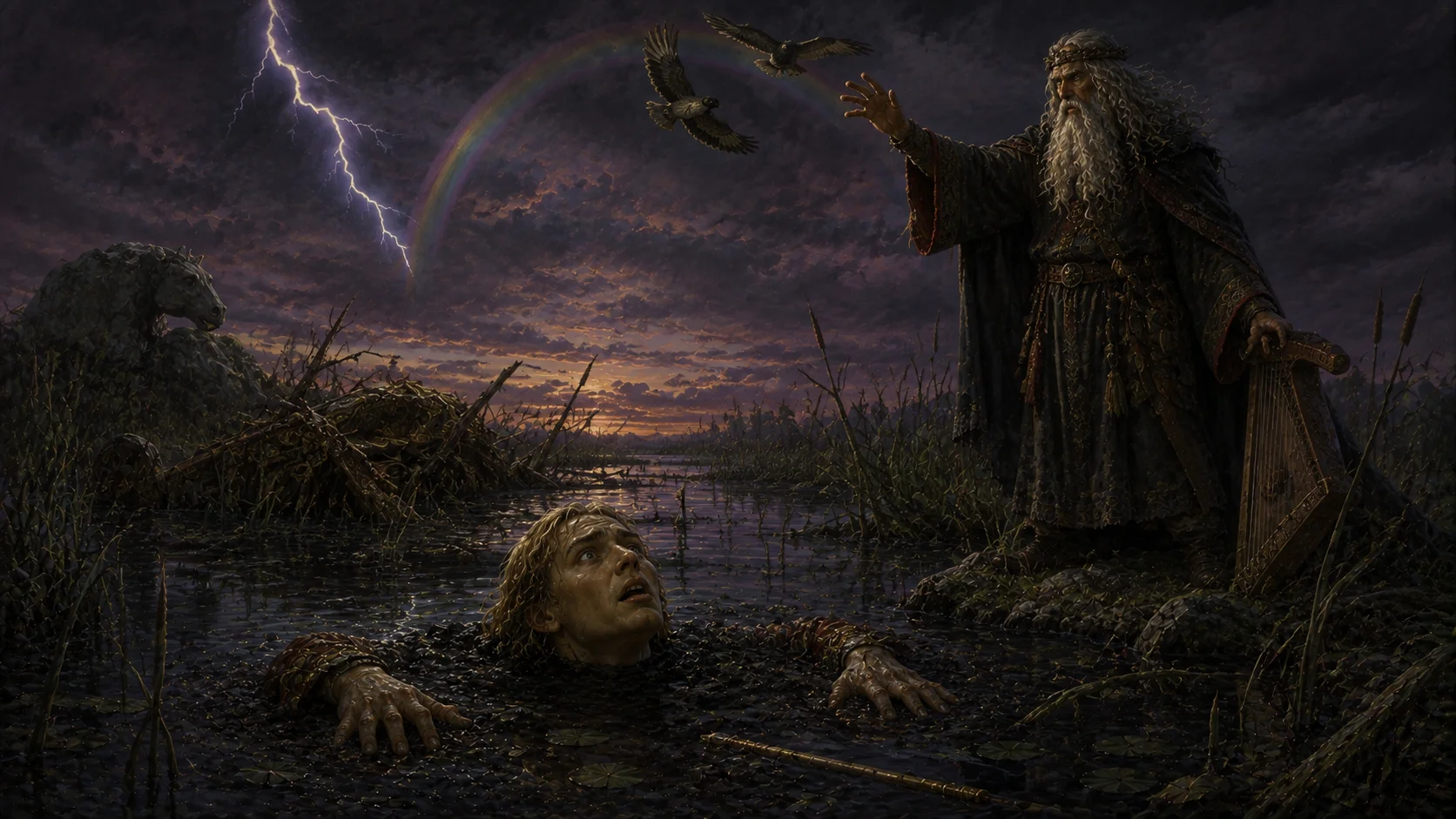
Väinämöinen's response is not another claim but an act. He begins a magic song, and the ground itself answers him — the earth beneath Joukahainen softens and gives way, drawing the young man down into a swamp until he is sunk to his mouth, unable to move, unable to do anything more than speak. It is the singing-contest's own logic made physical: the deeper song does not merely out-argue the shallower one, it acts upon the world, and Joukahainen's boast has led him, quite literally, into the ground. He is left there helpless, the confident traveler from Lapland reduced to a face above the mud, forced at last to recognize a power he cannot answer with more words.
A Life Bought With a Sister's Future
Terrified, sinking, Joukahainen begins to bargain, offering increasingly costly things for his release, until he reaches the one offer Väinämöinen accepts: his sister Aino, promised in marriage to the old singer in exchange for freeing him from the bog. It is a bargain struck entirely between two men, over the fate of a woman who is not present, not asked, and not imagined by either of them as someone who might refuse. Joukahainen's relief at being pulled from the mud comes at a price he does not have to pay himself — the debt is transferred whole onto his sister's life. Väinämöinen releases his song's grip, and Joukahainen returns home freed but changed, his pride broken and, though he may not yet grasp its full weight, his family bound by a promise he had no right to make alone.
Aino's Answer to a Bargain She Never Made
What follows belongs properly to Aino's own story, but it defines Joukahainen's forever after. Told that she is to marry a man decades her elder, chosen for her by her brother's desperation rather than her own will, Aino is inconsolable. She wanders in her grief and, rather than accept the marriage forced upon her, drowns herself — one of the Kalevala's most sorrowful passages, and one of its clearest statements on the human cost of a promise made under duress by someone other than the person bound to keep it. Joukahainen's bargain, struck to save his own life, ends his sister's. The contest he lost in a moment of pride becomes, through no further act of his own, a tragedy that outlasts him.
Grief Turned Toward a Single Target
Aino's death does not soften the enmity between the two men — if anything it sharpens it unbearably, on both sides. Väinämöinen is left grieving and embittered by the loss of the marriage he had been promised and, in his own way, by the death of a young woman he had wronged without quite meaning to. Joukahainen is left grieving his sister and carrying the unbearable knowledge that his own boastfulness set the chain of events in motion. Where Väinämöinen's grief turns inward, Joukahainen's turns outward, hardening into blame directed entirely at the man who bested him in the bog. The rivalry that began as a contest of songs has become something with no possibility of a peaceful end.
An Ambush Instead of Another Duel
Joukahainen does not challenge Väinämöinen to a second contest of knowledge — he has already learned what that contest costs him. Instead he waits with a crossbow and, catching Väinämöinen unaware, shoots the horse from beneath him, sending the old singer down into the sea. It is a deliberate inversion of their first meeting: where Väinämöinen once answered a boast with a song that could not be out-sung, Joukahainen now answers a humiliation with a weapon that needs no verse at all. It is the act of a man who has concluded that words will never again be enough.
The Fall That Sends Väinämöinen North
The ambush works exactly as violence often does in this epic — not cleanly, but consequentially. Väinämöinen is thrown into the sea and left adrift, beginning a long ordeal that carries him, eventually, to Pohjola, the great northern realm ruled over by its formidable mistress, Louhi. This is the hinge on which much of the rest of the Kalevala turns: Väinämöinen's arrival in Pohjola opens the door to his dealings with Louhi and, from there, to the epic's long central struggle over the Sampo, the wondrous device whose fate consumes much of the poem's later action. None of that would begin as it does without Joukahainen's arrow.
A Rivalry That Shapes More Than It Resolves
Once the ambush and its consequences are set in motion, Joukahainen himself steps back from the epic's center. He is not present for the Sampo's forging, its theft, or its final loss; his part in the larger story was never to see it through, only to set it running. His significance lies entirely in that early, concentrated sequence — the boast, the contest, the bog, the bargain, Aino's death, the ambush — a chain in which every link follows plainly from the one before it, without any need for further intervention from him once it has begun.
The North and South of an Old Rivalry
Joukahainen's origin in Lapland, set against Väinämöinen's home ground in Kalevala, echoes the wider pattern the epic returns to again and again: a rivalry between a northern realm and a southern one, between Pohjola's household and Kalevala's. Joukahainen's personal defeat is, in miniature, a first skirmish in that larger and longer contest, fought here not with armies but with a single overreaching claim to knowledge that the north could not make good.
What a Young Man's Pride Is Remembered For
Joukahainen endures in memory as a caution rather than a hero — a figure whose worth lay not in wisdom but in the willingness to claim it before he had earned it. His story is told and retold less for what he achieved than for what his boasting set loose: a broken promise made over another person's life, a sister lost to a bargain she never agreed to, and a rivalry that reshaped the fate of the epic's central figure. It is a hard portrait, but not an unsympathetic one — the tradition remembers him as young, proud, and undone by the same overreach that has undone boastful young men in every age, with consequences that fell, as they so often do, heaviest on someone who never spoke a single boast herself.
Sources & traditions
- EncyclopediaWikipedia — Joukahainen
- TraditionFinnish folk and village traditions (Finland)
Myths change from area to area and from time to time. This chronicle follows the most widely told versions; tellings in other villages, regions and eras may differ.