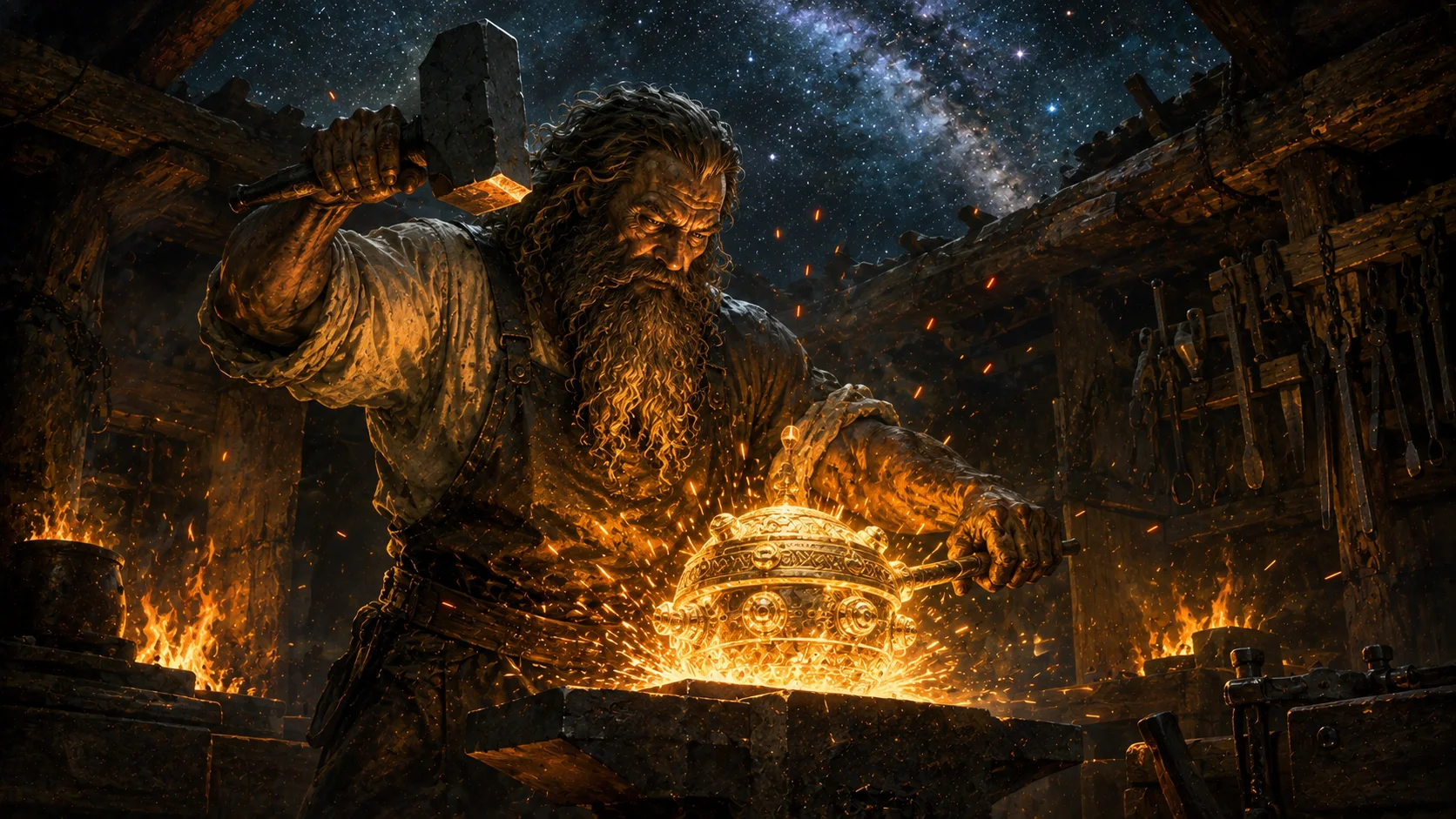
Ilmarinen is the eternal smith of the Kalevala, the compiled Finnish-Karelian epic assembled by Elias Lönnrot from oral runo-song tradition in 1835 and 1849. Introduced in the poem's opening runos as born upon a heap of charcoal, he is seppo Ilmarinen, "smith Ilmarinen," and takoja iänikuinen, "the eternal forger" — formulas that follow him through the entire cycle like a second name. He is credited with hammering out the sky's own dome, the taivon kansi, and with forging the sampo, the wonder-mill that drives the epic's central quarrel. His name carries ilma, air or sky, inside it, a trace folklorists read as evidence of an older weather- and sky-associated smith figure standing behind the literary hero Lönnrot arranged onto the page — though how much of that older theology survives intact beneath the runo-meter verse remains debated among scholars, since the material passed through generations of singers before it passed through an editor's hand.
The Hammer That Shaped the Vault of Heaven
Runo I through III open the Kalevala's account of Ilmarinen with a deed set before living memory: the forging of the sky's dome itself. Where other culture-heroes of the epic sing the world into shape or wrestle it into order, Ilmarinen works it at the forge, striking the taivon kansi into being with the same hands that will later shape the sampo. The act sits at the root of his identity in the poem — not a smith who happens to also do great things, but a figure whose competence with fire and iron is cosmic in scale from the very first mention of him. It is this deed, more than any other, that the runo-singers reach for when they need to establish who he is before the story asks anything of him.
Louhi's Bride-Price and the Bargain of Pohjola
The plot that carries Ilmarinen through the epic's middle books begins with a bargain struck by Louhi, the Mistress of Pohjola, the northern land that stands as Kalevala's rival and shadow. Louhi sets the forging of the sampo as the price for the hand of her daughter, the Maiden of Pohjola — a bride-price task in the oldest sense, a labor that must be completed before a marriage can be spoken of. Louhi functions throughout as Ilmarinen's patron and adversary at once: she commissions the very work that will make him famous, and it is against her that he will spend the rest of the epic's second half in conflict. The bargain is not private between two people; it is a transaction between two lands, with the smith's forge as its instrument.
The Forging of the Sampo
Runos VII and X give the sampo's making its full telling: Ilmarinen at his forge, laboring to answer Louhi's bride-price, until the mill takes shape — an artifact that grinds out grain, salt, and gold without end, a wonder whose making becomes the engine of everything that follows in the poem's middle chapters. Nothing in the fact of the sampo is small; it is the object every major figure in the later epic will want, fight over, and eventually lose. That the smith who forges the sky can also forge inexhaustible plenty is the epic's clearest statement of what Ilmarinen is for: he is the figure through whom Kalevala imagines craft answering need at the largest possible scale.
Tasks Set Before the Marriage
The sampo alone does not win the Maiden of Pohjola. Like Väinämöinen before him, Ilmarinen must complete a further set of impossible tasks laid down by Louhi — plowing a field sown with vipers among them, and capturing the Bear of Tuonela, or in other tellings the pike of the underworld river, labors drawn from the world of the dead and the monstrous rather than the world of ordinary work. He accomplishes them, the runos say, with the secret aid of the maiden herself, who gives him the counsel that turns each impossible task into a possible one. The victory belongs to the smith's hands, but the knowledge that makes it possible belongs to her — a detail the tradition keeps rather than smooths away.
Rival and Companion: Ilmarinen and Väinämöinen
Across the Kalevala, Ilmarinen is paired again and again with Väinämöinen, the epic's singer and sage, in a relationship the runos never let settle into simple friendship or simple rivalry. In runo XVIII the two compete openly for the Maiden of Pohjola's hand, each pursuing the same courtship by his own means. Yet they are also companions and, later, comrades on the same desperate expedition — the two central male figures of the whole epic, bound together by proximity to the same woman, the same magic object, and the same northern land, whether that binding takes the shape of contest or alliance in any given runo.
A Household Undone by Kullervo's Curse
Ilmarinen's marriage to the Maiden of Pohjola gives the epic one of its darker threads. In the tragedy of Kullervo, an enslaved and wronged figure whose story runs alongside Ilmarinen's own, the smith's household becomes a casualty of another man's vengeance. Kullervo, driven into servitude in Ilmarinen's house, is served bread with a stone baked into it by the mistress of the household — a cruelty repaid when Kullervo sends wolves and bears against her, killing her. The events of runos XXXI through XXXVIII bind the Kullervo cycle directly into Ilmarinen's own story: his wife's death does not arrive as an isolated grief but as the consequence of a wrong done inside his own house.
The Bride of Gold and Silver
Runo XXXVII turns from loss to a stranger response to it. Widowed, Ilmarinen goes back to his forge and does what no ordinary grief permits: he attempts to make a wife the way he has made every other wonder in his life, out of gold and silver, worked at the fire until she takes a woman's shape. What comes off the anvil is beautiful and is nothing else — cold, lifeless, incapable of the warmth a forge cannot supply. Ilmarinen rejects her and passes her to Väinämöinen, who refuses her in turn. The episode has become one of the most discussed in the whole epic precisely because it refuses to let the smith's mastery be limitless: the golden bride is the clearest boundary the Kalevala draws around what Ilmarinen's hands, however skilled, can actually make.
The Voyage to Reclaim the Sampo
The sampo does not stay forgotten once it leaves Ilmarinen's forge. Runos XXXIX through XLIII carry Ilmarinen, Väinämöinen, and in most versions of the epic Lemminkäinen as well, on a voyage to Pohjola to take the mill back by force from Louhi. It is the climactic action of the poem's second half, the moment every earlier thread — the bride-price, the bargain, the rivalry with Louhi — converges toward. The raid does not end in a clean victory: in the struggle at sea that follows, the sampo shatters, and its fragments scatter into the water, an ending that turns the object Ilmarinen labored to forge into something broken before the epic is through with it.
Iron Against the Ungovernable
Read across its full arc, Ilmarinen's story keeps returning to the same tension: the forge can shape the sky, but it cannot shape a living heart, and the mill that grinds out endless wealth still ends broken on the sea floor. Commentary on the Kalevala has long treated the sampo and the golden-maiden episodes together as a meditation on craft — on what human mastery over material can achieve, and on the precise point past which it cannot go. Ilmarinen is not punished for his skill in these tellings; he is simply shown its edge, twice, in the two objects that matter most to him.
The Smith Remembered Beyond the Runos
The reach of Ilmarinen's story outlived the oral tradition that shaped it and entered a distinct later layer of Finnish culture, one that belongs to the nineteenth and twentieth centuries rather than to the pre-literary myth itself. A statue of the smith stands in Helsinki; a Finnish insurance company carries his name; and the painter Akseli Gallen-Kallela gave the forging of the sampo some of its most recognized visual form in Finnish art. None of this reception should be mistaken for the older material it draws on — it is a separate, later chapter, built atop the runos rather than part of them, and worth naming precisely because the two are so often folded together without the distinction being marked.
What the Eternal Forger Leaves Behind
Across the length of the Kalevala, Ilmarinen never stops being the smith first — seppo Ilmarinen, takoja iänikuinen — whether he is hammering the dome of the sky into place at the start of the world, wringing plenty out of the sampo, wrestling impossible tasks into completion at Louhi's demand, or standing before a golden woman who will never be warm. The epic gives him no single triumph to rest on; it gives him instead a long sequence of makings, each one testing how far the forge can reach, and each one, sooner or later, showing him exactly where it stops.
Sources & traditions
- EncyclopediaWikipedia — Ilmarinen
- TraditionFinnish folk and village traditions (Finland)
Myths change from area to area and from time to time. This chronicle follows the most widely told versions; tellings in other villages, regions and eras may differ.