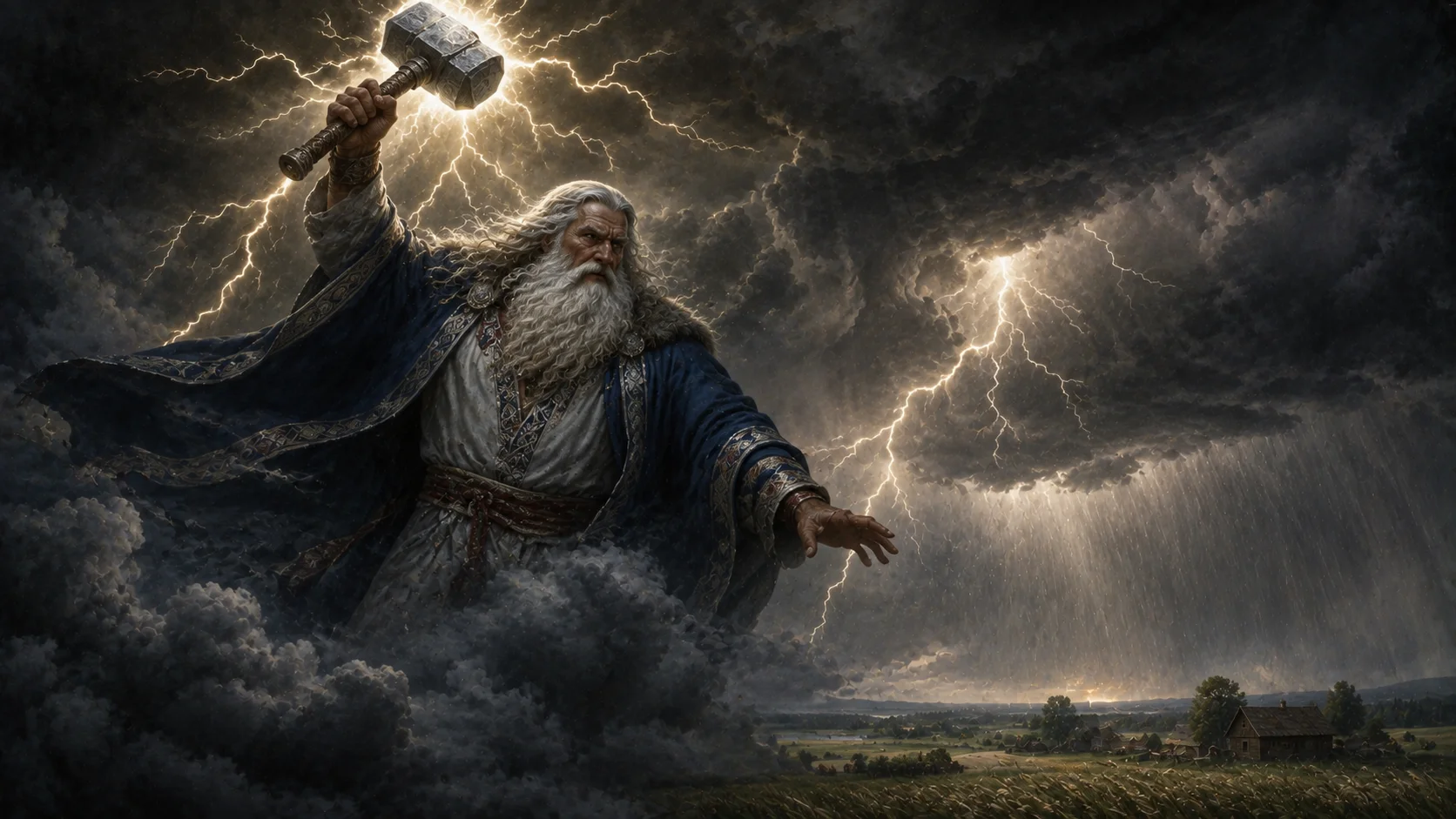
Ukko, called Ukko Ylijumala, "Ukko the High God," is the supreme sky-god of pre-Christian Finnish mythology, lord of the weather, the thunder and the harvest. His name itself means simply "old man," a respectful, half-euphemistic title rather than a personal name in the ordinary sense, and it is a mark of how thoroughly he entered the language of the people he ruled that the modern Finnish word for thunder, ukkonen, is literally "little Ukko," and thunder-weather itself is called ukonilma.
The Old Man Who Governs the Sky
Ukko is remembered in the old poetry as Isä Ukko, "Father Ukko," and as Pitkäinen or Pitkänen, "the Long One" or "the Tall One" — an epithet later folk-etymologized into a name for thunder in its own right. As Ylijumala, the "over-god" or high god, he stands above the sky itself, ruling the clouds, the rain, the wind and the fire that falls from the heavens. Since Finnish belongs to the Uralic family rather than the Indo-European one, his position is not a matter of shared ancestry with Thor, Perun or Zeus but of shared function: each is the figure a farming people turned to when the sky itself needed to be reasoned with. Scholars examining the Baltic-Finnic world alongside Estonian figures such as Vanaisa or Kõu, and the Baltic thunder-god Perkūnas, still debate whether these parallels reflect old contact and borrowing between neighbouring peoples or simple, independent invention by cultures facing the same sky. The honest answer is that it remains an open question, not a settled one.
A Name Recorded, Not a Genealogy
What is known of Ukko comes down through a narrow set of channels: Elias Lönnrot's Kalevala, the vast folk-poem archive known as the SKVR (Suomen Kansan Vanhat Runot, "The Old Poems of the Finnish People"), and the eighteenth-century clerical record of Christfrid Ganander, whose Mythologia Fennica of 1789 is one of the earliest attempts to set Finnish belief down as a systematic mythology. It is worth holding a caveat here rather than smoothing it away: the tidy hierarchy in which Ukko sits neatly atop a pantheon may owe something to the organizing instincts of the men who collected and arranged these poems centuries after the beliefs were living practice. Pre-Christian Finnish religion, as far as it can be reconstructed, was very likely more plural and more regionally varied than any single chart of gods can show, and Ukko's supremacy should be read as the picture the sources give us, not as a fact beyond question.
The Hammer That Falls as Stone
Ukko's weapon is his hammer or axe, the Ukonvasara, "Ukko's hammer," and its story does not end in myth alone — the name was also given, in folk belief, to the Neolithic stone axes that farmers turned up in their fields. Found centuries after the people who made them had vanished, these worked stones were read as thunderbolts, physical evidence that Ukko had struck the earth. This "thunderstone" motif is well attested across Baltic-Finnic folklore, a case where an everyday archaeological object was absorbed whole into a living belief about a sky-god's weapon, each thunderstorm a fresh reminder that the old stones in the soil had fallen from his hand.
Invoked, Not Adventuring
Within the Kalevala, Ukko does not appear as a hero with his own quests and wanderings. His role is invocatory: he is the power called upon, not the figure who acts out a story of his own. Väinämöinen and the other culture-heroes appeal to him at moments of crisis — when fire must be struck down from the sky, when a storm must be answered, when protection is needed beyond what any mortal or lesser spirit can provide. This is a liturgical presence more than a narrative one, the god addressed in the moment of need rather than followed through a sequence of deeds, and it is worth keeping that distinction clear rather than imagining for him adventures the sources do not give him.
Beer Poured Out Against the Drought
Ganander's eighteenth-century account preserves something rarer than myth: a description of actual ritual practice. Communities facing drought held rain-invocation ceremonies known as ukon vakat, "Ukko's bushels" or "Ukko's vessels," in which beer was offered to him in hope of rain. This ties his cult tightly to the agrarian year — he was not an abstract sky-power admired from a distance but a god petitioned directly, with real offerings, at the exact moment a failed harvest threatened a community's survival. The rains he was asked to send were not a poetic figure; they were the difference between a full granary and a hungry winter.
Akka, and a Name Held Loosely
Ukko's consort is generally given as Akka, forming a paired sky-father and earth or fertility-mother. In some regional traditions she is identified instead with Rauni, sometimes connected by folk etymology to the rowan tree, though that particular connection is a debated etymological guess rather than an established fact, and it should be presented as such rather than as settled lore. What is consistent is only the pattern: her identity and name vary meaningfully from region to region, which is itself a useful reminder of how regionally plural this belief-world actually was, consort included.
A God Folded Into a New Faith
When Christianity took hold in Finland, Ukko's attributes did not simply vanish; in places they blended into the new religion's own figures. Some folk invocations that once addressed Ukko directly came to be folk-blended with the Christian God, and, in a pattern also documented among Slavic and Baltic thunder-gods, with the prophet Elijah — known in some traditions as St. Elias — whose fiery ascent and command of storms made him a natural point of overlap. This blending is documented but regionally variable, meaning any particular folk-prayer text that survives should be read as a regional survival shaped by centuries of Christian contact, not as a transparent window onto pure pre-Christian belief.
The Word That Outlasted the Worship
Long after formal invocation of Ukko faded, his name stayed lodged in the Finnish language itself. Ukkonen, thunder, and ukonilma, thunder-weather, are used without a second thought by speakers who may give no thought to the god behind them — a linguistic fossil in the truest sense, a piece of belief preserved not in a temple or a text but in ordinary weather-talk, spoken every time a Finnish summer storm rolls in.
Painted and Written Back Into Memory
The nineteenth and twentieth centuries saw Ukko taken up again, this time deliberately, as Finnish national-romantic artists and writers reached back past Christianity for symbols of a distinctly Finnish, pre-Christian heritage. He became a figure through which a modern nation could point at something old and unmistakably its own, and his name has carried on since into ordinary Finnish naming and commercial use, still recognizable, still carrying the old charge of "the old man of the sky" even in entirely secular settings.
Called Upon Again
In the modern revival of Suomenusko, Finnish native-faith practice, Ukko has been taken up once more as an object of formal invocation, a living reconstruction of a role Ganander only ever recorded as folk-memory. It closes a long loop: a god petitioned with beer against drought in the eighteenth century, folded partly into Christian prayer, preserved unnoticed in the everyday word for thunder, and then deliberately called upon again by name in the present day.
The Sky as It Was Understood
Taken together, the record leaves Ukko not as a fixed statue of a god but as a name that kept doing work across many centuries — a title for whichever old, powerful figure a Finnish farmer needed to address when the rain would not come, a hammer for the stones turned up by the plough, a word for the thunder itself, and, now, a name spoken again with intent. What can be said of him is bounded carefully by what the Kalevala, the SKVR poems and Ganander's record actually preserve, and within those bounds he remains the high god of the Finnish sky: the Old Man whose hammer struck the thunderbolt and whose favor, once, decided whether the harvest came in.
Sources & traditions
- EncyclopediaWikipedia — Ukko
- TraditionFinnish folk and village traditions (Finland)
Myths change from area to area and from time to time. This chronicle follows the most widely told versions; tellings in other villages, regions and eras may differ.