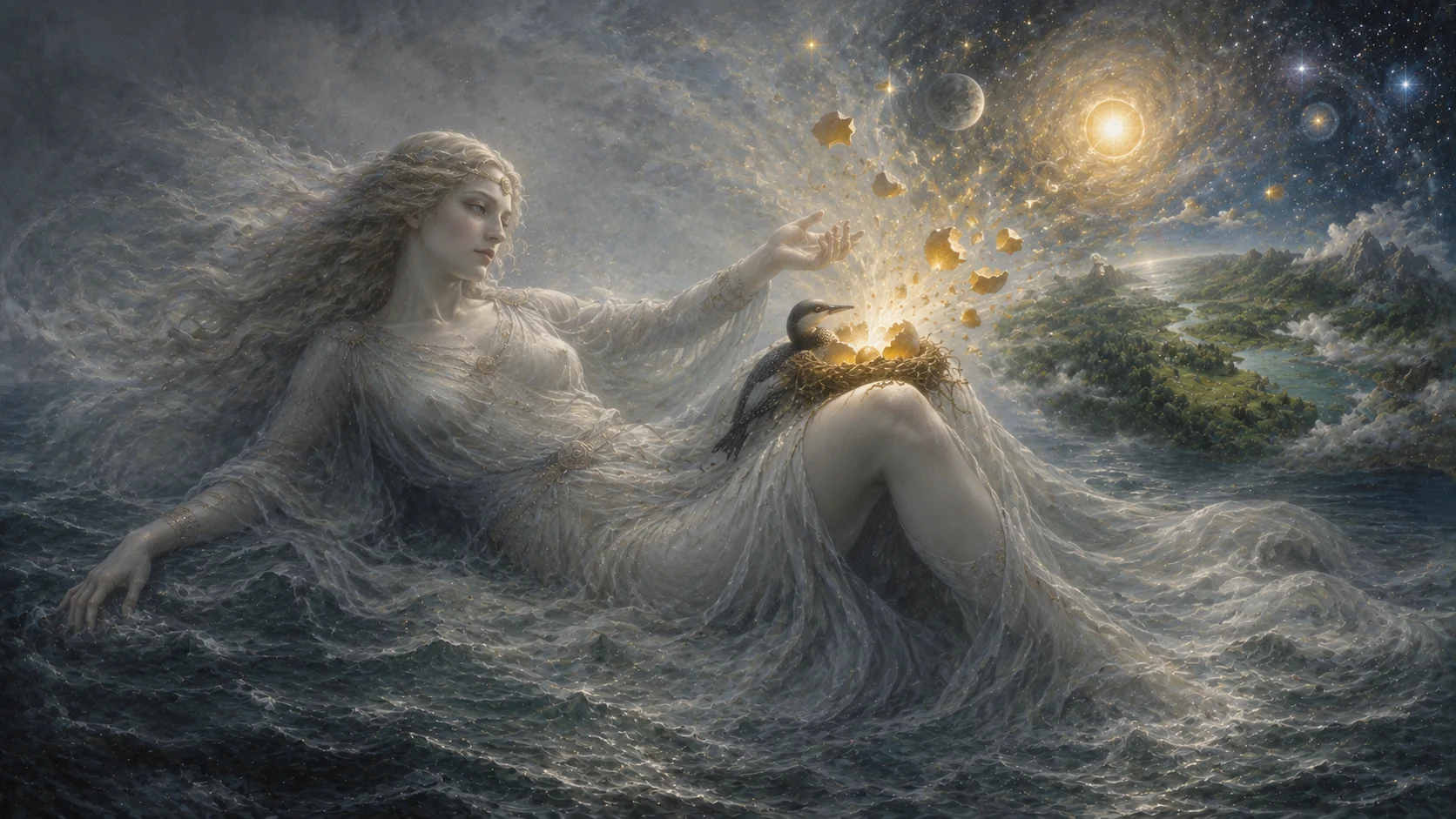
Ilmatar, the air-daughter, is the primordial spirit of the sky in the Kalevala's account of the world's beginning: a virgin daughter of the air who descends into the empty sea and becomes, through no union but the elements themselves, the mother of the world and of the first singer.
A Daughter Weary of the Sky
Before there was land, before there was a sun to mark the day, there was only Ilmatar and the air that bore her name. She is called Ilmatar, "air-daughter," and in the same breath of the poem, Luonnotar, "nature-daughter" — the two names moving through Rune 1 almost as one figure, a maiden of the empty heavens with no father named and no company but the wind. In time the stillness of the sky wearied her, and she left it. She lowered herself from the air down onto the face of the primeval sea, and there she remained, a virgin spirit alone on water that went in every direction to no shore at all.
The Long Drift Upon the Water
The sea took her in without violence and without welcome — it simply was, and she floated on it. The wind moved over the water and the water moved beneath her, and between the two of them, without any husband and without any act that the poem names as a joining, she conceived. This is the shape the Kalevala gives to her conception: not a story of a lover but of an element meeting an element, the air-daughter made fertile by wind and sea together. From that meeting she took the name Veden emä, Mother of the Waters, a title that sits beside Ilmatar and Luonnotar as another face of the same being.
Seven Hundred Years Unable to Give Birth
What conception did not bring quickly, birth did not bring at all for a very long time. The poem gives her seven hundred years adrift, carrying what she carried and delivering nothing, with no shore to come to rest on and no one to ease the waiting. This is the loneliest stretch of her story — not the fall from the sky, which is swift, but the centuries on open water that follow it, water that offers no bank, no reed bed, no resting place of any kind. She is, in this stretch of the telling, entirely alone with the beginning of the world inside her and no way yet to bring it out.
A Bird Mistakes Her for Land
Into that unbroken water came a scaup, a diving duck, searching the horizon for somewhere to nest and finding nothing — no island, no rock, nothing above the waterline anywhere. Ilmatar, moved by the bird's need, raised her knee above the surface of the sea. To the scaup it looked exactly like what it needed: a hillock rising out of the water, solid enough to build on. The bird settled there and laid its eggs on the knee Ilmatar had offered, mistaking the body of the world's mother for the first dry ground the world would ever have.
The Eggs That Became Sky and Earth
The scaup brooded its eggs on that resting place, and the warmth of the sitting bird grew, until Ilmatar felt the heat as a burning against her skin and drew her knee back down beneath the water. The eggs lost their perch and rolled from her knee into the sea, and there, striking the water, they broke apart. From the pieces of shattered shell the visible world took its first shape: the lower half of the shell became the earth, and the upper half became the sky arched over it. The yolk became the sun, carrying its light up into the new sky; the white of the eggs became the moon, paler beside it; and the fragments left over, the small broken pieces of shell too scattered to become anything so whole, became the stars and the clouds that fill the spaces between sun and moon and earth.
Shaping the Land with Her Own Hands
The breaking of the eggs gave the world its first, roughest form — earth and sky and the lights above them — but it was Ilmatar herself who finished the work, and by hand rather than by accident. Where the newly formed earth lay flat and featureless, she reached out and shaped it: pressing capes out into the water, hollowing sea-depths where the water could run deep, drawing coastlines where land should meet sea, and setting pits and hollows aside as places for fish to gather and shelter. The world as it is described in the same rune is therefore not only something that happened to her, in the accident of a nesting bird, but something she went on to make deliberately, feature by feature, with her own hands upon the earth the eggs had given her.
The End of the Long Waiting
All the while, what she had conceived from wind and sea in the earliest days of her drifting had not yet come into the world. The shaping of capes and depths and coastlines went on around a pregnancy that was itself still unfinished, carried far longer than any ordinary term — thirty years is the figure the poem gives it, a length so far beyond the natural that it marks the birth to come as no ordinary birth. Whatever waited inside her waited through the making of the whole visible world before it was ready to be born into it.
The Birth of Väinämöinen
When the child finally came, he came already old. Väinämöinen, born of Ilmatar after those long years of carrying, entered the world not as an infant but as a man aged by the very gestation that had produced him — the eternal sage and singer who becomes the Kalevala's central figure, its chief hero and its voice, was from his first moment already grown, already wise, already carrying the bearing of age his unnaturally long time in the womb had given him. He is, by this account, the son of the air-daughter and of nothing else named in the surviving poem — no father stands beside Ilmatar in the telling of his birth.
A Name Not to Be Mistaken for Another
The shared root of Ilmatar's name, *ilma*, "air," has caused her to be confused, in casual retelling, with Ilmarinen, the smith-hero of later runes who forges the Sampo and takes his own place among the Kalevala's central figures. The resemblance is in the sound alone. Ilmatar belongs to the world's first rune, before any hero has a forge or a name of his own; Ilmarinen belongs to the runes that follow, once the world she made is already standing and needs a smith rather than a mother. The two figures share nothing beyond four letters of air.
A Mother Without a Consort
Unlike the heroes who follow her into the poem, bound up in courtships, rivalries, and alliances, Ilmatar has no named spouse and no antagonist anywhere in the surviving material. Her only defining relationships are the two that carry the whole of Rune 1: a maternal bond to Väinämöinen, the son she carried and delivered, and a cosmogonic bond to the elements themselves — air, wind, water, the eggs of a wandering bird — out of which everything else in the poem's world is made. She stands apart from the social and political entanglements that shape the heroes who come after her, because her story is the making of the stage those heroes will later occupy.
A Voice Lönnrot Gave a Fixed Shape
The Ilmatar of the printed Kalevala is Elias Lönnrot's synthesis, assembled in 1835 and again in 1849 from older oral Kalevala-metric folk poems, runolaulu, gathered chiefly from Karelian singers. Among folklorists this compiled figure remains a point of open debate: whether "Ilmatar" specifically, as a fixed and named persona, held the prominence in the older oral tradition that Lönnrot's text gives her, or whether the tradition spoke more often in the looser terms of a generic Luonnotar, an air-maiden without so settled a name. The creation she performs — the descent, the drifting, the eggs, the shaping of the land — is old; the precise shape and title under which it is now known owes something to Lönnrot's editorial hand.
Sung Again in a Later Century
Her creation scene did not stay confined to the page. In 1913 the composer Jean Sibelius set the Rune 1 creation text as *Luonnotar*, a tone poem for soprano and orchestra that carries her descent from the sky and her long drifting on the sea into concert performance. The same episode — the world-egg breaking into earth and sky, sun and moon and stars — became one of the most frequently painted and illustrated scenes of the whole Kalevala in the era of Finnish national-romantic art, images returning again and again to the moment a bird's nest becomes a world. Read beside the other cosmogonies of Eurasia that tell of a world hatched from an egg, Ilmatar's creation stands as the Kalevala's own version of a widely shared myth: the world-parent who is, before anything else exists to name her by, simply the air, the water, and the will to shape both into a world.
Sources & traditions
- EncyclopediaWikipedia — Ilmatar
- TraditionFinnish folk and village traditions (Finland)
Myths change from area to area and from time to time. This chronicle follows the most widely told versions; tellings in other villages, regions and eras may differ.