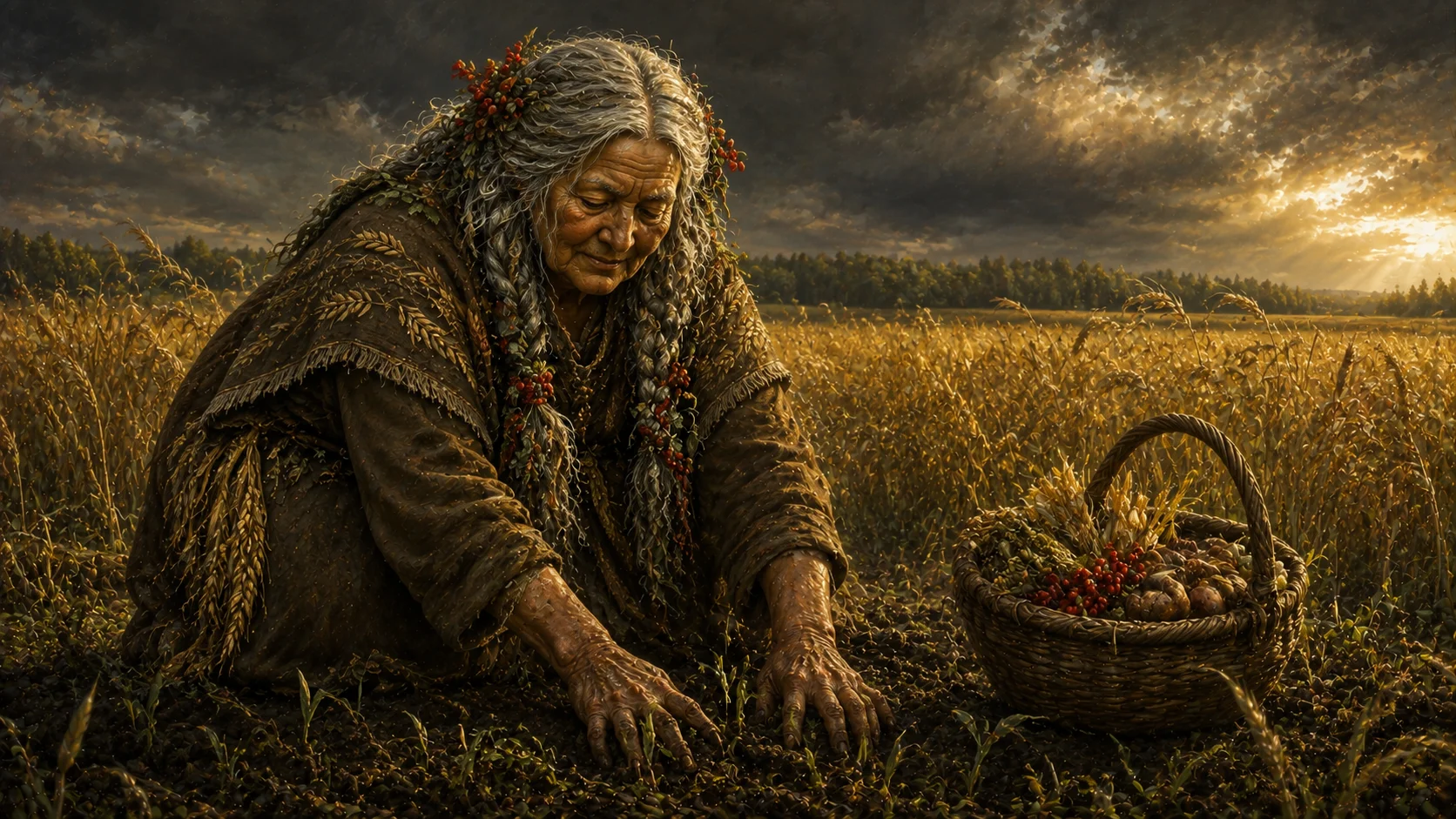
Akka, "the Old Woman," is not, properly speaking, the name of a single goddess but a title — one appended to a god's name to mark his female consort or counterpart. In Finnish-Karelian tradition its most prominent bearer is the wife of Ukko, the Finnic sky- and thunder-god, understood in this pairing as an earth-mother figure standing opposite Ukko's rule of sky, rain, and storm. What follows concerns that Akka specifically: Ukko's consort of the Kalevala-tradition Finnish-Karelian material, not the distinct and better-documented Sámi goddesses who share the same root word.
A Title Worn by Many, a Name Owned by None
The word akka is ordinary Finnish for "old woman" or "wife/mistress," and its mythic use follows that plainness: it is a productive suffix attached to a domain to produce a spirit-figure presiding over it. Maan-akka is the woman of the earth, Veden-akka the woman of the water, Kave-akka another such figure in the wider Finno-Karelian folk material, much of it carrying Sámi influence. None of these is "Akka" in the sense of one settled personal name; each is a local application of the same honorific. When collectors and later folklorists speak simply of "Akka," they most often mean the specific case of Ukko's wife — but the word's grammar keeps that meaning from ever being exclusive or fixed.
The Wife Set Against the Sky
As Ukko's consort, Akka occupies the earth-side of a sky-father/earth-mother structural pairing that recurs across Finno-Ugric comparative mythology. Ukko governs the storm and the rain that falls from above; Akka, by structural implication, is set against him on the ground the rain falls upon. This is a pairing built more from symmetry than from narrative — a relationship of position, sky answered by earth, rather than a story with a beginning, a complication, and an end. The pairing is a structural inference drawn by comparative scholars from the wider Finno-Ugric religious record, not a plot preserved intact in a single source; it describes how Akka relates to Ukko, not what she does.
Rauni: A Name Offered, Not Confirmed
Some folklore sources give this consort of Ukko a proper name of her own: Rauni, occasionally rendered Ravdna under Sámi influence, with "Akka" then standing as her title rather than her identity. Folklorists including Martti Haavio and Uno Harva have worked with this identification, and part of their reconstruction ties Rauni to the rowan tree, the pihlaja, as a tree-spirit. This equation — Akka is Rauni is the rowan-spirit — is attested in the record but debated among specialists, and should be read as a scholarly proposal for connecting scattered fragments rather than as a settled genealogy. A modern account that presents "Akka, also called Rauni, spirit of the rowan" as agreed fact is smoothing over a real disagreement in the sources. It is more honest to say: in some folk-poem variants and in Haavio's reconstruction, Ukko's Akka carries the name Rauni and a rowan association; other strands of the tradition simply call her Akka and leave the question of a proper name open.
Invoked Together, Petitioned as One
Where the record is firmest is in ritual practice. Early folklore collectors working across the seventeenth to nineteenth centuries recorded Finnish and Karelian peasants invoking Ukko and Akka jointly in agrarian fertility rites, asking the pair together for rain, for the fertility of the crops, and for thunder at the right season. This is Akka's clearest attested role: not as a figure with her own mythic episodes, but as the necessary second half of a petition addressed to a couple. The prayers survive; a plot centered on Akka alone does not. That the invocation names her at all, rather than simply asking Ukko for rain, is itself the strongest evidence that peasant religion treated the pairing as functionally necessary — the request for fertility was understood to require both the sky's rain and the earth's answering receptiveness, voiced as two names in one petition.
A Figure Without a Story of Her Own
This absence is worth stating plainly rather than papering over. Unlike Mielikki, who has independent episodes of her own within the Kalevala tradition, there is no substantial narrative centered on a goddess simply named Akka acting in her own right. She survives in invocation formulas, in epithets, and in the comparative reconstructions of scholars — not in a developed storyline. Where a source uses hedging language — "in some folk-poem variants," "according to Haavio's reconstruction" — that hedging is doing real work, marking the difference between what the oral tradition actually preserved and what later scholarship has proposed to connect the pieces. A confident, single fixed list of Akka's deeds would be manufacturing certainty the material does not have.
An Epithet That Marks Power, Not Just Age
The word's reach beyond deities is itself instructive. The Kalevala uses akka descriptively for various old women and wives among its human characters, and Louhi — the formidable mistress of Pohjola, whose proper name in the epic is Louhi and not Akka — is sometimes described in folk-poem register with akka-type language: old, powerful, a woman ruling a northern domain. This shows the word functioning as an epithet marking female authority and antiquity rather than as anyone's fixed mythic name. It is the same logic that lets "Akka" attach to Ukko's wife, to a water-spirit, and to an earth-spirit without any of them being confused for one another by the tradition itself — the title travels; the identity underneath it does not.
What the Epithet Shares Across Figures
Set side by side, Ukko's Akka and the Louhi of folk-poem register are not the same figure and are never claimed to be, but the coincidence of language is not accidental either. Both are described with the vocabulary Finnic oral poetry reserves for women who hold ground: age treated as authority rather than frailty, and a domain — a household, a kingdom, an earth — spoken of as theirs to answer for. Reading the two together clarifies what the title is actually doing: it is a register of speech, not a genealogical claim, and a writer should resist the temptation to let the shared word imply a shared story.
Not to Be Mistaken for the Sámi Akka Goddesses
A distinct and much better-defined family of akka goddesses exists in Sámi mythology, a neighboring but separate tradition: Máttaráhkká, the primal mother, and her daughters Sáráhkká, Juksáhkká, and Uksáhkká, who govern childbirth, the gender of children, and the household threshold respectively. These figures are frequently and popularly conflated with the Finnish Akka on the strength of the shared root word alone. They should not be merged here. The Sámi group is a separate pantheon with its own defined functions and family structure; the Finnish-Karelian Akka discussed in this entry is Ukko's consort, thinly attested, and structurally rather than narratively defined. Where the Sámi group has an internal genealogy — a mother and three named daughters, each with a distinct household or bodily domain — the Finnish Akka has no equivalent family structure at all; that absence is itself part of what distinguishes the two traditions, not merely their geography.
The Modern Duality, and Its Limits
Contemporary popular writing and neopagan Suomenusko practice often present Akka as a standalone earth-goddess cleanly paired with Ukko in a tidy sky-father/earth-mother duality, as though this were settled ancient doctrine. Scholars caution against taking that presentation at face value. What the oral tradition actually offers is scattered and regionally inconsistent: invocation formulas naming Ukko and Akka together, a disputed identification with Rauni, a scattering of other akka-titled spirits, and comparative inference from wider Finno-Ugric religion. The clean duality is a modern systematization built on top of that material, not a discovery recovered from it. A careful account keeps the modern reception and the historical record in separate rooms: the neopagan pairing is a real and living practice, but it should be named as a modern synthesis rather than presented as the tradition's own settled self-understanding.
What the Title Preserves
Taken as a whole, Akka is less a character than a position kept open in the tradition — the answering half of Ukko, the shape a female earth-figure takes wherever the old poetry needed one. She is invoked rather than narrated, reconstructed rather than recounted, named provisionally as Rauni by some collectors and left simply "the Old Woman" by others. That thinness is not a gap in the record to be filled in with invention; it is itself the honest shape of what survives — a title carried by many old, powerful, earth-bound women in the Finnish-Karelian imagination, most fully attached, when attached at all, to the wife who stood on the ground beneath Ukko's sky.
Sources & traditions
- TraditionFinnish folk and village traditions (Finland)
Myths change from area to area and from time to time. This chronicle follows the most widely told versions; tellings in other villages, regions and eras may differ.