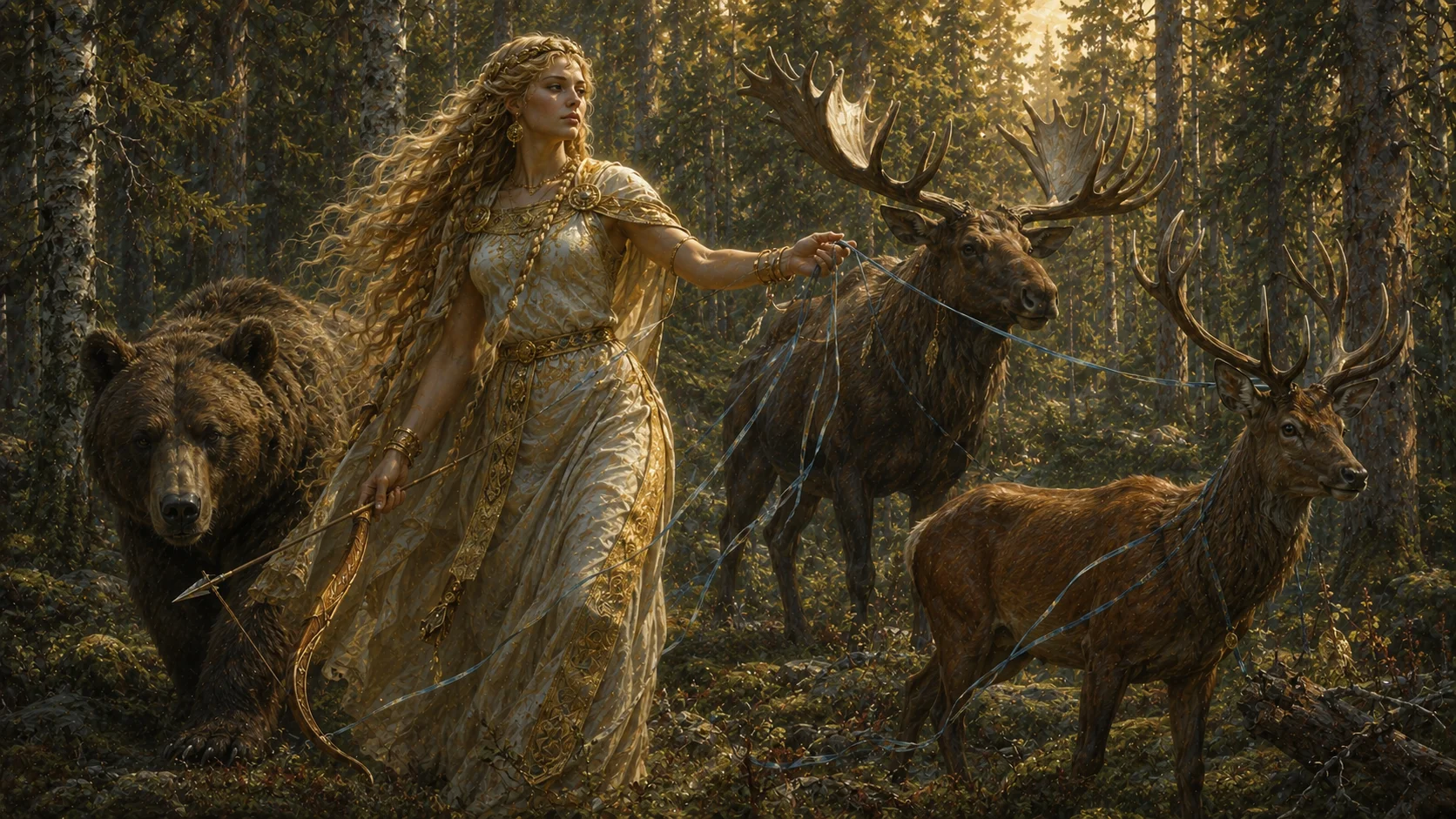
Mielikki is the forest spirit, or haltija, of Finnish-Karelian folk tradition: the mistress of the woodland (metsän emäntä), invoked above all by hunters seeking her favour before entering the forest. She is known chiefly through the Kalevala, compiled by Elias Lönnrot from 19th-century oral folk-poetry (runolaulu), and through the hunting charms (metsästysloitsut) gathered from singers across Karelia and Finland and preserved in archives such as the SKVR, the collection of old runes of the Finnish people.
The Emäntä of the Green Household
In the poems collected by 19th-century folklorists, Mielikki is not a ruler of the cosmos but a domain-spirit, a haltija bound to a single realm: the forest, or metsä. This is the pattern found throughout Finno-Karelian belief, where each significant resource has its own spirit-owner who must be approached with proper respect before that resource may be used — Ahti and Vellamo hold the waters, Ukko rules the sky, and Mielikki holds the wooded wild. She is most often styled metsän emäntä, the mistress or hostess of the forest, an epithet that marks her not as a distant divinity but as the one who keeps the forest's house, who must be spoken to as a householder is spoken to by a guest asking for hospitality.
Called Upon in the Rune of the Elk of Hiisi
Mielikki's clearest appearance in the printed Kalevala comes in Rune 14, where the hero Väinämöinen sets out to hunt Hiiden hirvi, the great elk of Hiisi, and calls upon Mielikki for aid in tracking and capturing it. He asks her to release the game from the depths of the forest and to mark out the trails by which the hunter may follow it. This is not an isolated literary flourish on Lönnrot's part but a synthesis of a widespread motif: across the older oral poems, hunters facing the forest's game routinely turn first to Mielikki, since the elk, the bear, and every other creature of the wild are understood to belong to her keeping until she consents to let them go.
Opening the Forest's Golden Storehouse
The hunting charms gathered by 19th-century folklorists preserve one of Mielikki's most distinctive and recurring ritual images: the hunter's plea that she open the forest's golden lid, box, or storehouse — variously rendered as the forest's aitta or lipas — so that the game hidden within may be released to him. This is the language of a granary or a treasury, not a battlefield: the forest's animals are pictured as goods kept under lock, and Mielikki alone holds the key. A hunter who set out without first addressing her in these terms, the charms imply, could expect the forest to yield nothing.
Praised, Flattered, and Petitioned
Because Mielikki can grant or withhold hunting luck at will, the charms that invoke her are built from careful, often flattering address — polite titles, praise of her generosity, and promises or offerings made in exchange for her favour. This reflects the broader Finno-Karelian worldview in which the forest's bounty is never simply taken; it belongs to a spirit-owner and must be petitioned for, much as one would ask a favour of a powerful and somewhat unpredictable host. The hunter who returned home empty-handed had, in this logic, failed to properly honour her rather than merely failed to find game.
The Household of Tapio
Mielikki's most consistent counterpart across the folk material is Tapio, the great god or king of the forest; together they are understood to head the forest-spirit household, sometimes described as ruling the forest realm known in the Kalevala tradition as Tapiola. The exact nature of their pairing is not fixed doctrine — some regional variants describe a more loosely defined household, or pair the forest's female spirit differently — and the genealogical detail of the wider folk-poem tradition should be read as variant material collected from many singers rather than a single settled myth. Lönnrot's Kalevala represents one editorial harmonization of this variant oral material into a continuous narrative, not an ancient fixed original.
Tellervo and Nyyrikki of the Forest Family
The wider household associated with Tapio in the Kalevala-tradition poems includes named younger figures: Tellervo, a forest maiden sometimes called Tapio's daughter, and Nyyrikki, a son of Tapio linked to the marking of hunting paths. Mielikki functions as the matriarchal figure of this forest family as it appears across the collected poems, though which of these figures belong specifically to her, as opposed to Tapio alone, shifts from singer to singer and region to region. The folk tradition does not offer a single settled family tree, and later retellings that present one should be understood as smoothing over that variation rather than reporting it.
The Disputed Kinship with Hongatar
In some charm variants Mielikki is invoked alongside, or even identified with, Hongatar, the spirit of the pine. This identification is inconsistent across the source material: some singers appear to treat Hongatar as another face of Mielikki, while others clearly separate her out as a related but distinct minor spirit of her own. The relationship should be flagged as an open, disputed point of the tradition rather than resolved one way or the other — a reminder that the forest-spirit world of the charms was populated by many overlapping figures whose boundaries were not drawn identically from village to village.
A Domain-Spirit, Not a High God
It is worth being precise about Mielikki's standing within Finnic cosmology. She is a haltija, a tutelary spirit governing a specific domain, not a high god presiding over cosmic affairs in the manner of Ukko in the sky. Her power is real and consequential — she can make or ruin a hunt — but it is local to the forest and its creatures. This domain-specific pattern recurs throughout the tradition, and understanding Mielikki correctly means resisting the temptation, common in later popular retellings, to inflate her into a supreme goddess figure that the 19th-century sources themselves do not describe.
Voices from Many Singers, Gathered into One Book
The Kalevala that most readers encounter today is Lönnrot's compilation, first published in 1835 and expanded in 1849, drawn from the oral performances of many different runolaulu singers across Karelia and Finland. Mielikki's epithets, her exact relationships, and the details of the charms addressed to her differ from poem to poem and source to source. Treating the printed Kalevala as a single ancient myth, rather than as a scholarly synthesis of variant oral material, obscures how the tradition actually worked: a living, regionally varied practice of song and charm, only later fixed into a continuous narrative for the printed page.
Illustrated and Reimagined in Later Art
Beyond the 19th-century charms and Lönnrot's compilation, Mielikki has continued to appear in later literary and artistic reworkings of the Kalevala tradition — illustrations, retellings, and Kalevala-inspired artwork that cast her as an iconic lady of the forest. These later depictions frequently elaborate on her visually and narratively well beyond what the original charms specify, giving her a more fixed appearance or personality than the variant oral sources ever fully settled. They are a genuine part of how Mielikki has been received and pictured, even as they stand at a remove from the attested folk-poem material itself.
A Name Carried into Modern Finland
Mielikki's afterlife extends well past the 19th-century collections. In modern Finland her name has been adopted as a given name and used symbolically in nature and forestry contexts, and it has named ships and organizations besides. Within 20th- and 21st-century Suomenusko revivalist and neopagan practice, she is drawn on directly as a nature-goddess figure to be honoured in new ritual contexts. This modern reception is worth marking clearly as its own layer, distinct in time and character from the 19th-century oral folk-poem material — a continuation and reinterpretation of her figure rather than a straightforward extension of it.
What the Charms Ask For
Read together, the hunting charms addressed to Mielikki describe a consistent transaction rather than a single fixed narrative: the hunter approaches the forest as a petitioner, names and praises its mistress, and asks that she unlock what is hers to give. Success in the hunt is her gift, granted or withheld according to whether she has been properly honoured. It is this transactional, relational picture — a spirit-owner and a respectful petitioner, worked out across dozens of variant songs rather than codified once — that the surviving folk-poem material actually preserves, and that later literary and revivalist reworkings have built upon in their own, later ways.
Sources & traditions
- EncyclopediaWikipedia — Mielikki
- TraditionFinnish folk and village traditions (Finland)
Myths change from area to area and from time to time. This chronicle follows the most widely told versions; tellings in other villages, regions and eras may differ.