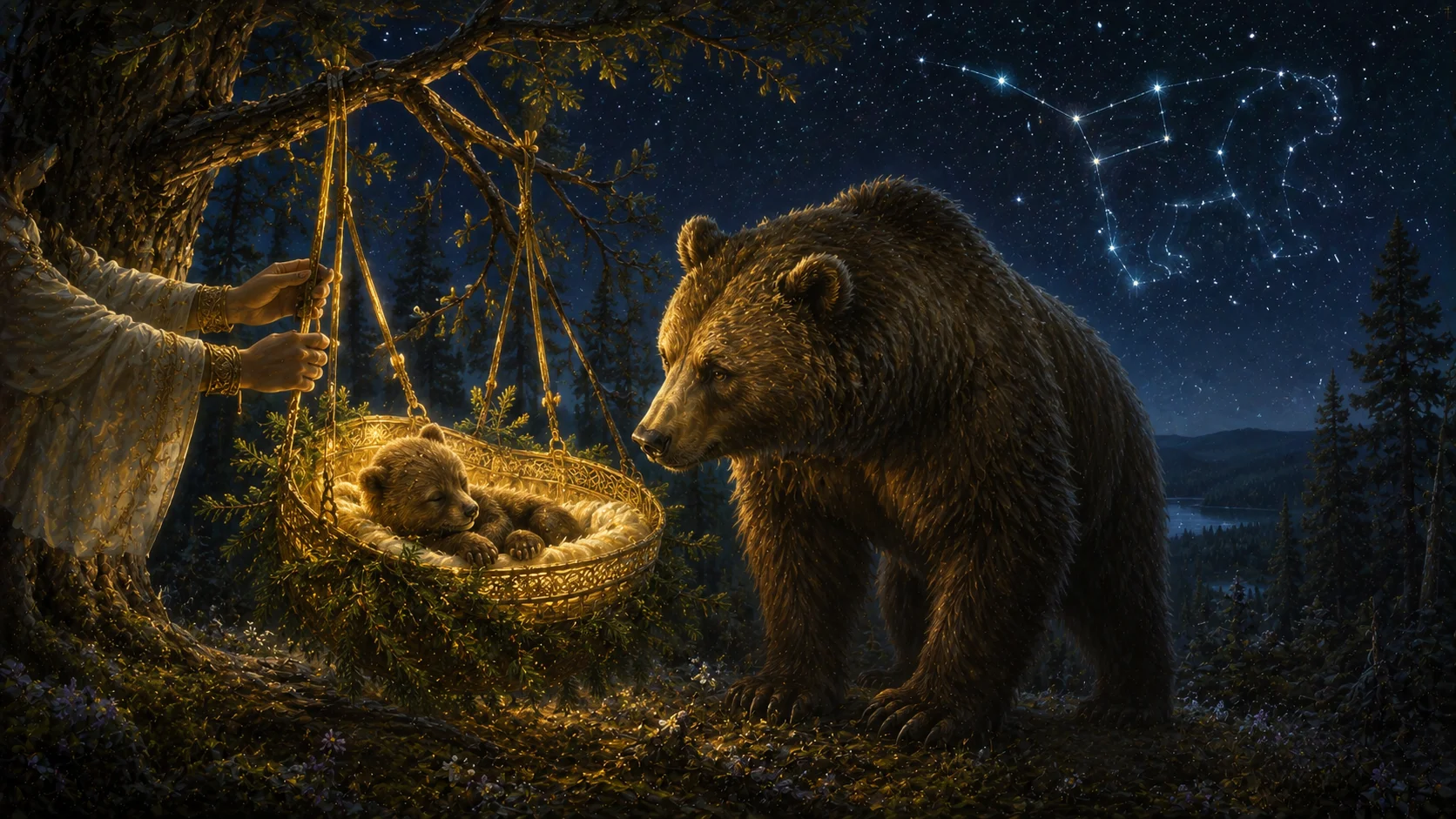
Otso is one of the great honorific names for the bear in Finnish-Karelian folk tradition, the being the oral poets of the Kalevala called king of the forest and honey-paw — a creature held too sacred and too powerful to be named outright, spoken of instead through a whole vocabulary of reverent circumlocution, sung down from the sky in a golden cradle, and, when killed, sent home again with feast, apology, and song.
A Name Too Heavy to Speak Plainly
Otso is not the bear's only name, and in a sense it is not quite the bear's real name either — that is the point of it. Finnish-Karelian hunters held the plain word for the animal, karhu, to be dangerous in the woods: spoken carelessly, it might summon the very thing it named, or worse, offend it. So a wide vocabulary of substitute names grew up around the bear, each carrying its own shade of flattery or caution. Otso is among the most common of these, standing alongside Ohto, Mesikämmen — literally honey-paw — Kontio, and Metsän kuningas, king of the forest. A ritual epithet, kultainen, golden, was reserved for moments of highest ceremony. This pattern, a taboo wrapped around the most formidable animal of the northern woods, is not unique to Finland; it belongs to a much wider circumpolar habit of speech found also among the Sami and various Siberian peoples, wherever the bear was the largest and most consequential thing a hunter might meet.
Born Above the Moon
The fullest account of Otso's origin comes from Runo 46 of the Kalevala, and it does not begin on earth. The bear, the songs say, was born in the sky itself — above the moon, alongside the sun, upon the very shoulders of the Great Bear, the constellation the Finns call Otava. There, in the cold clarity of the heavens, seven maidens of the ether rocked a golden cradle, and in that cradle the bear was raised until the time came for it to be sent down. It was lowered to the earth on a chain of gold and silver, arriving among the forests of men not as a wild animal born of den and mother but as a being let down deliberately from a celestial home, kin in origin to the stars that named it.
A Sky Full of Variants
It should be said plainly that this birth-in-the-sky account is not the only version the old singers preserved, and it is worth resisting the temptation to flatten the tradition into one tidy story. Even within the body of oral poetry that Elias Lönnrot gathered mainly from Karelian singers and wove into the Kalevala of 1835 and 1849, different regional variants disagree — some describing the sky-birth above Otava, others speaking instead of a bear-mother born of a forest maiden, earthbound from the start. Lönnrot's Kalevala presents a synthesis, a single continuous narrative built from many singers' voices, and the disputed birthplace is a reminder that what survives in print is a compilation, not a single fixed scripture. Different source regions carried different truths about where Otso came from, and both belong to the tradition.
The Name Written on the Sky
The link between the bear and the heavens is not confined to a single runo; it is built into the language itself. The Finnish name for the constellation Ursa Major, the Great Bear, is Otava — the same root that gives the bear-cradle its resting place in the origin myth. This is not incidental wordplay but a recurring point of interest in Finnish folklore scholarship: the sky-name and the sky-birth reinforce one another, each lending the other credibility, so that every time a Karelian hunter looked up and found Otava overhead, the story of the golden cradle and the seven maidens was, in a sense, still visible.
Kin, Not Quarry
Central to understanding Otso is that the bear was never regarded as ordinary prey, an animal to be hunted the way one hunted hare or elk. The bear's heavenly origin made it kin to the gods and, by extension, distant kin to the forest itself and to the people who lived in it. Terms of address for the bear leaned on kinship and endearment rather than the language of the hunt — honey-paw, forest apple — implying a family bond rather than a predator-prey relationship. The bear's domain was understood to sit under the authority of Tapio, the forest god, and his wife Mielikki; the great hunting rites of the tradition invoked this pair directly, asking their blessing and permission before game of any kind, and especially the bear, could rightly be taken.
The Hunt in the Songs
Within the Kalevala the killing of Otso is bound up with the hero Väinämöinen, and in some tellings with Lemminkäinen as well, both figured as the ones who track and bring down the great bear. But the poem is far less interested in the mechanics of the hunt than in what follows it. The runo devoted to the episode, often called Karhunpeijaiset, is built largely from ritual song — verse after verse addressed directly to the slain bear, asking its forgiveness, insisting the death was accidental, or claiming, in the elaborate fiction the songs maintain, that the bear had come to the hunters of its own will rather than having been killed by human hands at all. The hunt, in other words, is confessed to and apologized for in the same breath it is described.
The Bear's Wake
Karhunpeijaiset — the bear feast, sometimes rendered the bear's wake — names the entire ritual complex that followed a bear killing, and it is the episode's true center of gravity. The dead bear was not treated as a carcass but welcomed as an honored guest into the very community that had killed it. Hunters spoke to it with flattering, apologetic address, careful never to claim outright responsibility for its death. A structured ceremonial meal followed, eaten with song and formality rather than as ordinary provisioning. Nothing about the feast was incidental: every stage of it existed to manage the bear's spirit, to ensure that so great and sacred a being would not depart the world bearing a grudge against the people who had brought about its death.
The Skull Set in the Pine
The feast's culmination was the setting of the bear's skull high in a pine tree — the kallohonka, sometimes described by the related term kallonnosto, the raising of the skull. This was not disposal but a deliberate send-off: folklorists have read the rite as a way of returning the bear's spirit to the sky it had come from, lifting it back toward Otava and the celestial cradle where its story began. Understood this way, the whole arc of Otso's mythology closes a single circle — a being born above the moon, lowered to earth on a golden chain, honored and consumed in life's most solemn ceremony, and finally lifted again toward the stars to be born anew. Birth, death, and rebirth are not three separate ideas here but one continuous rite.
A Cult, Not Quite a God
It is worth being precise about what kind of figure Otso is, because the temptation to elevate the name into an independent deity is an easy one and not what the tradition itself supports. Scholars of Finnish folklore generally treat Otso not as a discrete god within a pantheon, comparable to Tapio, Ukko, or Ahti, each of whom held distinct domains and were addressed as personal beings, but as the sacred, taboo-bound name for the bear as an animal — a creature wrapped in an extraordinary density of ritual, reverence, and belief without being personified as a named, independent divinity in the way those gods were. The bear cult, the whole constellation of naming taboos, birth myth, and feast ritual, is the substance of Otso; it is a body of sacred practice organized around a real animal, not the biography of an anthropomorphic god.
One Voice Among Many Circumpolar Songs
The reverence given to Otso, remarkable as it is, is also part of something larger than Finland alone. Bear ceremonialism — the killing of a bear treated as an event requiring ritual propitiation, apology, and careful management of the animal's spirit — is a widely attested circumpolar pattern, found in one form or another wherever northern peoples lived alongside bears powerful enough to demand this kind of respect. What makes the Finnish-Karelian material distinctive is not its uniqueness but its documentation: the Kalevala preserves one of the fullest and most fully realized poetic versions of this bear cult anywhere in the folklore record, a depth of surviving song that scholars of comparative religion, among them Uno Harva, have drawn on repeatedly when studying the wider pattern.
From Oral Song to National Imagination
The material that makes up Otso's story reached the wider world through Elias Lönnrot, who compiled it from oral poems collected principally in Karelia and shaped it into the Kalevala across its 1835 and 1849 editions. From there, the bear cult descriptions rippled outward into Finnish national-romantic art and literature through the nineteenth and twentieth centuries, becoming one of the touchstone images of a native mythology being newly written down and newly claimed. It is worth noting, too, that this scholarly and literary legacy is distinct from a more recent trend: some modern retellings and games have taken to personifying Otso as a discrete bear-god or bear-king character, complete with agency and invented dialogue. That kind of portrayal is a contemporary literary extrapolation, built on top of the old material rather than found within it, and should be understood as a later reinterpretation rather than as attested original myth.
What the Golden Cradle Still Holds
What endures from all of this is not a god with a face and a will but something closer to an attitude — the sense that the greatest and most dangerous animal of the forest deserved a name too careful to speak plainly, a birth story too grand for the ordinary den, and a death too significant to pass without apology. Otso is the shape that reverence took: a bear let down from among the stars on a chain of gold and silver, addressed as honey-paw and king of the forest, feasted as an honored guest at its own wake, and lifted back skyward in the branches of a pine, so that Otava, the constellation that gave it its cradle, might one day receive it home again.
Sources & traditions
- EncyclopediaWikipedia — Otso
- TraditionFinnish folk and village traditions (Finland)
Myths change from area to area and from time to time. This chronicle follows the most widely told versions; tellings in other villages, regions and eras may differ.