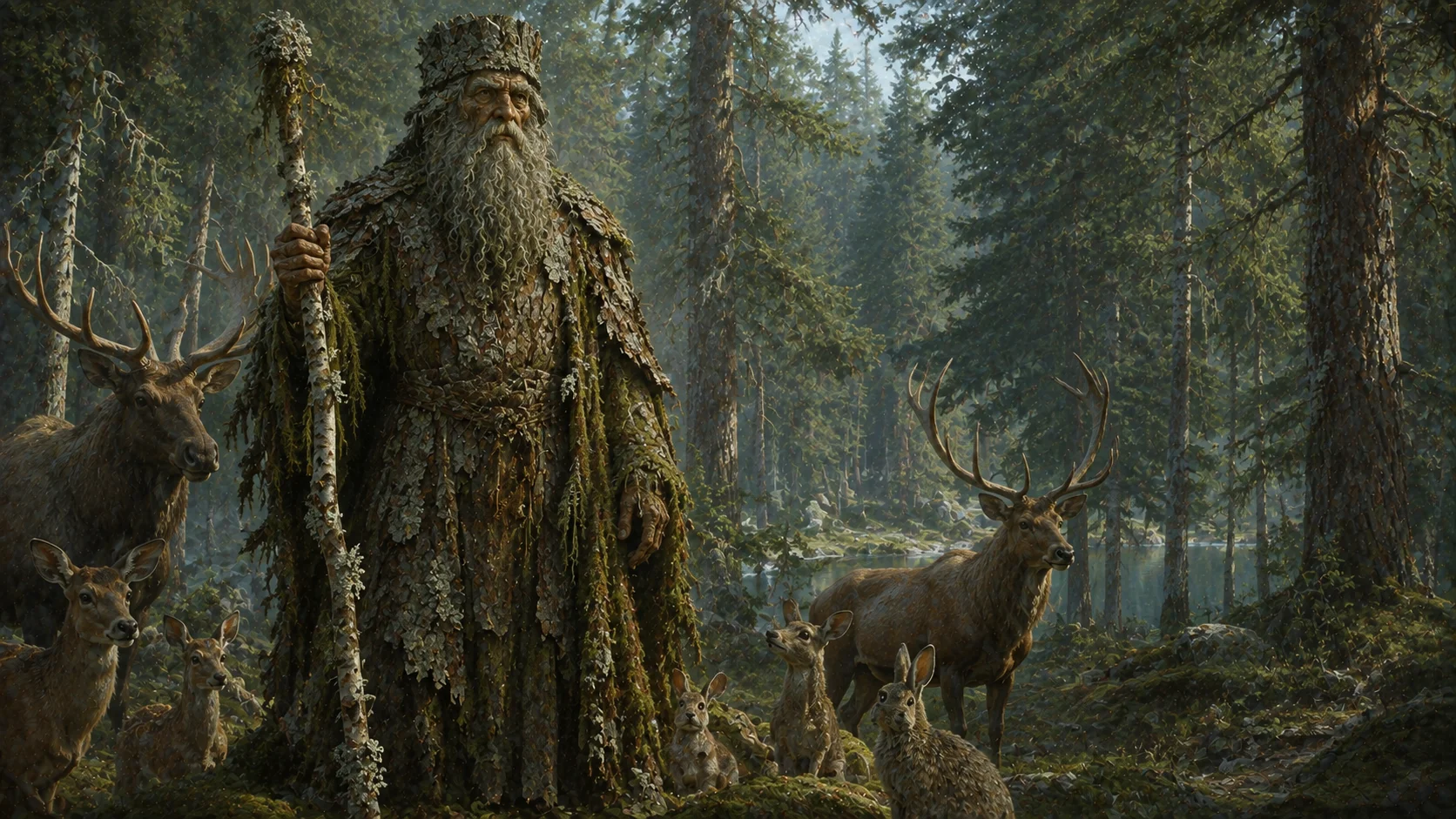
Tapio is the god of the forest in Finnish mythology: the lord of the woodlands and the wild, the master of the game animals and the giver of the hunt, a moss-bearded forest-king clad in lichen and pine whose favour the hunters of Finland sought before they entered his green domain. Attested in the Kalevala, the national epic Elias Lönnrot compiled from Finnish-Karelian oral poetry in 1835 and 1849, and in the older kalevalaic hunters' charms and bear-songs that fed into it, Tapio stands as one of the great domain-rulers of Finnish folk cosmology, holding the forest the way Ahti held the water and Ukko held the sky.
Tapiola, the Forest Made a Kingdom
Tapio's realm is Tapiola, envisioned in the old poetry not as an empty wilderness but as a rich and autonomous domain in its own right, with its own halls, its own herds of game, and its own inhabitants distinct from the human world beyond the trees. To step into the forest was, in this understanding, to step into someone else's kingdom, one governed by its own laws of hospitality and offence. Tapiola held storehouses of game that Tapio could open or withhold, and the forest's abundance or its silence was read as his verdict on the hunter's conduct and his correctly spoken word. The name has outlived the belief that shaped it: Tapiola remains a living Finnish place name today, most visibly the district of Espoo that carries it, a quiet inheritance of the mythological forest-realm in the geography of the present.
The Master of the Woodland Herds
Within Tapiola, Tapio is guardian and, in the language of the old charms, the symbolic owner of the forest animals: the elk, the bear, the deer, the game birds that sustained a hunting people. An animal could not simply be taken; it had, in the ritual logic of the tradition, to be granted by its keeper. This is why the poetry so often figures the game as Tapio's herds or his cattle, kept in the forest the way a farmer keeps stock in a byre, released only at the will of their lord. The idea reframes the hunt itself: not a taking from an empty wild, but a transaction with a being who owned what he gave, and who could just as easily give nothing.
Prayers Spoken at the Forest's Edge
Before entering the woods to hunt, it was the custom recorded in Kalevala-metre poetry for hunters to pray to Tapio, asking him to open his storehouse of game and grant safe passage through his domain. Such invocations were a recurring, formulaic feature of Finnish-Karelian hunting poetry generally, not confined to any single tale, and they cast the forest not as a backdrop to be crossed but as a threshold to be addressed. The prayers asked, in effect, for permission and for luck together, treating the two as inseparable: a hunter who spoke correctly to Tapio and to his household had reason to hope for a full catch, while one who entered carelessly risked the forest's silence.
The Hunt of Lemminkäinen
The Kalevala preserves one of the clearest pictures of this practice in its account of Lemminkäinen's pursuit of the elk of Hiisi, the demon, in Runo 14, where the hero calls on Tapio and on Mielikki for aid before and during the chase. The episode is one instance of a much wider poetic habit rather than a unique event: heroes and ordinary hunters alike are shown turning to the same forest-rulers whenever the woods must be entered and game must be found. That Väinämöinen and Lemminkäinen, the epic's great figures, are shown addressing Tapio in this register places him among the powers even heroes must ask rather than command.
Metsän Isäntä, Master of the Forest
Tapio carries attested epithets that describe his standing directly: Metsän isäntä, the master of the forest, and Tapiolan isäntä, the master of Tapiola, titles that name him as head of household over his domain rather than as a distant abstraction. The word isäntä, master or head of a household or farm, is a telling choice: it casts the forest itself as an estate with a resident authority, run on the same terms of hospitality, ownership, and correct address that governed a Finnish farmstead. A hunter's prayer to Tapio was, in this sense, the etiquette of a guest asking a household's master for provision.
Mielikki, Mistress of the Wild
Tapio's wife is Mielikki, the forest's mistress and goddess of game and the hunt, and in the surviving hunting charms she is, if anything, invoked more actively than Tapio himself. Where Tapio holds the forest as its lord, Mielikki appears repeatedly as the one directly petitioned to guide game toward the hunter's path, a gracious and generous figure whose favour was sought alongside, and sometimes ahead of, her husband's. Together they form the ruling pair of Tapiola, their household extending the forest's authority through a family rather than a solitary god.
Tuulikki, Who Herds the Game
Among the children and attendants of Tapio and Mielikki named in folk poetry is Tuulikki, their daughter, associated with the animals of the forest and often asked, in the hunters' charms, to herd game toward the waiting hunter. Her role sharpens the picture of Tapiola as a working household with its own divisions of labour: if Tapio holds the herds and Mielikki grants their yielding, it is Tuulikki who is pictured moving among the animals themselves, driving them along the paths where a hunter's prayer had asked them to come.
Nyyrikki, Spirit of the Chase
A son, Nyyrikki, appears in the same body of poetry as a hunting-spirit invoked specifically for a successful chase, his name called on at the moment of pursuit rather than at the threshold prayer. Between Tapio's ownership of the herds, Mielikki's granting of game, Tuulikki's herding, and Nyyrikki's aid in the chase itself, the forest household of Tapiola divides the hunt into stages, each attended by one of its own, so that a hunter moving from prayer to stalking to pursuit was, in the logic of the tradition, never addressing an empty wood but always one particular member of a family that ran it.
The Bear Brought Home with Reverence
Finnish-Karelian bear ceremonialism, the ritual treatment of a slain bear with careful, euphemistic speech and a feast known as karhunpeijaiset, sits closely alongside belief in Tapio and Mielikki as forest-rulers, reflecting the same underlying principle that an animal taken from the forest was not simply killed but received a kind of ritual apology and thanks. The bear cult itself is a broader phenomenon, shared across circumpolar and Finno-Ugric peoples well beyond Finland, and its precise theological connection to Tapio specifically is a scholarly reconstruction drawn from the wider pattern of forest-spirit belief rather than a single attested rule. Even so, the bear feast's insistence on respectful address toward a taken animal mirrors, in miniature, the larger relationship the tradition imagined between every hunter and Tapio's domain: nothing was simply taken from the forest, only granted, and gratitude was owed for the granting.
A Realm Beside Ahti's Waters and Ukko's Sky
Tapio is conceptually paired in Finnish folk cosmology with Ahti, ruler of the waters, and his consort Vellamo, and with Ukko, ruler of the sky and weather, as parallel figures each governing a guarded natural domain that a person entered only with due respect. It is worth being precise about the shape of this grouping: as with Ahti, there is no single canonical pantheon list in the primary sources naming these figures together in fixed order or rank. Their pairing is a modern scholarly and popular systematization built from scattered folk poetry recorded across many singers, regions, and generations, useful for understanding the shared logic of Finnish nature-belief but not itself an ancient doctrine.
Tapiola in Music and National Memory
Tapio and his forest realm found renewed cultural life in nineteenth and twentieth century Finnish national romanticism and Karelianism, a movement that looked to the old kalevalaic poetry for a distinctly Finnish identity. Jean Sibelius named his 1926 tone poem directly for this realm, Tapiola, drawing the concert hall's attention to the same forest-kingdom the old hunting charms had once addressed at the treeline. Beyond music, the name persists in Finnish place names, personal names, and the names of organisations that reach for the forest's old association with abundance and quiet authority, a long afterlife for a figure whose original worshippers, if that is the right word, have been gone for centuries.
How Much of This Was Belief, and How Much Was Poetry
How far Tapio represents a genuinely worshipped deity within a coherent pre-Christian religion, as opposed to a poetic personification preserved mainly through nineteenth-century oral-poetry collection, is a live question among scholars rather than a settled one. The material comes chiefly through the SKVR archive of collected folk poems and through Lönnrot's own editorial synthesis in assembling the Kalevala, both of which shaped as well as recorded what survives. The specific wording of hunters' prayers, and the extent to which any formal cult of Tapio ever existed as such, should be treated as reconstructions built from these folklore collections rather than as direct historical record of a fixed religious practice. What is not in doubt is the shape of the belief itself: a forest imagined as inhabited, owned, and ruled, entered rightly only through correct and respectful speech.
The Forest as Both Provider and Presence
What runs through every strand of Tapio's tradition, the herds he owned, the household that shared his rule, the prayers spoken at the forest's edge, the bear brought home with ceremony, is a single symbolic understanding of the forest as at once a provider and a semi-sentient presence that had to be approached correctly. In a pre-modern Finland and Karelia where the forest's yield was central to subsistence, this was not idle poetry but a working relationship with the land, given a face, a wife, a son, and a daughter so that it could be spoken to. Tapio endures, in the tone poems and the place names that carry his forest's name forward, as the form Finnish memory gave to the wood beyond the clearing: vast, provisioning, and never quite empty.
Sources & traditions
- EncyclopediaWikipedia — Tapio (spirit)
- TraditionFinnish folk and village traditions (Finland)
Myths change from area to area and from time to time. This chronicle follows the most widely told versions; tellings in other villages, regions and eras may differ.