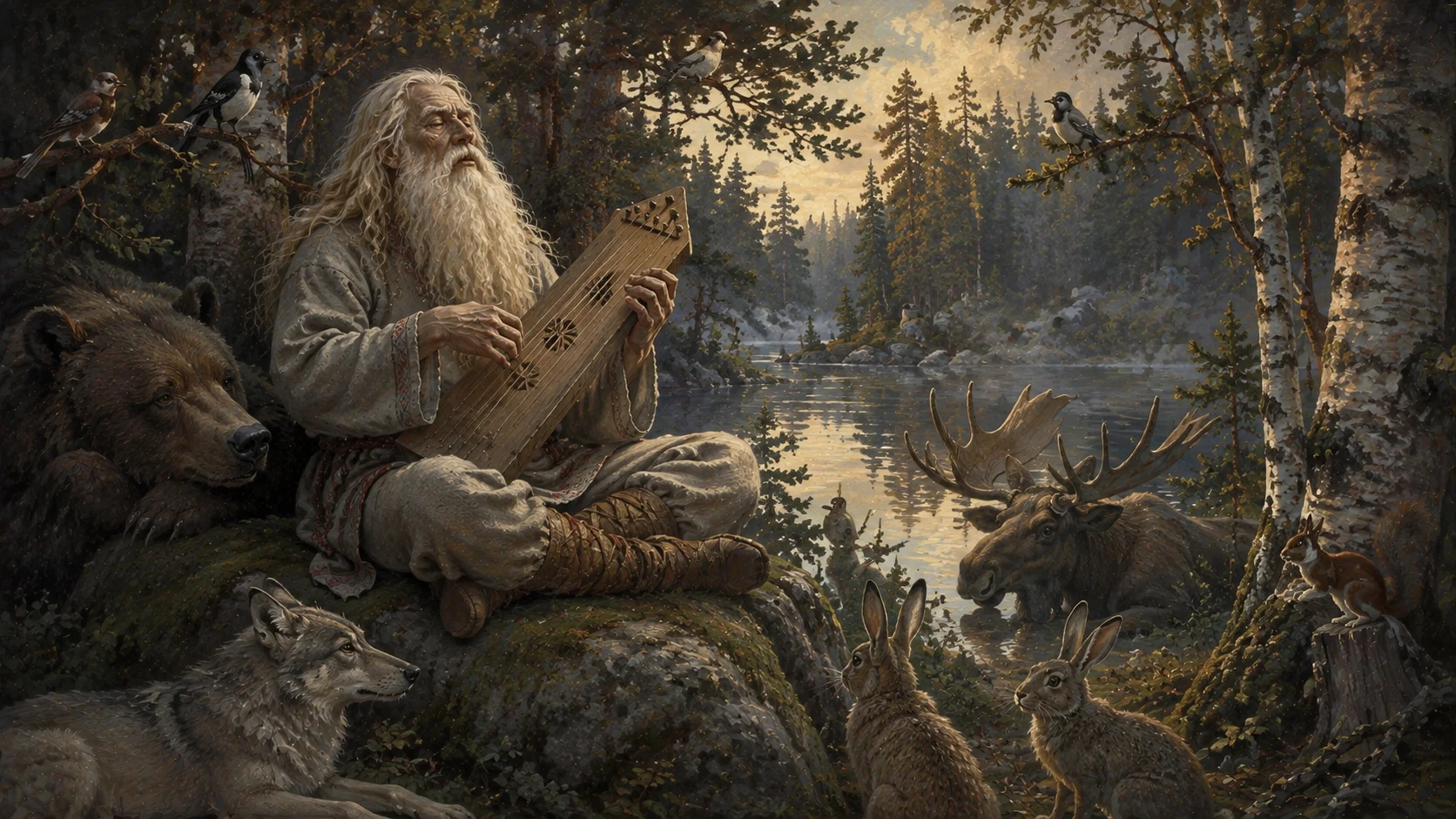
Väinämöinen is the central hero of the Kalevala and the greatest figure of Finnish mythology: the eternal sage, the divine bard, the master of song and magic, born old and wise from the primordial sea-mother Ilmatar. Through the power of his songs — for in Finnish myth, to sing is to work magic — he shapes the world, defeats his rivals, and pursues the wisdom and the treasures around which the epic turns. He is known throughout the Kalevala by his standing epithets, vaka vanha Väinämöinen, "steadfast old Väinämöinen," and tietäjä iänikuinen, "eternal sage" — formulas repeated so often across the poem's runot that they function almost as a second name.
Born of the Air-Maiden's Long Waiting
The Kalevala's first runo tells of Ilmatar, a sky-spirit who descends from the heavens into the primeval sea. There she drifts for uncounted years, and within her the child who will become Väinämöinen grows through an extraordinarily long gestation — so long that he is already old by the time he is finally born. He enters the world not as an infant but as a grown, bearded, and knowing man: the eternal sage, ancient from his very first breath. This cosmogonic origin sets him apart from Ilmarinen, the Kalevala's smith-hero, who is instead described as forged rather than born of woman. Väinämöinen's birth from the endless waters, rather than from fire and anvil, marks him from the outset as a figure of depth, patience, and accumulated knowledge rather than craft or strength.
The Egg That Became the Sky
Before or around the time of Väinämöinen's birth, the Kalevala recounts how the world itself was made. As Ilmatar floats upon the boundless primeval sea, a diving bird — a teal in most tellings — searches for dry land on which to nest, and finding none, settles upon Ilmatar's raised knee and lays her eggs there. When the knee shifts and the eggs tumble into the water and break, their scattered pieces do not sink but transform: the lower shell-halves become the solid earth, the upper halves the vault of the sky, the yolk becomes the sun, the white becomes the moon, and the fragments become the scattered stars. This episode of world-making, occurring in the same primeval sea from which Väinämöinen himself will emerge, is the cosmogonic foundation on which the entire Kalevala is built, and it binds the hero's own birth to the birth of the world.
A Contest of Knowledge in the Swamp
Runo III tells of the young and boastful Joukahainen, who rides out to challenge the elder sage to a contest — not of arms, but of song and knowledge, in the old tradition where singing is itself a form of power. Väinämöinen accepts, and as the two match verse against verse it becomes clear at once how unequal the contest is: the ancient sage's knowledge reaches back to the origins of things themselves, while the younger man's boasts are hollow beside it. Väinämöinen's singing does not merely defeat Joukahainen in argument — it acts on him directly, sinking him step by step into a swamp until he is submerged to his very neck and can no longer move. Trapped and desperate, Joukahainen begs for release, and to secure it he offers the one thing that might satisfy the old sage: his own sister, Aino, promised in marriage as the price of his freedom.
Aino's Refusal of the River
The ransom that saved Joukahainen becomes one of the Kalevala's most sorrowful threads. Aino is betrothed against her own will to Väinämöinen, a suitor far older than she is, and the marriage is not one she chooses or welcomes. Rather than submit to it, Aino goes to the water and drowns herself, refusing the union entirely. Her death, recounted in runo IV, is among the most-cited tragic episodes in the whole epic, and it leaves Väinämöinen — however unwittingly he came to be the cause — carrying a grief that follows him through the rest of the poem's action. The episode marks the first great cost of the sage's pursuit of a bride, and it colors everything that follows: his later courtships of the north are never again untouched by what happened to Aino.
Commissioning the Sampo
Undeterred by his losses, Väinämöinen turns his ambitions toward the Maiden of Pohjola, the daughter of the northern witch-mistress Louhi. As part of his courtship, he arranges for Ilmarinen — the epic's master smith, and his frequent companion and rival — to forge the Sampo, a wonder-working device whose creation becomes one of the central undertakings of the whole poem. The commissioning of the Sampo sets in motion the rivalry between the two heroes: Väinämöinen the elder and wiser figure whose word and plan set events moving, Ilmarinen the practical craftsman whose hands give the plan its form. Their partnership, and their competition, over the courting of the north's maiden and the making of the Sampo, runs through much of the Kalevala's middle runot.
Strings Cut from a Pike's Jaw
It is in runo XL that Väinämöinen becomes not only a singer but the maker of the instrument that will carry song forward. He constructs the very first kantele, the Finnish plucked string instrument, fashioning it initially from the jawbone of a giant pike and only later remaking it from birch-wood. The kantele becomes inseparable from him afterward: he is remembered as much for having given Finland its music as for anything he sang upon it. In the old tradition, this is not mere performance — laulaminen, singing, is understood as active magic, a force that can move the physical world, and the kantele becomes the instrument through which that magic is most fully expressed. Later tellings describe all of nature gathering to listen when he plays, though the core and best-attested fact is simply this: Väinämöinen made the first kantele, and in doing so became the patron of Finnish music and poetry alike.
Three Words Sought Among the Dead
Not all of Väinämöinen's knowledge comes easily, even to him. Runo XVI recounts his journey to Tuonela, the land of the dead, undertaken because he needs three particular words or spells to complete a boat he is building by magic alone, without axe or nail. The journey into Tuonela is perilous: he must cross into the realm ruled by Tuoni and encounter Tuoni's daughter, and he escapes the land of the dead only narrowly, without securing everything he had sought. The episode shows a side of the eternal sage rarely seen elsewhere in the epic — not triumphant but searching, incomplete, and willing to risk the underworld itself for words that lesser magic could not supply.
The Wound That Taught the Origin of Iron
Even the greatest of sages is not immune to accident. While building a boat, Väinämöinen wounds his own knee with his axe, and the injury bleeds freely enough that he must turn to magic to stop it. He does so by reciting the mythic origin of iron — a synty, or origin-charm, that traces how iron itself first came into being. In the runo-tradition, knowing the origin of a thing is understood to grant power over it, and the recitation of such origin-charms, syntyloitsut, is a well-attested feature of Finnish-Karelian folk healing magic. That the sage must heal himself this way, rather than by any ordinary remedy, reinforces what kind of hero he is throughout the epic: one whose power lies entirely in words, knowledge, and the recitation of origins, never in physical mastery alone.
Fragments Washed Ashore
Väinämöinen's dealings with Louhi and the north do not end with the Sampo's forging. After the Sampo is ultimately broken, its fragments are scattered, and some wash up on the shore where Väinämöinen retrieves them. In the telling the epic gives, these recovered pieces seed the future prosperity of Finland itself — the broken wonder-object, even shattered, still leaves something behind for the people who gather what the sea returns. This retrieval closes the long arc that began with Väinämöinen's commissioning of the Sampo for the sake of a bride he would in the end never win, turning a story of failed courtship into one of lasting, if diminished, gift.
A Berry-Born Child and a Passing Age
The Kalevala's final runo, L, tells of the virgin Marjatta, who conceives a son after eating a lingonberry. The child born of this conception is proclaimed King of Karelia, and his arrival marks the end of the world the poem has described. Väinämöinen, the eternal sage who has stood at the center of that world since before its making, finds himself displaced by this new order — one that scholars widely read as an allegory of the shift from the old ways to Christianity, though how much of that reading reflects the inherited oral material and how much reflects the editorial hand that shaped the printed Kalevala remains genuinely debated among scholars of the epic.
The Boat That Sails Toward the Horizon
Facing the new order that Marjatta's son represents, Väinämöinen does not fight to remain. He sails away in his own boat, leaving the land of Kalevala behind for the open horizon. Before he goes, he leaves behind his songs and his kantele for the people who remain — the music that first came from a pike's jawbone now passed on as inheritance. As he departs he speaks a promise rather than a farewell: that he will return one day, when he is needed again. The ending gives the epic's central hero an exit that is neither death nor defeat, but withdrawal — the sage sailing out of the story's present while leaving open, deliberately, the possibility of his return.
A Bard's Second Life in Paint and Sound
Väinämöinen's presence did not end with the Kalevala's final page. In the Finnish national-romantic art of the nineteenth and twentieth centuries he became a recurring subject, most famously in the paintings of Akseli Gallen-Kallela, and he appears in the orchestral and choral works of Jean Sibelius, including a piece titled for his song, with material touching the same cycle found in Sibelius's Kullervo and Lemminkäinen suites. He has also lent his name to institutions and to vessels built long after the runo-singers who first carried his story had passed. This later reception belongs to a distinct layer from the oral tradition itself — the work of nineteenth- and twentieth-century Finnish nationalism reimagining a figure the runo-singers had sung for centuries — and the two should be kept apart when weighing what is properly attested about him.
The Sage Who Ruled Through Words Alone
Across every episode of his long story, Väinämöinen is defined by what he is not: not the strongest, not the youngest, not a warrior in any conventional sense. His power is entirely that of the tietäjä, the shaman-sage, whose mastery lies in word-magic, origin-knowledge, and poetic and musical craft. He is often set beside Orpheus for the same reason — a figure whose song alone can move the physical world, calm what resists him, and command what force cannot. It is this quality above all that the runo-singing tradition of the Kalevala itself embodies and celebrates: a hero remembered not for what he conquered by strength, but for what he shaped, healed, and ultimately left behind, entirely through song.
Sources & traditions
- EncyclopediaWikipedia — Väinämöinen
- TraditionFinnish folk and village traditions (Finland)
Myths change from area to area and from time to time. This chronicle follows the most widely told versions; tellings in other villages, regions and eras may differ.