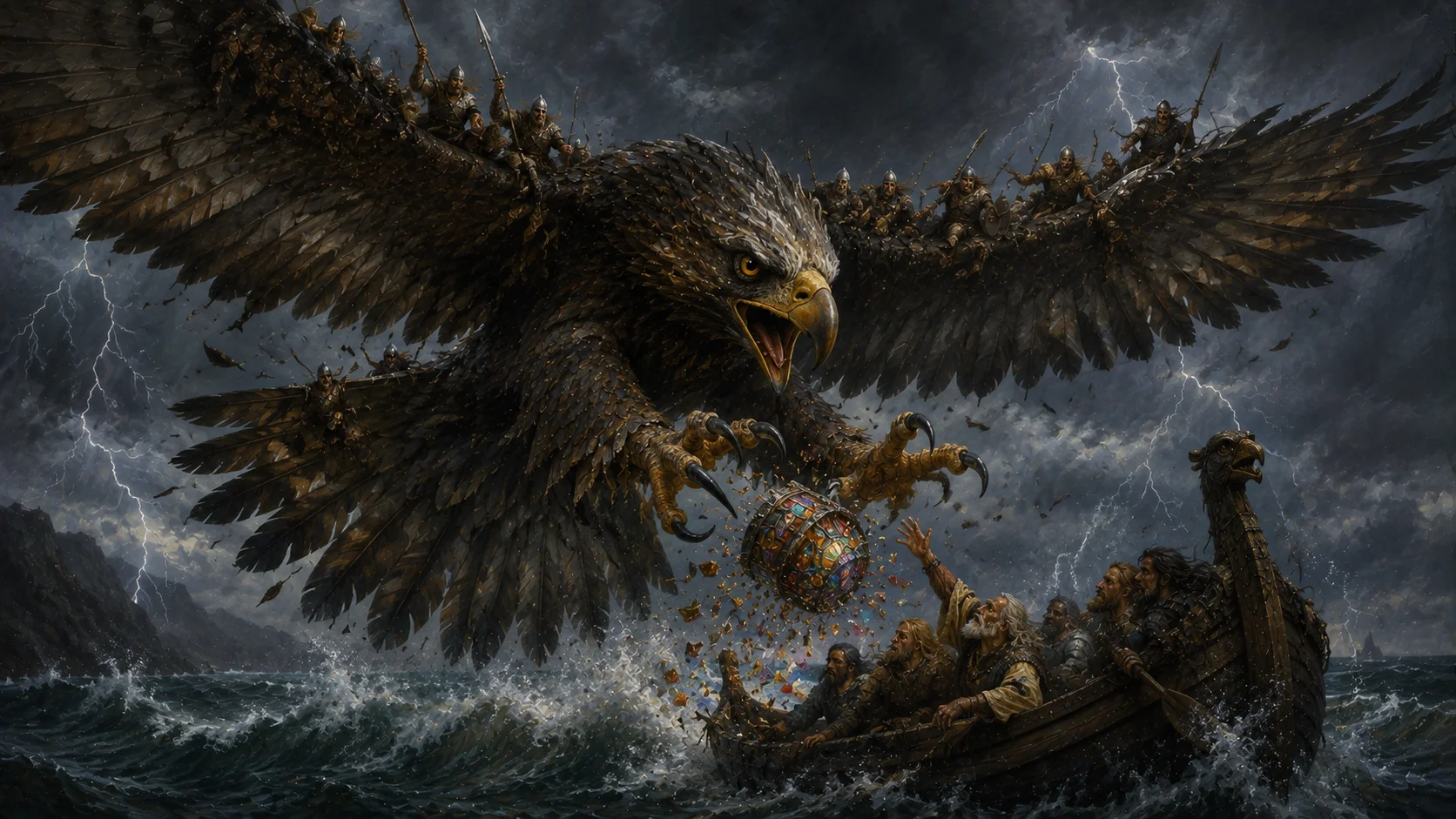
Louhi is the great witch-queen of the Kalevala: the powerful, cunning, and formidable mistress of Pohjola, the dark and cold realm of the north, whose rivalry with the heroes of Kalevala drives the central conflict of Finnish-Karelian oral epic. Compiled by Elias Lönnrot from generations of oral runo-singing and published as the Kalevala in 1835 and again, expanded, in 1849, her story is not the record of a single fixed myth but a woven synthesis of many regional variants — a distinction worth holding onto, since it is precisely what gives Louhi her many names, her many faces, and her unresolved edges.
Pohjan Akka, Toothy Crone of the North
Louhi is known by many titles: Pohjan akka, "the old woman of Pohjola"; Pohjolan emäntä, "the Mistress of Pohjola"; and simply akka, an old woman honored and feared in equal measure. The runos reserve for her a striking, recurring epithet — Pohjan akka, hammashampahinen, "the toothy, tusked crone of the North" — language that marks her as fearsome and set apart, her power written into her very appearance rather than hidden behind it. She is not a queen who reigns through a husband's name; she rules Pohjola in her own right, one of the few figures in the entire epic, male or female, who commands independent political and magical authority. In the world the runo-singers describe, Pohjola stands as the structural opposite of Kalevala itself — a cold, northern counter-realm against the more hospitable land of the heroes in the south — and Louhi is that realm's living embodiment, its sovereign and its will.
A Tietäjä of the North
To call Louhi merely a sorceress undersells what the tradition means by tietäjä — a seer, a knower, one whose power rests on command of sacred knowledge, incantation, and the deep words that shape the world. She stands in this way as a northern counterpart to Väinämöinen himself, the singer-sage of Kalevala, and much of the epic's tension comes from two tietäjät of comparable stature ruling opposed lands. Her magic is not incidental set-dressing; it is the foundation of her rule, the means by which she protects Pohjola, extracts promises from her visitors, and later wages war against the south when she believes herself wronged.
The Rescue and the Ransom of Väinämöinen
The pattern that defines Louhi's dealings with the heroes of Kalevala is set early. When Väinämöinen arrives in Pohjola wounded and in need, Louhi takes him in and gives him aid, healing him and offering him shelter in the northern hall. But her hospitality is not without a price. Before she will free him to return south, she extracts from him a promise — that he will forge or obtain for her the Sampo, a wondrous artifact of power and plenty. It is a bargain typical of her: generous in its immediate mercy, exacting in its long consequence, and it is this single promise that sets the entire arc of the Sampo in motion.
The Smith's Price and the Maiden of Pohjola
Väinämöinen cannot forge the Sampo himself, and the task falls instead to Ilmarinen, the great smith of Kalevala. Louhi commissions him to make the artifact, and the price she sets is not gold or tribute but marriage — the hand of her own daughter, celebrated in the runos as the Maiden of Pohjola, Pohjan neiti. Ilmarinen labors at his forge until the Sampo takes shape, and by that labor he earns the promise of the bride. Yet Louhi does not simply hand over what was promised; across the cycle she withholds and complicates the marriage, setting further trials and conditions before any suitor. This is the shape of nearly every courtship in the epic that touches Pohjola: Väinämöinen, Ilmarinen, and later the reckless Lemminkäinen each in turn desire the Maiden of Pohjola, and each is met by Louhi's tests — impossible tasks, dangerous errands, and no guarantee of success. She does not give her daughters away; she makes men earn the right to ask.
The Sampo Behind Nine Locks
Once forged, the Sampo comes to rest in Pohjola, and under Louhi's keeping it becomes the source of the north's abundance and strength — grinding out prosperity for her people and her realm. It is guarded, treasured, and utterly hers, the treasure that transforms Pohjola from merely a cold and forbidding land into one of real power. That the heroes of the south should come to resent this, and eventually resolve to take the Sampo back, is the inevitable consequence of a bargain that gave away something so valuable in exchange for a rescue and a marriage neither side fully honored to the other's satisfaction.
The Voyage North and the Breaking of the Sampo
The heroes of Kalevala — Väinämöinen, Ilmarinen, and Lemminkäinen together — sail north to seize the Sampo from Pohjola. What follows is one of the great climactic episodes of the entire epic: a magical confrontation in which Louhi, discovering the theft, pursues the heroes' ship with all the force of her power and her people. In the struggle that ensues, the Sampo is wrenched loose, broken, and scattered into the sea. Its fragments sink beneath the waves, though some wash ashore, and it is to this scattering — this partial, imperfect salvage — that later tradition attributes what prosperity the land possesses. Louhi loses the treasure she bargained and labored so hard to secure, but she does not accept the loss quietly.
Wings Over the Water
Among the most vivid images the runos give us is Louhi's transformation in pursuit of the stolen Sampo: she takes the form of a giant eagle, bearing her warriors upon her wings and back as she swoops down upon the heroes' vessel to reclaim what was taken. It is a moment that fuses her identity as sorceress-ruler with something closer to elemental force — a queen who does not merely command warriors but becomes, herself, an instrument of war. The image has proven durable far beyond the runo-singers who first shaped it, inspiring generations of later illustrators and painters drawn to its scale and its violence.
Darkness Loosed Upon Kalevala
Defeated in the battle over the Sampo but far from broken, Louhi turns her power against the land of Kalevala directly. In retaliation for what she has lost, she steals the sun and the moon from the sky and hides fire from the people of the south, plunging Kalevala into darkness and cold. It is a punishment fitted to her nature as ruler of a realm defined by darkness and winter — she does not merely strike at her enemies, she remakes their world in the image of her own losses. The darkness persists until Väinämöinen and Ilmarinen together manage to restore the sun and moon to the sky, undoing what Louhi's sorcery had wrought.
Plagues and Monsters Sent Southward
The theft of the celestial lights is not Louhi's only weapon. The runos also tell of her sending plagues against Kalevala, and of loosing monstrous adversaries upon the land — among them, in some variants, a great and terrible bear — each one an act of sorcerous aggression aimed at the heroes and the people who follow them. Each assault is met and overcome in turn, but the pattern itself is telling: Louhi's war against Kalevala is fought not with armies alone but with the full arsenal of a tietäjä's power, curse and creature and darkness turned as weapons.
Louhi and Louhiatar: A Disputed Kinship
Alongside Louhi, the runo tradition also preserves the figure of Louhiatar, a matronymic or patronymic form of the name attached in some songs to a hag associated with disease and affliction, sometimes described as a sorceress-mother of illnesses. Whether Louhiatar is simply another name for Louhi herself, a related figure, or a distinct being from a different strand of the oral tradition is disputed among folklorists, and the runos themselves do not resolve the question cleanly. This uncertainty is worth preserving rather than smoothing over — it belongs to the honest texture of a tradition assembled from many singers, many regions, and many centuries of retelling, and no single answer should be presented as settled where the sources themselves remain divided.
A Mother, A Ruler, A Rival
Two relationships anchor Louhi's place in the epic. She is the mother of the Maiden or Maidens of Pohjola, whose hand is repeatedly sought and repeatedly withheld, driving several of the epic's courtship episodes in turn. And she stands as the principal rival and antagonist to the heroes of Kalevala — not a minor obstacle in their path but a sovereign counterpart whose realm, power, and will match theirs at every turn. It is this pairing of roles, mother and ruler, protector of her line and sovereign of her land, that gives Louhi her particular weight in the epic: she is never merely an obstacle for heroes to overcome, but a figure whose own losses, bargains, and retaliations drive the story forward on equal footing with theirs.
The Witch-Queen in Later Memory
Louhi's afterlife extends well beyond the runos that first carried her. Through Lönnrot's Kalevala she became a touchstone of Finnish national culture in the nineteenth and twentieth centuries, taken up by the Karelianist movement in art and letters. Akseli Gallen-Kallela's paintings of the battle for the Sampo and of the theft of the sun gave her enduring visual form, fixing in Finnish visual memory the eagle-borne sorceress-queen of the runos. She has continued to surface in Finnish opera and musical works touching Kalevala material, in literature, and in popular culture generally, where she persists as an archetypal witch-queen — cunning, formidable, and never merely villainous, but a ruler defending her own realm, her own daughters, and her own losses on her own terms.
Sources & traditions
- EncyclopediaWikipedia — Louhi
- TraditionFinnish folk and village traditions (Finland)
Myths change from area to area and from time to time. This chronicle follows the most widely told versions; tellings in other villages, regions and eras may differ.