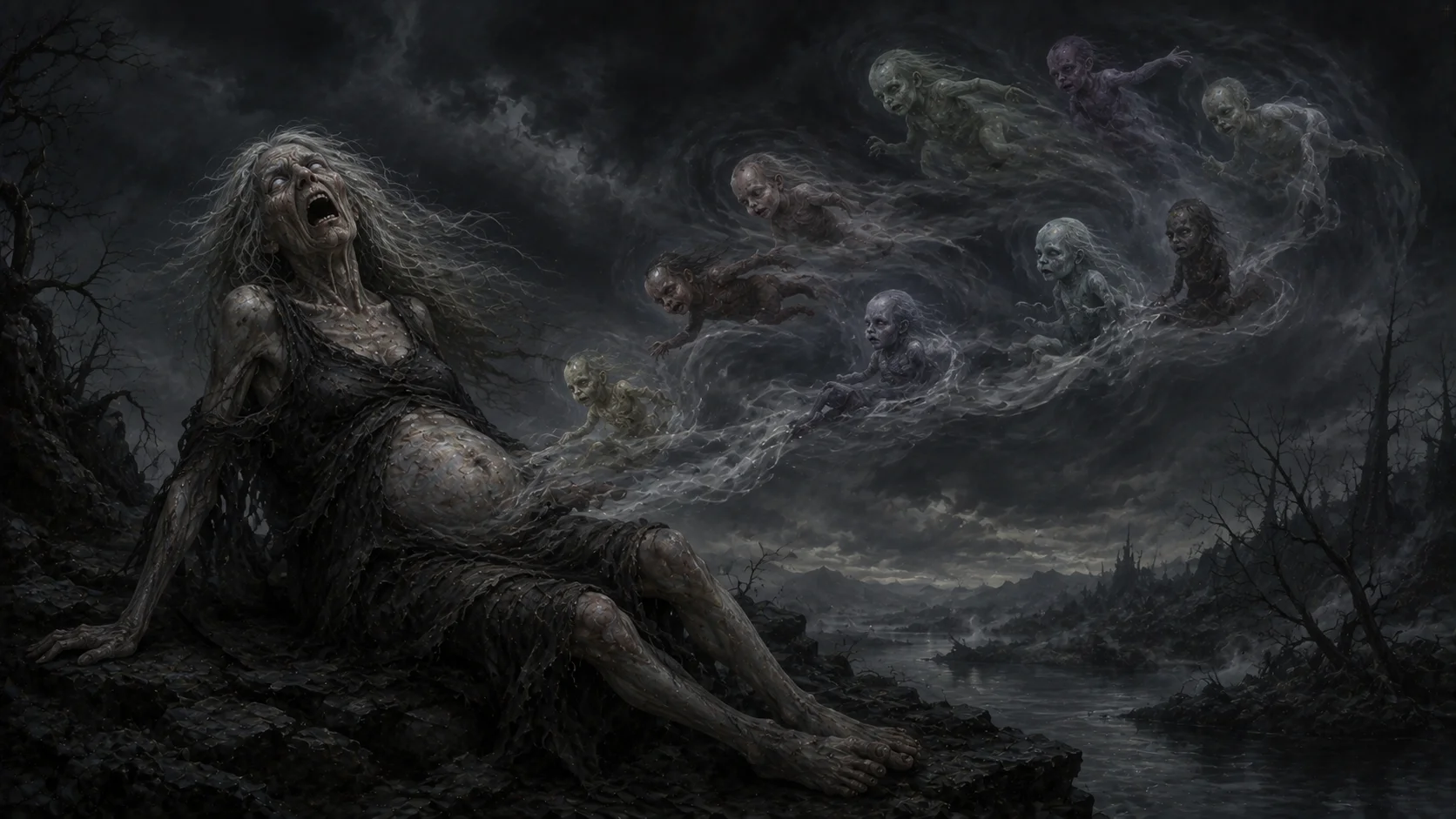
Loviatar is the dread hag-goddess of disease and pestilence in Finnish mythology: the blind, hideous daughter of the death-god Tuoni and Tuonetar, who, impregnated by the wind, gave birth to nine terrible diseases that afflict humankind.
The Blind Daughter of Tuonela
Loviatar is named in the Kalevala's forty-fifth rune as the offspring of Tuoni and Tuonetar, the ruling pair of Tuonela, the Finnish land of the dead. In variant tellings collected by Elias Lönnrot she is also called the blind daughter of Ilmatar, though the epic's own text most consistently ties her lineage to Tuoni's dark realm. She is blind, and her blindness is treated as part of her nature rather than an affliction laid upon her: a being who was never meant to see the living world clearly, only to reach into it. Her name itself, Loviatar, is thought by some Finnish folklorists to derive from lovi, a cleft or notch, and by extension a wound or opening in flesh or earth, though this etymology remains debated and unsettled among scholars rather than agreed fact.
The Worst of Tuoni's Kin
Among the dark spirits associated with the underworld and with Louhi's shadowed north, Loviatar is singled out as the worst. The Kalevala calls her pahin, "the worst," and describes her as the ugliest and most utterly malevolent of her lineage. She is not merely unpleasant or cruel in the ordinary sense given to underworld figures; the epic frames her as evil itself, a being whose whole substance is malice given form. Where other spirits of Tuonela guard the dead or ferry souls, Loviatar's role is generative: she does not merely dwell in darkness, she brings something new and terrible out of it into the world of the living.
Lying on the Wayside, Wind-Brought
The central episode of Loviatar's story begins with her lying exposed on the wayside, open to the wind. In the well-attested mytheme of Finnish-Karelian oral poetry, she conceives without any mate: the wind itself, tuulen tuoma, "wind-brought," gets her with child. There is no husband, no god, no named father in the ordinary sense — only the moving air, an intangible force, working on a blind daughter of death until she quickens. This impregnation-by-wind is not unique to Loviatar within the wider corpus of Finnish-Karelian runot, but her case is its most consequential telling, because what the wind brings into being through her is not one child but nine, and not nine ordinary children but nine diseases.
A Single Night, Nine Sons
Loviatar's labor is described as long and difficult, and in a single night she bears nine sons at once. The Kalevala's compiled version — Lönnrot's synthesis of variant songs sung by different Karelian and Finnish singers — enumerates these nine as personified diseases, illness-spirits born fully formed from her body and sent out into the world of Väinölä to afflict humankind. The exact count and naming order of the nine varies somewhat between the source songs Lönnrot drew on, and the epic's list should be read as his editorial synthesis rather than as a single fixed, uniform pre-literary myth. Even so, the nine plague-children as compiled in Rune 45 form one of the most vivid passages of disease-mythology to survive from Finnish oral tradition.
The Named Afflictions
The nine sons are traditionally glossed as Pistos, the stitch or colic; Luuvalo, rheumatism or bone-ache; Riisi, rickets; Rupi, scab, itch, or scabies; Syöjä, "the Eater," a wasting and consuming disease akin to cancer; Kaatuma, the falling sickness, epilepsy; and Vilutauti, fever and chills. Among Loviatar's brood, one — Rutto, plague itself — is in some variants counted as the ninth and most feared of all her children, though other tellings leave the ninth unnamed or vary its identity further. Together they form not an abstract catalogue of ailments but a family: nine siblings, born together of the same blind mother and the same wind, sent out at once to do their singular harm.
Illness Given a Name and a Body
What makes Loviatar's children distinct from disease as it is understood in later, clinical terms is that in the cosmology of Finno-Karelian folk-poetry, illness is not an impersonal process but an agent — something with an origin, a mother, and therefore a name that can be spoken against it. This pattern, in which sickness is mythologized as a malevolent being born out of darkness and death, sits at the heart of the syntyloitsu tradition, the origin-charms by which healers and singers would recite the birth-history of an affliction in order to gain power over it. Loviatar's nine sons are the clearest embodiment of this idea in the whole of the Kalevala: to know that a fever or a wasting sickness was born of the blind daughter of Tuoni, quickened by the wind on the wayside, was to hold the thread by which it might be unmade.
Louhi's Shadow Over the Affliction
Within the Kalevala's plot, Loviatar's disease-children are unleashed against the people of Väinölä in connection with Louhi, the mistress of Pohjola, in the wider conflict cycle between Väinämöinen and the dark north. The precise causal link between Louhi and the release of Loviatar's brood is not settled in the text itself and is read differently by different scholars — whether Louhi directly summons the nine, or whether the episode simply places Loviatar's plague-children within the same shadowed orbit as Pohjola's hostility toward Kalevala, should be treated as interpretation rather than fixed narrative fact. What is clear is that the episode belongs to the same broader movement of the epic in which the North turns dark magic and affliction against Väinämöinen's people.
Väinämöinen's Naming-Spell
It falls to Väinämöinen to answer the plague. In the same episode of Rune 45, he takes up incantation against the nine diseases, naming each one and, by naming it, banishing it. This is the syntyloitsu in practice: to recite the origin of an illness — its birth from Loviatar, wind-conceived on the wayside, born of the blind daughter of Tuoni in a single terrible labor — is to strip it of the power that its hidden origin gave it. Väinämöinen's spellcraft in this rune functions as the narrative answer to Loviatar's act of generation: where she brought nine afflictions into being nameless and loose upon the world, he sends them away one by one by speaking their birth aloud.
A Genealogy Written in an Editor's Hand
It is worth holding in mind that the Kalevala as it stands is Elias Lönnrot's nineteenth-century literary compilation, assembled from oral poems collected mainly from Karelian and Finnish singers across many villages and generations. Loviatar's genealogy — her parentage from Tuoni and Tuonetar, the precise list and order of her nine sons, even some of their names — reflects Lönnrot's synthesis of variant songs as much as any single, uniform myth that existed before the epic was written down. This does not diminish the figure; it is simply the honest shape of how she survives to be read at all, and it is why scholars treat some of the finer genealogical and enumerative details as compiled tradition rather than settled prehistoric fact.
A Hag Reimagined
In modern popular culture drawing on Kalevala mythology — fantasy fiction, role-playing game bestiaries, and other Finnish-mythology-inspired media — Loviatar appears as a named entity, typically cast as a standing disease-goddess or underworld hag figure with an ongoing domain and cult. These later portrayals often simplify or embellish what in the Kalevala itself is a single, dense episodic role — the blind daughter of Tuoni, wind-impregnated, mother of nine in one terrible night — into a fixed, personified deity of plague and death in a way the original oral tradition does not explicitly present her. The seed of that reimagining, however, is entirely genuine to the source: a figure whose single scene in Rune 45 is so vivid, so total in its malevolence, that later tellers have found in her a goddess worth expanding.
The Shape Left Behind
Loviatar's place in Finnish mythology is small in the space it occupies on the page and enormous in what it accounts for. In one episode, one labor, one blind daughter of death lying exposed to the wind, an entire mythic explanation for the origin of human suffering is delivered: colic, rheumatism, rickets, scab, the wasting eater, the falling sickness, fever, and plague, each born a sibling to the others, each answered in turn by a healer's naming-spell. She is not softened anywhere in the telling — pahin, the worst, is the word the epic gives her, and it is the word that has followed her ever since, through Lönnrot's compiled rune and into every retelling that has cast her since as the hag-mother of the world's afflictions.
Sources & traditions
- EncyclopediaWikipedia — Louhi
- TraditionFinnish folk and village traditions (Finland)
Myths change from area to area and from time to time. This chronicle follows the most widely told versions; tellings in other villages, regions and eras may differ.