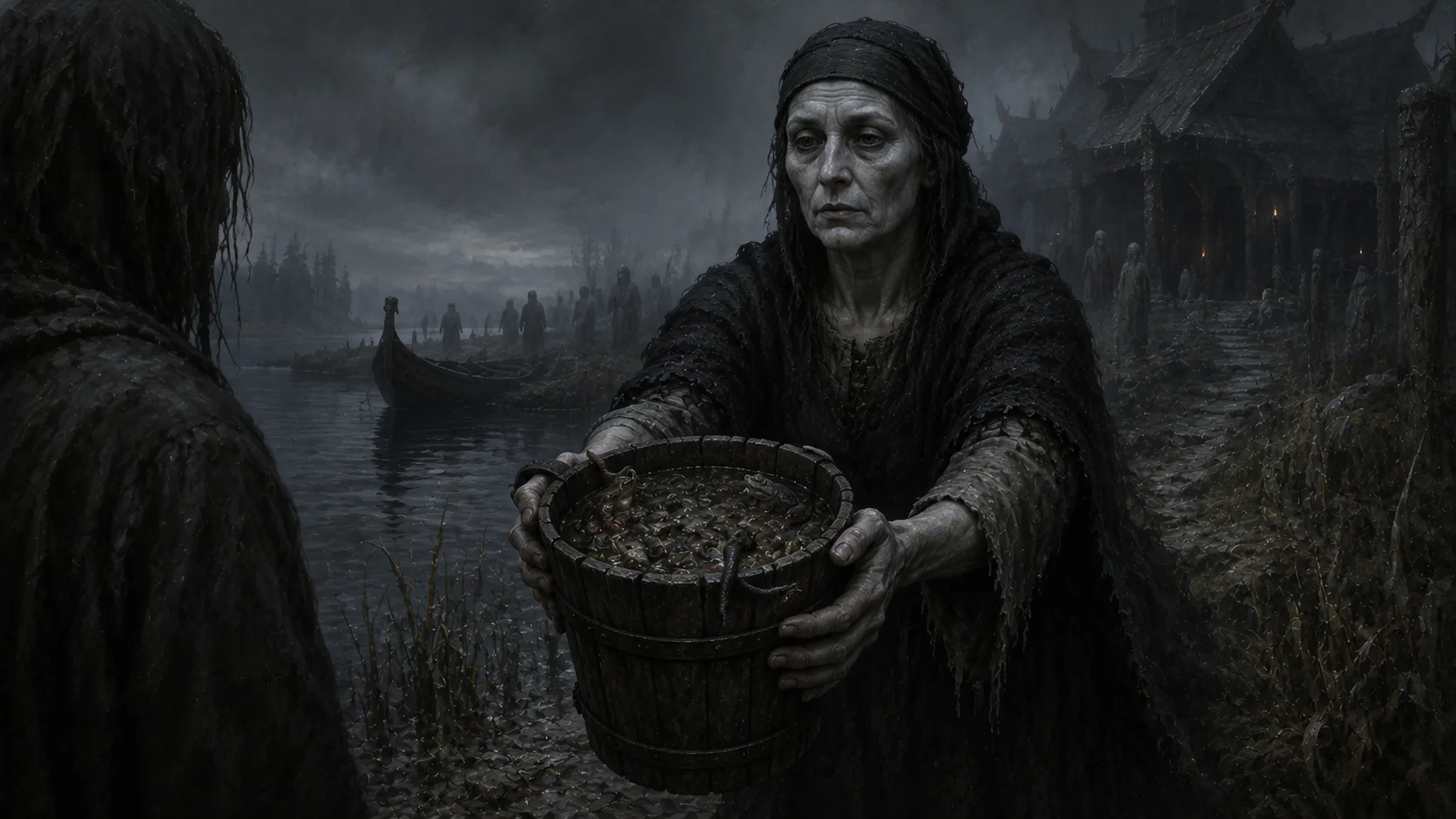
Tuonetar is the goddess and queen of the underworld in Finnish-Karelian oral poetry: the wife of the death-god Tuoni and mistress of Tuonela, the dark river-realm of the dead, who receives those who arrive at her shores and offers them the grim hospitality of the land beyond life.
The Mistress of the Black River
Tuonetar is known by more than one name in the sung tradition that preserved her. Singers called her Tuonen akka, the old woman or hag of Tuoni, and Tuonen emäntä, the mistress of Tuoni's realm — titles that mark her less as an individual with a private history than as a function, the female half of the rule of death. She should not be confused with Loviatar, a separate figure in the same tradition; the two are sometimes carelessly merged in retellings, but the runo-singers kept them distinct, and so must any honest account of her.
With Tuoni, lord of death, Tuonetar governs Tuonela, the island-realm of the dead ringed by the black river Tuonen joki, upon whose black waters a swan is said to swim. Tuonela in this tradition is not a fiery pit but a cold, watery, shadowed country, reached by boat across the current, and Tuonetar is its keeper: not a huntress of souls who goes out into the world of the living, but the one who waits at the threshold and receives whoever comes to it.
A Realm Without a Separate Myth
Scholarship on the Kalevala tradition has long noted an asymmetry between Tuoni and Tuonetar. Tuoni is the more prominently named ruler of the underworld, the figure the songs address by title and describe in his own right; Tuonetar functions chiefly as his consort and counterpart, the mistress who shares his rule and his house rather than a goddess with an independently elaborated cycle of her own adventures. This is not a gap in what survives so much as a feature of how the tradition itself shaped her — the underworld in Finnish-Karelian song is imagined as a household with a master and a mistress, and Tuonetar's role is bound to that household rather than extended beyond it.
The Cup Offered at the Threshold
Tuonetar's clearest appearance comes in Runo 16 of the Kalevala, in the tale of Väinämöinen's journey to Tuonela. The sage travels to the land of the dead seeking materials and words he needs to finish building his boat, and it is Tuonetar who receives him at the realm's edge. True to the hospitality that is her office, she offers him a drink — but the tankard she presses on him is no ordinary ale. Looking into the cup, Väinämöinen sees it teeming with frogs and worms, the true drink of Tuonela dressed as welcome. He refuses it, for to eat or drink in the land of the dead is to be bound there, and the offered cup is not mere courtesy but a trap woven into the etiquette of the place.
Read against what is known of the wider tradition, the scene is a hosting rather than a hunting act. Tuonetar does not pursue Väinämöinen or strike at him directly; she extends the realm's own logic of hospitality, and the danger lies in what accepting it would mean. Folklorists such as Martti Haavio have connected this pattern — poisoned drink offered at the threshold of the dead, trials that must be evaded or answered correctly before a visitor may leave — to older Finno-Ugric motifs of the shamanic spirit-journey, in which the traveler to the world of the dead survives only by recognizing and refusing the terms the dead set for him.
The Net Across the River
Väinämöinen's escape from Tuonela is not settled by the refusal of the cup alone. In the same episode, Tuoni's daughter attempts to prevent his return by casting a net across the river to catch him as he tries to cross back to the world of the living. The trial does not fall to Tuonetar herself in this instance — it is her daughter who takes up the task — but it belongs to the same design: Tuonela does not simply let a living visitor walk back out. Whatever brought him in must be matched by cunning or strength enough to get out again, and the realm's women, mother and daughter both, are woven into that gatekeeping.
The Black River and the Swan of Tuonela
A second, darker episode set within Tuoni and Tuonetar's domain concerns Lemminkäinen, in Runos 14 and 15. Attempting to shoot the swan that swims on the black river of Tuonela — one of the impossible tasks demanded of him as a suitor — Lemminkäinen is killed and dismembered at the river's edge. It falls to his mother to recover him, gathering the scattered pieces of his body from the water with a rake and restoring him to life. The episode unfolds inside Tuonetar's realm rather than at her hands directly, but it belongs to the same geography as Väinämöinen's crossing: the black river, the island of the dead, and the swan that has since become the most recognizable emblem of the entire underworld tradition.
The Household of the Grave
Folk-poem tradition gives Tuoni and Tuonetar children born, as the songs put it, at the threshold of Tuonela — dark, disease-associated offspring, among them Kipu-Tyttö, the pain-maiden. The exact genealogy of this household shifts from singer to singer and region to region; there is no single fixed family tree, only a shared sense that death's house, like any house in the songs, has its own children, and that illness and pain in the human world are imagined as having their origin in that house. This variability is characteristic of oral tradition generally and should be read as such, not smoothed into a single canonical lineage that no one singer ever actually sang.
A Compiled Portrait
Nearly everything known of Tuonetar in any detailed sense comes through Elias Lönnrot's Kalevala, first published in 1835 and expanded in 1849. Lönnrot compiled the epic from oral kalevala-meter runo-songs gathered chiefly in Karelia and Ingria, stitching fragments collected from many different singers into a continuous narrative and supplying connective material of his own where the fragments did not join cleanly. Folklorists studying the tradition have long debated how much of "Tuonetar" as a coherent, named character reflects genuine pre-Christian belief carried in the oral songs, and how much reflects Lönnrot's nineteenth-century editorial hand shaping loose regional material into a single figure with a single throne beside her husband's. Both things can be true at once — the underlying motifs of the death-river, the offered drink, and the guarded crossing are old, while the specific portrait of Tuonetar as a settled character owes real debt to the act of compilation.
A Swan Without Its Mistress
Tuonela's imagery long outlived the oral tradition that first shaped it. Jean Sibelius's tone poem Tuonelan joutsen, The Swan of Tuonela, first written in 1893 and reworked in 1895 as part of his Lemminkäinen Suite, draws directly on the river and the swan that swims upon it — the same black water and the same bird that killed Lemminkäinen. Tuonetar herself is not separately depicted in the piece; it is the landscape of her realm, not her person, that Sibelius set to music, a telling measure of how the underworld's atmosphere came to eclipse its named mistress in later reception.
An Emblem of the National Epic
Tuonela and its inhabitants took on a larger cultural life during the nineteenth-century movement known as Karelianism, when Finnish artists and writers turned to the Kalevala as a wellspring of national identity. Kalevala-themed painting, most famously the work of Akseli Gallen-Kallela, and a wide body of literature drew on Tuonela's black river, its swan, and its grim hospitality as touchstones of a specifically Finnish mythic imagination. Within that movement Tuonetar persisted less as a fully drawn goddess than as an atmosphere — the mistress whose house one does not want to enter, and whose cup one must know to refuse.
The Hostess Who Waits at the Water
Taken together, the songs and the scholarship around them describe Tuonetar not as an active seeker of the living but as a receiving presence — the one who is there when a traveler reaches the water's edge, who offers what hospitality the house of death has to offer, and whose offer is itself the danger. She embodies a particular vision of death: not an assault but an invitation, courteous in its form and total in its consequence if accepted. It is a portrait built from a handful of scenes, a compiled epic, and a variable folk memory of the household beyond the black river — modest in its documented detail, but distinct and enduring in what it does preserve: the queen of Tuonela, waiting with her cup at the threshold every soul must eventually cross.
Sources & traditions
- EncyclopediaWikipedia — Tuonetar
- TraditionFinnish folk and village traditions (Finland)
Myths change from area to area and from time to time. This chronicle follows the most widely told versions; tellings in other villages, regions and eras may differ.