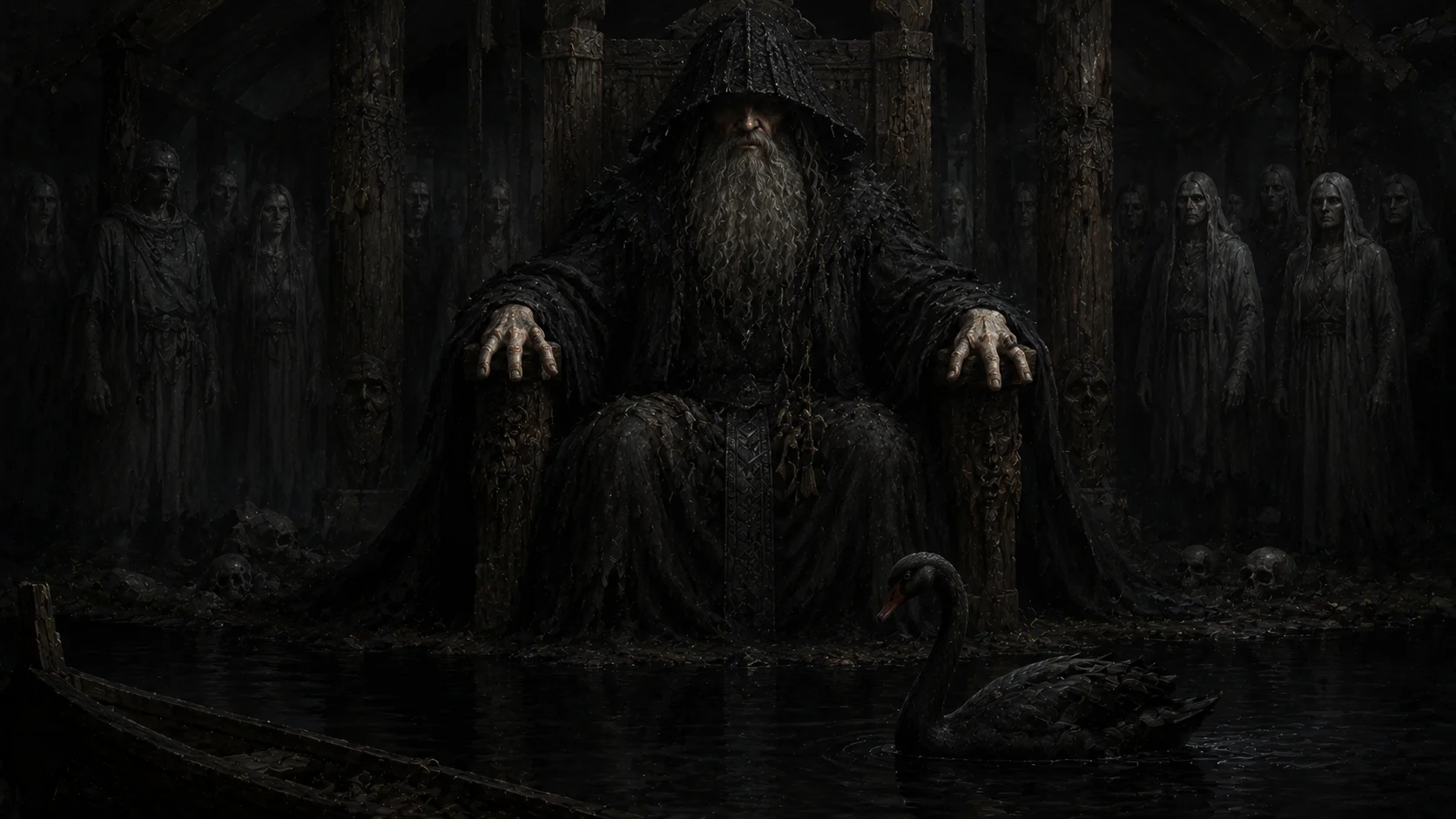
Tuoni is the god and personification of death in Finnish mythology, and the ruler of Tuonela, also called Manala, the grim Finnish underworld: the dark lord of the land of the dead, across whose black river the dead must pass to enter his cold and shadowy realm.
The Lord of the Land of the Dead
Tuoni is death itself given a name and a form, the god who rules Tuonela, the underworld, the realm of the dead, which lies across a dark and dreadful river. The dead, when they die, journey to Tuonela and cross the black river of death, ferried, or finding their own grim way, to enter Tuoni's realm, a cold, dark, shadowy land, a place of gloom and silence from which there is, for ordinary mortals, no return. Finnish folklore scholarship, following Elias Lonnrot's compilation of the Kalevala and later folklorists such as Martti Haavio, has long debated exactly how "worshipped" a figure Tuoni actually was among the pre-Christian Finns. Whether he was addressed as a true object of cult, prayed to and propitiated, or whether he functioned instead as a poetic personification of mortality itself, a figure the old runo-singers reached for whenever their songs needed to give death a face and a household, remains an open question rather than a settled one. What is certain is that the runot, the older layers of Finnish-Karelian oral poetry that predate Lonnrot's editorial hand, already spoke of Tuoni and his dark country long before the Kalevala gave the tradition its printed shape.
Manala, the Land Beneath
Tuonela's other name, Manala, points to a different and telling emphasis in how the Finns pictured the world of the dead. Where many mythologies send the departed skyward, into a heaven or a hall among the clouds, Manala derives from maa, meaning earth or land, and reflects a resolutely chthonic, earth-bound conception of the afterlife. The dead in Finnish tradition do not rise; they go down and inward, into the ground and into the dark country that borders the world of the living without ever quite touching it. The name Tuoni itself, and Tuonela with it, traces to a root bound up with death and the dead, a root that survives in modern Finnish in the phrase tuonpuoleinen, "the beyond" or, more literally, "that-side-ness" — the other side, spoken of still today as though Tuoni's country were simply the far bank of a river everyone will eventually have to cross.
The Black River and Its Current
The river of Tuonela is the single most persistent image bound to Tuoni's name, recurring across many of the Kalevala's underworld runes rather than appearing in only one. It is described consistently as dark, gloomy, and swift, a strong and merciless current that separates the living world from Tuoni's country and cannot simply be waded or swum. Whoever would enter Tuonela, or leave it, must cross this water, and the tradition treats the crossing itself, not merely the far shore, as the site of the realm's danger: a boat or a ferry is needed, and the river's own force is enough to answer for anyone who tries to defy it. It is on this same black river that the sacred swan of Tuonela, Tuonelan joutsen, is said to swim, an image so singular that it long outlived the runot that first carried it, resurfacing centuries later in an entirely different art form.
Tuonetar, Mistress of the Dark House
Tuoni does not rule Tuonela alone. His wife is Tuonetar, called in some tellings the mistress of the underworld, a figure who meets those who arrive in her husband's country and, in certain accounts, offers or tests visitors with a beer or drink belonging to the dead. Some sources treat Tuonetar as identical with, or closely bound to, Loviatar; others hold the two apart as distinct figures. The tradition itself is not uniform on this point, and it is best understood as unsettled rather than resolved one way or the other. Together, Tuoni and Tuonetar govern Tuonela as a divine couple presiding jointly over the dead, a pairing that echoes similar underworld couples found elsewhere among the Finno-Ugric peoples and more broadly across Indo-European mythology, where the realm of death is very often kept by two rulers rather than one.
A Household That Fathered Sickness Itself
The union of Tuoni and Tuonetar is, in the Kalevala's cosmology, more than a marriage of convenience between a dark lord and his dark lady — it is a genealogical source. The couple are named as the parents of several personified dark beings within the epic tradition, foremost among them Loviatar, who in turn is reckoned the mother of diseases. Other death- and misfortune-associated offspring appear in some variants of the tradition as well, so that Tuoni's own household becomes, in effect, the wellspring from which illness and misfortune spirits descend into the world of the living. To the runo-singers, sickness was not a random visitation; it had a lineage, and that lineage began in the dark house across the black river.
The Guardian Who Bars the Way Back
Tuonela is guarded as well as ruled. A son of Tuoni, referred to in some translations as Tuonen poika, appears across the underworld episodes as a guardian and, at times, an outright antagonist, meeting heroes who trespass into his father's country with hostility rather than welcome. The exact identity and role of this son shift somewhat from rune to rune and from translation to translation, but his function is constant: he stands as a reminder that Tuonela's residents are not passive, and that anyone who enters uninvited should expect to be met, tested, or opposed rather than simply left to wander.
Vainamoinen's Descent for Three Lost Words
In the sixteenth rune of the Kalevala, the great sage Vainamoinen travels to Tuonela not by accident or misfortune but by necessity: he needs three lost words, incantations he lacks, to finish building his boat, and only Tuonela holds them. His journey there is framed as a deliberate descent into peril for the sake of forbidden knowledge, and Tuonela answers that boldness in kind. Tuoni's daughter attempts to net or snare him in the river as he tries to leave, seeking to keep him in the underworld as she and her kin are said to keep all who arrive. Vainamoinen escapes only by transforming himself, using every resource of his cunning and his magic to slip the snare and win his way back across the water to the living world. The episode stands as one of the clearest illustrations in the whole epic of what Tuonela actually is: a realm that can be entered, sometimes even for a purpose as specific as retrieving lost words, but which does not release its visitors easily, and which treats return as the exception rather than the rule.
Lemminkainen Slain and Scattered in the Water
No episode tied to Tuoni's realm is more harrowing than what befalls the hero Lemminkainen across runes fourteen and fifteen. Drawn to the river of Tuonela to shoot the sacred swan that swims upon it, Lemminkainen is killed there and hacked into pieces, his body cast into the black current of the river of Tuoni. It is one of the Kalevala's most famous underworld episodes precisely because of what follows: Lemminkainen's mother, refusing to accept her son's death as final, rakes his scattered body parts from the river herself and sets about restoring him, piece by piece, with the aid of a bee sent to fetch healing salve, or honey, from the heavens. Where Vainamoinen's journey shows a living man narrowly escaping Tuonela, Lemminkainen's shows the opposite and rarer thing: a return made possible only after death itself, achieved not by the hero's own cunning but by a mother's refusal to let the river keep what it had taken.
The Swan Upon the Black Water
Of every image associated with Tuoni's country, the swan of Tuonela has traveled furthest beyond its original context. Swimming on the dark, swift river that bounds the land of the dead, the swan is at once the object of Lemminkainen's fatal quest and the emblem of Tuonela's stillness, a creature of quiet menace gliding on water that kills anyone who tries to cross it carelessly. The composer Jean Sibelius gave the image a second life entirely apart from the runot in his tone poem The Swan of Tuonela, first written in 1893 as the prelude to a planned opera and reworked in 1895 as part of the Lemminkainen Suite — a well-documented instance of Kalevala mythology entering the concert hall and, through it, reaching audiences who had never read a line of the epic itself.
A Realm of Transformation, Not Only Punishment
Read across its episodes, Tuonela emerges as something more particular than a simple land of punishment or a Finnish equivalent to a Christian hell, a distinction later reception of the myth has been careful to preserve. It is, in the Kalevala's own logic, the mythic realm of ultimate testing and knowledge: heroes go there to seek what cannot be had anywhere else, whether that is Vainamoinen's forbidden incantations or the harder knowledge that Lemminkainen's death and restoration impose upon his mother and, through her grief and labor, upon the story itself. This pattern, an underworld journey undertaken for transformation rather than mere descent, situates Tuonela within a much broader Eurasian tradition of shamanic-journey motifs, in which the land of the dead is a place one may enter changed and, rarely, leave changed again, rather than a place that exists only to hold the dead in stillness.
Gallen-Kallela's Brush and the Karelianist Revival
Tuoni and Tuonela's afterlife in Finnish culture extends well beyond Sibelius's tone poem. In the late nineteenth and early twentieth centuries, the Karelianism movement turned to the Kalevala as a wellspring of national art, and its underworld scenes were among the material painters and illustrators returned to again and again. Akseli Gallen-Kallela, the movement's foremost visual artist, illustrated scenes drawn from Tuonela's episodes as part of this broader effort to give Finland's oral epic a visual language of its own, work that helped fix Tuoni's dark river and its swan in the national imagination alongside Lonnrot's printed verses.
The Far Bank, Still Named Today
Tuoni and his shadowed country have not receded into pure antiquity. They continue to appear in modern fantasy literature, in games, and in Finnish cultural identity generally as the archetypal land of the dead, a figure held distinct from Christian conceptions of hell precisely because his realm was never framed, in the old poetry, as a place of moral punishment. It is, instead, simply the other side, tuonpuoleinen, the far bank of a black and swift river that every mortal life eventually reaches — ruled by a dark lord and his mistress, guarded by their children, and crossed, if the old songs are to be believed, only by the most cunning, the most desperate, or the most loved.
Sources & traditions
- EncyclopediaWikipedia — Tuoni
- TraditionFinnish folk and village traditions (Finland)
Myths change from area to area and from time to time. This chronicle follows the most widely told versions; tellings in other villages, regions and eras may differ.