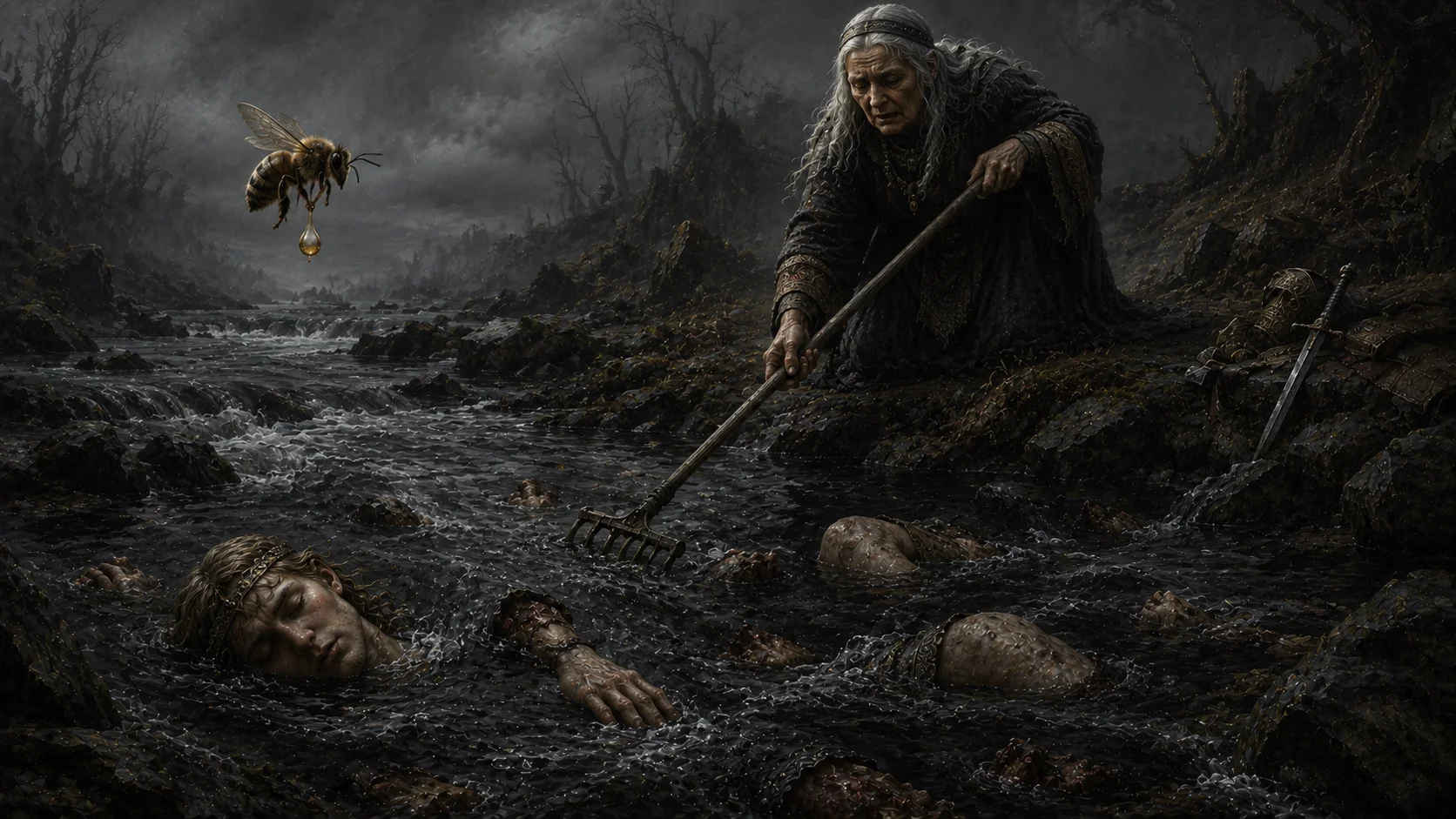
Lemminkäinen is the reckless, charming, and warlike hero of the Kalevala: a handsome, hot-blooded adventurer and seducer, a mighty warrior and magician, whose rash exploits, death, and resurrection by his devoted mother form one of the most dramatic episodes of the Finnish epic.
A Wanton Boy of Many Names
Lönnrot's compilation gives Lemminkäinen more than one identity woven into one. He is called Kaukomieli, "far-minded" or "reckless-minded," a name that captures both his wandering spirit and his hair-trigger temper, and he is called Ahti Saarelainen, "Ahti of the Island," tying him to a home among the sea-girt Saari. Scholars who study the runos beneath Lönnrot's stitching have long suspected that Ahti and Kaukomieli began as separate folk heroes, each sung in his own district, later merged into a single composite figure for the sake of the epic's shape. His mother's name in the songs is not fixed either; she appears simply as the devoted, unnamed "mother of Lemminkäinen," a figure whose grief and labor will later eclipse even her son's own adventures. The songs likewise vary on his parentage, sometimes naming Lempi as his father, sometimes tracing his line through a woman connected to Kyllikki's household. What survives every variant is the character beneath the names: young, vain, beautiful, and incapable of sitting still.
The Reckless Adventurer
Lemminkäinen is young, handsome, vain, and irresistibly bold, a great lover of women and a fearless warrior, ever ready to plunge into danger and adventure without a thought for the consequences. He is a powerful magician and singer in his own right, though more rash than wise, and where Väinämöinen the ancient singer weighs every word and Ilmarinen the smith weighs every blow of the hammer, Lemminkäinen weighs nothing at all before he leaps. His mother dotes upon him and warns him constantly against his recklessness, but Lemminkäinen rarely heeds her, charging off to woo maidens and to seek glory and the hands of the daughters of Louhi in the dangerous northern land of Pohjola. Among the Kalevala's three great heroes he is the wild counterweight: not the wisdom of the elder singer nor the patient craft of the smith, but appetite, daring, and beauty in a body too restless to stay home.
The Courtship and the Broken Oath of Kyllikki
Before his northern adventures, Lemminkäinen turns his attention to Kyllikki, a celebrated beauty of the island of Saari. He courts and carries her off to be his wife, and the two bind themselves with mutual oaths: he swears to give up warfare, and she swears to give up the dances of the village. For a time the bargain holds. But Kyllikki cannot resist the pull of the village gatherings, and when word reaches Lemminkäinen that she has broken her oath and gone dancing among the other young women, he holds himself released from his own promise in turn. Stung with wounded pride, he abandons Kyllikki and their island home outright, setting his sights instead on a far greater prize: the Maiden of Pohjola, daughter of the formidable witch-matriarch Louhi, mistress of the cold and hostile north.
Journey to the Iron-Cold North
Pohjola is no ordinary destination. Ruled by Louhi, a sorceress of fearsome power who guards her realm and her daughters with equal ferocity, it draws suitor after suitor from among the Kalevala's finest men. Lemminkäinen is not alone in his pursuit; Ilmarinen the smith competes for the same maiden's hand, and the rivalry between the heroes runs alongside their individual trials. True to form, Louhi does not simply hand her daughter to whichever man asks nicely. She sets each suitor a gauntlet of near-impossible tasks, bride-price trials meant to test cunning, strength, and magical skill as much as devotion, and it is on these trials that Lemminkäinen's fate in the north will turn.
The Hunt for the Demon's Elk
Among the tasks Louhi lays before Lemminkäinen is the capture of the elk of Hiisi, a creature conjured by the forest-demon Hiisi and set loose to outrun any ordinary hunter. It is no natural beast but a magical quarry, swift and elusive, meant to break the resolve of lesser men. Lemminkäinen answers with ski-magic and incantation, binding spell to motion as he pursues the elk across the snow, and where brute strength would fail, his skill as a singer-magician succeeds. He brings the demon's elk to heel, one trial closer to the hand of Louhi's daughter, and one more proof that for all his rashness, Lemminkäinen is genuinely gifted in the old arts.
The Swan of the Death-River
Louhi's final and cruelest task sends Lemminkäinen to Tuonela, the river of the underworld, to shoot the sacred swan that swims upon its black waters. It is a task set to kill, not merely to test, and Lemminkäinen walks into it with the same fearlessness that has carried him through every earlier adventure. He does not know, or does not care, that he has already made an enemy waiting on that shore: a herdsman he had once scorned and humiliated, blind or lame in the songs' telling, who now lies in ambush at the river's edge. As Lemminkäinen comes within sight of the swan, the herdsman strikes, loosing a dart fashioned from a water-snake and cutting the hero down where he stands.
Hacked Apart in the Black Water
The killing is only the beginning of Lemminkäinen's undoing. His body is hacked into pieces and cast into the river of Tuonela, scattered among the currents of the land of the dead, and there the son of Tuoni completes the dismemberment, ensuring that nothing recognizable as the hero remains whole. For a hero built entirely of motion, appetite, and daring, this is the epic's cruelest inversion: the swiftest and most restless of the Kalevala's men reduced to fragments drifting in a river he can no longer cross on his own strength. It is, folklorists have noted, a scene that echoes shamanic dismemberment-and-revival motifs found across circumpolar and Finno-Ugric tradition, though the Kalevala itself makes no such claim outright, presenting the horror simply as what happened to a son who would not be warned.
Blood on the Hairbrush
Far away, Lemminkäinen's mother receives the first sign of catastrophe not through any messenger but through an object he left behind: his hairbrush, kept at home, begins to weep blood. It is an omen worked by sympathetic magic, the vain hero's own comb turning traitor to announce what has become of the head it once groomed. The mother does not hesitate or doubt the sign. She sets out at once, searching across the world for news of her son, refusing every possibility that he might simply be delayed by some new adventure, until she learns the truth: that he lies dead and scattered in the river of the underworld.
The Rake Through Tuonela
Armed with grief and a great rake, Lemminkäinen's mother goes down to the river of Tuonela itself and combs its dark waters piece by piece, drawing up the scattered remnants of her son's body from wherever the current has carried them. It is patient, exhausting, unglamorous work, utterly unlike her son's own headlong style, and it is precisely that patience that succeeds where his own recklessness had failed him. Piece by piece she gathers what the death-river tried to keep, laying the fragments out and beginning the harder task still ahead: making a man whole again out of what a demon's dart and a god's son between them had torn apart.
Honey from the Halls of the Gods
Gathering the body is not enough; it must be joined and breathed back into life, and for that the mother turns to magic and to help beyond her own power. A bee is sent to the halls of the gods to fetch a healing honey-ointment, divine and unreachable by any mortal hand, and returns bearing what no earthly remedy could supply. With this ointment, with her own charms, and with the fierce persistence that has carried her from the omen on the hairbrush to the riverbank itself, Lemminkäinen's mother pieces her son back together and sings him back to life. It stands among the Kalevala's most famous scenes, later given lasting visual form in Akseli Gallen-Kallela's 1897 painting "Lemminkäinen's Mother," which fixed the moment of grief and labor over the reassembled body into Finnish national imagination, and Jean Sibelius folded the same death-and-swan episode into his 1895 "Four Legends from the Kalevala," most famously in the mournful movement "The Swan of Tuonela."
Return to the Company of Heroes
Restored to life, Lemminkäinen does not retire from adventure; he returns to the company of the epic's other great men. In the later runos he joins Väinämöinen and Ilmarinen in the raid to steal the Sampo, the magic mill of abundance, from Pohjola itself, the very realm that had cost him his life. He brings to that expedition exactly what he has always brought: bravado, a readiness for combat, and a refusal to let past disaster dampen present daring. Rejoined with the wise singer and the patient smith, he completes the trio the Kalevala builds its heroism from, each man supplying what the others lack.
An Editorial Hero, A Lasting Archetype
As with the epic's other great figures, the single continuous biography of Lemminkäinen is best understood as Elias Lönnrot's synthesis of multiple, sometimes locally distinct, oral hero-songs, stitched into one narrative from runos that once may have belonged to separate men. His exact genealogy and the boundaries between Ahti, Kaukomieli, and Lemminkäinen proper remain, in the scholarship, an open question rather than a settled fact. What the compilation preserved, whatever its seams, is an archetype that has outlasted the debate over its origins: the reckless, erotic, trickster-warrior youth, foil to wisdom and craft alike, whose death and resurrection at his mother's hands gave the Kalevala one of its most enduring images of love that will not accept loss as final.
Sources & traditions
- EncyclopediaWikipedia — Lemminkäinen
- TraditionFinnish folk and village traditions (Finland)
Myths change from area to area and from time to time. This chronicle follows the most widely told versions; tellings in other villages, regions and eras may differ.