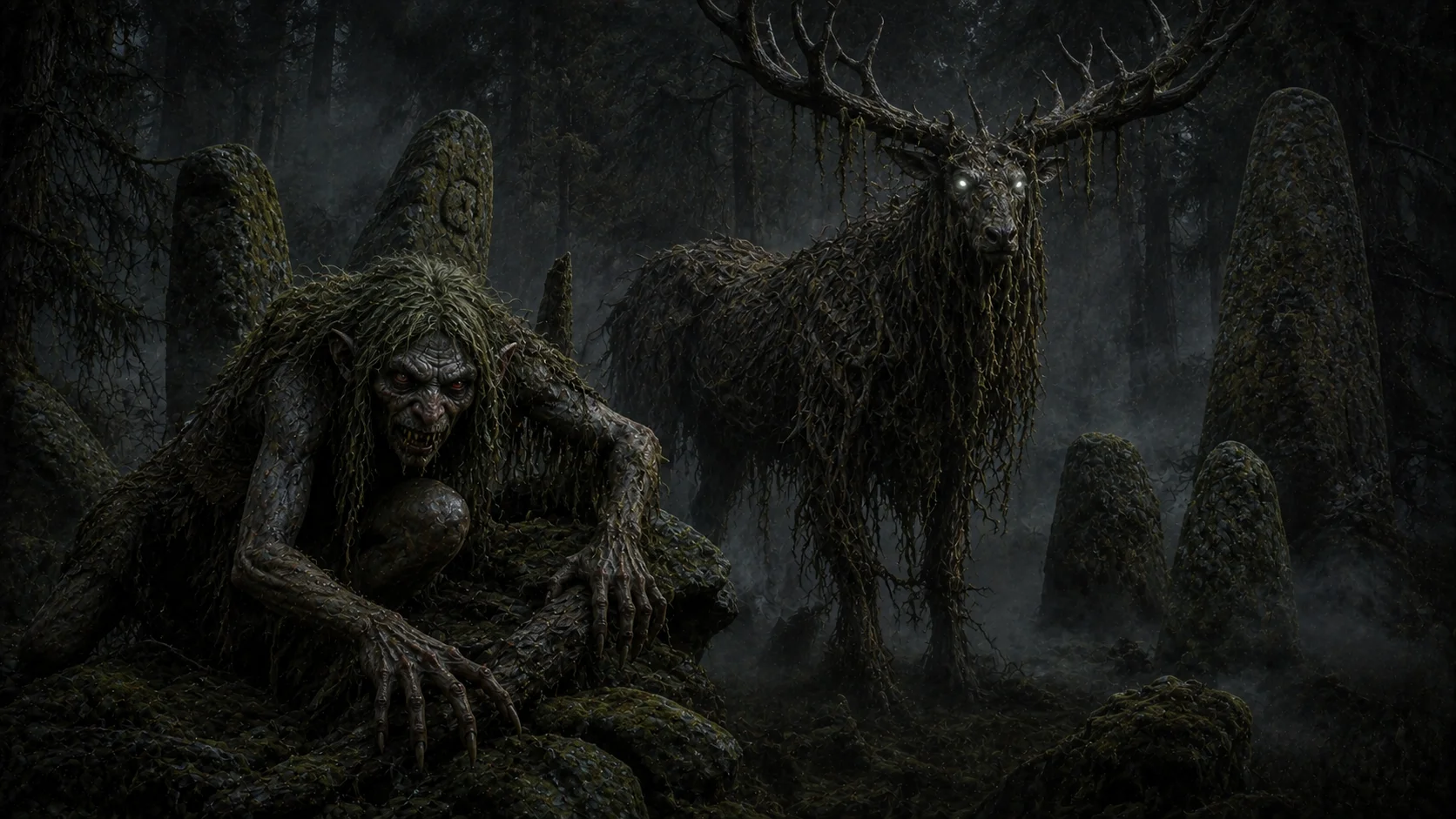
Hiisi is a malevolent spirit, or a class of evil spirits, and the dangerous places they haunt, in Finnish mythology: a goblin-demon of the forests, mountains, and wild stony places, a bringer of misfortune and harm, whose name became a Finnish word for the devil and for accursed, haunted ground.
A Word That Once Meant Sacred Ground
Before it named a demon, hiisi named a place. In pre-Christian Finnish folk belief, a hiisi was a sacred grove or a sacrificial and burial site, a hill, a rocky outcrop, a stretch of forest set apart from ordinary, cultivated land and treated as numinous, taboo, and worthy of ancestor veneration. The word is cognate with the Germanic loanword root behind terms used elsewhere for a sacred grove, a linguistic thread that ties the Finnish concept to a wider northern European habit of marking out certain patches of earth as belonging to something other than the living community. This place-based sense is the oldest layer of the word, and it predates, and for a long time coexisted with, the sense of hiisi as a being.
From Hallowed Grove to Haunted Ground
The transformation of hiisi from a holy place to an accursed one did not happen all at once, and it did not happen for internal reasons. It happened because Christianization arrived and needed somewhere to put the old religion's power. Sites that had been sacred under the old dispensation became, under the new one, dangerous, because their sanctity could not simply be erased, only recast as hostile. A hiisi-place kept its charge, its sense of being other than ordinary land, but the charge flipped in valence: what had once been hallowed became haunted, what had once been set apart for reverence became set apart for fear. This is a well-documented pattern in Finnish historical linguistics and folklore studies, and it is frequently cited by scholars as something close to a textbook case of how a Christian reinterpretation can hollow out a pre-Christian sacred vocabulary and refill it with dread, a pattern that has close parallels elsewhere in Europe, where pagan sites were demonized rather than simply forgotten after conversion.
The Shape the Demon Took
As the place-sense curdled, a being-sense grew up alongside it, and eventually overtook it in the popular imagination. In later folklore, and in the Kalevala, hiisi, capitalized as Hiisi, could denote a specific troll-like or giant or demonic figure, or a whole class of malevolent nature-spirits and forest-demons that haunted wild and liminal places, the kind of ground the word had always been attached to, now populated with something that meant harm. Under everyday Christian pressure, the word's meaning narrowed further still, into goblin, into demon, into evil spirit outright, until hiisi could simply mean the devil, and hiiteen, into the hiisi, became a common way of saying into hell, a mild curse still heard in spoken Finnish today.
The Elk That Could Not Be Caught
The most famous single episode attached to Hiisi in the Kalevala is the hunt for Hiisi's elk, Hiiden hirvi, a magical and fearsome creature created by or belonging to Hiisi. The hero Lemminkäinen is set the task of capturing and yoking this elk as one of three impossible bride-price trials imposed by the mistress of Pohjola, tasks meant to test, and very likely to destroy, the suitor who attempted them. The elk is not an ordinary quarry. It belongs to Hiisi's domain in the fullest sense, a beast out of the same wild, demon-marked wilderness that gives the word its oldest meaning, and hunting it means stepping onto ground that does not answer to ordinary hunters or ordinary luck.
An Antagonist Behind the Trials
Hiisi's role in this episode places the figure as an antagonistic force standing behind Lemminkäinen's bride-price ordeal, one piece of the wider cycle of trials and dangers connected to Pohjola and its mistress. Hiisi is associated with this cycle alongside other perilous figures of the same tradition, such as Iku-Turso, though the two are not the same being and the tradition does not conflate them. Hiisi's part is specific: the source of the elk, the wild antagonism the hero must overcome, not a rival suitor or a sorcerous adversary in the human sense, but the wilderness itself given a will and turned against him.
Iron, Curses, and the Charm-Singer's Knife
Beyond the elk hunt, Hiisi surfaces in the charm-poetry, the loitsut, in connection with the origin of iron and the birth of the sword, and with cursed objects more generally, a Hiisi's knife or Hiisi's weapon appearing in variant runo traditions. These motifs are not stable across the collected material; details shift from one recorded variant to the next, and the scholarly consensus treats this as evidence of a living oral tradition rather than a single fixed canon waiting to be reconstructed. What holds constant is the association itself: where iron is dangerous, where a blade carries a curse, where an object seems to remember violence, the name Hiisi is close by.
Kin to the Guardian Spirits, and Their Opposite
Finnish folk taxonomy sometimes groups the hiidet, as spirits, alongside other classes of nature-spirit, such as the metsänhaltija, the forest-guardian spirits, and the haltijat, guardian spirits in general. But the grouping is one of category, not of temperament. Hiisi carries a markedly more sinister and demonic valence than the comparatively neutral, often protective haltija spirits, standing at the dangerous end of a spectrum of beings that populate the same forests and hills. Where a haltija might be placated or asked for favor, a hiisi is a thing to be warded against.
A Name Written Into the Land Itself
The clearest surviving evidence for the word's oldest, place-bound meaning is not in any single text but scattered across the map of Finland itself. The word survives extensively in Finnish toponymy, in hills, lakes, and stones whose names incorporate hiisi or its genitive form hiiden, constructions such as Hiidenkivi, meaning Hiisi's stone. Finnish onomastic scholarship, the study of place names, treats this scattering of names as substantial documentary evidence that the sacred-site sense of the word was once widespread and taken seriously enough to be fixed permanently onto the land, long before the demon took over the word's everyday meaning.
The Line Between Cultivated Land and the Untamed
Symbolically, hiisi, in both its senses, marks a boundary. A hiisi-place is where the safe, known, cultivated world of the farm and the village ends and something else begins, the deep forest, the barren stony ground, the cold and liminal wilderness that does not answer to human order. A hiisi-being is the wilderness given intent, the danger of that boundary personified and set loose against anyone who crosses it carelessly.
The Ambiguity the Scholarship Keeps Rather Than Resolves
Because hiisi spans both a place-concept and a being-concept across different eras and regions, sources are not always consistent about which sense a given attested reference intends, whether a particular mention of Hiisi points to a location, to a class of spirits, or to one named entity. Scholars of Finno-Karelian mythology treat this ambiguity as well-attested and characteristic of the tradition itself, a genuine feature of how the concept was used and transmitted, rather than a gap in the record waiting to be filled in with invented specifics. The uncertainty is, in its own way, part of what the word preserves: a concept that never fully separated the haunted ground from what haunted it.
The Word That Would Not Let Go
Hiisi did not fade with the old religion it was carved out of. It remains productive in modern Finnish, turning up in fantasy literature, in games, and in ongoing discussion of Kalevala material, wherever a writer or a reader wants a name for the malevolent power of the deep wild. And hiiteen persists in everyday spoken Finnish as a mild expletive, a direct linguistic trace of the mythological concept still living in the mouths of people who may never have thought about sacred groves or demon-haunted stones at all. Few pieces of pre-Christian belief have left so plain and so ordinary a fingerprint on the language that replaced them.
The Dark Power of the Haunted Wild
In Hiisi, Finnish myth gave form to the malevolent spirit of the wild and the accursed place at once, the goblin-demon of the stony forests and dangerous ground, the bringer of harm and misfortune, the antagonist behind the elk no hero could easily yoke, and the dark, boundary-marking power of the haunted wilderness that still echoes, faintly, in a curse muttered under someone's breath.
Sources & traditions
- EncyclopediaWikipedia — Hiisi
- TraditionFinnish folk and village traditions (Finland)
Myths change from area to area and from time to time. This chronicle follows the most widely told versions; tellings in other villages, regions and eras may differ.