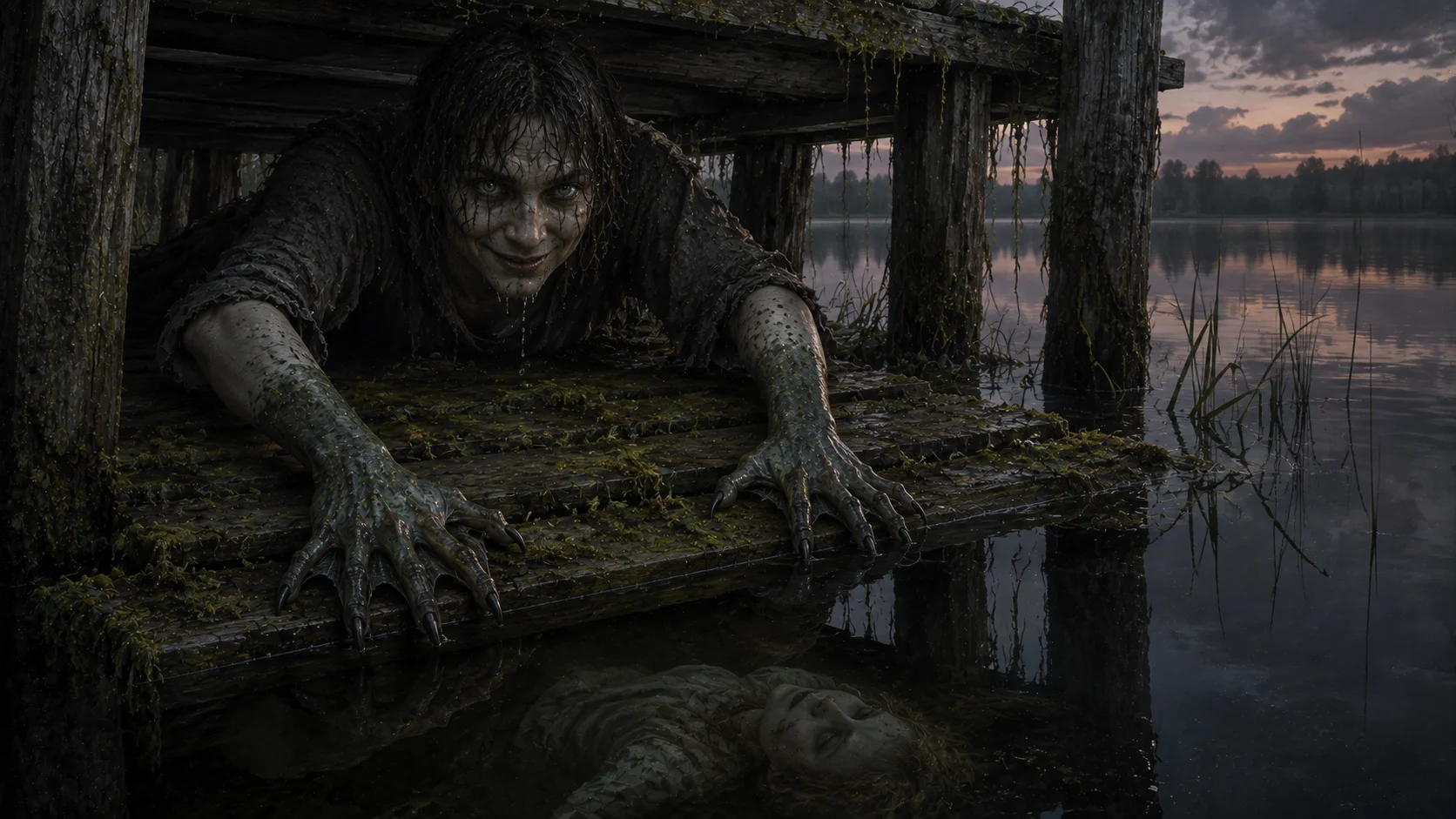
The näkki — rendered in simplified English spelling as "Nakki," though the correct Finnish form carries the diacritic ä — is a dangerous, shapeshifting water spirit of Finnish folklore (Suomen kansanusko). It dwells in lakes, rivers, wells, and millponds across the Finnish-speaking cultural area, and across the recorded folklore corpus its single most consistent trait is this: it lures the unwary, especially children, to the water's edge and pulls them under to drown.
A Name That Needs Its Dots
Written faithfully, the being's name is näkki, not "Nakki." The missing ä is not a small thing to a Finnish ear — it changes the word's shape and its sound. Anyone retelling this tradition in text should restore the diacritic. Linguists have long noted that näkki belongs to a wider Germanic and Scandinavian word-family: Old Norse nykr, Swedish näck, German Nix — names for water spirits carried across the Baltic through centuries of Scandinavian-Finnish contact. This is a comparative, scholarly observation about word history, not a claim that the näkki is the same figure as the Scandinavian näck. Within Finnish tradition itself, the näkki is treated as its own being, localized to its own lakes and wells, not a borrowed twin of a foreign spirit.
Kin of the Deep Water, Not One Fixed Family Tree
The näkki does not stand alone in Finnish water-spirit belief. Two related terms circulate alongside it: vetehinen, a water spirit or "water-man" sometimes treated as near-synonymous with näkki in some regions and as a wholly separate being in others, and vedenhaltija, the general term for a water spirit or water's guardian-spirit. Folklorists and folk speakers alike have never settled these into one tidy hierarchy — usage shifts from parish to parish. The honest way to hold this is not as a family tree with fixed branches, but as a set of overlapping, regionally fluid names for the unsettling presences believed to live in deep water.
A Shape That Refuses to Settle
Ask what the näkki looks like and Finnish tradition gives no single answer — and that inconsistency is itself part of what is known about the belief. In some tellings it appears as a person, often unnervingly beautiful, standing at the water's edge in a way calculated to draw a passerby closer. In others it takes the form of a horse or a foal, standing invitingly by the shoreline as though waiting to be caught or ridden — an image that recurs often enough across regional collections to count as a recognizable variant. In still other accounts it is something less defined: an indistinct, more monstrous shape glimpsed only at the moment it acts. No canonical portrait exists. The näkki was never meant to be seen clearly — it was meant to be feared at the edge of vision, in whatever shape the water happened to suggest.
The Lure and the Drowning
Stripped of regional variation, the core motif is simple and grim: the näkki lures a victim toward open water — by beauty, by the promise of a horse to catch, by whatever shape the local telling favors — and then pulls that victim under. Deep lake edges, mill dams, and wells are the recurring settings, each a real hazard in a landscape laced with water. This is not a single myth with a beginning, middle, and end. It is a motif, repeated with local variation across the Finnish folklore archive, told and retold at countless separate waters rather than handed down as one canonical story with named episodes. Anyone expecting a hero's saga about the näkki is asking the wrong question of this tradition; what survives is a pattern of warning, not a plot.
A Warning Wearing a Monster's Face
Finnish folklorists — including those working within the collecting tradition associated with the Finnish Literature Society's folklore archive — have been explicit about what the näkki belief actually did in daily life: it kept children away from dangerous open water. A lake edge that drops away suddenly, a mill dam with its churn and undertow, a well deep enough to swallow a fallen child — these were real threats long before anyone needed a spirit to explain them. Telling a child that a näkki waited beneath the surface, ready to seize anyone who strayed too close, was a practical safeguard dressed as a supernatural threat. The fear did useful work. It is one of the clearest documented cases in Baltic-Finnic nature-spirit belief of a genuine, everyday danger being transposed directly into supernatural causation — drowning given a face and a motive so that a warning would stick.
Coins Thrown to Quiet the Water
Alongside the warnings, Finnish folk custom recorded a second response to the näkki and to water-haltija spirits generally: propitiation. Coins or small offerings were thrown into wells or bodies of water associated with a näkki or water-guardian, part of a broader Finnish and Baltic-Finnic pattern of appeasing water spirits before drawing water, fishing, or swimming. This was not fear alone — it was a working relationship with the water, an acknowledgment that whatever watched from beneath the surface deserved a small tribute before a person asked anything of it. The gesture cost little and, in the logic of the belief, bought safety in return.
The Maiden of the Water, a Quieter Variant
A secondary and less universally attested strand of tradition names näkinneiti — glossed in some Finnish folklore reference works as a water-nymph, or a female or maiden form of the water spirit, appearing here and there in Finnish folk poetry and place-name lore. This should not be mistaken for a fixed, parallel figure sitting beside the näkki in every region; it surfaces as a variant, present in some sources and absent in others, more a poetic thread than a core piece of the belief. Where the drowning-lure motif of the näkki proper is attested with real consistency across collections, näkinneiti belongs to the softer, less universally shared edge of the tradition.
Water as a Country's Constant Companion
Finland's landscape is threaded with lakes, rivers, and ponds in a density few countries share, and the näkki belief is inseparable from that geography. Open water was never a background feature of daily life — it was a route for travel, a source of fish, a place to draw water and to wash, and, constantly, a danger. The näkki gave that danger a presence, an intention, a face that could be blamed and warned against. This is a well-documented pattern in Baltic-Finnic nature-spirit belief more broadly: the ambivalence of a landscape feature — useful and lethal in the same breath — rendered as a spirit with its own will, so that caution around it could be taught as a story rather than merely a rule.
A Loan Word, a Local Being
The comparative note about näkki's Germanic and Scandinavian relatives — nykr, näck, Nix — deserves to be treated as a scholarly aside rather than folk narrative content. It tells a history of contact: centuries of exchange across the Baltic left linguistic fingerprints, and näkki appears to be one of them. But this is a fact about the word's ancestry, not about the being's identity within the tradition that tells stories about it. Finnish tellers of näkki stories were not narrating a Scandinavian import; they were describing a presence in their own nearby lake or well, understood entirely on its own terms. The etymology is worth knowing. It is not a substitute for the folk belief itself.
Carried Into the Nursery and the Storybook
The näkki's didactic purpose did not end with the era of oral warning-tales. It continues into modern Finnish children's literature, illustrated folklore collections, and popular retellings, where it still appears as a cautionary water-monster figure, invoked for the same reason it always was: to keep children from swimming in dangerous or unsupervised water. The costume has updated across two centuries — picture books instead of a grandmother's voice at the hearth — but the function has not moved an inch. A spirit built to keep children safe near water is still doing that job in print today.
Named Waters, Local Memory
Beyond the general belief, näkki turns up attached to specific places — a particular lake or pond in local legend and place-name lore, said to be a näkki's home. These site-specific stories should be read as exactly what they are: local, often single-source variants tied to one community's memory of one body of water, not pieces of a shared, pan-Finnish canon. They matter as evidence of how alive and locally rooted the belief remained — every dangerous lake could, in principle, have its own näkki — but they do not stack into one unified mythology so much as they multiply the same warning across a hundred separate shorelines.
What the Näkki Leaves Behind
No single saga carries the näkki's story, because the belief was never built that way. What remains is a motif — luring, shapeshifting, drowning — told at the edge of countless waters, shaped a little differently in each parish, and aimed always at the same practical end: keep back from the water you do not understand. In wells appeased with a thrown coin, in a horse standing too invitingly by the shore, in a child's storybook still warning against the deep end of a lake, the näkki survives less as a fixed character than as a country's long habit of respecting water that could, without warning, take a life.
Sources & traditions
- EncyclopediaWikipedia — Nixie (folklore)
- TraditionFinnish folk and village traditions (Finland)
Myths change from area to area and from time to time. This chronicle follows the most widely told versions; tellings in other villages, regions and eras may differ.