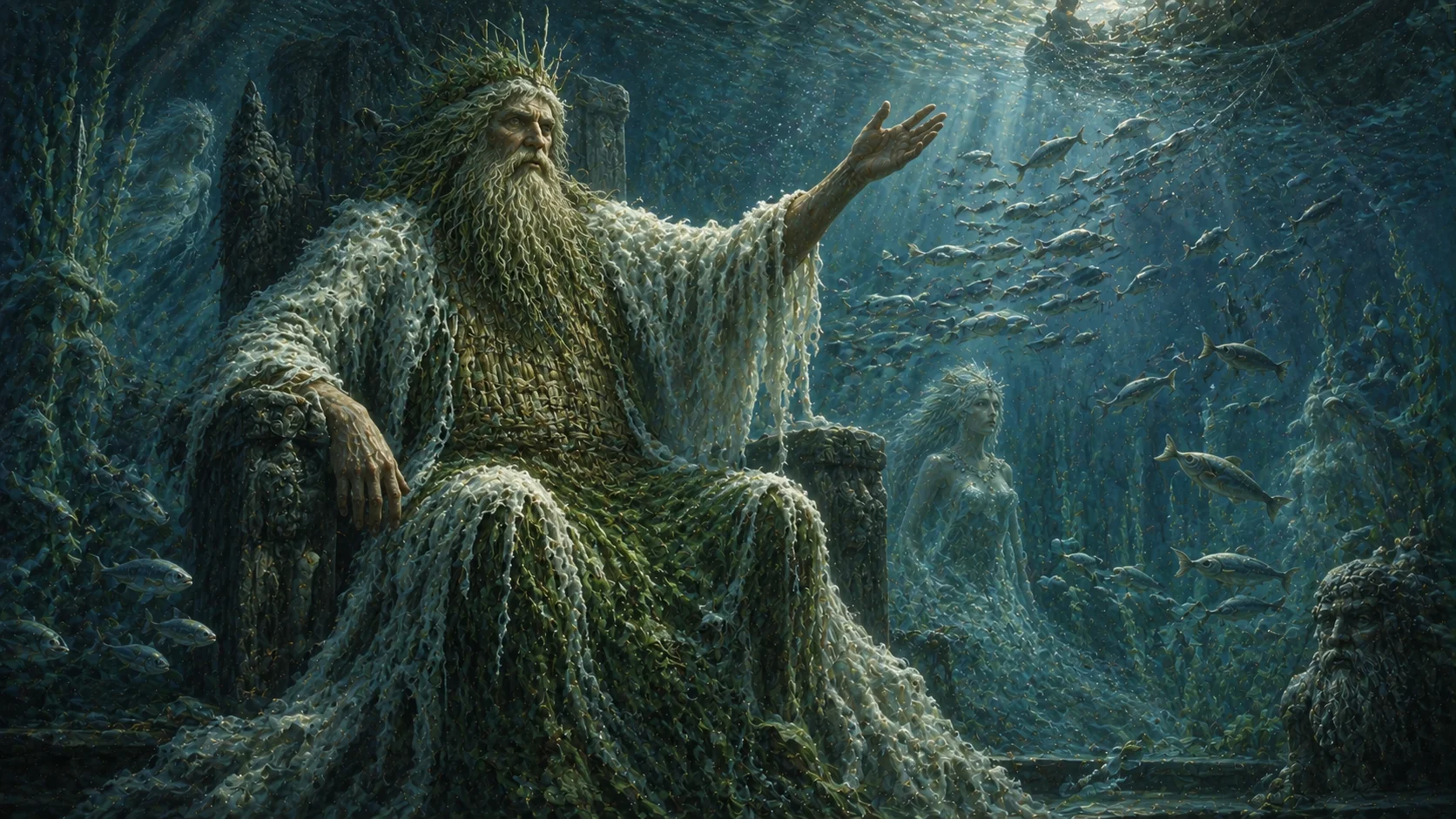
Ahti, also called Ahto, is the god of the waters, the sea, lakes, and rivers in Finnish-Karelian mythology: the lord of the deeps and the master of the fish, the bearded water-god to whom fishermen prayed for a good catch and sailors for safe passage. He is attested both in the Kalevala, the national epic compiled by Elias Lönnrot from oral material in 1835 and expanded in 1849, and in the older runo, or kalevalaic, songs collected across Karelia and Finland from which Lönnrot drew.
Vetten Isäntä, Master of the Waters
Ahti is known by epithets that describe the whole of his domain: he is called vetten isäntä, master of the waters, and aaltojen ahjo. These names place him over every body of water that mattered to the communities who sang of him, not the sea alone but the lakes and rivers of a land threaded with thousands of them. He is imagined as a vigorous, bearded water-god, lord of the deeps, whose authority extends wherever water gathers and moves. In the practical religion of agrarian and fishing communities, a spirit with that wide a reach was not an abstraction but a figure to be addressed before any crossing or any cast of the net.
Ahtola Beneath the Waves
Ahti's dwelling is a hall beneath the water called Ahtola, sometimes rendered Ahtiaila, where he is imagined to keep court amid riches gathered from the deep. It is to this submerged hall that the poems send both prayer and petition, and it is from Ahtola that Ahti is asked to release what the water holds, whether fish for the net or gold and treasure lost beneath the waves. The hall stands as the counterpart, beneath the surface, to the halls of the land-dwelling powers, a reminder that the waters were understood to have their own household, ruled and furnished, rather than being empty space.
Vellamo, Mistress of the Sea
Ahti's wife is Vellamo, goddess of the sea and water, and the poems do not always place her in his shadow. In some variants Vellamo is described as ruling alongside him, and in others she appears as the more prominent, more active mistress of the sea, the figure actually invoked to move the waters or yield their contents. The pairing of Ahti and Vellamo recurs through the tradition as a joint address: prayers and charms concerning the water tend to name them together, husband and wife sharing dominion over the same restless realm, so that appeals for calm seas, safe passage, or a full net are offered to the two of them as a single household of power.
Väinämöinen's Appeal to the Deep
The Kalevala shows Ahti and Vellamo drawn directly into its central action. In Runo 5, and again in the cluster of runos from roughly 42 to 48 concerning the Sampo, the hero Väinämöinen appeals to Ahti and Vellamo for help retrieving what the sea has taken, whether fishing nets and their catch or the fragments of the Sampo after its breaking. These episodes cast Ahti not as a distant abstraction but as a power capable of being reasoned with, petitioned, and moved to act, a figure whose cooperation the greatest of the poem's heroes must actively seek rather than simply expect.
Father of the Salmon, Lord of the Net
Ahti is at times described as father or lord of the fish, with particular association to salmon, and folk charms invoke him directly to release fish into waiting nets or to calm and raise the waters as fishing required. The fish are effectively his herds, held in the deep until he chooses to send them, and the language of the charms treats a good catch as a gift granted rather than a certainty of nature. This framing runs through the practical fishing culture of the lake-and-sea country: nets were cast in hope of Ahti's favour, not merely in expectation of fish.
Offerings Before the Cast
Fishermen traditionally made offerings to Ahti before setting out, a practice reflected across the collected folk poetry alongside the charms invoking him. Such propitiation, small sacrifices offered ahead of the catch, mirrored the practical weight that lakes and the Baltic held for Finnish and Karelian livelihoods: a poor relationship with the water's master could mean an empty net or a dangerous crossing, and a respectful one could mean abundance and safe return. The offerings functioned as the working end of belief, the point where a mythic relationship met the actual demands of a fishing economy.
The Two-Faced Nature of the Water
Ahti's character carries the double nature of the water he rules. He is provident, able to grant abundance in fish and safe passage across lake or sea, and he is dangerous, able to drown or punish those who fail to show the water proper respect. This is not a contradiction so much as an honest description of what water actually is to those who depend on it and travel across it: generous when calm, lethal when not. Ahti stands as the personification of that unpredictability, a power whose favour could not be taken for granted and whose displeasure carried real consequence.
Distinct from Ahti Saarelainen
A well-documented naming overlap runs through the Kalevala: the hero Lemminkäinen is also called Ahti, or Ahti Saarelainen, Ahti of the Island, as a personal name or epithet attached to him within the poems. This is a homonym, not an identity: the sea-god Ahti and the hero-epithet Ahti are separate figures who happen to share a name across the tradition. Scholars, among them Martti Haavio, treat the sea-god and the hero's byname as belonging to distinct strands of the material rather than as one figure appearing in two roles, and the poems themselves keep the sea-god's domain and the hero's adventures apart even as the name repeats.
Among the Domain-Spirits
Ahti is loosely grouped in the folk tradition alongside other Finnish nature-deities who preside over their own domains, such as Tapio over the forest and Ukko over the sky. These figures are not depicted in the source material as members of a formal, organized pantheon with fixed ranks and relationships; rather they appear as parallel folk-belief figures, each sovereign within a sphere that mattered to daily survival, water for Ahti as forest for Tapio and sky for Ukko. Ahti and Vellamo's court of water-spirits belongs to this same pattern, a domain populated and administered rather than left empty.
Names Carried Through the Songs
The tradition preserves Ahti under several attested names, Ahti, Ahto, and Ahtolainen among them, with his hall consistently called Ahtola. This variation in naming is itself part of what oral, kalevalaic poetry looked like as it was collected across different singers and regions: a shared figure recognisable under related forms of a single name, gathered from performance to performance rather than fixed in a single canonical text before Lönnrot's compilation gave the material its best-known written shape.
How Much Was Believed, and How We Know It
Folklorists debate how far Ahti was genuinely worshipped as a deity, in the sense of formal religious practice, versus how far he functioned as a poetic or folkloric personification of the sea and its moods. This is not a minor caveat: most of what is known about Ahti comes from nineteenth-century collected oral poetry, chiefly Lönnrot's compilations and the wider SKVR archive of runo songs, rather than from earlier primary religious sources contemporary with any pre-Christian practice. Reconstructions of what belief in Ahti actually looked like, and what ritual around him actually involved, are scholarly inferences drawn from that later material, not direct testimony from the period they describe.
The Sea-God After the Kalevala
Ahti's later life runs through the Karelianism movement of the nineteenth and twentieth centuries, the wave of national-romantic Finnish art and literature that drew directly on the Kalevala, including work produced in the circle around Akseli Gallen-Kallela. Through that reception the sea-god passed from collected song into painting and print as one of the epic's recognisable figures. The name has continued into ordinary use as well, carried today as a Finnish given name and applied in commercial and place naming wherever a reference to the sea is wanted, a quiet survival of the water-god's name well outside the water he was once asked to rule.
Sources & traditions
- EncyclopediaWikipedia — Ahti
- TraditionFinnish folk and village traditions (Finland)
Myths change from area to area and from time to time. This chronicle follows the most widely told versions; tellings in other villages, regions and eras may differ.