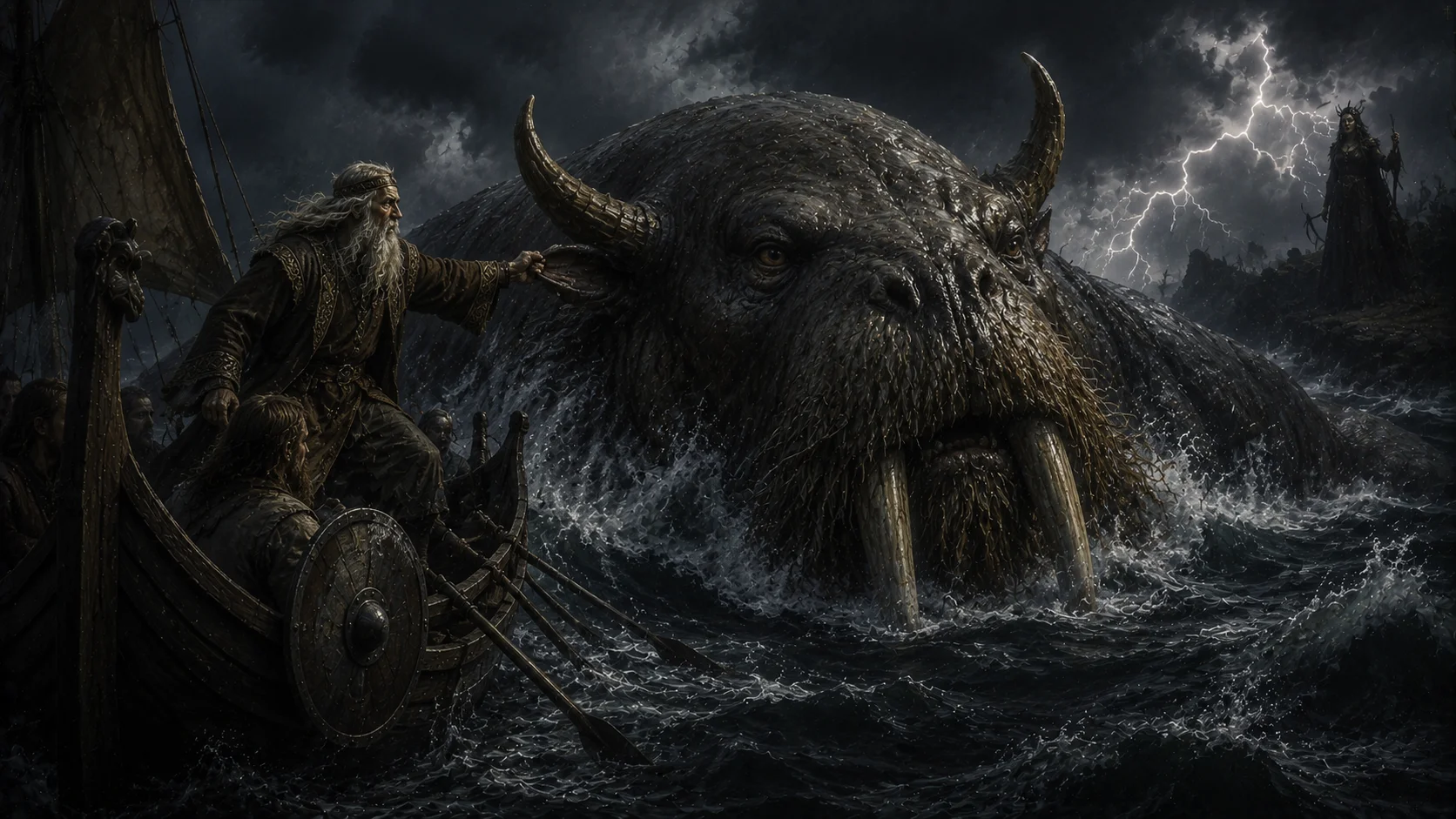
Iku-Turso is a malevolent sea-monster or water-spirit of Finnish-Karelian mythology, a fearsome being of the ocean depths appearing across the collected oral poetry — the runo songs — that fed into the Kalevala. Known also as Tursas or simply Turso, he is imagined in serpent-like or walrus-like forms, a dweller of the cold deep water and a hazard invoked wherever the sea itself was feared.
A Name Carried by the Waves
The figure appears under several related names across the surviving oral poems: Iku-Turso, Tursas, and Turso. The prefixed epithet "Iku-" — roughly "ancient" or "eternal" — marks him in some tellings as a primordial figure, older than the events of the songs that feature him, a being whose presence in the sea predates the human world the runo-singers describe. Some philologists have proposed a link between the element "turso" and Old Norse or wider Germanic words related to "thurs," a term for a giant or monstrous being. This connection is debated rather than settled, resting on comparative etymology across language families rather than direct textual evidence, and it should be held as a scholarly hypothesis, not a confirmed origin for the name.
Waters That Remembered Older Terrors
Beneath the version of Iku-Turso familiar from the printed Kalevala lies an older and less certain layer. Scholars reconstructing the pre-Lönnrot folk poetry — the fragmentary runo variants collected across Karelia before Elias Lönnrot compiled them into a continuous epic — have associated Iku-Turso with cosmogonic sea-monster imagery, and in some reconstructions with the birth of fire itself. This layer is far less certain than his role as Louhi's agent in the printed epic; it survives only in fragments, pieced together from variant songs that do not agree with one another, and it should be treated as a scholarly reconstruction rather than a single canonical account of his origins.
Sent Up From the Deep by Pohjola's Mistress
In the Kalevala's Sampo cycle, Iku-Turso is bound to Louhi, the powerful witch-ruler of Pohjola, the "North Farm," as her sea-monster agent. When the Sampo — the magical mill or artifact at the center of the epic's great contest — becomes the object of conflict between Pohjola and the heroes, Louhi sends Iku-Turso up from the sea to act on her behalf: in variant tellings, either to steal the Sampo back for her, or to attack Väinämöinen directly. The monster's rising from the water is Louhi's move in a struggle she otherwise fights through cunning and sorcery rather than open combat, and Iku-Turso stands as the physical, monstrous instrument of a conflict that is, at its root, hers.
Väinämöinen and the Beast of the Waves
Iku-Turso's most vivid appearance in the Kalevala is his confrontation with Väinämöinen, the epic's central culture-hero and shaman. Rising from the sea at Louhi's bidding, Iku-Turso comes up against Väinämöinen — and is caught, cornered, and mastered. Väinämöinen forces, or frightens, an oath out of the sea-monster: a binding promise that Iku-Turso will never again rise from the sea to trouble humankind or attack ships. This is the pivotal act that defines Iku-Turso within the printed epic — not endless rampage, but a single decisive subjugation, after which the terror of the deep is, at least in this telling, permanently checked.
A Familiar Shape in Finnish Epic Song
The binding of Iku-Turso belongs to a recognizable pattern in Finnish epic poetry: the hero who subdues or binds a chaotic force of nature rather than simply destroying it. Other Kalevala episodes tell of similar bindings — of frost, of disease — where the danger is not annihilated but constrained, forced into a promise of restraint. Iku-Turso's oath to Väinämöinen fits this same shape, and it reinforces Väinämöinen's identity as a shamanic master of natural forces: his power lies not merely in strength but in the ability to command obedience from something as vast and old as the sea itself.
An Agent Among Pohjola's Hostile Powers
Within the wider cosmology of the Kalevala, Iku-Turso exists alongside other beings aligned with or hostile from Pohjola, the beings Louhi commands or calls upon in her contest with the heroes. He is not consistently paired with any single other named creature across the variant songs — his appearances are his own, tied specifically to the Sampo cycle and to his confrontation with Väinämöinen, rather than part of a fixed monstrous retinue. This looseness is characteristic of the oral tradition behind the Kalevala more broadly, where figures recur with different companions, different roles, and different outcomes from one sung variant to the next.
The Sea as a Living Danger
Beyond his role in the Sampo narrative, Iku-Turso carries a symbolic weight rooted in the daily life of an agrarian and maritime Finnish-Karelian world. He personifies the sea's danger and unpredictability — the hazard that sailors and fishermen lived alongside and feared. In a worldview where the ocean's depths were unknown and unforgiving, a monstrous, ancient presence lurking beneath the waves gave that danger a shape and a name, something that could be invoked apotropaically, warned against, or sung about as a way of naming a fear too large and formless to otherwise put into words.
An Editor's Hand on Older Songs
It is worth stating plainly what the printed Kalevala is and is not. Elias Lönnrot compiled the epic from a great many separate oral poems gathered from singers across Karelia in the nineteenth century, weaving them into a continuous narrative. The coherent story of Iku-Turso as Louhi's singular sea-monster agent, bound once and for all by Väinämöinen, is in part an editorial construction — a synthesis Lönnrot built from variant songs that did not always agree. The underlying folk poetry shows Iku-Turso and Tursas with inconsistent, sometimes contradictory roles depending on the region and the singer, and this inconsistency should be understood as the ordinary condition of oral tradition, not a flaw in it. The printed epic offers one coherent thread pulled from a much more tangled and regionally varied body of belief.
Recorded Before It Could Be Lost
Iku-Turso's survival into written record owes everything to the nineteenth-century folklore collectors who traveled through Karelia gathering runo songs from singers who carried them orally, Lönnrot foremost among them. Finnish folklore scholarship treats Iku-Turso as a notable example of pre-Christian Finnish sea-monster belief that survived long enough to be captured in this collected material — a fragment of an older mythological world preserved at the point where oral tradition and written scholarship met, rather than a belief invented for the printed epic itself.
Echoes in Later Retellings
Since the Kalevala's compilation, Iku-Turso has continued to surface in works that draw on Finnish mythology, appearing as a named entity or creature in some video games and fantasy fiction that reach back to Kalevala material for inspiration. The general fact of this reception is attested, though the specifics vary considerably from one work to another and should be verified against the particular project in question rather than assumed to follow the Kalevala's account faithfully. What persists across these later appearances is the core image established in the epic: an ancient, dreadful power of the sea, vast enough that even a hero of Väinämöinen's stature had to confront it directly rather than simply overpower it.
What the Old Songs Preserved
Taken together, the surviving material on Iku-Turso offers a layered figure rather than a simple monster. At its clearest, he is Louhi's sea-monster agent, sent against the heroes in the struggle over the Sampo and bound by Väinämöinen's oath-taking never to trouble humankind again. Beneath that clear episode lies an older, more fragmentary layer of cosmogonic sea-monster imagery, reconstructed rather than directly attested, and around it sits a genuine folk memory of the sea's danger, personified and given a name. The name itself — Iku-Turso, Tursas, Turso — moved through generations of singers before it was ever fixed on a page, carrying with it a warning about waters that could not always be trusted, and a story about the one hero who, in this telling, made them promise otherwise.
Sources & traditions
- EncyclopediaWikipedia — Iku-Turso (creature)
- TraditionFinnish folk and village traditions (Finland)
Myths change from area to area and from time to time. This chronicle follows the most widely told versions; tellings in other villages, regions and eras may differ.