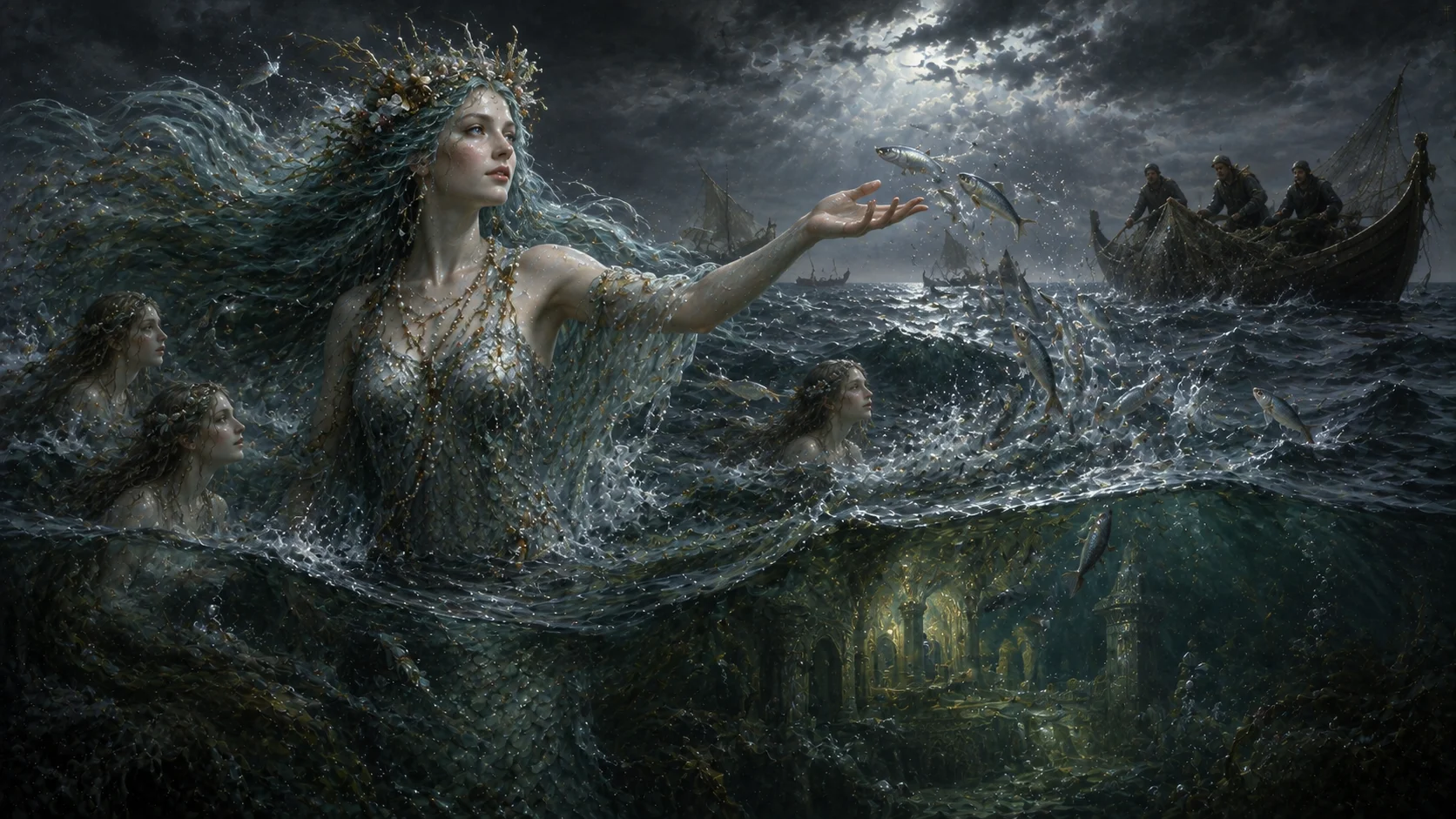
Vellamo is the female deity of the sea and the waters in Finnish mythology, most consistently named as the wife of Ahti (also called Ahto), the god of the sea and fish, in the tradition gathered around the Kalevala. She is the gracious mistress of the deeps, so closely bound to the waters themselves that her name became a poetic word for the sea, and fishermen of a land threaded with lakes and coastline looked to her for a full net and a safe crossing.
A Name That Means the Sea Itself
In the poetic diction of the Kalevala tradition, Vellamo's name is used almost interchangeably with the sea as a place and a force. Phrases invoking "Vellamo's waters" or "Vellamon aallot," Vellamo's waves, function as formulaic synonyms for the sea in the old runo-song verse, the same way that the name of Tuoni, ruler of the underworld, stands in for death itself. To speak of Vellamo's realm was, in this sung language, simply another way of speaking of the water: its surface, its depths, and everything that moved beneath it. This layering of a person's name over a place is one of the more distinctive habits of Kalevala poetic language, and Vellamo is one of its clearest examples, so that a listener could not always be certain whether a line invoked the goddess as a being or the sea as a substance, and in the old songs that ambiguity was not a flaw but the point.
Wife of the Sea-God Ahti
Vellamo's most consistent relationship in the tradition is as the wife of Ahti, also known as Ahto, the god who rules the sea and its fish. In some variant tellings she appears instead as his daughter rather than his wife, and the tradition does not resolve this into a single fixed genealogy; both forms are attested across the body of collected folk poetry. What remains steady across the variants is the pairing itself: Vellamo belongs beside Ahti as a ruling figure of the waters, and together the two of them form one of the domain-paired couples that structure the wider Finnish folk-pantheon, in the same way that Tapio and Mielikki together govern the forest and Ukko presides over the sky. This is a pantheon built up domain by domain through the work of nineteenth-century folklore collectors such as Elias Lönnrot rather than handed down as a single codified system, and the Ahti-Vellamo pairing is one of its more clearly attested structures.
The Voyage for the Sampo
Vellamo is named notably in Runo 42 of the Kalevala, in connection with the forging and recovery of the Sampo and the sea voyage undertaken by Väinämöinen, Ilmarinen, and Lemminkäinen. She is invoked in relation to the events that unfold on and beneath the sea during this expedition, her presence marking the waters through which the three travel as they pursue the Sampo. The episode places her within the central action of the epic rather than at its margins, tying the goddess of the waters directly to one of the Kalevala's pivotal undertakings, even where the surviving verses do not expand her into a fully drawn actor with her own speech or decisive intervention in the plot.
The Kantele Lost Beneath the Waves
A well-known episode of the tradition tells of Väinämöinen losing his first kantele, an instrument he had made from the jawbone of a giant pike, into the sea. It is into Vellamo's realm, the waters over which she and Ahti hold sway, that the instrument sinks and is lost. This loss belongs to the wider cycle in which Väinämöinen later crafts a second kantele, this time from birch, after the first has gone down beneath the waves. The sea's role as the place where the first kantele disappears links Vellamo's domain to one of the more memorable turns in the story of the Kalevala's great singer and his instrument, even though the surviving verses do not describe Vellamo herself acting to take or keep it.
Foam-Gowned and Crowned with Reeds
Folk-poem imagery describes Vellamo adorned in a manner that reflects the sea itself: she is given epithets evoking a headdress or ornament of foam and reeds, and is described in terms that translate roughly as foam-gowned, vaahtopukuinen, her garments taking the colors and textures of the water she rules. This visual tradition presents her not as a figure merely associated with the sea from the outside but as one whose very appearance is fashioned from it, foam at her collar and reeds in her hair, a mistress whose dress is inseparable from her domain. It is a detail preserved in folk verse rather than in a single canonical portrait, and it appears with the kind of formulaic, repeated phrasing typical of oral poetic composition, where an epithet once fixed to a figure recurs wherever she is named.
Vellamo's Maidens of Lake and Sea
Beyond the central pairing with Ahti, some folk-poem variants associate Vellamo with, or describe her as mother to, lesser water-spirits known as vellamon neidot or vedenneidot, Vellamo's maidens or water-maidens, said to populate lakes and the sea across Karelian-Finnish folklore. This maiden-retinue motif appears more prominently in folk charms and incantations than in the Kalevala proper, suggesting a broader oral tradition surrounding Vellamo that extended past the verses eventually gathered into the epic itself. In this picture, Vellamo stands not only as a ruling consort beside Ahti but as a figure with an attendant company of her own, populating the waters beneath her with lesser spirits who shared, in smaller measure, her association with lakes and the sea.
Not to Be Confused with the Näkki
Vellamo is distinct from, but sometimes confused in popular retellings with, the näkki or näkinneito, a dangerous water-spirit or water-sprite associated with drowning, and with the various individual haltija, guardian spirits tied to a single lake or stretch of water. Vellamo is specifically the ruling figure of the sea and waters as a whole, a mistress of the domain rather than a localized presence, whereas näkki-type beings are typically bound to one place and are, in much of the folklore, malevolent rather than gracious. Keeping these figures separate matters for understanding the tradition accurately: where Vellamo is invoked for a good catch and calm passage, the näkki is a hazard to be avoided, and the two do not share a role or a temperament in the older folk material even though both belong to the same watery landscape of Finnish belief.
Invoked for the Catch and the Calm Crossing
Vellamo represents, above all, the fertility, abundance, and danger of the sea and the waters more broadly, and fishermen's charms and incantations invoke her, together with Ahti, for good catches, calm seas, or protection on the water. This is a practical, livelihood-based reverence rather than an abstract one: in a fishing and coastal culture, and one equally shaped by countless inland lakes, the favor of the water's mistress had direct bearing on whether a household ate well through the season. The charms that named her were working tools of daily life, sung or spoken by people whose survival depended on what the water gave up, and they placed Vellamo alongside Ahti as the pair whose goodwill made the difference between an empty net and a full one.
A Loosely Attested Mistress of the Water
Among the names and epithets attached to her, Vellamo appears as Vellamon impi or Vellamon neiti, Vellamo's maiden, a phrase that in different tellings refers either to the goddess herself or to one of her attendant water-maidens. She is also connected, though more loosely, to the compound veden emäntä, mistress of the water, a title used generically in folk tradition for female spirits who rule over water. Whether this exact epithet belongs to Vellamo by name specifically, or describes water-mistress figures as a class, varies by source, and the tradition does not settle the question into a single fixed formal title. This looseness is characteristic of orally transmitted material collected from many singers across a wide region, where a title could shift in scope from one reciter to the next.
Poetry Recorded, Worship Uncertain
How far Vellamo was an object of actual pre-Christian cultic worship, with offerings and shrines, as opposed to primarily a poetic and mythological figure preserved in oral verse, is not firmly established in scholarship. Much of what is known about her comes from nineteenth-century folklore collection, above all the work of Lönnrot and collectors like him, rather than from earlier primary religious documentation contemporary with any pre-Christian practice. Her exact ritual status in that older practice, then, remains uncertain and disputed rather than settled fact, and this gap should be held honestly alongside everything the poetry itself preserves: a rich verbal portrait of a sea-goddess, but not a documented record of altars raised in her name.
Named in Steel and Stone
Vellamo's identification with the sea has carried into modern Finnish culture in concrete, present-day forms. The Finnish Navy has named a minelayer and coastal defense ship Vellamo after her, and the maritime museum Merikeskus Vellamo in Kotka bears her name as well. These namings reflect a continuity in which the goddess of the waters remains the natural figure to invoke wherever Finnish culture wants to mark its own relationship to the sea, carrying her out of oral verse and into steel hulls and museum halls built centuries after the runo-songs that first named her were sung.
One Domain Among Many
Vellamo takes her place within the broader Kalevala pantheon alongside the other domain-ruling figures of Finnish folk belief: Ahti as her husband and co-ruler of the waters, Tapio and Mielikki governing the forest as the water-pair's counterpart on land, and Ukko presiding as the sky-god above them all. This is a structured pantheon in the sense that each domain of the natural world, sea, forest, sky, has its own ruling figure or pair, but it is not a rigidly systematized theology; it survives mainly through the eighteenth- and nineteenth-century folklore collection that gathered the runo-songs from singers across Finland and Karelia, rather than from any single codified ancient religious text. Within that structure, Vellamo stands as the sea and the waters made into a gracious, foam-gowned presence, invoked wherever a Finnish fisherman looked to the deep for a living and the safe return home.
Sources & traditions
- EncyclopediaWikipedia — Vellamo
- TraditionFinnish folk and village traditions (Finland)
Myths change from area to area and from time to time. This chronicle follows the most widely told versions; tellings in other villages, regions and eras may differ.