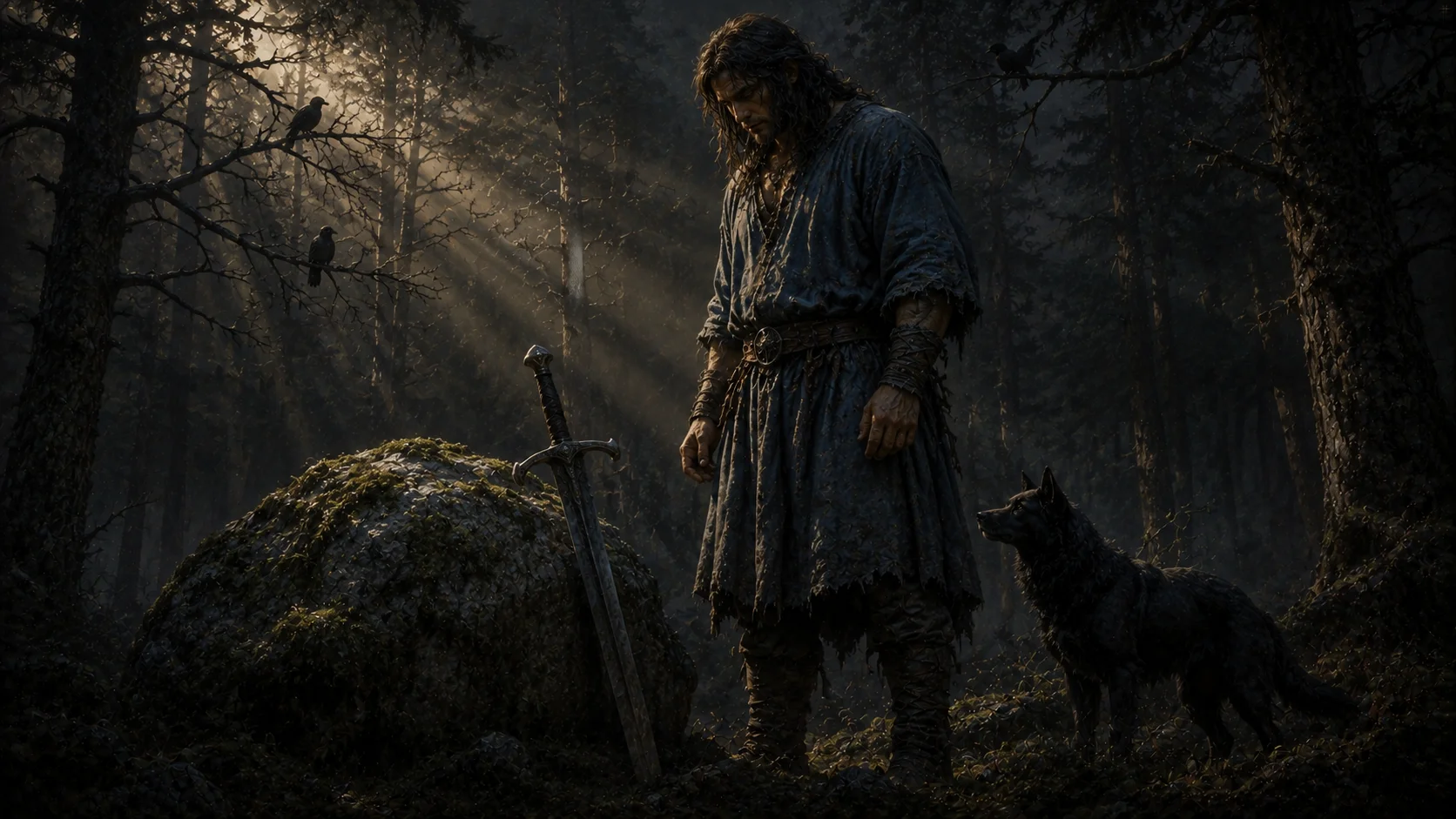
Kullervo is the tragic hero of the Kalevala: a child born into a blood feud and slavery, whose supernatural strength and inescapable misfortune drive him through violence, unwitting incest, and grief to his own death by the sword. His story, gathered by Elias Lönnrot from Karelian oral poetry and given its fullest telling across Runos 31–36, stands as one of the epic's longest and most sustained narrative cycles — and, by wide agreement, its darkest.
A House Undone in a Single Night
Kullervo's story begins not with him but with the ruin of his family. The household of Kalervo stood locked in a deadly rivalry with the household of Untamo, and that rivalry ended in slaughter: Untamo's men fell upon Kalervo's people and destroyed them. Only one survivor was left among the wreckage — an infant, Kullervo, too small to be worth killing outright. Untamo took the child back with him, not out of mercy but as a slave in waiting, raising within his own household the one person with cause to destroy it.
The Child Who Would Not Die
From his earliest years Kullervo showed a strength no child should have, and a destructiveness that came with it — he broke a cradle simply by lying in it, and ruined whatever ordinary task was set before him. Untamo, uneasy at raising his enemy's blood under his own roof, tried more than once to be rid of him: by drowning, by fire, by hanging. Each attempt failed. Kullervo survived them all, and the failures marked him, even as a boy, as someone fate had reserved for something else — not protection, but a doom too large to be stopped early.
Sold Into the Smith's House
Unable to kill the boy and unwilling to keep him, Untamo eventually sold Kullervo into servitude to the smith-hero Ilmarinen, one of the great figures of the Kalevala's central plot. In Ilmarinen's household Kullervo found no relief. It was Ilmarinen's wife who mistreated him, and she did so through the one object that still carried Kullervo's lost family with him: bread. She baked a stone into the loaf she gave him, and when Kullervo cut into it, the knife broke — his father's knife, his sole keepsake of a household he barely remembered. The loss of that blade, more than the cruelty itself, seems to be the moment the story marks as unforgivable.
A Revenge That Could Not Be Undone
Kullervo's answer to the broken knife was violent, and it fell on Ilmarinen's wife. The Kalevala does not soften this into a clean act of justice; it is presented as the response of a person who has been shaped, from infancy, by attempted murder and repeated betrayal, and who has finally been given a reason to strike back at someone who is, in that moment, within reach. It is one of several points in the cycle where the poem seems to ask whether Kullervo was ever given the chance to be anything other than what violence made him.
The Road and the Girl He Did Not Know
Having done what he could not undo, Kullervo left and traveled onward. On the road he met a girl, a stranger to him, and the encounter that followed — described in the tradition as a seduction that was in truth an assault — set in motion the cycle's most devastating turn. Neither of them knew, in that moment, who the other was.
The Truth That Could Not Be Taken Back
Only afterward did the truth surface: the girl was Kullervo's own sister, lost to the same family catastrophe that had swallowed him as an infant, and unrecognized by him after years of separation. The horror of what had happened between them, once known, was unbearable to her. She went to the river and drowned herself rather than live with it. Of all the losses in Kullervo's story, this is the one the tradition treats as unanswerable — there is no revenge to take against fate itself, and no undoing an act committed in ignorance that becomes, on discovery, unbearable knowledge.
Learning His Family Still Lived
In the aftermath, consumed by guilt, Kullervo learned something that reframed everything: his parents and remaining siblings had not all died in the massacre after all — some were still alive. He sought them out and was reunited with them, however briefly. Of the household, only his mother received him without reservation, offering the one unconditional welcome in a story otherwise built from betrayal, mistreatment, and catastrophe. It did not undo what had happened, and it did not lift the burden he carried. The reunion is not a resolution; it is a pause before the story's final turns.
War Against the House of Untamo
Kullervo's answer to everything that had been done to his family was, finally, war. He marched against Untamo's people — the household that had murdered his kin, enslaved him as an infant, and tried repeatedly to kill him as a child — and this time he did not fail. He destroyed Untamo's household as thoroughly as his own had once been destroyed, closing the feud that had defined his entire life before he could even understand it.
A Homecoming to Nothing
Victory brought no relief. Kullervo returned from the destruction of Untamo's house to find that his own family — the household he had briefly, painfully been reunited with — had died in his absence. The vengeance that should have closed the story instead emptied it entirely: the enemy was gone, but so was everyone he might have shared that ending with.
The Sword's Answer
What remains of the Kullervo cycle after this is grief with nowhere left to go — no enemy to fight, no family to return to, and the memory of his sister's death pressing on him without any possibility of repair. In the epic's most famous and most discussed scene, Kullervo turns to his sword and asks it directly whether it is willing to kill him, given everything it has already been made to do in his hands. The sword answers that it is willing — that it sees no reason to spare a life that has brought so much suffering, including its own maker's family's ruin. Kullervo throws himself upon the blade and dies. It is one of the starkest death scenes in the whole epic, and one that later readers and scholars have returned to as the Kalevala's most novelistic, most psychologically interior passage — a hero's ending built entirely from despair rather than glory.
A Story Running Beside the Epic's Center
Unlike the adventures of Väinämöinen, Ilmarinen, and Lemminkäinen, which interlock across much of the Kalevala, Kullervo's cycle runs largely on its own track. His path crosses Ilmarinen's only for the span of his servitude in the smith's household; otherwise his story is self-contained, a tragedy that unfolds beside the epic's main heroic business rather than inside it. That separateness is part of why the cycle reads, even within a compiled national epic, almost like an independent tale of fate and family ruin.
Fate, Feud, and a Life Shaped by Others
Kullervo is not a god and claims no divine domain; his significance in Finnish tradition lies precisely in his humanity and his powerlessness against what has been done to him. He embodies the destructive momentum of family feud carried across generations, the cruelty of slavery imposed on a child, and the idea of a fate that cannot be escaped no matter how many times death is attempted or avoided. Where other Kalevala heroes triumph through cunning or song, Kullervo's story insists that some damage, once done, cannot be sung away.
An Oral Cycle Gathered, Not Invented
As with the rest of the Kalevala, the Kullervo material reflects Lönnrot's synthesis of multiple oral ballad variants collected from Karelian singers rather than a single fixed original myth. Regional tellings differed in details — including the specific means by which Untamo's household tried and failed to kill the young Kullervo — and those variations are a recognized, unremarkable feature of the epic's compiled nature rather than any inconsistency in the tradition itself.
An Afterlife Beyond the Page
Kullervo's tragedy has continued to resonate well past the Kalevala's own pages. The composer Jean Sibelius drew directly on this material for his early symphonic work bearing Kullervo's name, and the cycle continues to be read and discussed as the most sustained, darkest, and most emotionally interior narrative arc in the entire Finnish national epic — a story less about a hero's victory than about what inherited violence and irreversible loss can do to one life.
Sources & traditions
- EncyclopediaWikipedia — Kullervo
- TraditionFinnish folk and village traditions (Finland)
Myths change from area to area and from time to time. This chronicle follows the most widely told versions; tellings in other villages, regions and eras may differ.