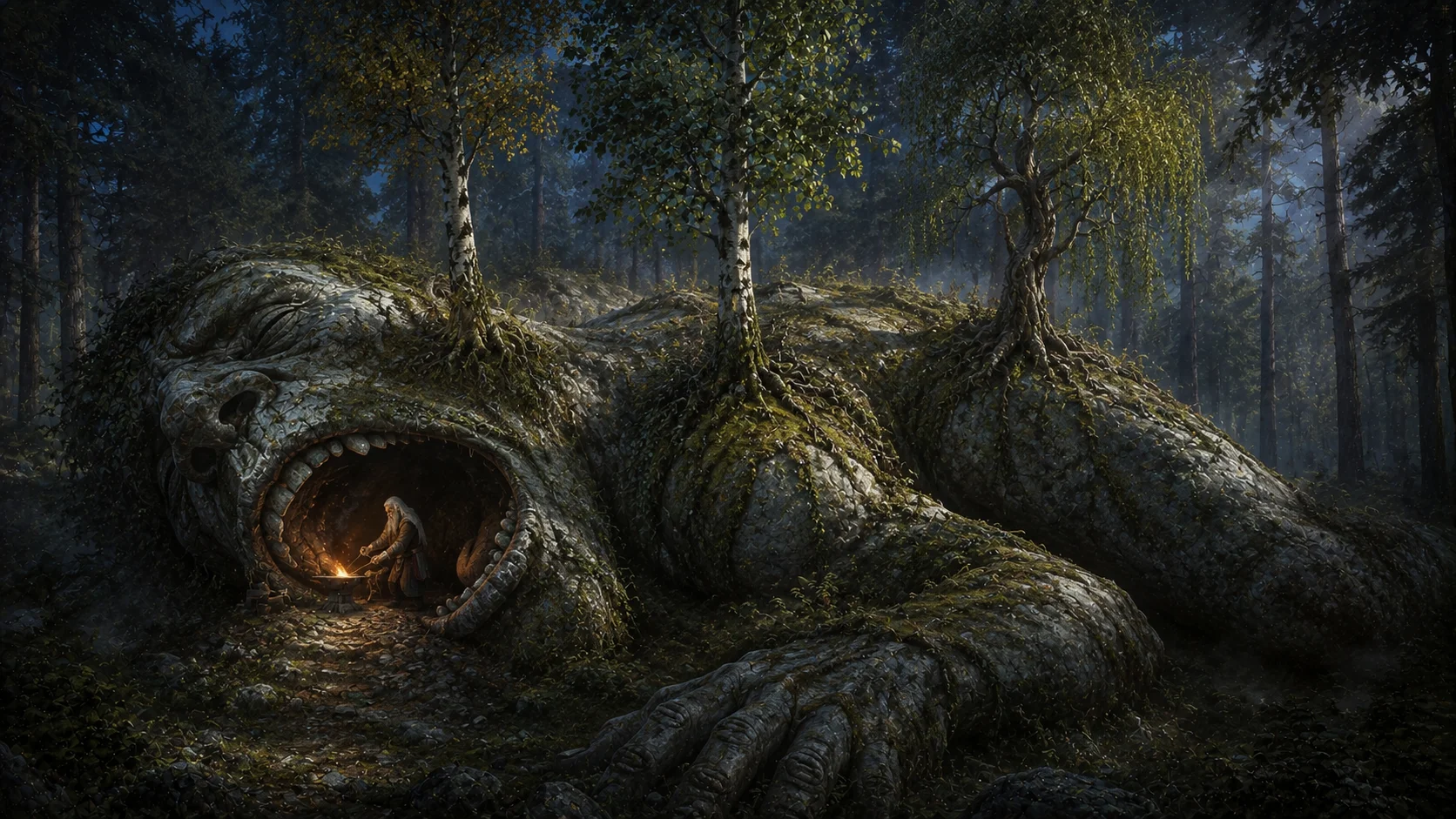
Antero Vipunen is the dead giant-sage of the Kalevala, the Finnish national epic assembled by Elias Lönnrot in the nineteenth century from oral runo-songs gathered chiefly in Karelia. Vipunen is not a figure of scripture or cult but of song: a being so old that forests have taken root on his body, and so full of buried knowledge that a hero must force it out of him by fire and pain. His single great episode, recounted in Runo 17 of the epic, is one of the strangest and most striking wisdom-quests in European tradition — a descent not into the underworld but into the belly of a sleeping earth-giant.
A Body Mistaken for the Land Itself
Long before Väinämöinen ever seeks him out, Vipunen has already passed out of the world of the living, or something very like it. He lies in a death-like sleep so profound and so lasting that his enormous frame has ceased to read as a body at all. Pines and birches have seeded themselves across his chest; moss has crept over his limbs; what a traveler sees is not a giant but a ridge of forest, a fold in the earth. This is the detail that gives the episode its peculiar power: wisdom, in this telling, does not live in a temple or a shrine but is literally buried under the landscape, indistinguishable from the ground people walk on until someone goes looking for it on purpose.
The Kalevala never fixes why Vipunen fell into this state, and that vagueness is honest rather than accidental. Lönnrot's epic is a synthesis of many singers' variant songs, not a single fixed scripture, and the oral tradition he drew on did not agree on Vipunen's origin or the precise cause of his death-sleep. What survives is the image, not a tidy biography: an ancient being, older than memory, lying so still and so long that the world has grown a second skin over him.
Three Words Short of a Finished Boat
The episode begins with a practical problem. Väinämöinen, the epic's central sage and culture-hero, is building a boat by magic song alone, shaping the timbers with charms rather than tools. He completes the hull but finds himself three words short — specific charm-words needed to finish the working, and words that exist nowhere in his own store of knowledge. This is a recurring principle in the magical world the Kalevala describes: certain words are not universal, they are owned. A particular being holds a particular charm, and no amount of general skill substitutes for the one phrase that only that being knows. Vipunen is famous precisely because he is understood to hold the deepest, oldest reserve of such words in existence.
So Väinämöinen sets out to find him. The search itself is telling: he is not visiting a rival sorcerer in a hut or a hall, but hunting across the land for a landmark that turns out to be alive. When he finally locates the tree-grown ridge that is Vipunen's body, he does what anyone might do to a fallen tree or a hummock in his way — he disturbs it, and in doing so wakes something that has not stirred in an age.
Swallowed by the Sleeping Giant
The waking goes wrong in the most literal way available to the story: investigating the giant's mouth, Väinämöinen slips and is swallowed whole, passing living into Vipunen's stomach. It is a startling reversal of the quest-for-wisdom pattern — the seeker does not humbly petition the sage from outside, he ends up trapped inside him, digesting in the dark with no way out except through the giant's own cooperation. Finnish and comparative folklore scholarship has long noted how closely this structure echoes shamanic descent narratives: a hero enters a liminal, death-associated body in order to retrieve knowledge that only that boundary between life and death can hold. Vipunen's belly functions as its own underworld, small and intimate rather than vast, but no less a threshold.
Trapped without an exit, Väinämöinen does not wait passively for release. He improvises with whatever the situation offers him: standing inside the giant, he sets up a forge, using the very body that has swallowed him as his workshop.
The Forge in the Belly
Working entirely from within, Väinämöinen hammers and stokes his makeshift forge until the heat and the battering become genuinely unbearable to the giant carrying him. Vipunen, roused from centuries of stillness only to be tormented from the inside, cannot fight what he cannot reach or see. Pain becomes his only avenue of negotiation. He is not persuaded or bargained with in the ordinary sense — he is compelled, driven past endurance until the one relief available to him is surrender through speech: reciting his knowledge aloud in the hope that this will satisfy the intruder and end the torment.
This is the moment the episode is remembered for, and it captures something distinctive about the magical logic of the Kalevala's world. Knowledge here is not simply taught or shared; it can be a hoarded, almost physical possession, capable of being forced out of its keeper the way water is forced from a wrung cloth. The forge-in-the-belly is not cruelty for its own sake in the logic of the song — it is the mechanism by which buried wisdom re-enters the world of the living.
A Flood of Ancient Words
Once Vipunen begins, he does not offer a narrow answer to a narrow question. He pours out a vast recitation of ancient lore, reaching back to cosmogony itself — knowledge of how the world and its elements came to be, the kind of deep creation-lore that only a being as old as the earth's own forests could plausibly hold. The scale of what he sings matters: it establishes Vipunen not as a minor charm-keeper with one useful phrase, but as a living archive of the oldest layer of knowledge the tradition imagines existing at all. What Väinämöinen actually needs is a small, specific fragment of this vast store, but Vipunen's wisdom clearly extends far beyond that single practical requirement.
Only after this extended outpouring does Vipunen finally reach and yield the specific missing charm-words — the exact phrases needed to finish the boat Väinämöinen left unfinished at home. The practical problem that opened the episode is answered almost as an afterthought within the much larger gift of cosmological knowledge that precedes it.
Release and Departure
With the words secured, Väinämöinen has no further reason to remain, and the episode allows him to leave the giant's body once his purpose is served. The Kalevala does not linger on Vipunen's condition afterward; he recedes from the narrative as abruptly as he entered it, returning to whatever stillness he occupied before being disturbed. The story's attention stays with Väinämöinen, who carries the recovered words back to his half-built boat. Vipunen's sole major role in the epic's mythology is this one encounter, and it is entirely defined by what he unwillingly gives rather than by anything he seeks or does for himself.
An Unwilling Teacher
It is worth being precise about the shape of the relationship between the two figures, since it is easy to sentimentalize. Vipunen does not choose to mentor Väinämöinen, bless him, or recognize him as worthy of the knowledge he holds. He is compelled by pain into releasing it, and the episode never suggests reconciliation or gratitude on his part. And yet the outcome is genuine aid: the words Vipunen surrenders are exactly what completes Väinämöinen's boat. The Kalevala is comfortable holding both truths at once — that the help was real and that it was entirely coerced. This tension is part of what makes the episode feel less like a moral fable about wisdom freely given and more like a folk-magical account of how difficult, valuable knowledge is actually obtained: not through kindness, but through struggle.
A Type, Not Only an Individual
Vipunen is the best-known example of a broader figure recognized in Finnic folk belief: the ancient earth-giant or dead sorcerer whose body, grave, or resting place is a source of knowledge unavailable anywhere else in the living world. This is a recognized motif across the wider tradition, not an invention unique to the Kalevala's telling. Reading Vipunen only as a single named character in one epic understates his place in the folklore; he is also representative of a whole category of belief about where the deepest and oldest magical knowledge is thought to reside — not with the living, but with the dead who have not entirely finished being present.
What the Buried Giant Represents
Beyond the specifics of the boat and the forge, Vipunen carries a clear symbolic charge within the tradition. He personifies knowledge that is old, buried, and inaccessible by ordinary means — the sort of understanding that cannot simply be looked up or requested politely, but must be dug for, and sometimes forced out through hardship. He also dramatizes a specific folk-magical principle running through the Kalevala more broadly: that certain words and charms are not common property. They belong to particular beings, often reluctant ones, and possessing the right relationship, courage, or leverage to extract them is itself a kind of power. In this sense Vipunen is less a villain or an obstacle than a personification of the cost of deep knowledge — it exists, it can be reached, but never for free and rarely without difficulty.
A Name Carried by Compilation, Not by a Single Voice
Scholars note that "Vipunen" is sometimes used alone in translation and academic discussion, with "Antero" functioning as a personal-name element attached to him within the epic text itself rather than as a separate, independently attested title. This small detail is a useful reminder of what the Kalevala actually is: not a single ancient scripture handed down whole, but a nineteenth-century literary synthesis, stitched by Lönnrot from many singers' variant oral songs collected across Karelia. The exact contours of Vipunen — his precise origins, the cause of his long sleep, even the fixed form of his name — were never uniform across the oral tradition. What the epic preserves is the durable core all those variants agreed on: an unimaginably old, tree-covered giant, sleeping near death, who holds the words no one else can give, and who must be made, painfully, to give them up.
Sources & traditions
- EncyclopediaWikipedia — Antero Vipunen
- TraditionFinnish folk and village traditions (Finland)
Myths change from area to area and from time to time. This chronicle follows the most widely told versions; tellings in other villages, regions and eras may differ.