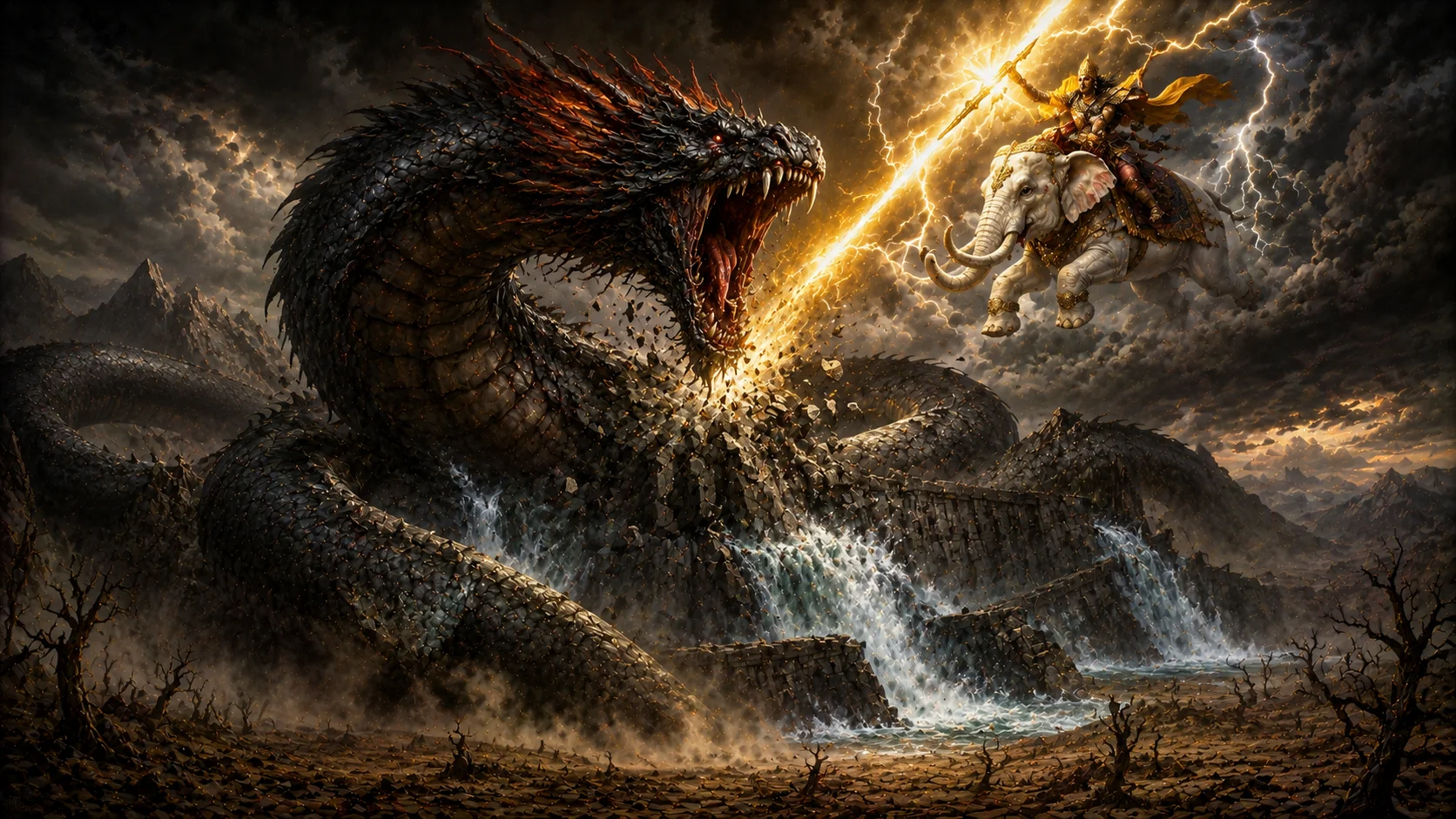
Vritra is the great serpent-demon of drought in Hindu myth — the cosmic dragon or serpent who imprisoned the world's waters, coiling around the mountains to hold back the rivers and rains, and was slain by Indra with his thunderbolt to release the waters and bring the rains, the central enemy of the Vedic myth. The drought-serpent, Vritra is the cosmic dragon who imprisoned the waters until Indra slew him to free the rains.
The Serpent of Drought
Vritra (Sanskrit Vṛtra, "the enveloper, the obstructer") is a great serpent or dragon demon — an asura, an ahi of the old Vedic tongue — the personification of drought and the cosmic enemy who obstructs and imprisons the waters. He is a colossal serpent, the obstructer who holds back the life-giving waters and rains, coiling around the mountains and the cosmic waters to imprison them, so that the rivers cannot flow and the rains cannot fall, and the world languishes in terrible drought. He is the great adversary, the embodiment of the forces that withhold the waters and threaten life with drought, the chief enemy of the storm-king Indra. His very name, cognate with the idea of a coverer or restrainer, names the role he plays in the oldest hymns: chaos and obstruction given serpent-form, standing against the ordered flow of the world.
A Birth Recounted Differently by Different Voices
Even Vritra's origin is not told with one voice across the old texts. He is named as the son of the divine artisan Tvashtri in some accounts, while others describe him as formed or fashioned by Tvashtri rather than born of him — a distinction the Vedic and Puranic sources themselves do not resolve into a single lineage. What both versions agree on is the bond to Tvashtri, the craftsman-god who shapes weapons and forms for gods and demons alike, and whose workshop stands at the center of Vritra's story in more ways than parentage alone, for it is Tvashtri's hand that will also forge the weapon that ends him.
The Imprisonment of the Waters
Vritra's great and terrible deed is the imprisonment of the world's waters. The serpent-demon coiled around the mountains and the cosmic waters, holding back the rivers and the rains, so that the waters could not flow and the world was struck with drought — the rivers dried, the rains failed, and life languished and withered without the life-giving waters. By imprisoning the waters, Vritra threatened the world with the catastrophe of drought, withholding the very source of life and fertility. This imprisonment of the waters by the drought-serpent is the central crisis of the great Vedic myth, and in later ritual interpretation it is read cosmologically as the ending of drought and the release of the monsoon rains themselves — the yearly crisis of a parched land given the shape of a single cosmic battle.
The Vritrahatya of the Rigveda
The confrontation between Vritra and Indra is told most famously in the Rigveda's own celebrated hymn, Rigveda 1.32 — the Vritrahatya, the slaying of Vritra, one of the oldest and most central myths preserved in that most ancient of Vedic collections. It stands as the chief antagonism of the entire Rigveda: Indra, the king of the gods, against Vritra, the great serpent who obstructs the world's order. Around this single combat, sung and re-sung across the hymns, the whole cosmology of drought and rain, chaos and order, turns.
The Bones of Dadhichi
The weapon that ends Vritra carries its own story within the story. Indra's thunderbolt, the vajra, was fashioned by Tvashtri — but not from ordinary metal. It was forged from the bones of the sage Dadhichi, a detail the tradition preserves as central rather than incidental: the weapon that restores cosmic order is made from a sage's sacrifice, craftsman and ascetic together supplying what the storm-king alone could not. Tvashtri's hand shapes it, as it may have shaped Vritra himself — the same workshop standing behind both the obstruction and the instrument of its ending.
The Slaying by Indra
The slayer of Vritra is Indra, the king of the gods and the god of storms and rain — and this slaying is the central and most celebrated deed of the Rigveda. Strengthened by the sacred drink soma, wielding the mighty vajra forged by Tvashtri from Dadhichi's bones, Indra did battle with the great serpent Vritra. In a tremendous combat, Indra struck and slew Vritra with his thunderbolt, shattering the drought-serpent and releasing the imprisoned waters — so that the rivers flowed once more, the life-giving rains fell upon the earth, and the world was freed from drought and restored to life and fertility. This victory — the storm-king slaying the drought-serpent to release the waters and bring the rains — is the great cosmic triumph celebrated again and again in the hymns of the Rigveda, framed as the restoration of rita, the cosmic order, against the chaos and obstruction that Vritra embodied.
Vritrahan, the Slayer's Enduring Title
So central is this single combat to Indra's identity that its memory is carried forward in his own name. Vritrahan — "slayer of Vritra" — becomes one of Indra's principal epithets throughout the whole of Vedic literature, invoked wherever his might and kingship among the gods are praised. The demon's defeat is not a single episode set aside from Indra's character; it becomes part of how he is named and known, the deed folded permanently into the title.
An Ascetic Recast: The Weight of Brahmahatya
The Rigveda's telling is a nature-myth, storm against drought, order against chaos, and nothing more is asked of it. But the Mahabharata and the later Puranas reach back into the story and reinterpret it in ethical and dharmic terms. In these later accounts, Vritra is described as a great ascetic, a Brahmin in a sense the earlier hymns never claimed for him — and killing him, however necessary, becomes an act that lays brahmahatya, the grave sin of killing a Brahmin, upon Indra himself. The slaying that the Rigveda sang as unambiguous triumph becomes, in these later tellings, a deed shadowed by guilt.
Indra's Flight and the Rites of Purification
That guilt is not left to sit quietly in the epic-Puranic accounts. Indra is described as fleeing and hiding in the aftermath of the slaying, burdened by the sin he has incurred, and requiring rites of purification before he can be restored to his place among the gods. The episode marks a visible seam in the tradition: the Rigveda's pure, ancient nature-myth of storm defeating drought has been elaborated, generations later, into a story about moral consequence, sin, and atonement — the same combat, read through a very different lens.
The Bhagavata's Redemptive Turn
The Puranic tradition carries the reinterpretation further still. In the Bhagavata Purana, Vritra is recast once more — this time as a devoted worshipper of Vishnu, an asura who, despite his demonic nature, held true devotion within him. In this telling his death at Indra's hand becomes an unusually gentle fate for an adversary of the gods: a peaceful death and liberation, moksha, granted through the very blow that ends him. It is a redemptive framing found nowhere in the Rigveda's account, layered on centuries later, and it sits alongside the brahmahatya narrative as a second, quite different way the later tradition chose to soften and complicate a myth that began as unclouded triumph.
One of the Oldest Dragon-Slayings
Scholars of comparative mythology count the Vritrahatya among the oldest attested dragon-slaying myths in the Indo-European record, and frequently set it beside other combat myths that share its shape — Zeus against Typhon among them. Such comparisons belong to scholarly analysis of shared inheritance across related mythological traditions, not to any claim made within the Vedic or Puranic material itself; the Rigveda knows only Indra and Vritra, storm and drought, order and the serpent that obstructs it.
The Drought-Dragon of the Vedas
Vritra endures as the great serpent-demon of drought — the cosmic dragon who imprisoned the world's waters and was slain by Indra's thunderbolt to release the rains, the central enemy of the oldest layer of Vedic myth, and a figure the later tradition could not leave untouched, returning to recast him first as a slain Brahmin whose death cost Indra dearly, then as a devotee granted liberation through that same blow. He embodies the cosmic force of drought, the withholding of the life-giving waters, and the great adversary whose defeat brings fertility and life; and he stands, across every retelling, as the drought-serpent whose fall opened the rivers and the rains to a waiting world.
The colossal drought-serpent who coiled around the mountains to imprison the world's waters — until Indra, wielding the thunderbolt forged from a sage's bones, slew the dragon and released the rivers and the life-giving rains.
Sources & traditions
- EncyclopediaWikipedia — Vritra
- TraditionHindu texts, oral tradition and village tellings (South Asia)
Myths change from area to area and from time to time. This chronicle follows the most widely told versions; tellings in other villages, regions and eras may differ.