The Sheepsquatch (the White Thing) is an American cryptid — a large, white, woolly, bear-like or sheep-like quadrupedal (or bipedal) beast said to inhabit the woods of West Virginia and Appalachia, with shaggy white wool or fur, horns, sharp teeth and claws, and a foul smell. The white woolly beast of Appalachia, the shaggy white monster of the West Virginia woods, the Sheepsquatch is one of the famous regional American cryptids, the woolly white terror of the Appalachian hills.
The White Woolly Beast
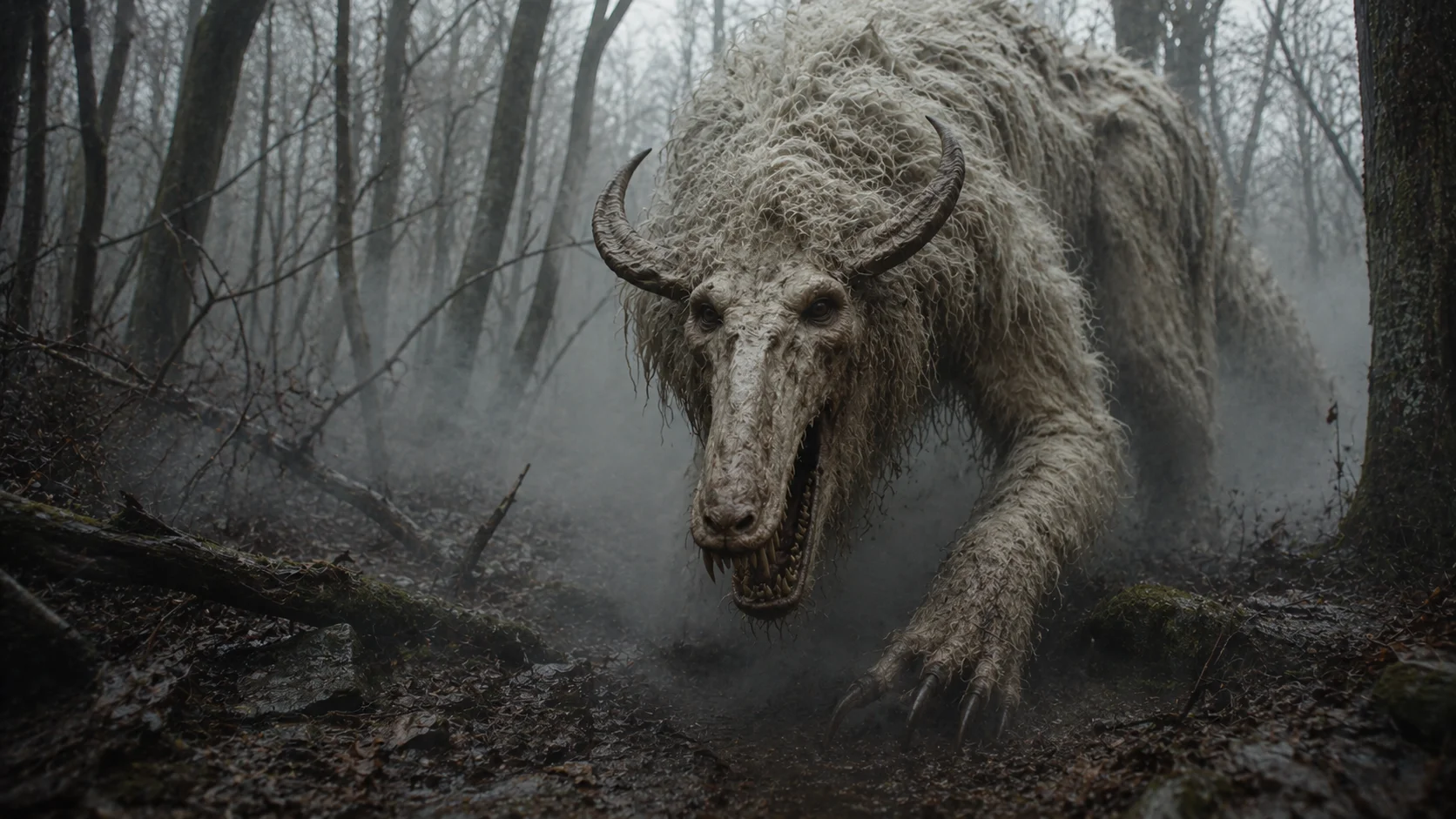
The Sheepsquatch is described as a large, white, woolly beast — a great creature covered in shaggy, dingy white wool or fur (like a sheep), with a bear-like or sheep-like body, a long snout or dog-like/sheep-like head, curved horns, sharp teeth and claws, a long tail, and an accompanying foul, sulphurous smell — a shaggy, white, woolly, horned, clawed beast. It is variously described as quadrupedal (moving on four legs, bear-like) or bipedal (standing and walking on two legs, Bigfoot-like), and is given the name “Sheepsquatch” (a portmanteau of “sheep” and “Sasquatch”) for its sheep-like wool and its Bigfoot-like size and form, or called the “White Thing” for its white wool. It is said to inhabit the woods of West Virginia and Appalachia — the wooded hills, forests, and remote areas of West Virginia and the Appalachian region — the white woolly beast of the Appalachian woods. As the white woolly beast, the shaggy, horned, clawed white monster of the West Virginia woods, the Sheepsquatch is the woolly white terror of Appalachia.
The Sightings of Appalachia
The Sheepsquatch has been the subject of sightings in West Virginia and the Appalachian region, where it is a famous regional cryptid. Sightings of the Sheepsquatch — the large white woolly beast seen in the woods, the shaggy white creature with horns and claws, the foul smell, the encounters and glimpses — have been reported in West Virginia, especially in the southwestern part of the state, and the surrounding region, the white woolly beast of the Appalachian woods. The Sheepsquatch is a famous regional cryptid of West Virginia and Appalachia, a beloved (and feared) figure of Appalachian folklore and local identity, the white woolly monster of the woods. Skeptics explain the sightings as misidentifications (of bears — perhaps a bear with mange or unusual colouring — or other animals), hoaxes, and legend; but the Sheepsquatch endures as a famous regional cryptid. As the subject of the sightings of Appalachia, the famous white woolly beast of the West Virginia woods, the Sheepsquatch is the reported woolly monster of the Appalachian hills.
The Appalachian Cryptid
The Sheepsquatch belongs to the family of American hairy/woolly-beast cryptids and to the rich tradition of Appalachian cryptid and monster lore — the strange beasts and monsters of the Appalachian woods and hills, a region with a deep and rich folklore of monsters, beasts, and strange creatures (the Mothman, the Flatwoods Monster, the Sheepsquatch, the “White Things,” and the various beasts and monsters of West Virginia and Appalachia). The Sheepsquatch is distinguished, among the hairy-beast cryptids, by its white woolly coat (the white wool, like a sheep, as opposed to the dark hair of Bigfoot) and its horns and bear-like or quadrupedal form, the white woolly beast of Appalachia. It belongs to the broader category of “White Things” or white beasts of Appalachian folklore — the white, woolly, or pale monstrous creatures reported in the Appalachian woods — the white woolly beast of the region. Like the other regional cryptids, the Sheepsquatch is regarded by science as folklore and misidentification; but it endures as a famous and beloved (and feared) regional cryptid of West Virginia and Appalachia. As the Appalachian cryptid, the white woolly beast of the West Virginia and Appalachian woods and a famous figure of Appalachian monster lore, the Sheepsquatch is the woolly white terror of the Appalachian hills. As the white woolly beast of Appalachia — the Sheepsquatch, the White Thing, the shaggy white horned clawed monster of the West Virginia woods — it stands as one of the famous regional American cryptids.
Legacy
The Sheepsquatch endures as one of the famous regional American cryptids, the large, white, woolly, horned, clawed beast of the woods of West Virginia and Appalachia, the “White Thing” of Appalachian folklore, a famous and feared figure of Appalachian monster lore and local identity, the woolly white terror of the Appalachian hills. As the white woolly beast of Appalachia — the Sheepsquatch, the shaggy, white, horned, clawed monster of the West Virginia woods, the White Thing of Appalachian folklore — the Sheepsquatch stands as one of the famous regional American cryptids, the woolly white beast of the Appalachian woods, the shaggy white monster of West Virginia, the white woolly terror of the Appalachian hills.
A Late Name for an Old Shape
Sheepsquatch is a young name for an old kind of dread. The reports that anchor the modern legend are generally placed in the 1990s and cluster around Boone County, in the state’s southwest — recent enough that the creature arrived already equipped with a coinage, rather than growing one slowly across generations. That coinage follows a pattern visible right across American monster-lore: once Sasquatch became the default vocabulary for anything large, hairy and glimpsed at the treeline, every region that produced its own beast named it by bolting one strange local detail onto that borrowed archetype. Arkansas got the Fouke Monster, a bottomland creature whose fame was cemented by the low-budget 1972 film The Legend of Boggy Creek. Florida got the Skunk Ape, named for the reek that supposedly precedes it through the cypress. Wisconsin got the Beast of Bray Road, a wolf-headed biped seen along a single stretch of country road. Most of those names keep their distance from Sasquatch and merely borrow its shape; West Virginia’s went the other way and kept the suffix outright — producing a name that does the witness’s work for them, telling you exactly which parts of the sighting felt most wrong before you have heard a word of the story.
The pattern is worth noticing in its own right. It is a folk taxonomy assembled in real time, by ordinary people, using the nearest cultural shorthand available rather than the vocabulary of zoology or theology. A frightened driver does not reach for Linnaean classification. They reach for the last monster they heard named, and fasten the new detail to it. Sheepsquatch is, in that sense, less a single sighting-line stretching back into deep folklore than a modern label fitted over much older raw material — a pale shape in dark woods — that long predates the word given to it.
Older Company in the Hollow
Long before anyone in these hills said “cryptid,” West Virginia already had a vocabulary for pale things seen at dusk. The regional tradition of “haints” — restless or warning spirits — was substantial enough that the folklorist Ruth Ann Musick was able to gather a book of it, The Telltale Lilac Bush and Other West Virginia Ghost Stories, published in 1965, decades before the Sheepsquatch name existed. The older “White Thing” label the creature still answers to belongs to that stratum rather than to cryptozoology, and it is the more revealing of the two names: one describes a body, the other describes an omen.
There is a plain visual logic underneath the dread. Woodland mammals are brown, grey, dun and black — colours that dissolve into leaf litter and shadow. A white shape breaks that rule instantly, which is why it registers as wrong to the eye a beat before the mind has worked out why. Whatever people were actually seeing, they were seeing it in a landscape where a pale form among the trees already carried a settled meaning, and where the readiest word for it sat closer to omen than to animal. Sheepsquatch never had to invent that fear. It only had to walk into a room where the fear was already furnished, and wait to be given a body.
A Monster of the Coalfields
It is not an accident that West Virginia’s woods have produced so dense a bestiary. The state’s terrain is steep, heavily wooded, and cut through with narrow hollows where a house, a road and a treeline can sit within yards of one another — wilderness pressed directly against daily life rather than held at a comfortable distance. For generations that same terrain was worked by logging crews and coal operations, industries that send people out alone, and after dark, into places the forest has not fully surrendered.
Extractive industry recruits its own supernatural staff the world over for exactly this reason. Cornish tin miners held a durable belief in knockers — small spirits blamed for the rapping heard in the workings, read variously as a warning of collapse or as a hint towards ore — and when Cornish miners emigrated in the late nineteenth century they carried the belief into the mining districts of Colorado, Nevada and California, where the creatures were renamed tommyknockers. That is a separate tradition from Sheepsquatch and the two should not be collapsed into one another; they are cousins in cause rather than in kind. Dangerous, half-tamed landscapes worked by people who know the ground can turn on them will reliably generate this shape of story: something present and watchful in the part of the world that the work has not yet cleared.
From Hollow to Screen
Sheepsquatch’s most recent habitat is not a hollow at all but a games console. Bethesda’s Fallout 76 (2018), set in a post-apocalyptic Appalachia, stocked its wasteland from the region’s real folklore instead of inventing monsters from scratch: Mothman, the Flatwoods Monster, the Grafton Monster, the Snallygaster — that last one properly a neighbour, belonging to Maryland’s German-settled country rather than to West Virginia — and Sheepsquatch, all of them creatures a player can meet in the game’s hills. For a regional cryptid that had never enjoyed anything near Mothman’s national profile, this was a considerable widening of audience: players in their millions who will likely never set foot in West Virginia now know the outline of the White Thing, even if they met it only as something to shoot. It is a modern echo of the process that made Bigfoot a household word decades earlier — mass media taking a local sighting-story and installing it in a far larger cultural memory.
The current runs back the other way too. West Virginia has leaned deliberately into its reputation as cryptid country, and Point Pleasant’s Mothman museum and annual festival are the clearest case of folklore converted into civic identity and tourist revenue in a part of the country otherwise defined, in the national imagination, by the retreat of coal. Sheepsquatch is smaller and stranger than Mothman, and rides the edge of that same current — one more reason for a curious visitor to slow down on a mountain road.
Why the Wool, Why the Horns
It is tempting to read the horns as the monstrous element of the composite, and they are the one detail that is not. A great many domestic breeds are horned in both sexes — the Dorset Horn, the Wiltshire Horn, the Scottish Blackface, the Jacob with its four — and a heavy-horned ram is an entirely ordinary sight in a field. The horns are the most sheep-like thing about the creature. What is wrong is everything fastened to them.
That is where the unease actually lives, and it is not really about the woods at all. It is about the farm. A sheep is the least threatening animal a rural household keeps: penned, sheared, counted, herded, eaten. Centuries of breeding went into making it manageable, and the whole of its meaning to us is that it stays where it is put. Sheepsquatch takes that animal and hands it back with the management stripped out — the wool still there, the horns still there, but now carrying claws, teeth, a predator’s bulk and a stench, and standing exactly where nobody put it. The horror is an inversion of the domestic order rather than an invasion out of some wholly alien wild: the tame thing gone feral, met on the seam where cleared pasture gives way to uncleared forest. That seam is the line every household in these hills lives beside. Sheepsquatch is what walks back across it.
Sources & traditions
- TraditionLocal sightings, press reports and regional folklore (North America)
Myths change from area to area and from time to time. This chronicle follows the most widely told versions; tellings in other villages, regions and eras may differ.