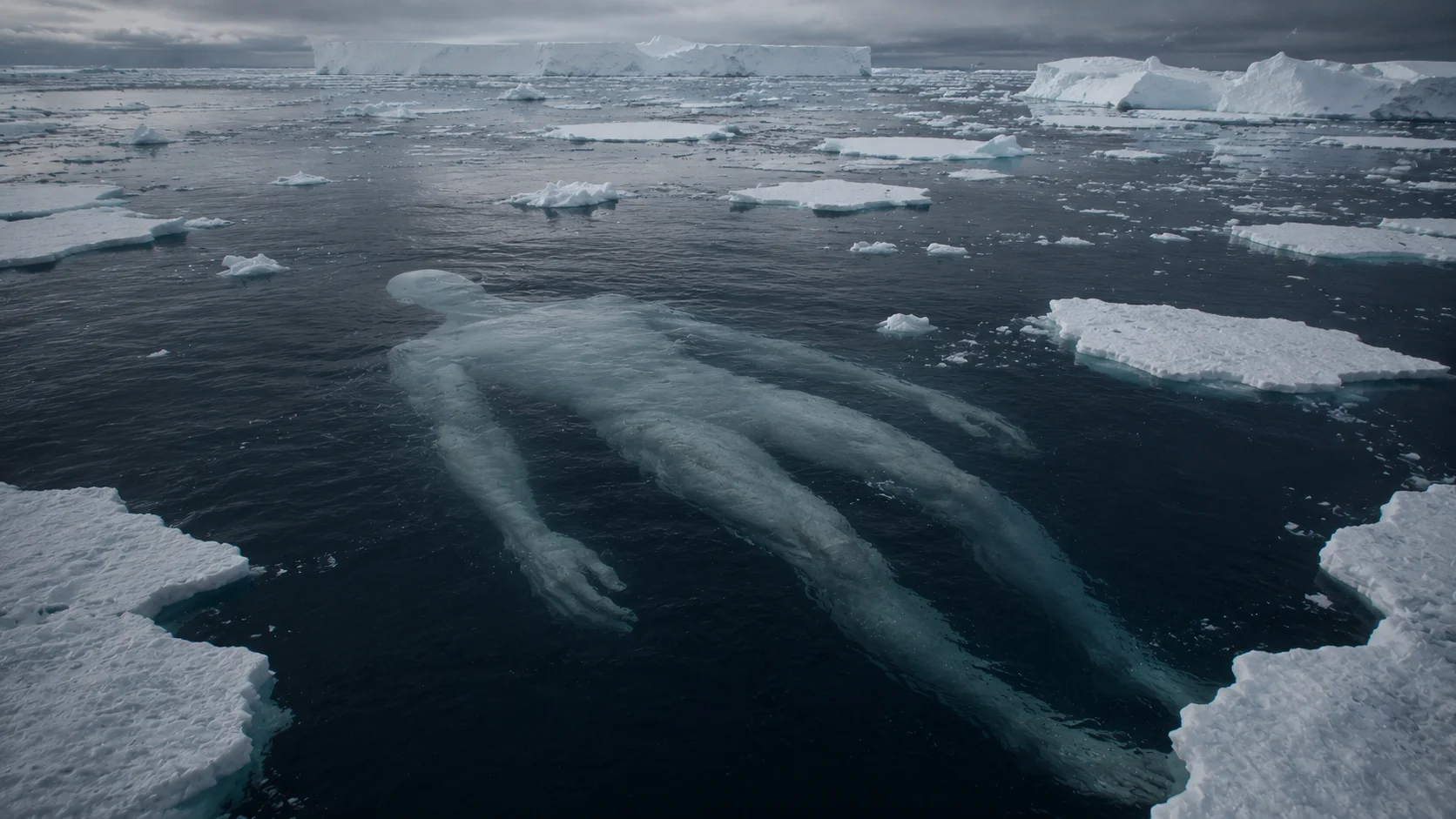
The Ningen (Japanese for “human”) is a modern cryptid of the Antarctic and Pacific seas — a giant, pale-white, humanoid sea-creature said to inhabit the cold polar waters, reported (especially in Japanese internet lore) by sailors and crews in the Antarctic seas as an enormous white humanoid figure with a vaguely human shape, smooth skin, and great size. The giant humanoid of the Antarctic seas, the pale-white sea-being of the polar waters, the Ningen is one of the strangest and most modern of the sea cryptids, the colossal human-shaped creature of the cold deep.
The Giant Humanoid of the Sea
The Ningen (Japanese for “human” or “human being”) is described as a giant, pale-white, humanoid sea-creature — an enormous creature, said to be tens of metres long (perhaps twenty to thirty metres or more), with a smooth, featureless, pale-white or whitish skin, and a vaguely human or humanoid shape: a large body, with what appear to be human-like features — a head, arms or fins resembling arms, hands, and sometimes legs or a fish-like or mermaid-like lower body — the giant white human-shaped sea-being. It is said to inhabit the cold Antarctic and polar seas (and the surrounding Pacific and southern oceans), the pale humanoid of the cold deep waters, reported mostly by Japanese sailors and crews (such as those of whaling or research vessels) in the Antarctic seas, seen floating or swimming in the cold water, the enormous white human-shaped creature glimpsed in the polar seas. As the giant humanoid of the sea, the colossal pale-white human-shaped creature of the Antarctic and polar waters, the Ningen is the giant human-shaped sea-being of the cold deep.
The Modern Internet Cryptid
The Ningen is a notably modern cryptid, a creature largely of the internet age — for the Ningen emerged and spread chiefly through Japanese internet lore and discussion (online forums, message boards, and the like) in the 2000s, where the reports, stories, and (alleged) images of the giant white humanoid sea-creature of the Antarctic seas spread and grew, the Ningen becoming a famous figure of Japanese and then international internet cryptid lore. It is one of the cryptids born and spread chiefly in the internet age, through online discussion, reports, and images, a creature of modern internet cryptid culture. The reports and (alleged) images — said to derive from sailors, crews, and even satellite or aerial images — have been the subject of much online interest, discussion, and debate, the believers holding the Ningen a strange unknown sea-creature and the skeptics dismissing it as a hoax, an internet legend, a misidentification (of whales, large fish, ice formations, or other phenomena), and the product of online myth-making and the power of suggestion. The Ningen is widely regarded as a modern internet legend and creepypasta-style cryptid rather than a documented creature, a creature of modern internet folklore. As the modern internet cryptid, the giant white humanoid sea-creature born and spread through internet lore, the Ningen is the pale human-shaped sea-being of modern internet cryptid culture.
The Pale Being of the Polar Deep
The Ningen belongs, loosely, to the family of sea cryptids and humanoid sea-creatures — the strange creatures and humanoid beings reported in the world’s seas, including the sea-serpents, the merfolk, the sea-monsters, and the strange humanoid sea-creatures of cryptid and folkloric lore — but it is distinguished, among them, by its giant size, its pale-white humanoid form, its Antarctic and polar habitat, and its modern, internet-age origin. It draws, in part, on the deep human fascination with and fear of the cold, dark, mysterious depths of the polar and deep seas — the vast, cold, dark, mysterious, and little-explored waters of the Antarctic and the deep ocean, the perfect setting for the imagining of strange and giant unknown creatures — and on the eerie idea of a giant, pale, human-shaped being in the cold deep water, the uncanny humanoid of the polar seas. The pale, human-shaped form — the giant white humanoid, vaguely human in shape but vast and alien — gives the Ningen a particular uncanny and eerie quality, the colossal human-shaped being of the cold deep. As the pale being of the polar deep, the giant white humanoid sea-creature of the cold Antarctic waters and a modern member of the sea-cryptid family, the Ningen is the colossal human-shaped sea-being of the cold deep. As the giant humanoid of the Antarctic seas — the Ningen, the colossal pale-white human-shaped creature of the polar waters — it stands as one of the strangest and most modern of the sea cryptids.
Legacy
The Ningen endures as one of the strangest and most modern of the sea cryptids, the giant, pale-white, humanoid sea-creature of the Antarctic and polar seas, a creature born and spread chiefly through Japanese and international internet lore in the modern age, a famous figure of modern internet cryptid culture, the colossal human-shaped being of the cold deep. As the giant humanoid of the Antarctic seas — the Ningen, the colossal pale-white human-shaped sea-creature of the polar waters, the modern internet cryptid of the cold deep — the Ningen stands as one of the strangest and most modern of the sea cryptids, the giant human-shaped sea-being of the cold polar deep, the pale colossal creature of the Antarctic seas and modern internet cryptid lore.
A Monster With No Name of Its Own
Almost every creature in Japanese lore carries a name that marks it out as other. The umibōzu is the sea-monk. The ningyo is the human-fish. The kappa is the river-child. Each name does the work of separating the thing from us before the story even starts. The Ningen has no such name. Ningen is simply the ordinary, unremarkable Japanese word for a human being — the word you would write on a form, the word a schoolchild uses in a sentence about people. Its only rival as a name is hitogata, “human-shaped”, which gives up even sooner. Whoever first told the story did not reach for a monster-name. They looked at a white shape in the Antarctic water and called it, flatly, a human. That refusal to name it anything else is the whole engine of the legend. The creature is not frightening because it is alien. It is frightening because the only word anybody could find for it was ours.
Where the Story Actually Begins
The Ningen was not handed down. It was posted. The story belongs to 2channel, Japan’s enormous anonymous textboard — the same occult and paranormal threads that produced most of the country’s modern ghost lore — where it circulated through the 2000s and broke into wide view around 2007. It arrived in the form that anonymous boards make almost inevitable: a poster relaying what he said was the account of the crew of a Japanese whale-research vessel working the Antarctic, who took the pale thing surfacing beside them for a submarine until it went under. No name. No ship. No date.
This is worth sitting with, because it inverts the way evidence normally works. In a conventional cryptid case a sighting comes first and pictures, however bad, are offered afterwards as support. With the Ningen the story came first and the images were recruited to it. By late 2007 the Japanese paranormal magazine Mu had run a piece on a pale shape visible in satellite imagery off the coast of Namibia, floating the possibility that it was a human-shaped creature — a ningen, a hitogata. With that, the legend acquired the one thing it had been missing: a set of coordinates any reader could type in and check personally. That is why it caught. It made every reader a participant. You were not being told about the Ningen; you were being invited to go and look, and the ambiguity of what you found was indistinguishable from confirmation. English-language cryptid sites picked the story up later, in translation, and it hardened on the way across — measurements firmed up, hedges fell away, and a rumour about a rumour arrived in the anglophone world dressed as a sailors’ sighting report.
The Sea-Humanoids That Came Before
The Ningen is new. The shape it takes is not. Japan has been imagining human-formed things in its water for well over a thousand years, and the older figures explain a great deal about why this one felt immediately familiar to Japanese readers.
The ningyo — literally “human-fish” — is nothing like the alluring European mermaid. It is a grotesque: a fish body with a disturbingly human face, sometimes with hands, and in most tellings an omen rather than a temptation. To catch one was to invite storm, plague or war, and fishermen who netted one were expected to put it back. Its most famous story is that of the nun of Wakasa, who as a girl unknowingly ate ningyo flesh and could not afterwards die, outliving husbands, children and everyone she had ever known through eight hundred years before she was finally allowed to go. Immortality as a curse of loneliness — that is the register Japanese sea-humanoids work in.
The umibōzu is closer still to the Ningen’s silhouette. It rises from a flat calm without warning: an enormous, smooth, dark, bald head and shoulders, featureless as a monk’s shaven skull, showing only above the waist and towering over the boat. In the best-known version it demands a ladle from the crew and, once given one, uses it to scoop the sea into the hull; the sailors’ only defence is to hand over a ladle with the bottom knocked out. Note what it shares with the modern cryptid — the enormous scale, the smooth featurelessness, the sudden vertical emergence from quiet water, the crew of a working vessel as witnesses.
And the amabie — a scaly, long-haired, beaked being reported in the sea off Higo Province in 1846, on a cheap woodblock news-sheet — is the reminder that this tradition was never purely oral. It arrived as mass-produced media, with a picture, instructing readers to copy that picture and pass it on as protection against coming sickness. Which is exactly what happened again in 2020, when a nineteenth-century broadside creature was reposted around the world and printed on Japanese health-ministry pandemic posters. A sea-being that spreads by being reproduced and shared is not an innovation of the internet. The internet merely gave it a faster ocean.
Born on the Boards: The Ningen’s True Family
Trace the Ningen’s actual lineage, though, and it leads not to Edo-period scrolls but to the other monsters of the anonymous board era — and the resemblance is much sharper.
The closest relative is Kunekune, posted in 2003: a slender white figure writhing at a great distance across a summer rice field, in air that is not moving. The rule of the story is that you must not try to make it out. The man in the original account raises a pair of binoculars, understands what he is looking at, and never recovers his mind. Set that beside the Ningen and the family likeness is unmistakable — a white humanoid, always at a distance, always at the edge of resolution, whose horror is generated entirely by the viewer’s straining to see clearly. Alongside it stand Hasshaku-sama, the eight-foot woman in white who fixes on a child and follows, and Kisaragi Station, the account of a commuter who steps off at a stop that does not exist and posts updates until the posts stop. Same board, same decade, same grammar: an anonymous ordinary witness, a mundane setting, a prohibition, a deliberate refusal of resolution, and a reader who completes the story by believing it.
The degraded image is not a weakness of this genre. It is the genre’s central technique. A sharp photograph would kill a Ningen instantly, because a sharp photograph of anything in the Southern Ocean is a whale, a berg or a wave. Low resolution is the medium in which the human eye does its most enthusiastic work — pareidolia, the face-and-body detector we all carry, tuned by evolution to accept a hundred false positives rather than miss one real predator. Show that machinery a pale blur in cold water and it will hand you a torso, a head and something like arms, unprompted and free of charge.
Antarctica, the Continent That Had To Import Its Monsters
Antarctica is the only landmass on earth with no indigenous people and therefore no inherited folklore. It has no ancestral spirits, no local names for its features that predate the ships. Every monster there was carried in, in the hold, by outsiders — and the imported ones have been remarkably consistent about their colour.
Edgar Allan Poe ended The Narrative of Arthur Gordon Pym of Nantucket in 1838 with a boat drifting into the polar sea toward a vast shrouded human figure whose skin, he wrote, had “the perfect whiteness of the snow” — and then simply stopped writing. Melville gave a chapter of Moby-Dick in 1851 to the argument that whiteness is the most appalling colour there is, precisely because it is a blank on which anything may be projected. Lovecraft took Poe’s polar terror and built At the Mountains of Madness (1936) on top of it, citing Poe by name and lifting his cry of Tekeli-li outright. Two years later John W. Campbell put a thing that wears human shape into an Antarctic research camp in Who Goes There?, the story that became The Thing — the definitive modern nightmare of a polar creature that looks like us and is not.
The Ningen arrives at the end of that queue, and it is no coincidence that it arrives white, enormous, human-shaped and Antarctic. That is the shape the continent has been given by nearly everyone who has written about it. The 2000s simply supplied a new delivery system.
What the Southern Ocean Actually Puts In Front of Sailors
None of which means the witnesses are lying. The Southern Ocean is genuinely one of the most deceptive visual environments on the planet, and it manufactures Ningen-shaped experiences reliably.
- There is no scale reference on open water. No trees, no buildings, no objects of known size along the horizon. A one-metre object thirty metres away and a thirty-metre object a kilometre away subtend the same angle. Every reported length in a sea-monster account is a guess dressed as a measurement.
- Small ice looks like flesh. Growlers and bergy bits — the low, wave-worn fragments that ride almost awash — are smooth, rounded, blue-white and half translucent; they rise and settle with the swell, and in flat polar light they lose all texture. Whiteout conditions erase the boundary between sea, ice and sky entirely.
- Rorquals are pale underneath. The ventral pleats of a rolling fin, sei or minke whale flash white and smooth, and the fin whale is famously asymmetrical — white on the right side of its lower jaw, dark on the left. A whale turning at the surface can present a large, pale, limbless mass that is gone before anyone can fix on it.
- Dead whales are worse than living ones. A drifting carcass sloughs its dark outer skin and bloats, going pale, smooth and grotesquely misshapen. Beach one anywhere in the world and it will be reported as an unknown monster. These globsters have been washing up and frightening people for well over a century — the St Augustine mass of 1896 is the classic case — and the ones put through modern tissue and DNA analysis have come back as decayed whale: collagen and blubber, nothing more.
Why It Isn’t Absurd — and Why It Still Fails
The honest case for taking the Ningen even slightly seriously is that the Southern Ocean has form for hiding giants. The colossal squid was named in 1925 from nothing but two arm crowns cut out of a sperm whale’s stomach. Whole animals only began coming up in nets in the 1980s, and a fully mature adult was not landed until February 2007, when a New Zealand toothfish boat hauled one from the Ross Sea. The largest invertebrate on earth spent most of a century known chiefly by its leftovers. The deep polar sea can plainly still surprise us.
But that is exactly the standard the Ningen fails, and it fails it comprehensively. The colossal squid left a trail at every stage — beaks in sperm whale stomachs, hook scars on whale skin, damaged animals coming up on toothfish lines — for decades before anyone had a grown one on a table. A thirty-metre air-breathing vertebrate would leave vastly more. It would have to surface to breathe, repeatedly, in daylight. It would strand. It would be struck by ships. It would turn up in the bycatch of the krill and toothfish fleets, in the hydrophone arrays that listen to the Southern Ocean around the clock, in decades of cetacean survey data, in whaling records that logged every large animal taken for most of a century. It would leave bones, and bones are the one thing the sea always eventually gives back.
There is no Ningen bone. No tissue sample, no unidentified acoustic signature, no stranding, no carcass, no net-caught fragment. For a creature the size of a blue whale, in one of the most intensively fished, sailed and instrumented bodies of water on earth, that is not a gap in the record. That is the record.
The Guilt in the Water
One detail of the legend is too consistent to pass over. In telling after telling, the witnesses are not tourists or explorers. They are the crews of Antarctic whaling and whale-research vessels — people whose work is finding, chasing and killing the largest animals alive, in one of the most bitterly contested hunts of the last half-century.
Read the story with that in mind and it changes character. A crew hunting enormous bodies in cold water sees an enormous body in cold water that turns out to be shaped like a person. The hunters are shown something in their own image, at their own quarry’s scale, and it looks back. Whether or not anyone intended that reading, it is why the Ningen sits heavier than a standard lake-monster story. There is a moral shape underneath the physical one, and the pale, silent, unhunted thing floating just out of range plays the part of a witness rather than a beast.
Why the Story Persists
The Ningen survives because it exploits a very specific fault in human perception. We are not much disturbed by animals that are merely large; whales are the biggest creatures that have ever lived and we put them on nursery walls. What unsettles us is the familiar shape at the wrong size. A human silhouette scaled to thirty metres is not a bigger person. It is a violation of a category we do not consciously know we hold, and it trips the same alarm as a face that is almost right — the uncanny, operating at oceanic scale.
It also survives because it cannot be finished. There is no origin document to debunk, no named hoaxer to expose, no single photograph to discredit. The legend lives in a state of permanent low resolution, distributed across thousands of anonymous posts, and every attempt to sharpen it simply generates more of it. In that sense the Ningen is not a failed cryptid at all. It is a perfectly successful one for its medium — a creature made of, and made for, the endless reposting that carries it.
And underneath both of those there is the oldest reason of all. The maps are finished. There is no unexplored forest left, no blank interior, nowhere on land to put anything. The deep polar ocean is the last place a person can still honestly say we do not know what is down there — and so it is the last place we can still put something. That the something turns out to be shaped like us is the part worth thinking about. Given the whole dark sea to fill with monsters, the modern imagination reached in and pulled out an enormous, pale, silent human.
Sources & traditions
- EncyclopediaWikipedia — Ningen (folklore)
- TraditionLocal sightings, press reports and regional folklore (Antarctic)
Myths change from area to area and from time to time. This chronicle follows the most widely told versions; tellings in other villages, regions and eras may differ.